3.08 Gallery Critique and Version 2: Testing the Scaled Recipe
give and use evidence-based critique, test my team’s leavening plan against every criterion, and justify the changes in version 2 with revised explanations and stoichiometric calculations.
- I can revise or expand my explanation about the outcome of a chemical reaction when given new evidence or context, and justify my changes.
- I can predict the relative number of atoms in the reactants and products of a chemical reaction using mathematical representations.
- I can calculate the mass of any substance in a chemical reaction if I know the mass of another substance involved.
Phase 4: Build
Warm-Up ~5 min
Do Now. Plot your version 1 CO2 mass at 2, 10 and 30 minutes and after the hot bath. Mark the point where half the total gas had been released. Did your plan pass the wait test?
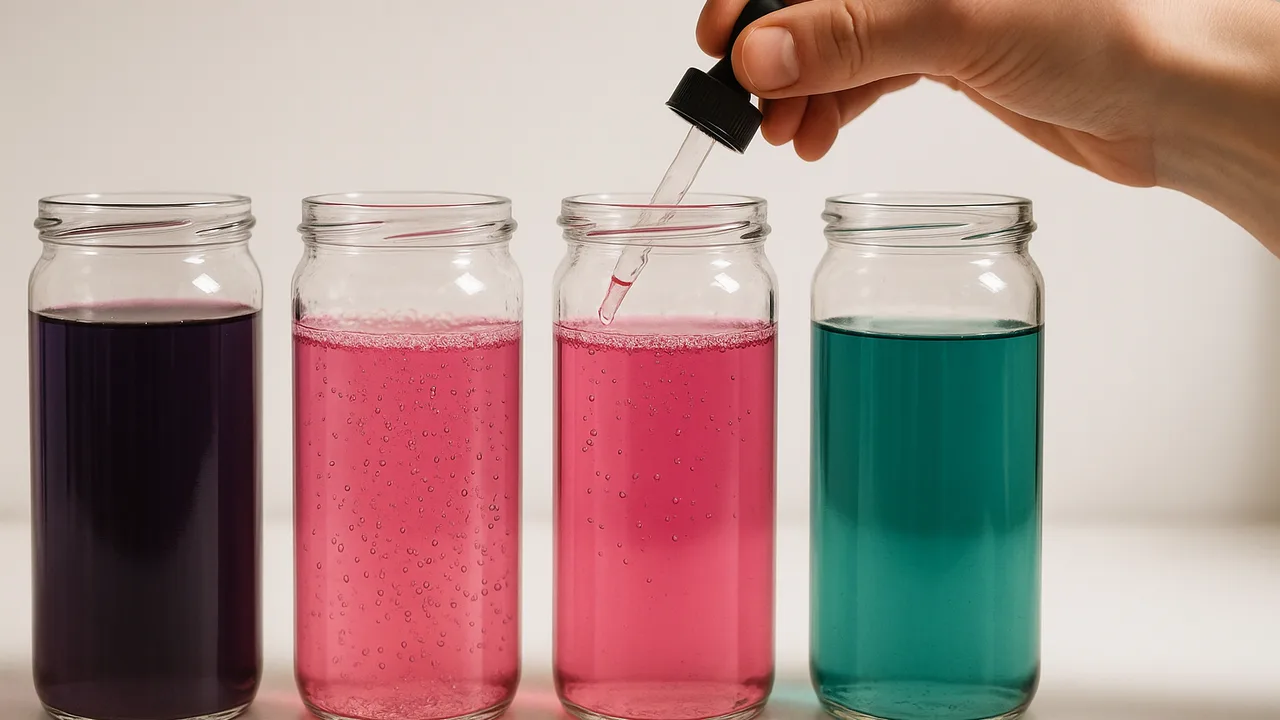
A team's spent test liquid turned blue-green with red cabbage indicator. What does that tell them?
Instruction ~10 min
Gallery critique protocol. Each team posts its equations, 200-loaf calculations, decision matrix and bench-test graph. Visitors leave three sticky notes: I like… (a strength tied to a criterion), I wonder… (a question about evidence or the chemistry) and What if… (one specific change). Every note must cite a number or a reason from the model; “looks good” does not count.
Class criteria and constraints (sample values set by the class). A leavening plan for the 200-loaf batch must (1) leave no leftover soda: after the bench test, the liquid stays purple or pink with red cabbage indicator, never blue-green; (2) supply acid within 0–5% above the stoichiometric amount, so the loaf is not sour; (3) make at least 85% of the theoretical CO2 in the bench test (0.22 g of the 0.262 g a quarter-loaf mix can make); (4) still have at least half its gas to give after a 30-minute wait, by ingredient choice or by process, because big batches wait for oven space; (5) cost no more than 4 sample budget points per loaf; and (6) use ingredients the co-op can buy at a grocery store.
Worked example 1: a revised explanation (sample data). Jamal’s team (concept A, all buttermilk) used exactly the 60 g of buttermilk their calculation called for, yet the liquid turned blue-green. Their first explanation was “we measured wrong.” A visitor’s note asked, “I wonder if your carton has the same acid as the co-op’s?” They titrated their carton: 0.80% lactic acid, not 0.90%. Revised explanation: the buttermilk, not the soda, was limiting, because this carton held less acid per gram. Recalculated: 0.005952 mol of soda needs 0.536 g of lactic acid ÷ 0.0080 = 67 g of buttermilk. For a full loaf, 2.145 g ÷ 0.0080 = 268 g. Version 2 adds a small measured amount of cream of tartar, so the recipe no longer depends on each carton’s acidity.
Worked example 2: a timing trade-off (sample data). Priya’s team (concept B, cream of tartar) passed the indicator check and made 0.24 g of CO2, a 92% yield (0.24 ÷ 0.262). But 0.20 g (83%) was gone by 30 minutes: it failed the wait test. They kept the chemistry and changed the process: mix the dry leavening into each tray’s batter only when that tray is next for the oven, so no batter waits after the acid and soda meet.
| Criterion | Version 1 | Change made | Version 2 | Met? |
|---|---|---|---|---|
| Indicator (no leftover soda) | ||||
| Acid margin (0–5%) | ||||
| CO2 yield (≥ 85%) | ||||
| Wait test | ||||
| Budget |
Putting numbers on the fix. State every change in grams and moles for the 200-loaf batch. If version 2 of concept A adds cream of tartar to cover a carton that is 0.10 percentage points weak, the missing lactic acid for 48 kg of buttermilk is 48,000 × 0.0010 = 48 g = 0.53 mol, replaced by 0.53 × 188.176 = 100 g of cream of tartar.
What our bench test cannot show. A flask is not a loaf: real batter traps gas in a gluten and starch network, the oven sets the crumb, and taste depends on more than chemistry. Your recommendation must name at least one limit of the bench test and suggest a test bake the co-op could run.
Guided Exercises ~15 min
Use your version 1 data and the sticky notes you received.
Independent Practice ~10 min
Run version 2 and complete the comparison table.
Compare version 1 and version 2 on every criterion. Which criterion improved most, and what did you give up to get it?
🔎 Mini case study: Baking in the mountains ~8 min
Bakers in high mountain towns have long found that recipes from the lowlands misbehave: cakes overflow their pans and then fall, and quick breads come out coarse and dry. The cause is air pressure. At about 1,500 m above sea level, the air pressure is only about 84% of its sea-level value.
The leavening reaction still makes the same number of moles of carbon dioxide, because the balanced equation and the masses have not changed. But at lower pressure each mole of gas takes up more room, so the bubbles grow larger, merge and escape before the crumb sets, and the cake collapses. Water also boils at a lower temperature, so batter dries faster. High-altitude baking guides respond by reducing the baking soda or baking powder, often by roughly a fifth or more, and by baking a little hotter so the structure sets sooner.
Think about it: Which of our class criteria would a mountain bakery need to change, and why does cutting the leavening still require keeping the acid and soda in a 1 : 1 mole ratio?
Closure ~5 min
Version 2 is tested and justified. Next phase, you write the leavening brief and present it to the co-op.
Exit ticket: name one piece of evidence from this week that made you change your explanation, and state your old and new explanation.
Teacher notes
Materials: the same materials as 3.07 for version 2, sticky notes in three colors, red cabbage indicator color card, and, if your school has one, access to a family-and-consumer-sciences kitchen for an optional test bake run there under its own food-safety rules (never in the chemistry lab).
Timing: graphing 5 minutes, critique 15 minutes, version 2 bench test 20 minutes, comparison write-up 10 minutes.
Titration note: if you titrate a buttermilk carton for teams, use 0.10 M sodium hydroxide with phenolphthalein (teacher prepared); lactic acid % = mL × 0.10 × 90.078 ÷ (1000 × sample g) × 100. Otherwise give teams the sample value 0.80%.
Listen for: “more acid is always safer” (sour); changes with no reason; “the bench test proves the bread will rise.”
Support / stretch: provide critique sentence starters. Stretch: using the case study, estimate how much larger 0.583 L of CO2 becomes at 84% of sea-level pressure (0.583 ÷ 0.84 ≈ 0.69 L), and how much to cut the leavening to keep the same volume (to about 84%).