4.03 Coffee-Cup Calorimetry: Hot and Cold Dissolving
use a coffee-cup calorimeter and q = mcΔT to measure the energy released or absorbed when substances dissolve or react in water, and explain the energy change as an equal and opposite change in the surroundings.
- I can describe how the net energy change in a chemical reaction system results from the bonds broken and formed, and how energy is transferred between the system and surroundings by molecular collisions.
- I can explain how the total energy change in the chemical reaction system is balanced by an equal but opposite energy change in the surroundings.
- I can use my model to show that whether energy is released or absorbed depends on the change in potential energy from reactants to products.
- I can collect and record the data needed to calculate the change in thermal energy for each component in the system.
Phase 2: Investigate
Warm-Up ~5 min
Do Now. You add a spoonful of road-melt salt (calcium chloride) to a cup of water and the cup warms. You add baking soda and citric acid to another cup and it cools. Write what you would need to measure to say how much energy each one moved.
The same amount of energy goes into 50 g of water and into 100 g of water. Which warms more?
Instruction ~10 min
Why a lab here. The nonprofit needs numbers: how much energy each heating chemical releases per gram. We cannot put a thermometer inside a reaction, but we can let the reaction happen in water and measure the water. That is calorimetry. This lab runs two 50-minute periods.
Specific heat. The specific heat c of a substance is the energy needed to raise 1 g of it by 1 °C. For liquid water c = 4.184 J/(g·°C), which is large: water soaks up a lot of energy for a small temperature change. Metals are much lower: aluminum 0.897, iron 0.449, copper 0.385 J/(g·°C). The energy that flows into or out of a sample is q = m c ΔT, where ΔT = Tfinal − Tinitial. A positive ΔT means the sample gained energy.
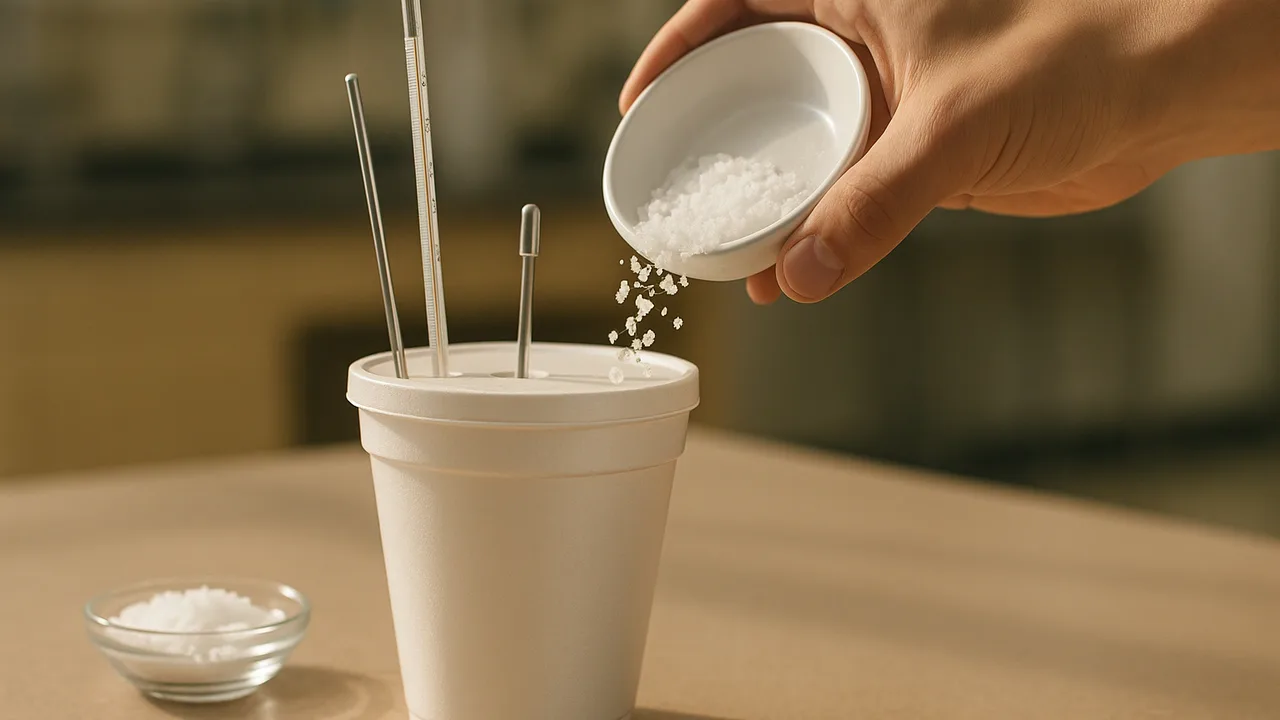
The coffee-cup calorimeter. Two nested foam cups with a lid make a nearly closed system: foam is a poor conductor, so little energy escapes during a few minutes. The water (and dissolved solid) are the surroundings of the reaction. Energy is conserved, so qreaction = −qsolution. Dividing by the moles that reacted gives the enthalpy change ΔH in kJ/mol, the energy change at constant pressure.
Worked example 1: calcium chloride (sample data). Keisha dissolved 5.00 g of CaCl2 in 50.0 g of water. The temperature rose from 21.4 °C to 34.6 °C, so ΔT = 13.2 °C. The solution mass is 55.0 g; she used c = 4.184 J/(g·°C) for the dilute solution. qsolution = 55.0 × 4.184 × 13.2 = 3,040 J = 3.04 kJ. So qreaction = −3.04 kJ. Moles of CaCl2 = 5.00 g ÷ 110.98 g/mol = 0.0451 mol. ΔH = −3.04 kJ ÷ 0.0451 mol = −67.4 kJ/mol. The published enthalpy of solution is −81.3 kJ/mol, so her value is about 17% low in size. Where did the missing energy go? Into the cup, the thermometer and the air, and some may never have been released if her salt had already absorbed water from the air.
Significant figures. Masses to 0.01 g and temperatures to 0.1 °C give ΔT to 0.1 °C. In 13.2 °C that is three significant figures, so the answer is reported to three: −67.4 kJ/mol, not −67.427.
Worked example 2: predicting a cold pack. Tomas used the published enthalpy of solution of ammonium nitrate, +25.7 kJ/mol, to predict a result. 5.00 g NH4NO3 ÷ 80.04 g/mol = 0.0625 mol; energy absorbed = 0.0625 × 25.7 = 1.61 kJ = 1,610 J. That energy leaves 55.0 g of solution: ΔT = −1,610 J ÷ (55.0 g × 4.184) = −7.0 °C. Water at 22.0 °C should fall to about 15.0 °C. Commercial cold packs use much more solid per gram of water, which is why they get far colder.
Procedure. (1) Nest two foam cups, add exactly 50.0 mL of room-temperature water (50.0 g) and fit the lid with the thermometer through it. (2) Record the temperature every 15 s for 1 minute to get a steady starting value. (3) Add 5.00 g of CaCl2, replace the lid, swirl gently, and record every 15 s until the temperature peaks and starts to fall. (4) Repeat in a fresh cup with 3.00 g citric acid and 3.00 g baking soda (sodium hydrogen carbonate) added together, recording until the temperature reaches its lowest point. (5) Run each reaction twice.
| Trial | Water (g) | Solid(s) added (g) | Tinitial (°C) | Tmax or min (°C) | ΔT (°C) | qsolution (J) |
|---|---|---|---|---|---|---|
| CaCl2 1 | ||||||
| CaCl2 2 | ||||||
| Citric + soda 1 | ||||||
| Citric + soda 2 |
Reading the result. Expect CaCl2 to warm the water by roughly 12–16 °C and the citric acid and baking soda to fizz and cool it by several degrees. For the fizzing reaction, use only the 50.0 g of water as the mass in q = mcΔT, since carbon dioxide escapes. Reading. OpenStax Chemistry 2e, chapter 5.2 (calorimetry) and Table 5.1 (specific heats), CC BY 4.0; enthalpies of solution from the NIST/NBS tables of chemical thermodynamic properties.
Guided Exercises ~15 min
Answer as you collect data; finish after clean-up. Show units in every calculation.
Independent Practice ~10 min
Lab analysis, in your Energy Notebook.
Calculate ΔH in kJ/mol for your CaCl2 trials, average them, and compare with the published −81.3 kJ/mol as a percent difference. Name two sources of error and say whether each makes your value too large or too small.
Use the published value to calculate how many grams of CaCl2 would have to dissolve to release the 41.8 kJ needed to heat a 250 g meal by 40 °C. Is dissolving a salt a practical meal heater? Explain.
Closure ~5 min
We can measure energy per mole with a cup and a thermometer. Next class: what happens when a hot object and a cold one share a cup.
Exit ticket: a classmate says, “The citric acid reaction made cold.” Rewrite the sentence so it describes the energy flow correctly.
Teacher notes
Materials (per team): four foam cups and two lids, a digital thermometer (0.1 °C), a 50 mL graduated cylinder, a balance (0.01 g), anhydrous calcium chloride pellets in a sealed jar, citric acid and baking soda, weigh boats, stir rods, timer, splash goggles.
Two periods: day 1 data collection; day 2 calculations and the CER. Keep the CaCl2 jar closed between uses: it absorbs water from the air and the results drop. No-lab alternative: the sample data in the lecture plus a teacher video of both trials.
Listen for: “the thermometer measures the reaction”; the sign of q flipped; mass of solid forgotten in the solution mass; ΔT taken as Tinitial − Tfinal.
Support / stretch: give a calculation template with the four steps (qsolution, qreaction, moles, ΔH). Stretch: include the cup by measuring a calorimeter constant with hot and cold water, then correct the CaCl2 result.