2.06 Water’s Unusual Properties: Planning the Freeze-Thaw Investigation
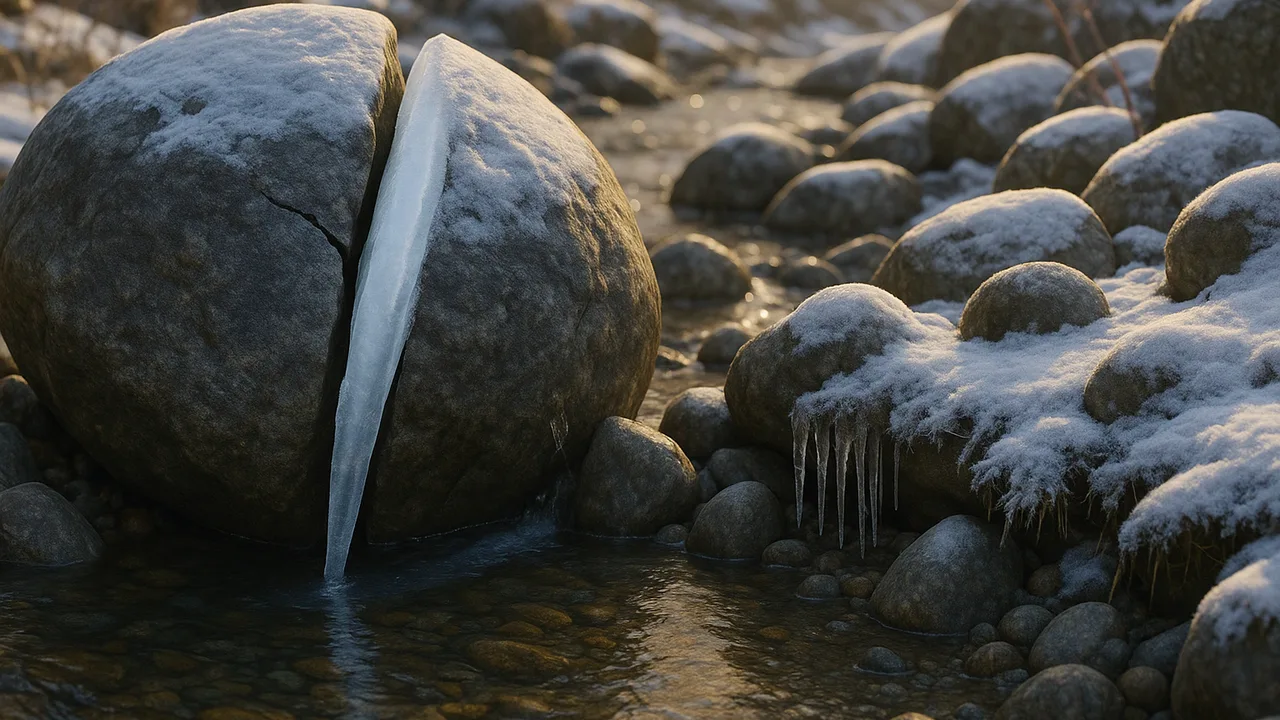
explain water’s high heat capacity, its solvent power and the low density of ice from hydrogen bonding, connect each to effects on rock and pavement, and plan an investigation of freeze-thaw damage to Earth materials.
- I can describe how the properties of water are connected to their effects on Earth materials and surface processes.
- I can plan an investigation that includes collecting data about the heat capacity, density, and polarity of water.
- I can explain how the properties of water affect energy transfer, temperature patterns, air movement, and water movement at Earth’s surface.
- I can identify and plan to collect data showing the mechanical and chemical effects of water on Earth materials, such as erosion, weathering, and changes in rock.
- I can include ways to measure or indicate the effects of water’s properties—such as heat capacity, flow, polarity, and density—on Earth’s materials or surface processes in my investigation plan.
Phase 3: Make Sense
Warm-Up ~5 min
Do Now. On a sunny March afternoon, the dry asphalt of a road is warm to the touch, but a puddle on the same road is still ice-cold and a slush pile at its edge has barely melted. Write one reason the water warms so much more slowly than the pavement.
Ice has a density of 0.917 g/cm3; liquid water at 0 °C is 1.000 g/cm3. What volume does 100.0 g of water fill once frozen?
Instruction ~10 min
Water’s network. Each water molecule can form up to four hydrogen bonds: two through its hydrogens and two through its lone pairs. In the liquid, these bonds constantly break and re-form. That network explains three properties that shape Earth’s surface and our roads.
1. Ice is less dense than water. As water freezes, every molecule locks into four hydrogen bonds in a hexagonal lattice that holds the molecules farther apart than in the jostling liquid. Ice’s density is 0.917 g/cm3, against 0.9998 g/cm3 for water at 0 °C, so water expands by about 9% as it freezes. In a crack that is sealed by ice at the top, the expanding water has nowhere to go and presses on the walls. Repeated many times, this frost wedging splits rock from road cuts and lifts and breaks pavement. Water is most dense near 4 °C, so lakes freeze from the top down and life survives below.
Worked example 1: water in a crack. Imani estimated that a pavement crack holds 50.0 g of water. As liquid at 0 °C: 50.0 ÷ 0.9998 = 50.0 cm3. As ice: 50.0 ÷ 0.917 = 54.5 cm3. The ice needs 4.5 cm3 more room than the crack holds. Freezing is driven by falling temperature, not by the room available, so the ice pushes outward, and each thaw lets fresh water flow into the slightly wider crack.
2. Water has a very high heat capacity. Warming water means speeding up molecules that are tied together by hydrogen bonds, so much of the energy goes into stretching and breaking those attractions. Water’s specific heat is 4.184 J/g·°C; typical rock and concrete are about 0.8–0.9 J/g·°C, roughly one fifth. Melting ice takes even more: 334 J for every gram, with no temperature change. That is why wet ground and puddles lag behind dry pavement, why large lakes keep nearby shores milder in autumn, and why air over a still-warm lake picks up moisture and dumps it as lake-effect snow downwind.
Worked example 2: energy budget of a puddle. Jamal compared freezing 1.0 kg of puddle water at 0 °C with cooling 1.0 kg of concrete by 10 °C. Freezing: 1,000 g × 334 J/g = 334,000 J. Cooling concrete: 1,000 g × 0.88 J/g·°C × 10 °C = 8,800 J. A night must remove almost forty times more energy to freeze the water than to chill the same mass of concrete by ten degrees, so pavement often freezes first at its dry surface while water in the cracks freezes later, from the top down, sealing itself in.
3. Water is a powerful solvent. Polar water molecules pull ions from mineral surfaces. Rainwater, slightly acidic from dissolved carbon dioxide, slowly dissolves the calcite that cements many sandstones together; gypsum, the mineral in plaster, dissolves at about 2 g per liter. This is chemical weathering, and it works together with the mechanical weathering of frost wedging: dissolving widens pores, and freezing water in the wider pores breaks grains loose.
Planning our investigation. Question: how does repeated freezing and thawing of water affect common Earth and building materials, and does salty water change the effect? Materials: sandstone, red clay brick and cast plaster blocks, three of each per condition. Conditions: (a) soaked in fresh water, frozen and thawed each day; (b) soaked in 3% salt water, frozen and thawed; (c) soaked in fresh water but kept at room temperature (separates dissolving from freezing); (d) dry, frozen and thawed (separates cold itself from water). Data: dry mass and soaked mass at the start (water absorbed, a measure of pore space), mass of loose grains brushed off after each cycle, a crack count and a photo from a fixed position, and a freezer temperature log. At least five cycles. Each team runs one material through all four conditions, and the class pools results, so the work is done in groups.
Reading. OpenStax Chemistry 2e, sections 10.1 (hydrogen bonding), 10.3 (phase transitions, enthalpy of fusion) and 5.1 (specific heat), CC BY 4.0. Densities of water and ice from NIST.
Guided Exercises ~15 min
Answer, then draft your team’s part of the class plan.
Independent Practice ~10 min
Start the investigation.
Record the dry mass, soaked mass and percent water absorbed for each of your samples ((soaked − dry) ÷ dry × 100). Predict which material will lose the most mass after five cycles, and why.
Explain how each of water's three properties (density of ice, heat capacity, solvent power) affects either temperature patterns, air movement or water movement at Earth's surface. Give one example of each.
Closure ~5 min
The samples go into the freezer tonight. Next phase: designed materials that fight back against water and ice.
Exit ticket: why would sandstone with more pore space be at greater risk from freeze-thaw cycles than dense granite? Use the words density and expand.
Teacher notes
Materials: sandstone pieces (about 5 cm, landscaping offcuts), red clay brick pieces, plaster of paris cast by the teacher in a muffin tin a week ahead; zip bags or lidded containers; 3% salt water (30 g NaCl per liter); 0.1 g balance; soft brushes and weighing paper; science freezer (about −18 °C) with a min/max thermometer; devices for the sim.
Schedule: soak samples for 24 hours, then run one cycle per school day: freeze overnight (at least 12 hours), thaw on the bench during the day (at least 6 hours). Collect cycle data at the start of each class; 2.08 analyzes the full set after five or more cycles.
Listen for: “ice is lighter because it has air in it”; confusing heat capacity with temperature.
Support / stretch: a planning template with the four conditions pre-labeled. Stretch: design a fifth condition testing calcium chloride solution, and predict its effect.