2.04 Lab: How Cold Can Each Brine Get? Freezing Points of De-icer Solutions
measure the freezing points of de-icer solutions in an ice-salt bath, compare them with the freezing-point depression equation, and judge the accuracy and precision of the data.
- I can explain how I will collect data, how many trials I will conduct, and what experimental setup and equipment I will use.
- I can assess the accuracy and precision of my data and identify any limitations in my investigation.
- I can evaluate whether my data provides the evidence needed to support my conclusions.
- I can explain how measurable properties like melting point, boiling point, vapor pressure, and surface tension relate to the strength of electrical forces between particles in a substance.
Phase 2: Investigate
Warm-Up ~5 min
Do Now. A bag of rock salt says “melts ice to 15 °F” (about −9 °C). A bag of calcium chloride says “melts ice to −25 °F” (about −32 °C). Write one reason a dissolved substance might stop water freezing, and one way to test a label’s claim in class.
Equal numbers of moles of NaCl, CaCl2 and sugar are each dissolved in 1 kg of water. Which solution freezes at the lowest temperature?
Instruction ~10 min
Why dissolved particles stop water freezing. At 0 °C, pure ice and pure water are in balance: molecules leave the ice surface for the liquid as fast as liquid molecules lock onto the ice. Dissolved ions or molecules get in the way of molecules joining the ice, but they do not stop molecules leaving it. Melting wins, so the solution must be cooled further before ice can grow. This freezing-point depression is a colligative property: it depends on how many solute particles are dissolved, not what they are.
The equation. For dilute solutions, ΔTf = i × Kf × m, where Kf for water is 1.86 °C·kg/mol, m is molality (moles of solute per kilogram of water) and i is the number of particles each formula unit gives (ideally 2 for NaCl, 3 for CaCl2 and MgCl2, 1 for sugar). Real ionic solutions act as if i were a bit smaller, because some oppositely charged ions cluster together.
Worked example 1: equal moles. Elena made 0.50 mol/kg solutions. NaCl: 2 × 1.86 × 0.50 = 1.86 °C, so it should freeze at −1.86 °C. CaCl2: 3 × 1.86 × 0.50 = 2.79, freezing at −2.79 °C. Sugar: 1 × 1.86 × 0.50 = 0.93, freezing at −0.93 °C. Per particle, the three are identical; per formula unit, calcium chloride wins.
Worked example 2: equal grams, which is what a truck spreads. Theo dissolved 10.0 g of each in 100 g (0.100 kg) of water. NaCl: 10.0 ÷ 58.44 = 0.171 mol, m = 1.71 mol/kg, ΔT = 2 × 1.86 × 1.71 = 6.4 °C. CaCl2: 10.0 ÷ 110.98 = 0.0901 mol, m = 0.901, ΔT = 3 × 1.86 × 0.901 = 5.0 °C. Sugar: 10.0 ÷ 342.30 = 0.0292 mol, ΔT = 1.86 × 0.292 = 0.54 °C. Gram for gram, rock salt lowers the freezing point at least as much as calcium chloride, and sugar barely does anything. So why does calcium chloride work on colder nights?
The limit: how much can dissolve. Freezing-point depression keeps growing as more salt dissolves, until the solution is so concentrated that salt (or a salt hydrate) crystallizes out together with ice. That lowest liquid temperature is the eutectic point. Published values: NaCl about −21 °C at 23% salt by mass; MgCl2 about −33 °C; CaCl2 about −50 °C at roughly 30% by mass. On a real road, brine is constantly diluted by meltwater, so practical working limits quoted by road-maintenance guides are much warmer: roughly −7 to −10 °C for rock salt, about −15 °C for magnesium chloride, and about −25 to −30 °C for calcium chloride (approximate; they vary with sun, traffic and rate of spreading).
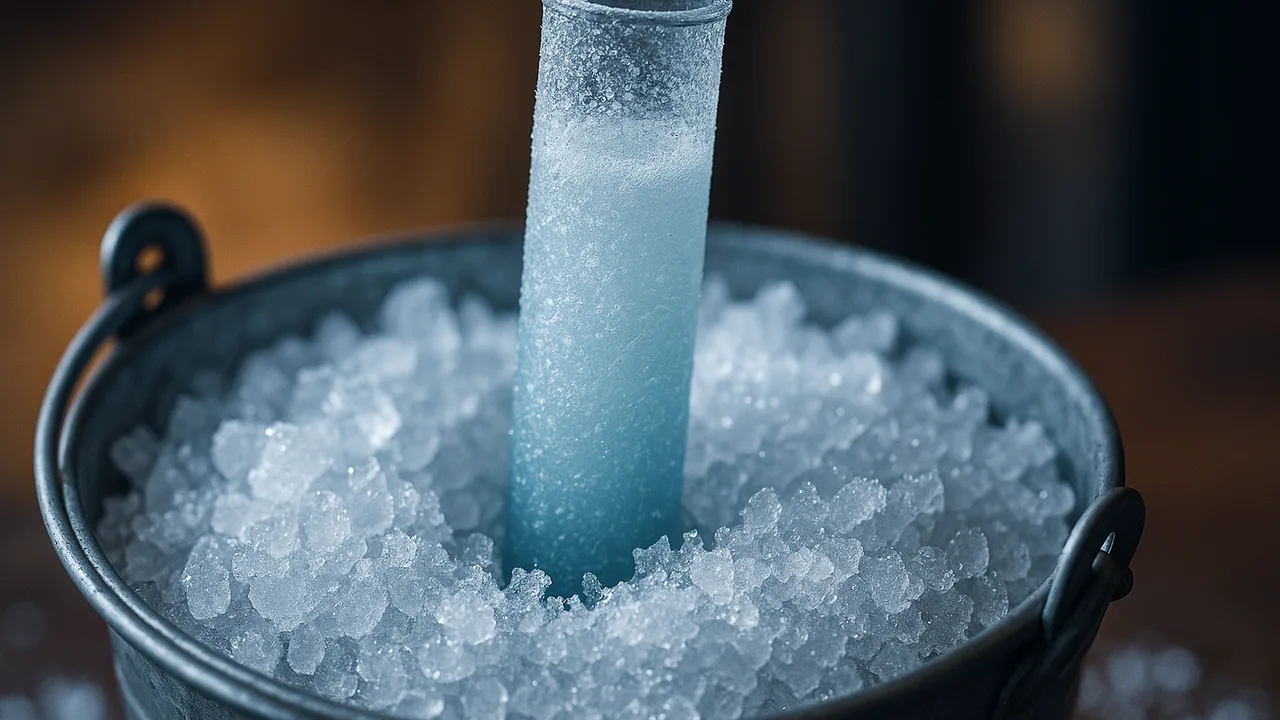
Measuring a freezing point. Put 10 mL of solution in a test tube, stand it in an ice-salt bath (crushed ice with rock salt, about −10 to −15 °C), stir with a wire stirrer and read the thermometer every 30 seconds. The temperature falls, often dips below the freezing point (supercooling), then jumps up and levels off as ice crystals form. The level stretch, or the highest point just after the jump, is the freezing point. First run distilled water to check the thermometer reads 0.0 °C; any offset is a correction for all your readings. Run three trials of each solution.
| Solution (0.50 mol/kg) | Trial 1 (°C) | Trial 2 | Trial 3 | Mean | Predicted (ideal) |
|---|---|---|---|---|---|
| Distilled water | 0.00 | ||||
| Sugar | −0.93 | ||||
| NaCl | −1.86 | ||||
| CaCl2 | −2.79 |
Reading. OpenStax Chemistry 2e, section 11.4 (colligative properties, Kf of water), CC BY 4.0. Eutectic temperatures from the CRC Handbook of Chemistry and Physics.
Guided Exercises ~15 min
Use Kf = 1.86 °C·kg/mol. Show units.
Independent Practice ~10 min
Graph and analyze.
Plot one cooling curve (temperature against time) for a salt solution. Label the supercooling dip and the freezing plateau, and explain what the water molecules are doing on each part.
Compare your mean freezing points with the ideal predictions. Calculate an apparent i for NaCl and CaCl2, and evaluate whether your data are accurate and precise enough to rank the de-icers.
Closure ~5 min
The number of particles sets the freezing point. Next class: a model of why water molecules hold on to each other so strongly in the first place.
Exit ticket: a road supervisor says, “Sugar beet juice is a great de-icer on its own.” Use one calculation from today to respond.
Teacher notes
Materials (per team): 400 mL beaker of crushed ice with about 100 g rock salt (the bath), four test tubes, wire loop stirrer, digital probe thermometer reading to 0.1 °C (or a −20 to 110 °C alcohol thermometer), stopwatch, distilled water, 0.50 mol/kg stock solutions prepared by the teacher, goggles, gloves, insulated mitt.
Recipes (0.50 mol/kg, per 100 g water): NaCl 2.92 g; anhydrous CaCl2 5.55 g (or dihydrate 7.35 g); sucrose 17.1 g. If you add MgCl2·6H2O, use 10.17 g and note that its 5.4 g of hydrate water slightly dilutes the solution.
Listen for: reading the supercooling minimum as the freezing point; “CaCl2 is always better per gram.”
Support / stretch: a worked-equation card with blanks for i, Kf and m. Stretch: explain why the eutectic of CaCl2 is so much lower than that of NaCl, using solubility (about 75 g against 36 g per 100 g water at 20 °C).