2.05 Lewis Structures, Shapes and Polarity: The Intermolecular Forces Model
draw Lewis structures, predict molecular shapes with VSEPR, decide whether a molecule is polar, and use London, dipole-dipole and hydrogen-bonding forces to explain boiling point, vapor pressure, surface tension and solubility.
- I can explain how measurable properties like melting point, boiling point, vapor pressure, and surface tension relate to the strength of electrical forces between particles in a substance.
- I can explain how changes in particle spacing during an experiment can occur without changing the identity of the particles (for example, water molecules remain the same when boiled but move farther apart).
- I can describe how adding thermal energy affects the electrical attraction between particles and their ability to stay close together.
- I can analyze how patterns of interactions at the molecular scale are reflected in the behavior of substances at the macroscopic scale.
- I can describe how attractive and repulsive electrical forces between molecules affect the arrangement and structure of a designed material, such as whether it forms a solid, liquid, gas, network solid, or polymer.
Phase 3: Make Sense
Warm-Up ~5 min
Do Now. Methane (CH4, molar mass 16) boils at −161.5 °C. Water (H2O, molar mass 18) boils at 100 °C. The molecules are almost the same mass. Write one idea that could explain a difference of more than 260 degrees.
Carbon dioxide has two polar C=O bonds. Is the CO2 molecule as a whole polar?
Instruction ~10 min
Lewis structures. A Lewis structure shows every valence electron as a dot or as a line for a shared pair. Steps: (1) add up valence electrons; (2) connect the atoms with single bonds; (3) give outer atoms full octets (hydrogen gets 2); (4) put leftover electrons on the central atom as lone pairs; (5) if the central atom is short of an octet, turn a lone pair on a neighbor into a double bond.
Worked example 1: water and carbon dioxide. Sasha counted valence electrons for H2O: O has 6, each H has 1, total 8. Two O–H bonds use 4; the other 4 sit on oxygen as two lone pairs. For CO2: C 4 + 2 × 6 = 16. Single bonds O–C–O use 4; giving each oxygen an octet uses the other 12, leaving carbon with only 4 electrons. Moving one lone pair from each oxygen into a bond gives O=C=O, with every atom at an octet.
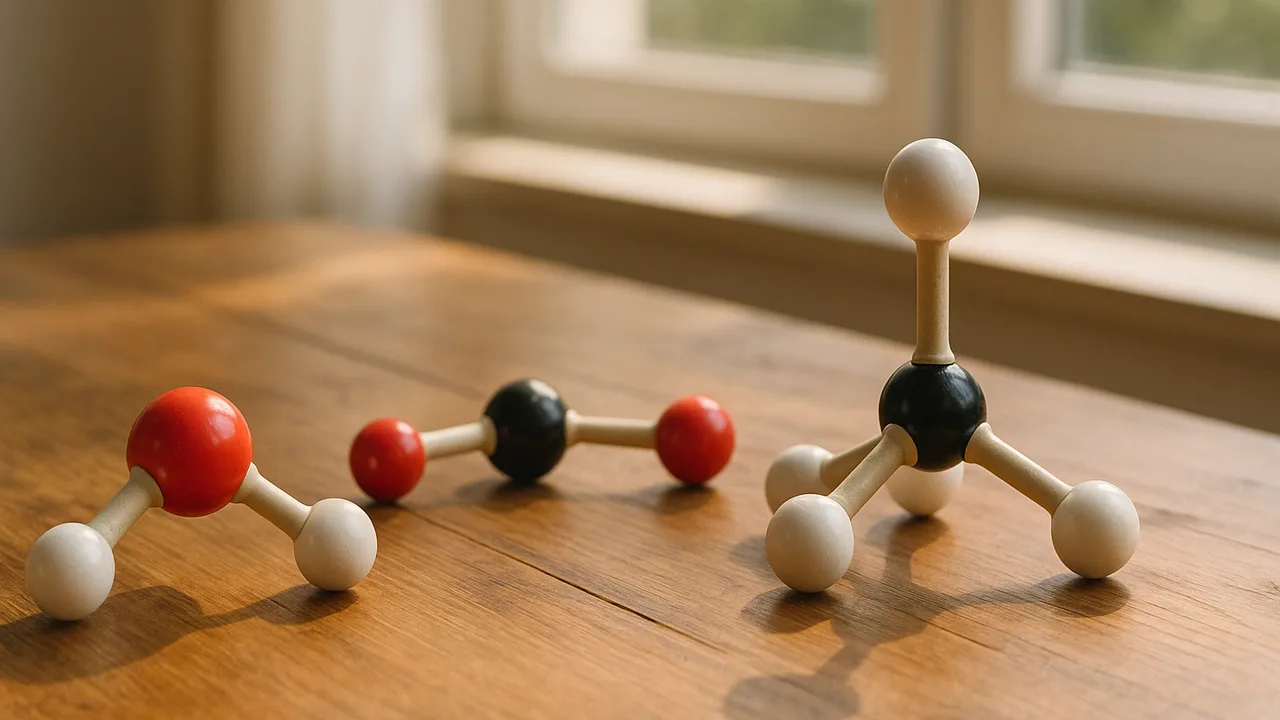
VSEPR shapes. Electron groups around a central atom (bonds and lone pairs; a double bond counts as one group) repel and spread as far apart as possible. Two groups: linear, 180° (CO2). Four groups, no lone pairs: tetrahedral, 109.5° (CH4). Four groups with one lone pair: trigonal pyramidal, about 107° (NH3). Four groups with two lone pairs: bent, about 104.5° (H2O). Lone pairs push a little harder than bonds, so the angles squeeze below 109.5°.
Polarity. A molecule is polar if it has polar bonds and a shape in which their dipoles do not cancel. CO2 and CH4 are nonpolar; H2O and NH3 are polar. Long hydrocarbon chains, such as those in asphalt binder, oils and waxes, are nonpolar because C–H bonds are barely polar.
Three intermolecular forces. London dispersion forces act between all molecules: electron clouds shift for an instant, creating temporary dipoles that attract their neighbors; bigger electron clouds give stronger dispersion forces. Dipole–dipole forces act between polar molecules: the δ+ end of one attracts the δ− end of the next. Hydrogen bonds are an especially strong dipole–dipole attraction between an H bonded to N, O or F and a lone pair on another N, O or F. Even a hydrogen bond is far weaker than a covalent bond, but in water every molecule can form up to four of them.
Worked example 2: ranking boiling points. Ravi compared three small molecules (NIST data). CH4: nonpolar, dispersion only, boils at −161.5 °C. H2S: bent and polar, dipole–dipole, −60 °C. H2O: bent, polar and hydrogen-bonded, 100 °C. H2S is almost twice as heavy as water, so its larger electron cloud should give it more dispersion force; water still boils 160 degrees higher. The pattern points to hydrogen bonding, not size, as the deciding factor.
Bulk properties follow the forces. Stronger attractions between molecules mean a higher boiling and melting point, a lower vapor pressure (fewer molecules escape from the surface) and a higher surface tension (surface molecules are pulled inward harder). At 20 °C water has a vapor pressure of 2.34 kPa and a surface tension of 72.8 mN/m; ethanol, which forms fewer hydrogen bonds per molecule, has about 5.9 kPa and 22.3 mN/m. Solubility follows “like dissolves like”: polar and ionic substances dissolve in water; nonpolar substances (oil, asphalt) do not. When water boils, its molecules move far apart but stay H2O.
Reading. OpenStax Chemistry 2e, sections 7.3–7.6 (Lewis structures, molecular structure and polarity) and 10.1–10.2 (intermolecular forces, properties of liquids), CC BY 4.0. Boiling points from NIST.
Guided Exercises ~15 min
Draw each Lewis structure before you answer.
Independent Practice ~10 min
Complete the molecule table.
| Molecule | Lewis structure | Shape | Polar? | Strongest IMF |
|---|---|---|---|---|
| CH4 | ||||
| NH3 | ||||
| H2O | ||||
| CO2 | ||||
| CH3OH (methanol) |
Rank the five molecules by predicted boiling point and justify the ranking from their intermolecular forces. Then explain why a molecular solid such as ice melts at a far lower temperature than an ionic solid such as salt.
Closure ~5 min
Shape sets polarity, and polarity sets the forces. Next class: the hydrogen-bonded network that makes water expand when it freezes.
Exit ticket: use one bulk property from today to explain why spilled rubbing alcohol dries off a road sign faster than water.
Teacher notes
Materials: molecular model kits or balloons, devices for the PhET sim, a boiling-point table (NIST values for CH4, NH3, H2S, H2O, pentane, ethanol, glycerol).
Listen for: “polar bonds always make a polar molecule”; hydrogen bonds described as bonds inside a water molecule; “boiling breaks H2O apart.”
Support / stretch: a five-step Lewis card and a VSEPR shape chart. Stretch: predict whether the boiling point of methanol (65 °C) or ethanol (78 °C) is higher and explain the difference with dispersion forces.