4.04 Hot Meets Cold: Thermal Equilibrium in a Closed Cup
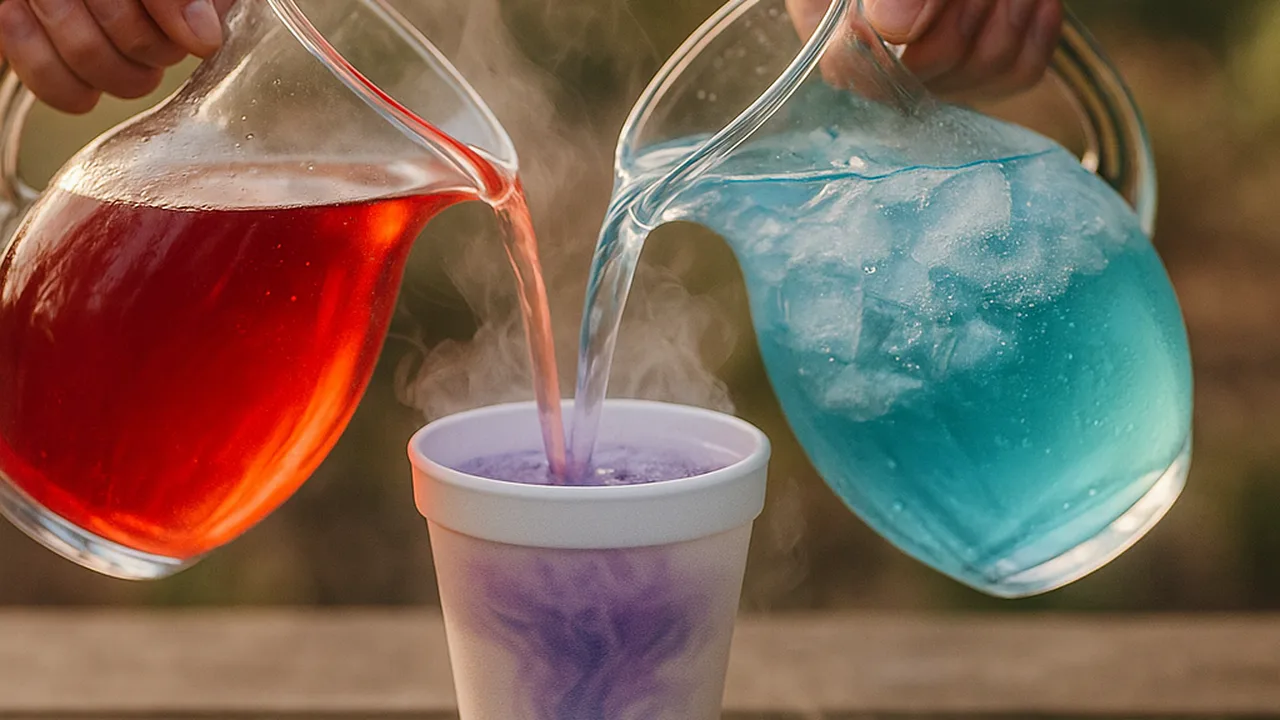
plan and carry out an investigation that combines hot and cold components in a nearly closed system, use temperature data and specific heats to show that the energy lost by the hot part equals the energy gained by the cold part, and explain the result with the second law of thermodynamics.
- I can explain that when two objects at different temperatures are combined in a closed system, thermal energy transfers between them until their energy is more evenly distributed, as described by the second law of thermodynamics.
- I can plan an investigation to measure how the temperature of a hot object decreases and the temperature of a cold object increases when they are combined in a closed system.
- I can use temperature data and heat capacity values from scientific sources to show that the thermal energy lost by the hot object equals the energy gained by the cold object, resulting in a more uniform energy distribution.
- I can describe how to set up a nearly closed system for the investigation, including defining the system’s boundaries and initial conditions.
- I can identify the data I need to collect, such as the masses of the components and their initial and final temperatures.
- I can outline the experimental procedure, including how I will collect data, how many trials I will run, and what equipment I will use.
- I can collect and record the data needed to calculate the change in thermal energy for each component in the system.
Phase 2: Investigate
Warm-Up ~5 min
Do Now. A volunteer pours 100 g of hot water (80 °C) and 100 g of cold water (20 °C) into one insulated mug. Predict the final temperature and write one reason the real mug might end a little lower.
Equal masses of water at 80 °C and 20 °C are mixed in an insulated cup. What is the final temperature closest to?
Instruction ~10 min
Why this matters for the brief. Every heater in our kit is a hot component touching a cold one: a heater pad against a meal, a warm pouch against a cold hand. Before we model those, we test the rule underneath them with the simplest system there is: hot and cold water in one cup.
Thermal equilibrium. When two components at different temperatures touch inside a closed system, the faster-moving particles of the hot one collide with the slower particles of the cold one and pass on kinetic energy. The hot component cools, the cold one warms, and the transfer stops when they reach the same temperature: thermal equilibrium. In a perfectly closed system, energy lost by the hot part = energy gained by the cold part, or mhch(Th − Tf) = mccc(Tf − Tc).
The second law. The energy always flows from hot to cold on its own, never the reverse. A lukewarm cup never separates by itself into a hot half and a cold half, even though that would not break conservation of energy. The second law of thermodynamics says that in any spontaneous process energy becomes more spread out, more evenly shared among the particles. Thermal equilibrium is the most evenly spread state the cup can reach.
Worked example 1: unequal masses. Priya mixed 150.0 g of water at 70.0 °C with 50.0 g at 10.0 °C. Since c is the same for both, it cancels: 150.0(70.0 − Tf) = 50.0(Tf − 10.0), so 10,500 + 500 = 200.0 Tf and Tf = 55.0 °C. Check: hot water lost 150.0 × 4.184 × 15.0 = 9,410 J; cold water gained 50.0 × 4.184 × 45.0 = 9,410 J. The larger mass moves less in temperature, but the energies match.
Worked example 2: metal into water. Omar heated 50.0 g of iron washers in hot water to 80.0 °C and dropped them into 100.0 g of water at 20.0 °C. Iron: m c = 50.0 × 0.449 = 22.45 J/°C. Water: 100.0 × 4.184 = 418.4 J/°C. Tf = (22.45 × 80.0 + 418.4 × 20.0) ÷ (22.45 + 418.4) = 23.1 °C. The iron fell almost 57 °C while the water rose about 3 °C; each moved 1,280 J. Water’s high specific heat is why it is such a good component for storing and carrying energy.
Planning the investigation. Your team plans its own version. Decide: (a) the system boundary (the two components and the cup, with the lid closed); (b) the initial conditions you set and measure (masses to 0.1 g, starting temperatures to 0.1 °C); (c) the data you need to calculate each component’s energy change (mass, specific heat from Table 5.1, initial and final temperature); (d) the procedure, the equipment and the number of trials (at least three). Then run one water + water mix and one metal + water mix.
Sample class data. 100.0 g at 78.5 °C mixed with 100.0 g at 19.5 °C reached 46.8 °C, not the ideal 49.0 °C. The hot water lost 418.4 × 31.7 = 13,300 J; the cold water gained 418.4 × 27.3 = 11,400 J. About 1,900 J (14%) is missing from the water. It went into the cup, the thermometer and the air while the water was being poured. Finding where energy seems to vanish is part of evaluating the design of an investigation.
Reading. OpenStax Chemistry 2e, chapter 5.1 (heat transfer and thermal equilibrium) and chapter 16.3 (the second law of thermodynamics), CC BY 4.0.
Guided Exercises ~15 min
Plan with your team, then answer as you collect data.
Independent Practice ~10 min
Investigation write-up, in your Energy Notebook.
Write your plan as another team could follow it: system boundary, initial conditions, data to collect, equipment, procedure and number of trials.
Explain, using the second law, why the hand warmer in the relief kit can warm a cold hand but a cold hand can never warm the hand warmer. Then predict which would warm a 300 g meal more from the same energy: a meal that is mostly water or one that is mostly oil (c about 2.0 J/(g·°C)).
Closure ~5 min
We have measured energy moving toward equilibrium and seen some of it escape. Next phase: why reactions store or release energy at all.
Exit ticket: name one change to your cup setup that would reduce the energy that seems to go missing, and explain why it helps.
Teacher notes
Materials (per team): nested foam cups with lids, two digital thermometers, a 100 mL graduated cylinder, a balance, about 50 g of iron or steel washers on a string, a hot-water bath held at 75–80 °C, ice water, tongs, heat-resistant gloves, devices for the PhET sim or paper sketches.
Timing: planning 15 minutes, water mix 15 minutes, metal mix 15 minutes, analysis 5 minutes. Steel’s specific heat (about 0.47 J/(g·°C)) is close to iron’s 0.449; tell students which value to use.
Listen for: “the iron had more heat because it was hotter”; “cold moved into the hot water”; temperatures averaged for unequal masses.
Support / stretch: give a planning template with the four headings. Stretch: use the sample data to estimate the cup’s heat capacity (about 1,900 J ÷ 27 °C ≈ 70 J/°C) and correct the model.