4.05 Bonds Broken, Bonds Formed: Energy Diagrams
develop an energy diagram for a reaction that shows the bonds broken and formed, use average bond energies to estimate ΔH, and explain why a reaction releases or absorbs energy from the difference in potential energy between reactants and products.
- I can develop a model of a chemical reaction that identifies the system, the surroundings, and the bonds that are broken and formed.
- I can use my model to describe how energy is transferred between the system and surroundings, and how potential energy changes to kinetic energy (or vice versa) during molecular collisions.
- I can use my model to compare the relative potential energies of the reactants and products in a chemical reaction.
- I can use my model to illustrate that the energy change in a chemical reaction comes from the difference in bond energies between reactants and products.
- I can explain that breaking bonds requires energy input and forming bonds releases energy, and that energy transfer between the system and surroundings happens during molecular collisions.
- I can use my model to show that the total energy of the system and surroundings is conserved during a chemical reaction, and that changes in bond energy account for the relative potential energies of reactants and products.
Phase 3: Make Sense
Warm-Up ~5 min
Do Now. A classmate says, “The hand warmer gets hot because breaking the bonds in iron and oxygen releases energy.” Write whether you agree, and what you would need to know to decide.
Breaking a chemical bond releases energy.
Instruction ~10 min
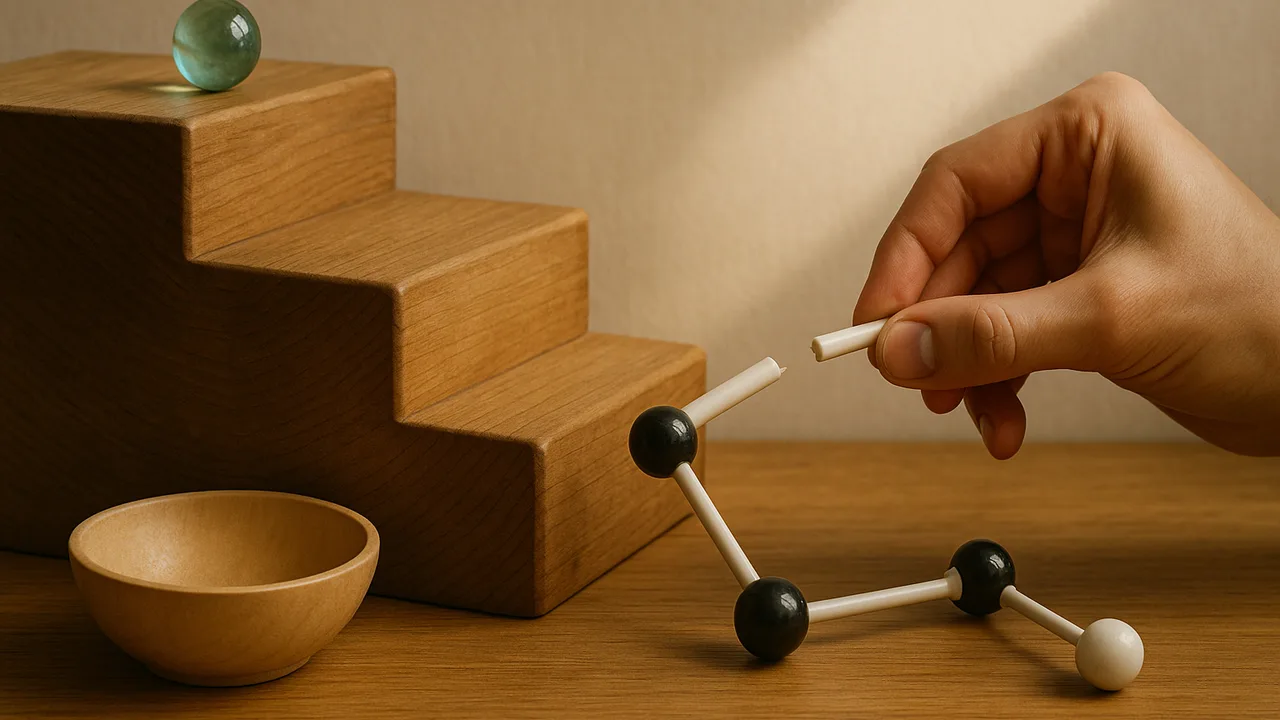
Where the energy is. In 4.01 we said the hand warmer’s energy is stored as chemical potential energy. Now we locate it. Atoms held together by a bond are at lower potential energy than the same atoms pulled apart. So breaking a bond requires an energy input, and forming a bond releases energy. Every reaction does both: reactant bonds break and product bonds form.
The bottom line. ΔH ≈ (energy to break all reactant bonds) − (energy released forming all product bonds). If the product bonds are stronger overall, more energy comes out than went in: the products sit lower in potential energy and the reaction is exothermic. If the reactant bonds are stronger, the reaction is endothermic. The bond energy is the energy needed to break one mole of a given bond in the gas phase; tables list average values, so a bond-energy ΔH is an estimate.
Worked example 1: hydrogen and oxygen. Lucia estimated ΔH for 2H2(g) + O2(g) → 2H2O(g). Bonds broken: 2 H–H (2 × 436) + 1 O=O (498) = 1,370 kJ. Bonds formed: each water has two O–H bonds, so 4 O–H (4 × 464) = 1,856 kJ. ΔH ≈ 1,370 − 1,856 = −486 kJ. The measured value is −483.6 kJ: the average bond energies get within 1%. Strong O–H bonds are why this reaction releases so much energy.
Drawing the energy diagram. Put potential energy on the vertical axis and the progress of the reaction across. Draw the reactants as a level on the left and the products as a level on the right: lower for exothermic, higher for endothermic. The vertical gap is ΔH. Between them draw a hump: the activation energy, the energy colliding particles must have to start breaking bonds. Label the climb “bonds breaking: energy in” and the drop “bonds forming: energy out.”
Collisions move the energy. Where does the energy to break bonds come from, and where does the released energy go? From and to the motion of particles. In a collision, kinetic energy of the colliding molecules turns into potential energy as bonds stretch and break. When new bonds form, potential energy turns into kinetic energy of the product particles. Those fast particles collide with water molecules, the pouch and your skin, passing kinetic energy on. That is how a drop in chemical potential energy becomes a rise in the temperature of the surroundings, with the total energy of system plus surroundings unchanged.
Worked example 2: hydrogen and chlorine. Kenji estimated H2 + Cl2 → 2HCl. Broken: H–H 436 + Cl–Cl 243 = 679 kJ. Formed: 2 H–Cl = 2 × 432 = 864 kJ. ΔH ≈ 679 − 864 = −185 kJ (measured −184.6 kJ). Reversing the reaction, splitting HCl into its elements, would need +185 kJ: same bonds, opposite direction, opposite sign.
Dissolving works the same way. When CaCl2 dissolves, no covalent bonds break, but attractions do: the ionic attractions in the crystal and some hydrogen bonds between water molecules. New attractions form between each ion and the water molecules that surround it. For CaCl2 the new ion–water attractions release more energy than breaking the old ones costs, so it is exothermic. For ammonium nitrate the balance tips the other way and the cold pack absorbs energy.
Reading. OpenStax Chemistry 2e, chapter 7.5 (strengths of ionic and covalent bonds; Table 7.2 average bond energies) and chapter 5.3 (enthalpy), CC BY 4.0.
Guided Exercises ~15 min
Use these average bond energies (kJ/mol, OpenStax Table 7.2): H–H 436, O=O 498, O–H 464, Cl–Cl 243, H–Cl 432, N≡N 946, N–H 390. Draw structures to count bonds.
Independent Practice ~10 min
Model practice, in your Energy Notebook.
Draw a matching pair of energy diagrams on the same axes: the CaCl2 hot pack and the ammonium nitrate cold pack. For each, explain in two sentences why the products are higher or lower than the reactants and how the energy change in the system is balanced by the surroundings.
A student's model shows energy appearing from nowhere when the hand warmer heats. Rewrite the explanation so that the total energy of system plus surroundings is conserved, using the words potential, kinetic and collision.
Closure ~5 min
We can explain where a reaction’s energy comes from. Next class we compare the candidate heaters number by number.
Exit ticket: correct the Do Now classmate. Explain in two sentences why the hand warmer releases energy even though breaking bonds absorbs energy.
Teacher notes
Materials: bond-energy table cards, molecular model kits for counting bonds, graph paper or whiteboards for energy diagrams.
Listen for: “breaking bonds releases energy” (the most common misconception in the topic); “bonds formed minus bonds broken” with the sign reversed; counting one O–H per water molecule.
Support / stretch: give a two-column “in / out” table for bond counting. Stretch: explain why the bond-energy estimate for water vapor is closer to the measured value than an estimate for liquid water would be (bond energies are gas-phase values; condensing water releases extra energy).