2.07 Designed Materials for Winter Roads: Structure Decides Function
explain how the molecular structure of water-repellent sealers, air-entrained concrete, beet-sugar brine additives, sand and steel determines what each does on a winter road, and test two of them.
- I can identify and explain how the molecular-level structure and atomic interactions of a designed material determine its function.
- I can communicate how the properties of a material make it suitable for its intended use.
- I can represent and clearly identify the molecular structure of a chosen designed material using an appropriate model or diagram.
- I can describe how electrostatic forces at the atomic and molecular scale result in contact forces like friction, normal forces, or stickiness that we observe on the macroscopic scale.
Phase 4: Build
Warm-Up ~5 min
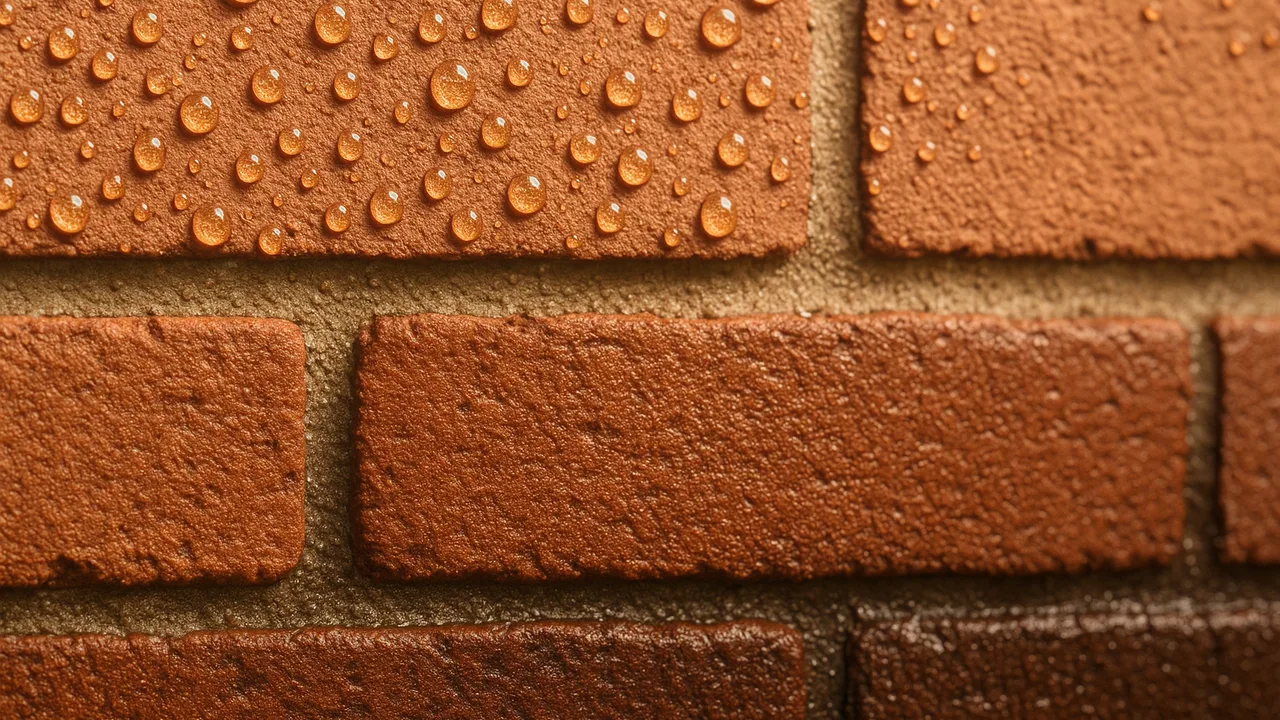
Do Now. Record cycle 2 data for your freeze–thaw samples. Then look at the two bricks on your bench: one was treated with a clear masonry water repellent last week, one was not. They look the same. Write how you could tell them apart in ten seconds without a label.
A drop of water is placed on each brick. What will you see?
Instruction ~10 min
Designed materials. A designed material is one whose structure has been chosen or engineered to give a particular function. Every material on a winter road can be explained with the same three-step chain: structure (which particles and how they are arranged) → force (which bonds or intermolecular attractions act) → property and function (what it does on the road).
Water-repellent sealers. Silane and siloxane sealers soak into concrete and brick. One end of each molecule reacts with the Si–OH groups on the mineral pore walls and forms strong covalent Si–O–Si links; the other end is a nonpolar hydrocarbon chain that sticks out into the pore. Water meeting that surface feels only weak dispersion attraction to it, much weaker than the hydrogen bonds water forms with itself, so it beads and runs off instead of entering the pores. Because the pores are lined, not plugged, water vapor can still escape. Less liquid water in the pores means less ice to wedge them apart.
Worked example 1: the sealer chain. Olivia wrote: Structure: silane molecules covalently bonded to the pore walls, nonpolar chains outward. Force: water is attracted to the chains only by weak dispersion forces, while water–water hydrogen bonds are strong. Function: water beads and stays out, so less water is in the pores to freeze and expand. Each link names a particle or a force, not just “it is waterproof.”
Air-entrained concrete. For roads that freeze, engineers add a small amount of a surfactant to the concrete mix. Its molecules have a polar (often ionic) head and a long nonpolar tail; they gather at air–water surfaces and stabilize billions of microscopic bubbles, so the hardened concrete is roughly 5–8% tiny air voids. When pore water freezes and expands, it can push into a nearby empty void instead of cracking the paste. Designed porosity protects against water’s 9% expansion.
The beet-brine additive. Sugars from beet processing are covered in O–H groups. Each sugar molecule forms many hydrogen bonds with water and with other sugar molecules, so the blend is thicker (more viscous) than plain brine. It clings to the pavement instead of running off or bouncing away, so less salt is wasted. The sugar adds only a little freezing-point depression (2.04): its job is to hold the salt in place.
Sand and friction. Friction is a contact force, and at the scale of atoms it is electrical: where two surfaces touch, atoms on each are close enough to attract, and rough points interlock and must be pushed past one another. Ice is slippery partly because its surface carries a thin, liquid-like film of loosely held water molecules that the surfaces slide on. Sharp quartz grains press through that film, giving tires many more solid contact points. Worked example 2. Marco dragged a 500 g block across an ice sheet with a spring scale (sample data). Bare ice: 0.4 N. Sanded ice: 1.9 N. The weight is 0.500 kg × 9.8 N/kg = 4.9 N, so the friction coefficient rose from 0.4 ÷ 4.9 = 0.08 to 1.9 ÷ 4.9 = 0.39, nearly five times the grip.
Steel, salt and mobile electrons. Plow blades, guard rails and bridge reinforcing bars are steel: iron atoms in a sea of mobile electrons. That structure makes steel strong, bendable and conductive. It also lets iron give up electrons to oxygen where water touches it. Dissolved chloride ions make the water a better conductor, speeding up the electron flow between rusting and non-rusting spots, which is why salted roads corrode vehicles and bridges faster. Corrosion inhibitors added to some de-icers coat the metal and slow this down.
Reading. OpenStax Chemistry 2e, sections 10.1 (intermolecular forces), 10.5 (the solid state) and 17.6 (corrosion), CC BY 4.0. Air-content range from published concrete-industry guidance.
Guided Exercises ~15 min
Test the bricks and the ice sheet, then answer.
Independent Practice ~10 min
Two formats, one material.
Choose one of the five winter treatments. Present its structure and intended function in two formats: a labeled particle diagram and a short paragraph (or a data table and a paragraph). Cite one source, such as OpenStax Chemistry 2e.
Record your freeze–thaw cycle 2 data in the class table and describe one change you can see in any sample so far.
Closure ~5 min
Structure decides function for every material on the road. Next class: the freeze–thaw results and version 2 of our recommendation.
Exit ticket: the county could seal its concrete curbs with a silane repellent. Explain how that could reduce freeze–thaw damage, naming one force.
Teacher notes
Materials: pairs of clay bricks (one treated with a water-based silane/siloxane masonry repellent a week ahead and cured), droppers; an ice sheet frozen in a baking tray overnight, a 500 g wooden block with a hook, a spring scale (0–5 N), a cup of dry sand; a small bottle each of salt brine and the beet-blend model from 2.03 for a quick flow comparison on a tilted tile.
Timing: freeze–thaw readings 5 minutes, bead and friction tests 15, lecture 15, modeling 15.
Listen for: “sand melts ice”; “the sealer blocks the pores” (it lines them); friction described as non-electrical.
Support / stretch: give a three-box structure-force-function frame. Stretch: explain why too much air in concrete would lower its strength, and how engineers balance durability against strength.