4.10 Unit 4 Checkpoint: Gravitation, Electric Force, Orbits and Simulations
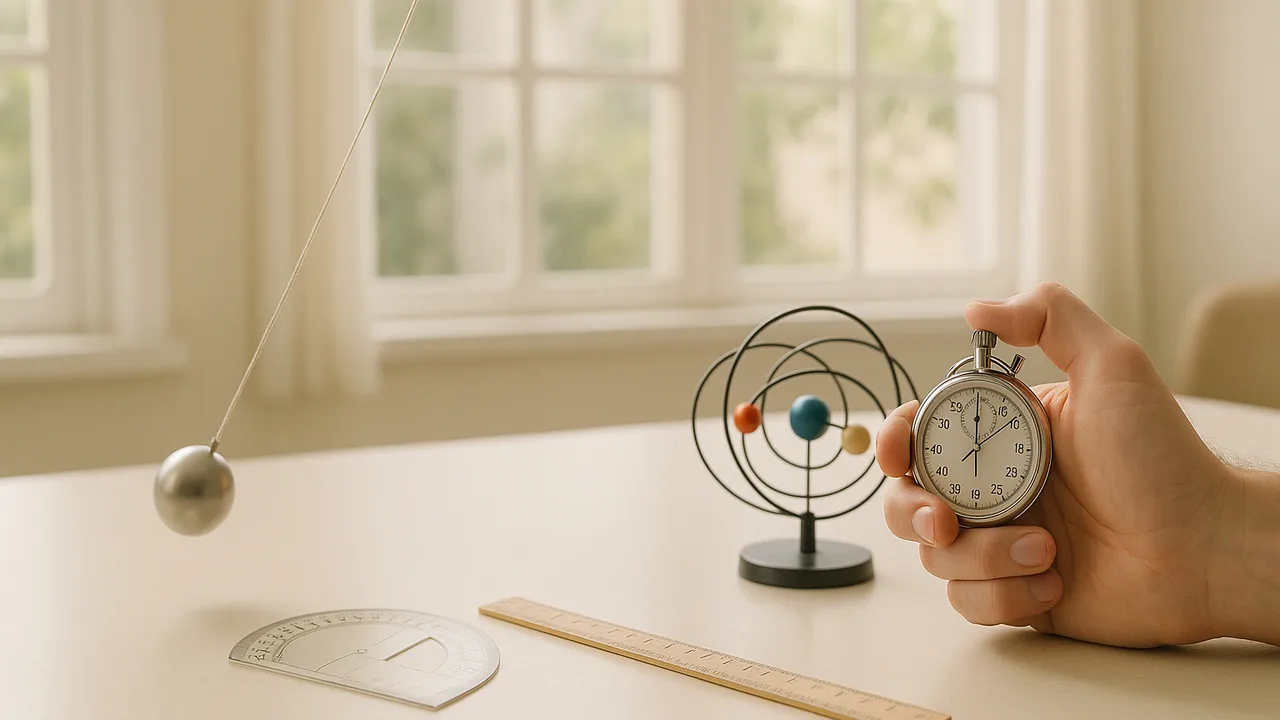
show what I learned about net force and acceleration in circular motion, gravitational and electric forces, and using a computer simulation to evaluate design solutions.
- I can express that a net force on an object causes the object to accelerate, using the relationship Fnet = ma.
- I can use the gravitational or electrostatic force formulas to calculate and predict the force between two objects.
- I can identify the limitations of the computer simulation.
Phase 5: Prove It
Warm-Up ~5 min
Do Now. Back to our phenomenon: a satellite circles Earth for years with no engine. In two sentences, explain why it neither falls to the ground nor flies away.
Higher satellites move faster than lower ones.
Instruction ~10 min
Physicists, this is the unit checkpoint. Part A is multiple choice with data and a scenario set where several questions share one situation. Part B is four short constructed responses scored 0–3. Show units and reasoning.
How a 0–3 answer is scored. 3: a correct claim, accurate evidence or calculation with units, and reasoning that names the physics or design idea. 2: correct claim and evidence with weak or missing reasoning, or one small error. 1: a partly correct claim with little support. 0: incorrect or blank.
Worked example: from 2 points to 3. Question: “Why do astronauts float on the ISS?” “There is no gravity” earns 0. “They are falling” earns 2. Diego wrote: “Gravity there is still about 8.6 N/kg, but it is the net force making the astronauts and the station accelerate together toward Earth at v2/r, so nothing presses them on the floor.” That earns 3.
Data for questions 1–3 (sample data). A 0.020 kg puck on a string moves in a horizontal circle on a frictionless table; the string tension is the net force.
| Net force (N) | 0.40 | 0.60 | 0.80 |
|---|---|---|---|
| Centripetal acceleration v2/r (m/s2) | 20 | 30 | 40 |
Scenario set for questions 12–17 (illustrative). A coastal flood-warning office builds a spreadsheet orbit simulation to choose satellites that watch river levels. Inputs: altitude and number of satellites. Relationships: v = √(GM/r) and T = 2πr/v. It assumes circular orbits, no drag and a non-rotating Earth.
Guided Exercises ~15 min
Part A: answer on your own. Your teacher reviews answers after everyone finishes.
Independent Practice ~10 min
Part B: constructed responses, each scored 0–3.
18. Organize the puck data in a graph (describe the axes and shape), find the slope and explain how the data support Fnet = ma. Explain why these data show cause and effect rather than only a correlation, and predict the acceleration for a 1.00 N net force. (0–3)
19. A 500 kg satellite orbits at r = 7,071 km. Identify the two interacting objects, calculate the gravitational force on it, and explain why that force is always attractive. Then compare with two charges of +1.0 µC and −1.0 µC 0.10 m apart: compute Fe, explain its sign, explain why the ratio of the two kinds of force between two given particles does not depend on distance, and describe how the system's energy changes if the satellite is raised. (0–3)
20. Using the scenario simulation, choose realistic inputs to compare two satellite plans for the flood-warning office. Describe the system the simulation models and its boundary, give the outputs, compare them with what you expected, and predict what each plan would mean for people on the ground. (0–3)
21. Name two limitations of the office's simulation and how each could change a recommendation. Then describe one plan whose negative consequences would outweigh its benefits, and explain how you decided. (0–3)
Closure ~5 min
Finished. You have modeled motion, forces, momentum and gravitation, and used them to design for real clients.
Exit ticket: which question was hardest, and what idea do you want to practice next?
How confident are you that you can I can analyze gravitational and electric forces, explain orbits with F<sub>net</sub> = ma, and use a simulation to evaluate designs.
Teacher notes
Materials: printed checkpoint with the data table and scenario, calculators, the 0–3 scoring guide.
Setup: about 35 minutes for Parts A and B, then a short review. Item tags: 1 PS2-1:1a, 3a; 2 PS2-1:2a; 3 PS2-1:3c; 4 PS2-1:3b; 5 PS2-4:1b; 6 PS2-4:2a; 7 PS2-4:1c, 3c; 8 PS2-4:3a; 9 PS2-4:3b, 3c; 10 PS2-4:3d; 11 PS2-4:1a; 12 ETS1-4:1a; 13 ETS1-4:2a; 14 ETS1-4:3a; 15 ETS1-4:3b; 16 ETS1-4:3c; 17 ETS1-4:3d; 18 PS2-1:1a, 2a, 3a, 3b, 3c; 19 PS2-4:1a, 1b, 1c, 2a, 3a, 3b, 3c, 3d; 20 ETS1-4:1a, 2a, 3a, 3b; 21 ETS1-4:3c, 3d. Use the tags to plan reteaching.
Listen for: altitude used as r; “no gravity in orbit”; half instead of a quarter at twice the distance.
Support / stretch: read items aloud on request and allow a formula card. Stretch: for item 19, find the altitude where the satellite’s period is exactly two hours.