3.04 Where Did the Momentum Go? Arguing from Collision Data
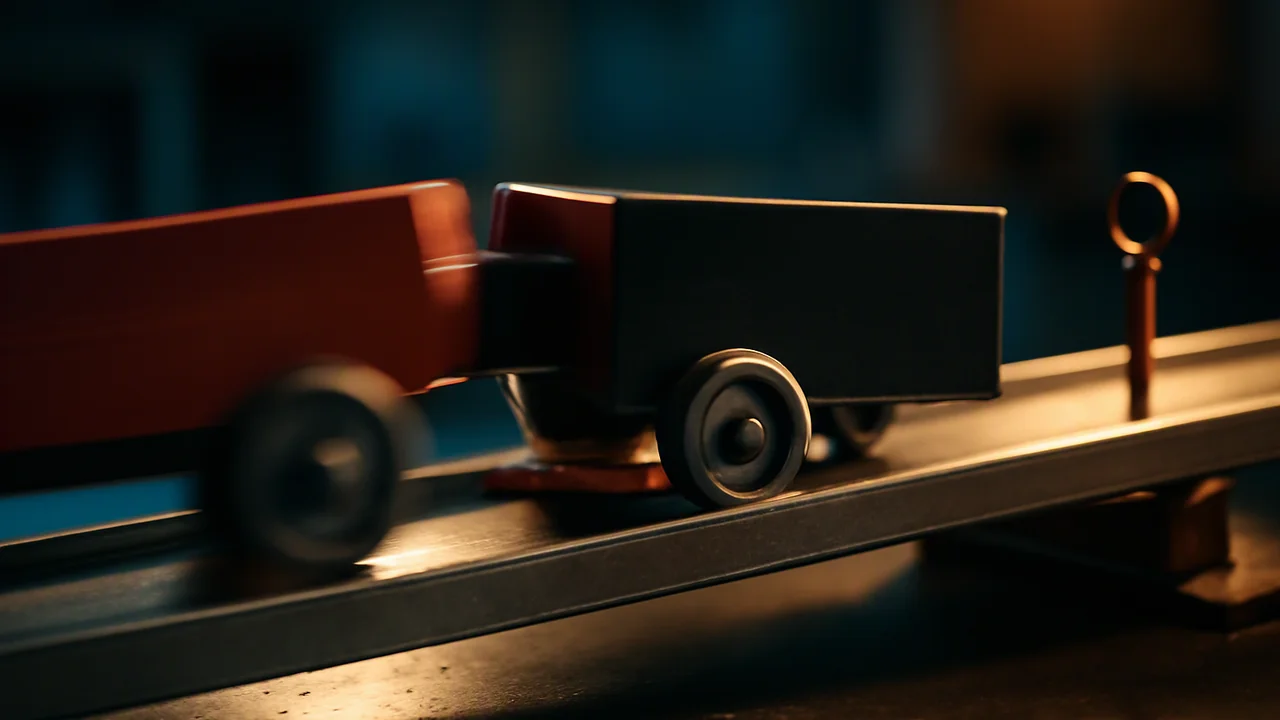
derive conservation of momentum from Newton’s third law, distinguish elastic from inelastic collisions by kinetic energy, apply component conservation to a two-dimensional collision, and argue from my lab data whether momentum was conserved.
- I can use mathematical models to describe how the momentum of each object changes during their interaction.
- I can explain how any change in momentum of one object is balanced by an equal and opposite change in the other, keeping the total momentum constant.
- I can use calculations of total momentum to support the claim that the system’s momentum is the same before and after the interaction.
Phase 2: Investigate
Warm-Up ~5 min
Do Now. A loaded delivery truck and a small car bump at a parking-lot entrance at walking speed. Which vehicle pushes harder on the other? Write your answer and one reason before we argue it out.
During a collision between a heavy cart and a light cart, how do the forces they exert on each other compare?
Instruction ~10 min
Why momentum is conserved: Newton’s third law. During a collision, cart A pushes on cart B with force FA on B, and B pushes back on A with FB on A. Newton’s third law says these are equal in size and opposite in direction at every instant: FB on A = −FA on B. The two forces also act for exactly the same time Δt, because they exist only while the carts touch. Multiply each by Δt and use impulse = Δp:
ΔpA = FB on AΔt = −FA on BΔt = −ΔpB, so ΔpA + ΔpB = 0.
Whatever momentum A loses, B gains. The total cannot change unless something outside the two carts exerts a net force. This is the argument you will defend: conservation of momentum is not a separate rule, it follows from the third law (and second law) applied to a system.
Worked example 1: tracking each object. In the 3.03 sticking trial, cart A went from 0.3277 to 0.512 × 0.32 = 0.1638 kg·m/s, so ΔpA = −0.1639 kg·m/s. Cart B went from 0 to 0.498 × 0.32 = 0.1594 kg·m/s, so ΔpB = +0.1594 kg·m/s. The two changes are nearly equal and opposite; the small mismatch is the 1.4% you already found. If the contact lasted 0.020 s (illustrative), the average force on each cart was about 0.16/0.020 = 8 N.
Where did the “lost” momentum go? Your lab totals were rarely identical. External forces explain part of it. Suppose rolling friction on a cart is about 0.05 N (illustrative) and you measured its velocity 0.5 s before the collision instead of just before. Friction delivered an impulse of 0.05 × 0.5 = 0.025 N·s, which is 7.6% of the 0.328 kg·m/s in the sticking trial. The collision itself lasts only milliseconds, so friction does little during contact; it matters in the time between your measurements and the collision. A tilted track (gravity has a component along it) and a cart scraping a wall are other external forces.
Elastic and inelastic collisions. Momentum is conserved in every collision of an isolated system. Kinetic energy, KE = ½mv2, is not. An elastic collision keeps total kinetic energy; an inelastic one converts some into thermal energy, sound and permanent deformation; a perfectly inelastic collision is one where the objects stick.
- Illustrative sticking trial: KE before = ½ × 0.512 × 0.642 = 0.1049 J; after = ½ × 1.010 × 0.322 = 0.0517 J. About 51% of the kinetic energy is gone, while momentum changed by only 1.4%. When the target starts at rest and they stick, theory predicts the fraction kept is mA/(mA + mB) = 51%.
- Illustrative bouncing trial: KE before 0.0922 J, after 0.0839 J, so 91% was kept: nearly elastic.
For two equal masses in a perfectly elastic head-on collision with one at rest, the moving object stops and the target leaves with its full velocity (think of a Newton’s cradle).
Worked example 2: a collision in two dimensions. Momentum is a vector, so it is conserved in each direction separately. Split every momentum into east (x) and north (y) components with cosine and sine, and write two conservation equations. A 0.20 kg puck A moving east at 3.0 m/s strikes an identical puck B at rest. Afterward A moves at 1.5 m/s, 60° north of east. Find B’s velocity.
- A after: vx = 1.5 cos 60° = 0.750 m/s; vy = 1.5 sin 60° = 1.299 m/s.
- The masses are equal, so velocity components add like momenta. x: 3.0 = 0.750 + vBx, so vBx = 2.250 m/s. y: 0 = 1.299 + vBy, so vBy = −1.299 m/s.
- Speed: √(2.2502 + 1.2992) = 2.60 m/s at tan−1(1.299/2.250) = 30° south of east.
Check the energy: before, ½(0.20)(3.0)2 = 0.90 J; after, ½(0.20)(1.52 + 2.602) = 0.90 J. This collision is elastic, and the pucks leave 90° apart, the signature of an elastic glancing collision between equal masses.
Misconceptions to argue against. (1) “In an inelastic collision momentum is lost.” Kinetic energy is lost; momentum is conserved unless an external force acts. (2) “The heavier cart pushes harder.” The forces are equal and opposite; the lighter cart simply has the larger change in velocity.
Argument structure. Claim (momentum was or was not conserved) / Evidence (class totals, percent differences, uncertainty) / Reasoning (third law, external forces) / Rebuttal (answer the strongest counter-claim with data).
Guided Exercises ~15 min
Use your 3.03 data and the class data table.
Independent Practice ~10 min
Build the argument you will present.
Present (live or recorded, 3–4 minutes) or write: “Was momentum conserved in our collisions?” Show, with numbers, that the carts moved at steady velocities before contact (so the net external force was small), that their momentum changes were equal and opposite, and that the totals before and after agree within your uncertainty. Then classify one trial as elastic or inelastic from kinetic energy.
Closure ~5 min
Momentum is conserved because forces come in equal and opposite pairs. Next, we model how crush distance and materials control the force in a crash.
Exit ticket: explain, using Newton's third law, why any change in momentum of one cart is balanced by an equal and opposite change in the other.
How confident are you that you can I can explain conservation of momentum with Newton's third law and decide from data whether a collision was elastic or inelastic.
Teacher notes
Materials: class data table from 3.03 projected, devices for the PhET sim (or graph paper and protractors), chart paper for argument maps.
Setup: pair teams with different results so rebuttals use real disagreements. Friction values and contact time are illustrative.
Listen for: “momentum is lost in inelastic collisions”; “the heavier cart pushes harder”; adding speeds in two dimensions instead of components.
Support / stretch: give an argument organizer with claim, evidence, reasoning and rebuttal boxes. Stretch: show algebraically that a perfectly inelastic collision with the target at rest keeps the fraction mA/(mA + mB) of the kinetic energy.
Reading: OpenStax Physics (high school), chapter 8.