3.03 Collision Carts Lab: Is Total Momentum Conserved?
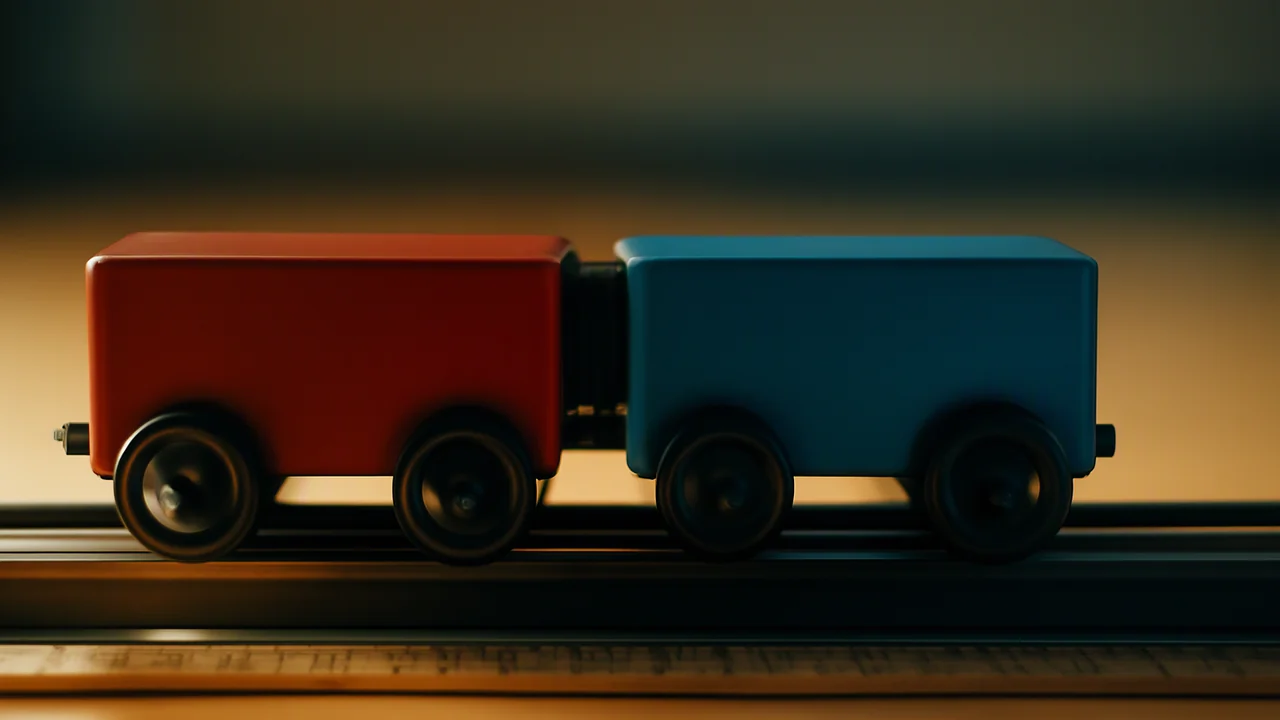
measure velocities from phone video, compute total momentum before and after sticking and bouncing collisions, and judge whether the difference is within my measurement uncertainty.
- I can describe and calculate the momentum of each object in a one-dimensional system using the formula p = mv.
- I can calculate and describe the total momentum of a system by adding the one-dimensional momenta of two objects.
- I can use calculations of total momentum to support the claim that the system’s momentum is the same before and after the interaction.
Phase 2: Investigate
Warm-Up ~5 min
Do Now. Cart A rolls into cart B, which is at rest, and they stick together. Predict: is the pair’s speed afterward more than, equal to or less than A’s speed before? Write one reason.
Two identical carts: A moves at 0.60 m/s into B at rest, and they stick. How fast does the pair move?
Instruction ~10 min
Conservation of momentum. Choose a system: here, two carts on a track. If the net external force on the system is zero (or negligible), the total momentum of the system does not change, whatever happens inside it:
mAvA + mBvB = mAv′A + mBv′B
Primes mark velocities after the collision. Velocity carries a sign: choose one direction along the track as positive, and a cart moving the other way has negative velocity and negative momentum. Today you test this claim with your own measurements. Before the carts touch, check the system: on a level track the weight of each cart is balanced by the normal force, and friction is small, so the net external force is nearly zero. The carts’ steady speeds just before contact are the evidence.
Measuring velocity with a phone. Film the track from the side with a meter stick in view. Most phones record at 30 frames per second, and slow-motion modes at 120 or 240. Step through the video frame by frame, note a cart’s position at two frames, and divide:
v = Δx / (number of frames ÷ frame rate)
Example: in the illustrative trial below, cart A moved 0.192 m in 9 frames at 30 frames per second. The time is 9/30 = 0.300 s, so vA = 0.192 / 0.300 = 0.64 m/s. Measure just before and just after contact, because friction slows the carts a little the whole time they roll.
Worked example 1: a sticking collision. Cart A (0.512 kg) rolls at 0.64 m/s into cart B (0.498 kg) at rest. Velcro makes them stick, and together they move 0.096 m in 9 frames, so v′ = 0.096/0.300 = 0.32 m/s.
- Momentum before: 0.512 × 0.64 + 0.498 × 0 = 0.3277 kg·m/s.
- Momentum after: (0.512 + 0.498) × 0.32 = 1.010 × 0.32 = 0.3232 kg·m/s.
- Percent difference: |0.3232 − 0.3277| / 0.3277 × 100% = 1.4%.
Worked example 2: a bouncing collision. With magnet or rubber-band bumpers: A at 0.60 m/s hits B at rest; afterward A creeps forward at 0.02 m/s and B moves at 0.58 m/s. Before: 0.3072 kg·m/s. After: 0.512 × 0.02 + 0.498 × 0.58 = 0.2991 kg·m/s, a difference of 2.6%.
Is a small difference “conserved”? No measurement is exact, so compare the difference with your uncertainty. If you can read a position to about ±0.5 cm, a 19.2 cm displacement carries about 2.6% uncertainty, and every velocity you compute inherits it. A percent difference of a few percent is consistent with conservation; a difference of 20% means something outside the system pushed on the carts or a measurement went wrong. Longer displacements (more frames) shrink the relative uncertainty.
Common mistakes. (1) Dropping the sign: a cart that bounces backward has negative momentum. Adding speeds instead of velocities makes momentum look “created.” (2) Measuring velocity far from the collision, where friction has already changed it. (3) Forgetting that the stuck pair’s mass is mA + mB.
Lab procedure: is total momentum conserved?
Question. When two carts (or toy cars) collide on a level track, is the total momentum just after the collision equal to the total momentum just before, for both bouncing and sticking collisions?
Materials. Two low-friction carts or two similar toy cars; a level track (smooth floor, board or a length of vinyl rain gutter); a meter stick or tape measure taped along the track; a phone or tablet camera (slow-motion mode if available) on a stack of books; a kitchen or lab scale; Velcro strips or modeling clay (sticking bumper) and rubber bands or small magnets (bouncing bumper); washers or coins and tape to change a cart’s mass; safety goggles.
- Measure and record the mass of each cart, including bumpers and tape, in kilograms.
- Tape the meter stick along the track and set the camera level with the track, 1–2 m away, so the scale and both carts are in frame. Film a test run and check that the scale is readable.
- Sticking trials: put Velcro or clay on the facing ends. With cart B at rest, give cart A a gentle push. Film at least 10 frames before and 10 frames after the collision. Do 3 trials.
- Bouncing trials: replace the Velcro with rubber-band or magnet bumpers and repeat 3 trials with B at rest.
- Change the mass: tape washers to cart B (about double its mass) and repeat one sticking and one bouncing trial.
- For each video, step frame by frame. Just before contact, read cart A’s position at two frames about 6–10 frames apart; just after contact, do the same for each cart. Compute each velocity as distance divided by (frames / frame rate), with a sign.
- Compute total momentum before and after and the percent difference, and record everything in the table.
| Trial | Type | mA (kg) | mB (kg) | vA (m/s) | vB (m/s) | v′A (m/s) | v′B (m/s) | p before (kg·m/s) | p after (kg·m/s) | % difference |
|---|---|---|---|---|---|---|---|---|---|---|
| Illustrative 1 | stick | 0.512 | 0.498 | 0.64 | 0 | 0.32 | 0.32 | 0.3277 | 0.3232 | 1.4 |
| Illustrative 2 | bounce | 0.512 | 0.498 | 0.60 | 0 | 0.02 | 0.58 | 0.3072 | 0.2991 | 2.6 |
| 1 | ||||||||||
| 2 | ||||||||||
| 3 |
The two illustrative rows show the format and are not real measurements. Keep at least 8 trials of your own.
No equipment? Use the PhET Collision Lab (Explore 1D screen): set ball 1 to 0.50 kg at 0.60 m/s and ball 2 to 0.50 kg at rest, run trials at elasticity 0%, 50% and 100%, record the velocities before and after, and complete the same table. Your teacher can also provide a class video set with a visible scale to measure frame by frame.
Guided Exercises ~15 min
Answer as your team collects data. Use the worked examples to check your method.
Independent Practice ~10 min
Write the lab analysis in your Design Notebook.
Claim, evidence, reasoning: state whether your data support conservation of total momentum. Cite your mean percent difference for sticking and for bouncing trials, compare it with your estimated velocity uncertainty, and explain why the carts form a nearly isolated system during the collision. Name two sources of error and the direction each would push your “after” momentum.
Closure ~5 min
We tested a conservation law with our own data. Next, we argue why it holds and where the “missing” momentum went.
Exit ticket: a 0.60 kg cart at 0.50 m/s sticks to a 0.40 kg cart at rest. Predict the pair's velocity, and explain what measured result would make you doubt the system was isolated.
Teacher notes
Timing: Poly ran this lab as 2 × 50 min. Run it over two periods: period 1 for setup and filming, period 2 for frame counting, calculations and the analysis.
Materials: per team: two carts or toy cars, a level track, meter stick, phone, scale, Velcro or clay, rubber bands or magnets, washers, tape, goggles.
Listen for: adding speeds instead of signed velocities; measuring far from the collision; using one cart’s mass for the stuck pair.
Support / stretch: pre-fill the masses and one velocity for the first trial. Stretch: run a head-on trial with both carts moving and check that the signed totals match.
Reading: OpenStax Physics (high school), chapter 8; OpenStax College Physics 2e, chapter 8.