4.06 Two Inverse-Square Forces: Gravity, Electric Force, Energy and Ideate
compare Newton’s law of gravitation with Coulomb’s law, explain why one only attracts and the other can attract or repel, relate force and energy to distance, and brainstorm orbit designs for the client.
- I can use the formula Fe = k q1q2 / d^2 to describe the electrostatic force between two objects.
- I can explain how the sign of the force tells whether the electrostatic force is attractive or repulsive.
- I can describe and explain that the ratio of gravitational to electric force between two objects with a given mass and charge does not depend on the distance between them.
- I can use force formulas to explain how the energy of objects interacting through gravitational or electric forces changes as the distance between them changes.
Phase 3: Make Sense
Warm-Up ~5 min
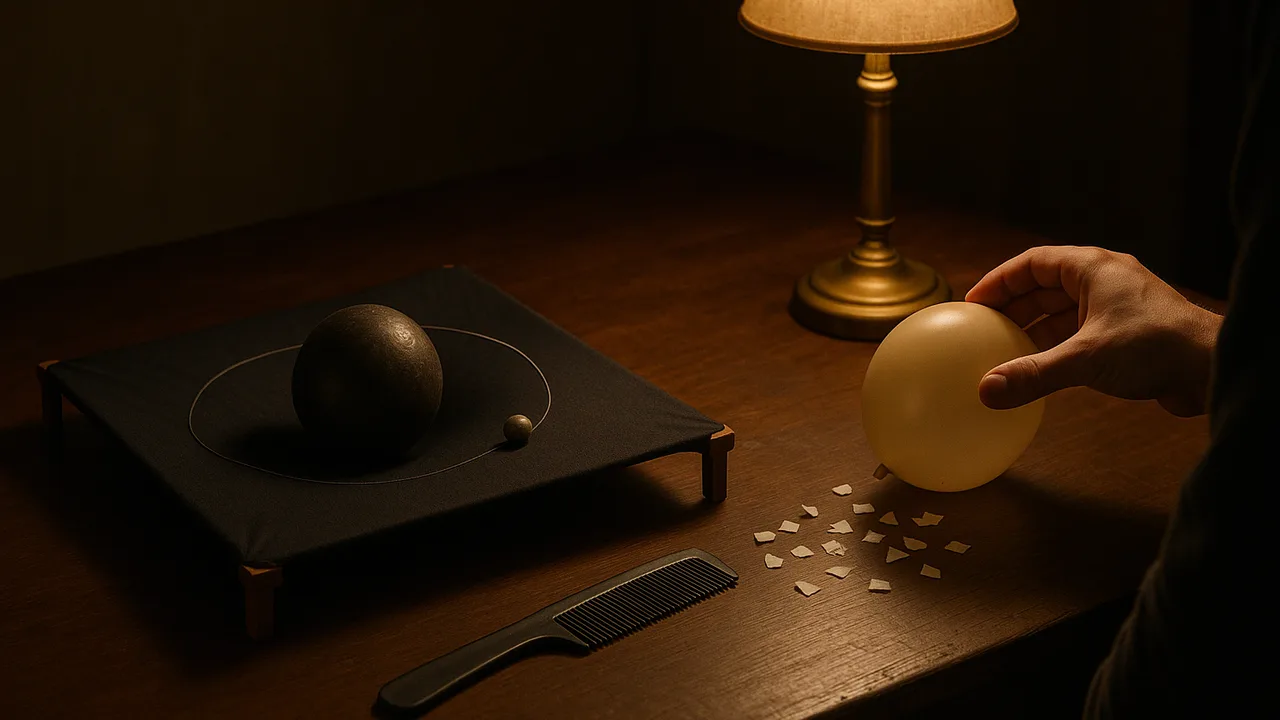
Do Now. Rub a balloon on your hair and hold it near a few bits of paper, then near the wall. Write what you see. How is this pull like gravity, and how is it different?
Two small charged spheres repel with 0.90 N when 10 cm apart. What is the force at 20 cm?
Instruction ~10 min
Revising our model. Our orbit model rests on one inverse-square force. Nature has a second one: the electric force that holds atoms together, makes balloons cling to walls and, in Unit 3, explained why foam pushes back. Comparing them shows what is special about gravity, and why it rules the motion of satellites.
Coulomb’s law. Two point charges q1 and q2 a distance r apart exert
Fe = kq1q2/r2, k = 8.99 × 10⁹ N·m2/C2
Charge comes in two signs. If q1q2 is positive (like charges), Fe is positive and the force is repulsive; if it is negative (opposite charges), Fe is negative and the force is attractive. Compare gravity, written Fg = −Gm1m2/r2: mass has only one sign, so the result is always negative, always attractive.
Worked example 1: electric forces. Two +1.0 µC charges 0.10 m apart: Fe = (8.99 × 10⁹)(1.0 × 10⁻⁶)2/0.102 = +0.899 N, repulsive. At 0.20 m it is 0.225 N, one quarter. A +2.0 µC and a −3.0 µC charge 0.30 m apart: Fe = (8.99 × 10⁹)(2.0 × 10⁻⁶)(−3.0 × 10⁻⁶)/0.302 = −0.599 N, attractive.
Worked example 2: the ratio does not depend on distance. Two protons (mass 1.673 × 10⁻²⁷ kg, charge 1.602 × 10⁻¹⁹ C) both attract gravitationally and repel electrically. Divide one law by the other: Fe/Fg = ke2/(Gmp2) = 1.2 × 1036. The r2 cancels, so the ratio is the same at every distance. In a hydrogen atom the electric attraction between the electron and proton is about 8.2 × 10⁻⁸ N, while their gravitational attraction is about 3.6 × 10−47 N.
So why does gravity run the solar system? Because large objects are almost perfectly neutral. A planet holds equal amounts of positive and negative charge, so electric forces cancel over large distances, while every kilogram adds to gravity. Electric forces dominate inside materials; gravity dominates between planets and satellites.
Energy and distance. When objects that attract move apart, the system’s potential energy rises; when they come together, it falls and kinetic energy can rise. For gravity, Ug = −GMm/r. Raising a 1,000 kg satellite from the ISS radius (6,791 km) to 7,071 km increases its gravitational potential energy by GMm(1/r1 − 1/r2) = 2.3 × 10⁹ J, energy the rocket must supply. For charges, Ue = kq1q2/r: two +1.0 µC charges store 0.090 J at 0.10 m and 0.045 J at 0.20 m, so if they are released they fly apart and the 0.045 J difference becomes kinetic energy. Opposite charges behave like gravity: energy falls as they approach.
| Gravity | Electric force | |
|---|---|---|
| Law | Fg = −Gm1m2/r2 | Fe = kq1q2/r2 |
| Source | Mass (always positive) | Charge (+ or −) |
| Direction | Always attractive | Like charges repel; opposite attract |
| Distance | 1/r2 | 1/r2 |
| Where it dominates | Planets, moons, satellites | Atoms, materials, contact forces |
Claim, evidence, reasoning. Sentence starters: I claim that … / The evidence is … (calculations, the Moon test, the ratio) / This happens because … (inverse-square law, sign of mass or charge) / Someone might argue …, but …
Ideate. The client needs an orbit plan. Every idea must use what the model says about altitude, speed and period. Example ideas: one low polar satellite; a constellation of several low satellites in one or more planes; one geostationary satellite for constant watch; a hybrid of geostationary watch plus low satellites for detail; a lower orbit for sharper images, accepting more drag. Brainstorm rule: quantity first, judge later.
Guided Exercises ~15 min
Use the comparison table and the worked examples.
Independent Practice ~10 min
Ideate for the client.
Brainstorm at least five orbit plans for the fire-watch system. For each, give the altitude or altitudes, use your spreadsheet to find the period and orbits per day, and name one criterion it serves well and one it serves poorly. Circle the three your team will compare in the Build phase.
Revise your Wonder Board: mark which questions you can now answer and write one new question today's comparison raised.
Closure ~5 min
We have a revised model and a list of orbit ideas. Next phase: test them in the simulation and choose.
Exit ticket: two masses and two charges each move from 1 m apart to 3 m apart. By what factor does each force change? Which force could change direction if one object were swapped, and why?
How confident are you that you can I can compare gravitational and electric forces with their formulas and explain how force and energy change with distance.
Teacher notes
Materials: balloons, paper bits, calculators, chart paper for CERs and the brainstorm.
Setup: this lesson adds the electrostatic half of HS-PS2-4, which the Poly unit did not cover. Constants are standard values (k, e, proton mass, G).
Listen for: “negative force means smaller force”; assuming the force ratio depends on distance; treating potential energy signs as magnitudes.
Support / stretch: give a two-column formula card. Stretch: find the distance at which the electric repulsion between two +1.0 µC charges equals the weight of a 10 g object.