1.02 Project Brief and Wonder Board: Time to Stop
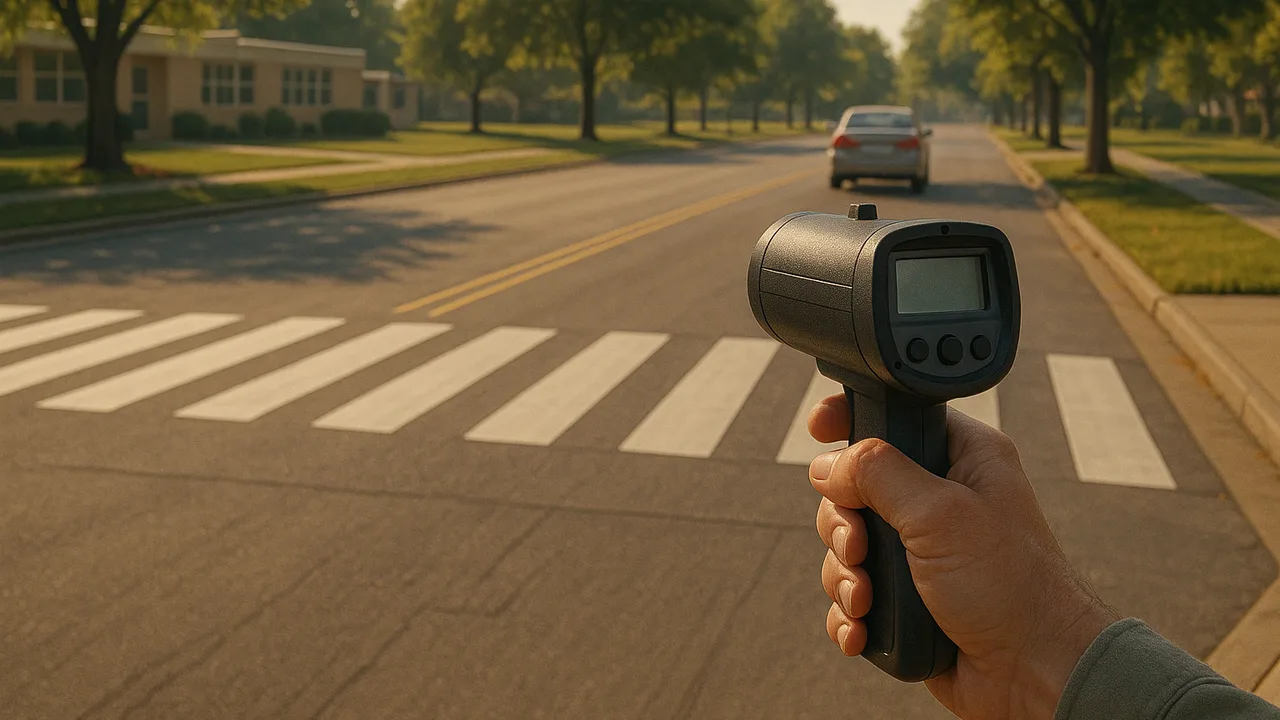
Time to Stop: Safer Crossings
How long should a yellow light last, and how fast should cars go near a school crosswalk, so that every driver can stop in time?
The mystery: A crossing guard steps into a school-zone crosswalk as a car approaches at 25 mph, and a signal down the street turns yellow: can each driver stop in time? Client: a city transportation department’s school-safety team.
Questions we will figure out together in this unit:
- How far does a car travel before the driver even touches the brake?
- Does doubling the speed double the stopping distance?
- How hard can a car brake on dry pavement, and on wet?
- Who decides how long a yellow light lasts, and how?
- Why do some streets near schools have lower speed limits?
- Does a heavier car take longer to stop?
- Can a phone video measure acceleration accurately?
- What happens if a driver is distracted for one second?
describe the school-crossing problem as an engineering problem, identify the driver-car-road system, and list the needs of the people it affects.
- I can describe a major global problem and explain why it is a significant challenge for society or the environment.
- I can use both qualitative and quantitative information to explain how serious the problem is and what could happen locally and globally if it is not solved.
- I can find and document background research about the problem from at least two sources, including research journals.
- I can identify the physical system where the problem exists, including its main parts, how they interact, and what is inside or outside the system boundaries.
- I can describe the needs and wants of society that relate to the problem.
Phase 1: Spark
Warm-Up ~5 min
Do Now. Read the client’s letter below. Underline every number and circle every person or group it mentions.
Which statement is written as an engineering problem, not a complaint?
Instruction ~10 min
The client’s letter. “To the physics class: Our city’s transportation department has a school-safety team. Parents have asked us to review two places near your school. At a mid-block crosswalk, parked cars hide children until a driver is fairly close. At a signalized corner, drivers complain that the yellow light is too short to stop. We need a recommendation we can defend at a public meeting: a yellow-light duration for the corner, or a speed limit for the crosswalk, backed by physics. — The School-Safety Team”
Driving question. How long should a yellow light last, and how fast should cars go near a school crosswalk, so that every driver can stop in time?
Why the problem is significant. Engineers describe a problem with both qualitative and quantitative information. Qualitatively: pedestrians, especially children, have no protection in a collision, and a driver who cannot stop has no good choice. Quantitatively (from the illustrative table in 1.04): at 25 mph a stop takes about 26 m, and at 35 mph about 41 m. A crosswalk visible from only 30 m works at one speed and fails at the other. Locally, that means one crossing; globally, road crashes are among the leading causes of death for young people, so methods that make crossings safer matter everywhere.
Worked example 1: the system. Mei maps the system. Inside the boundary: the driver (perception and reaction), the car (brakes and tires), the road surface, the crosswalk, the signal timing and the sight line. Outside the boundary but acting on it: weather, parked cars, school start times and traffic volume. Interactions: the driver sees the hazard, reacts, applies the brakes; friction between tires and road slows the car; the sight line sets how much distance is available.
Worked example 2: needs and wants. Jamal lists stakeholders. Families need children to cross safely. Drivers want predictable signals and reasonable travel times. Bus operators need schedules that work. The city needs a low-cost change that follows federal signal guidance. Some needs conflict: a longer yellow or a lower limit improves safety but slows traffic. Good designs name those trade-offs openly.
Background research. Strong problem statements cite at least two sources. In this unit you will use the OpenStax Physics (high school) chapters 2, 3 and 5 and OpenStax College Physics 2e chapters 2–3 for motion, the federal Manual on Uniform Traffic Control Devices (MUTCD) for signal guidance, and your own measured data.
Teams and roles. Teams of four rotate roles each phase: Project Manager (keeps the timeline and the criteria list), Data Analyst (runs calculations and graphs), Modeler (builds the stopping-distance spreadsheet), Communicator (writes and presents to the client).
Guided Exercises ~15 min
Work in your new team. Build the Wonder Board as you go.
Independent Practice ~10 min
Write the team’s problem statement and need-to-knows.
Write a problem statement for the client in three or four sentences. Name who is affected, what happens, one qualitative and one quantitative reason it matters, and what kind of solution the city wants.
List five need-to-knows (for example: How long is a driver's reaction time? How hard can a car brake on wet pavement?). Star the two your team thinks matter most.
Closure ~5 min
The project is launched. Next, we measure acceleration ourselves in the ramp lab.
Exit ticket: name the system's boundary and one need from two different stakeholders. Which need would you protect first, and why?
Teacher notes
Materials: printed client letter, chart paper for the Wonder Board and system diagrams, role cards.
Setup: the client and sites are generic. If a local official or school resource officer can visit or send a short video, it strengthens the launch.
Listen for: problem statements with no user or no measurable goal; systems that leave out the driver.
Support / stretch: provide the frame “___ is affected when ___, so the city needs ___.” Stretch: add a second system boundary that includes nearby intersections and explain what changes.