2.09 Performance Task: Design a Runaway-Truck Escape Ramp
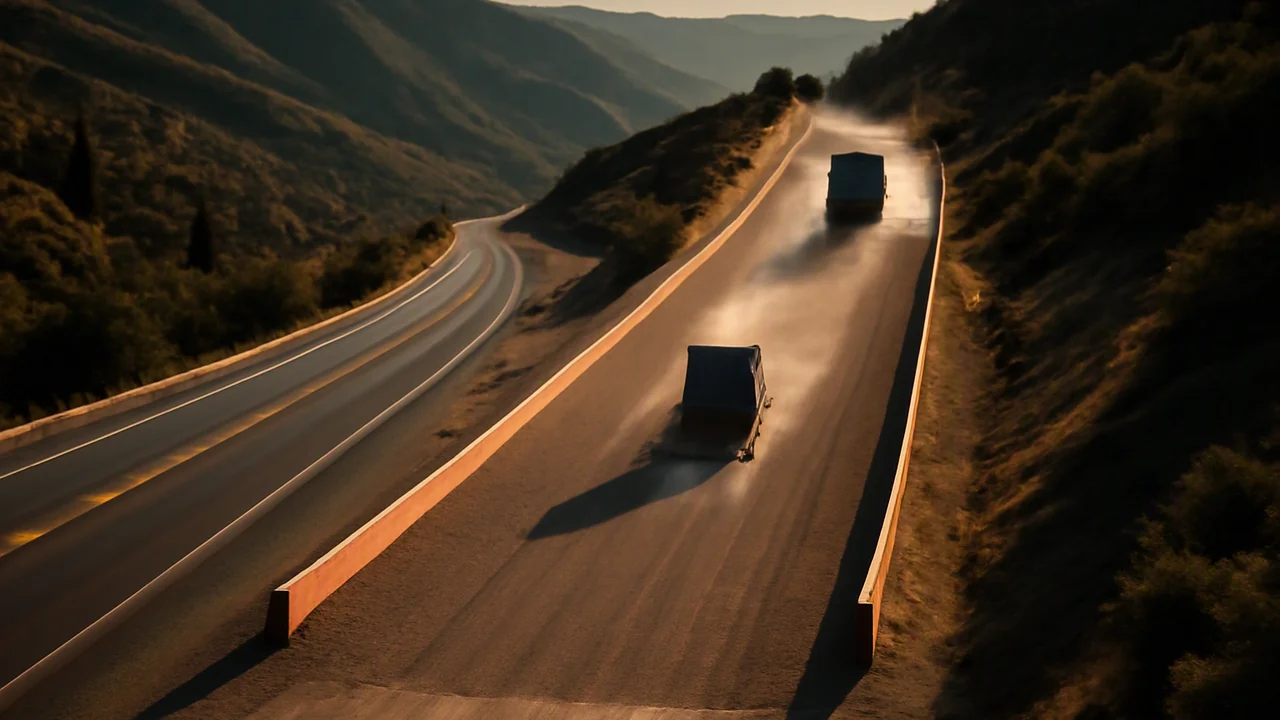
break the design of a runaway-truck escape ramp into sub-problems, model each with Newton’s second law and kinematics, and recommend and defend a ramp design with a sensitivity analysis.
- I can break down a complex real-world problem into two or more smaller sub-problems and show this in writing, a diagram, or a flow chart.
- I can explain how solving the sub-problems helps address the larger problem and describe how the solutions to the sub-problems are connected.
- I can express that a net force on an object causes the object to accelerate, using the relationship Fnet = ma.
Phase 5: Prove It
Warm-Up ~5 min
Do Now. Write the four sub-problems from memory and the one equation that links two of them.
At 35.76 m/s on a bed that decelerates trucks at 2.94 m/s2, the stopping length is m and the stop takes s.
Instruction ~10 min
The design problem. The highway department is considering a new runaway-truck escape ramp beside a long, steep mountain highway grade (you choose the site from three in the task, or supply numbers you can source). Your job is to recommend the ramp’s grade, bed material and length, and to justify them with a Newton’s-law model. Real escape ramps are designed by engineers using published highway design guidance; this is a model of their reasoning, not a substitute for it.
Break the problem into sub-problems (HS-ETS1-2). (1) Design speed: how fast will a runaway truck be moving when it reaches the ramp? (2) Deceleration: what grade and bed material will slow it, and how hard is too hard for the driver and the load? (3) Length: how long must the bed be, with what safety margin? (4) Site constraints: how much land is available, and how steep can the terrain be built? Solve each part with the physics, then check that the parts fit together.
A worked design (illustrative values). Design speed: 80 mph = 35.76 m/s. Grade: 5% up (θ = 2.86°). Bed: loose gravel with μ = 0.25.
- Deceleration: a = 9.8(sin 2.86° + 0.25 cos 2.86°) = 2.94 m/s2, about 0.30g. That is firm but survivable for a belted driver.
- Stopping length: L = 35.762/(2 × 2.94) = 218 m.
- Stopping time: t = v/a = 12.2 s.
- Safety factor: the gravel may be compacted or wet, and the truck may be faster than the design speed, so multiply by 1.25: a design length of about 272 m.
Criteria and constraints. Criteria are what success means: the design truck stops within the bed; deceleration stays below a value you justify; the driver can see and steer into the entrance. Constraints are limits: available length of land, construction cost, how steep the terrain allows, and maintenance (gravel must be raked loose after every use). Trade-offs are unavoidable. A steeper grade shortens the ramp but a truck that stops on it can roll backward, which is one reason real ramps use deep loose beds and why towing is needed after every use.
Test your model. Change one assumption at a time: entry speed ±10 mph, μ from 0.20 to 0.30, grade from 0% to 10%. Which assumption changes the length most? A model you understand is one whose sensitivities you can state.
Limits of the model. Real gravel beds decelerate a truck mainly by letting its wheels sink and plow, which is not exactly sliding friction, and the resistance grows as the wheels sink. That is why μ here is an effective coefficient. Say so in your report.
Guided Exercises ~15 min
Check your method on Site A before you design.
Independent Practice ~10 min
Draft, review and revise across the three sessions.
Peer review: redraw your partner's free-body diagram, recompute the deceleration and length, and challenge one assumption in writing.
Final: submit your 1,000–1,400 word report and present or record your five-minute defense.
Design Report: A Runaway-Truck Escape Ramp
Task: Recommend a design for a runaway-truck escape ramp beside a steep mountain highway grade for the highway department’s design team. Break the problem into at least four sub-problems and solve each with the physics from this unit: a free-body diagram of a truck on your ramp, the deceleration from Newton’s second law, the stopping length and time from kinematics, and a safety factor you justify. State every input and its source or label it illustrative. Graph how your ramp length changes with one assumption (entry speed, grade or μ), explain the trade-offs between grade, length, cost and safety, and state the limits of the friction model for a gravel bed. Safety: never collect data on or beside a highway.
Choose one site. All three earn full credit and are the same difficulty. The inputs are illustrative values, chosen so that each site is a different design problem. You may replace any of them with a value you can source, and if you do you must say which one and cite it.
| Site | Downgrade | Design entry speed | Ramp grade available | Bed, effective μ | Land available |
|---|---|---|---|---|---|
| A | A long interstate downgrade over a high mountain pass | 80 mph = 35.76 m/s | up to 5% up | loose gravel, 0.25 | about 300 m |
| B | A two-lane state route over a mountain pass | 65 mph = 29.06 m/s | up to 8% up | coarse sand, 0.30 | about 180 m |
| C | A steep interstate grade descending through a canyon pass | 60 mph = 26.82 m/s | up to 10% up | loose gravel, 0.25 | about 150 m |
Site A is the worked example in the lesson, so use it to check your method: a = 2.94 m/s2, L = 218 m, t = 12.2 s, and 272 m with a 1.25 safety factor, which fits the land. Sites B and C also fit their land at a 1.25 factor, so if yours does not, check how you converted the grade into an angle. The table gives every input; no map work is required.
Submission workflow
- Stage 1, Plan: site and scenario, the list of sub-problems, your criteria and constraints (at least three of each), and the equations you will use with every input and its source.
- Stage 2, Peer-reviewed draft: a partner redraws your free-body diagram, recomputes your deceleration and length, and challenges one assumption; submit their notes and your revision plan.
- Stage 3, Revised final: 1,000–1,400 words with the free-body diagram, calculations, a sensitivity graph, the trade-offs and a clear recommendation.
- Stage 4, Presentation or defense: five minutes, live or recorded (equal credit): your design, the evidence for it, one trade-off, and answers to two questions about your model.
How it is scored
| Criterion | What proficient looks like |
|---|---|
| Problem decomposition (HS-ETS1-2) | Breaks the design into clear sub-problems, states criteria and constraints for each, solves them in a justified order and shows how the solutions fit together. |
| Force model (HS-PS2-1) | Correct free-body diagram and Newton’s-second-law deceleration with components on the grade. |
| Mathematical reasoning | Correct stopping length, time and safety factor with units; numbers are checked. |
| Sensitivity and trade-offs | Tests how the design responds to changed assumptions and justifies which criteria win when grade, length, cost and safety conflict. |
| Sources and limits | Every input sourced or labeled illustrative; limits of the friction model stated. |
| Defense | Explains the design clearly and answers questions with reasoning from the model. |
Closure ~5 min
Your recommendation goes to the design team. Next: the unit checkpoint.
Exit ticket: which Wonder Board question can you now answer with a number? Write the question and your answer.
How confident are you that you can I can break an engineering problem into sub-problems and use Newton's laws to design and defend a solution.
Teacher notes
Timing: three sessions, as in Poly: plan; peer-reviewed draft; final and defense.
Materials: rubric copies, the site table, devices or graph paper.
Setup: invite a staff member or volunteer to play the highway design team. Site descriptions are generic and all inputs illustrative. Check values: Site B a ≈ 3.71 m/s2, L ≈ 114 m, 142 m designed; Site C a ≈ 3.41 m/s2, L ≈ 105 m, 132 m designed.
Listen for: grade read as degrees; safety factor dropped to fit the land; no limits stated for the friction model.
Support / stretch: a report outline with headings. Stretch: model a bed whose μ rises as the wheels sink (two zones) and compare lengths.
Reading: OpenStax Physics (high school), chapters 4 and 5.