3.06 Why Foam Pushes Back: Forces Between Molecules, Model Revision and Ideate
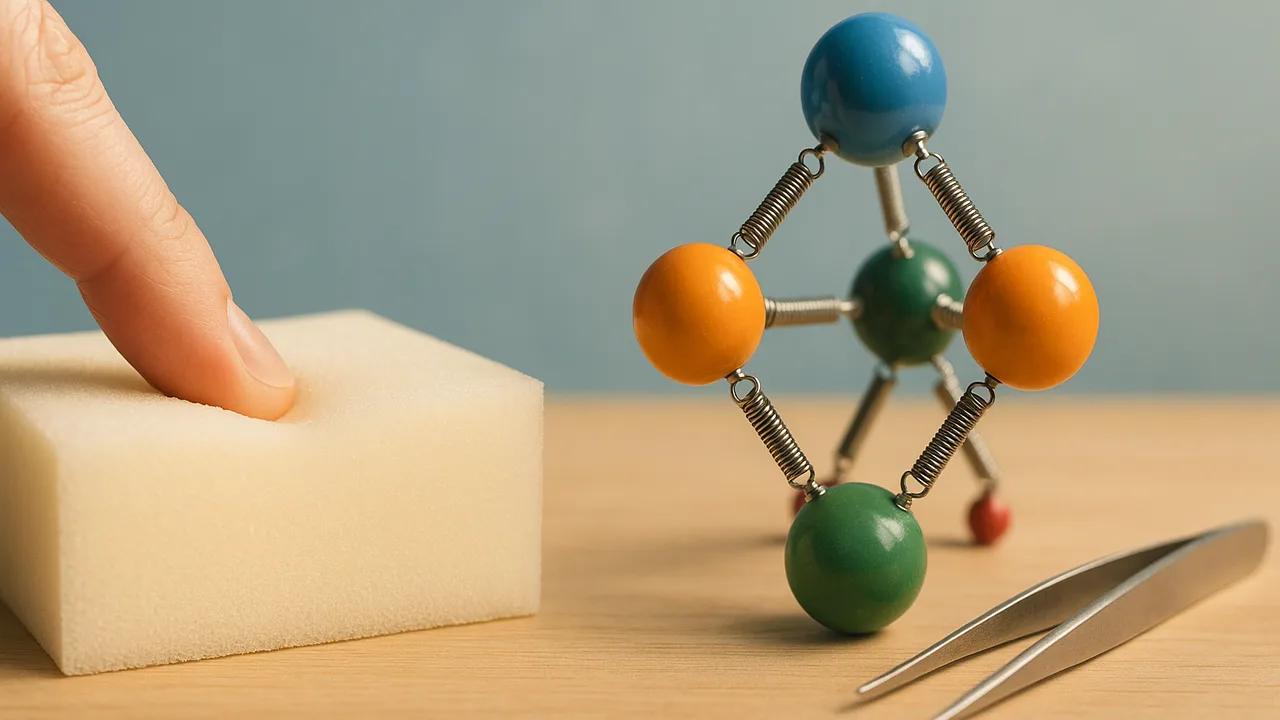
explain how electrical forces between atoms and molecules give a material its structure and its contact forces, revise our impact model, and brainstorm liner designs for the client.
- I can describe how attractive and repulsive electrical forces between molecules affect the arrangement and structure of a designed material, such as whether it forms a solid, liquid, gas, network solid, or polymer.
- I can describe how electrostatic forces at the atomic and molecular scale result in contact forces like friction, normal forces, or stickiness that we observe on the macroscopic scale.
- I can use mathematical models to describe how the momentum of each object changes during their interaction.
Phase 3: Make Sense
Warm-Up ~5 min
Do Now. Look back at your 3.01 Do Now sentence. Rewrite it using the words impulse and stopping time. Then answer a new question: when an egg presses on foam, what actually pushes back on the egg, at the scale of atoms?
When you push on a wall, the wall's atoms and your hand's atoms never quite touch; the push you feel is an electrical repulsion between their electron clouds.
Instruction ~10 min
Revising our model. So far our impact model is “stopping distance sets stopping time, and stopping time sets the average force.” Today we ask why a material pushes back at all, and why different materials push back so differently. The answer is electrical.
Contact forces are electrical forces. Every atom has a positive nucleus surrounded by negative electrons. When two surfaces are pressed together, their outer electron clouds come very close and repel strongly, which we feel as the normal force. Where surfaces stick for an instant and are dragged apart, attractions between atoms show up as friction; where they stick for good, as adhesion (tape). The force from the foam on the egg, from the road on a tire and from the floor on your feet all come from electrostatic forces at the atomic scale.
Structure from attraction and repulsion. Whether a substance is a gas, liquid, solid, network solid or polymer depends on how strongly its particles attract compared with how fast they move. Atoms and molecules attract at moderate distances and repel when pushed too close, so each settles at a preferred spacing.
| Material | Particles and forces | Structure | Behavior in an impact |
|---|---|---|---|
| Diamond, glass | Strong covalent bonds in a 3-D network | Rigid network solid | Very stiff; cracks instead of bending (tiny stopping distance) |
| Steel | Metal ions in a sea of free-moving electrons | Crystal grains that can slip | Bends and stays bent; a folded rail crumples steadily |
| Rubber | Long chains joined by occasional cross-links | Coiled chains that straighten and recoil | Stretches and springs back (bounce) |
| Polystyrene (EPS) | Long chains held by weaker attractions between chains | Tangled glassy chains in thin cell walls | Cells buckle and stay crushed |
| Air in the cells | Molecules far apart, weak attractions | Gas | Compresses easily; leaks out of a crushed cell |
Worked example 1: two chains, two functions. Rubber and polystyrene are both polymers. In rubber, cross-links (covalent bonds between neighboring chains) act like anchor points: stretch it and the chains straighten, let go and the electrical forces pull them back into coils. In EPS there are no cross-links; chains are held only by weaker attractions between molecules and are frozen in place at room temperature. Push hard enough and they slide and fold into new positions instead of recoiling. Same kind of molecule, different arrangement, opposite function.
Worked example 2: tracking momentum through the impact. A 60 g egg lands at 4.43 m/s on a liner and stops in 13.6 ms. Its momentum falls from 0.266 kg·m/s to 0 at an average rate of 0.266/0.0136 = 19.6 kg·m/s per second, which is the 19.6 N average force. Meanwhile the liner and Earth gain exactly 0.266 kg·m/s downward: Earth’s mass is so large that its change in velocity is far too small to notice. As a mathematical model, pegg(t) = 0.266 − 19.6t during the crush, and pEarth(t) = 19.6t, so their sum stays 0.266 kg·m/s at every instant.
Claim, evidence, reasoning. Sentence starters: I claim that … / The evidence is … (crush distances, forces, material behavior) / This happens because … (forces between molecules; impulse) / Someone might argue …, but …
Ideate. The client needs a liner, not just an explanation. Every idea must change a term in F = mv2/(2d) or the shape of the force-distance curve. Example ideas: a thicker crush layer (larger d); two layers, soft over firm, so small and large hits both crush; a honeycomb or straw array that crushes at a flat plateau; trapped-air cells (a “bubble” liner) that can be reused; a corrugated-card cone pattern. Brainstorm rule: quantity first, judge later.
Guided Exercises ~15 min
Use the structure table and the momentum model.
Independent Practice ~10 min
Ideate for the client.
Brainstorm at least five liner concepts for the scale-model test. For each, sketch it, name its material and structure, and say which term of F = mv2/(2d) (or which feature of the force-distance curve) it changes. Circle the three your team will prototype.
Revise your Wonder Board: mark which questions you can now answer and write one new question the molecular model raised.
Closure ~5 min
We have a revised model and a list of ideas. Next phase: design, prototype and choose.
Exit ticket: explain how attractive and repulsive electrical forces between particles decide whether a material is a gas, a rubbery polymer or a rigid network solid, with one example of each.
How confident are you that you can I can explain how forces between atoms and molecules give a material its structure, its contact forces and its behavior in an impact.
Teacher notes
Materials: samples of EPS, rubber, a steel paper clip and glass (a microscope slide, handled with care), chart paper for CERs and the brainstorm.
Setup: keep chemistry at the level of HS-PS2-6: structure explains function. Molecular diagrams can be simple chain sketches.
Listen for: “the atoms touch”; “foam is soft because it is weak”; treating Earth as receiving no momentum.
Support / stretch: give the CER starters on a card. Stretch: explain why a rubber ball bounces lower on a very cold day, in terms of chain motion.