2.02 Project Brief and Wonder Board: The Escape Ramp
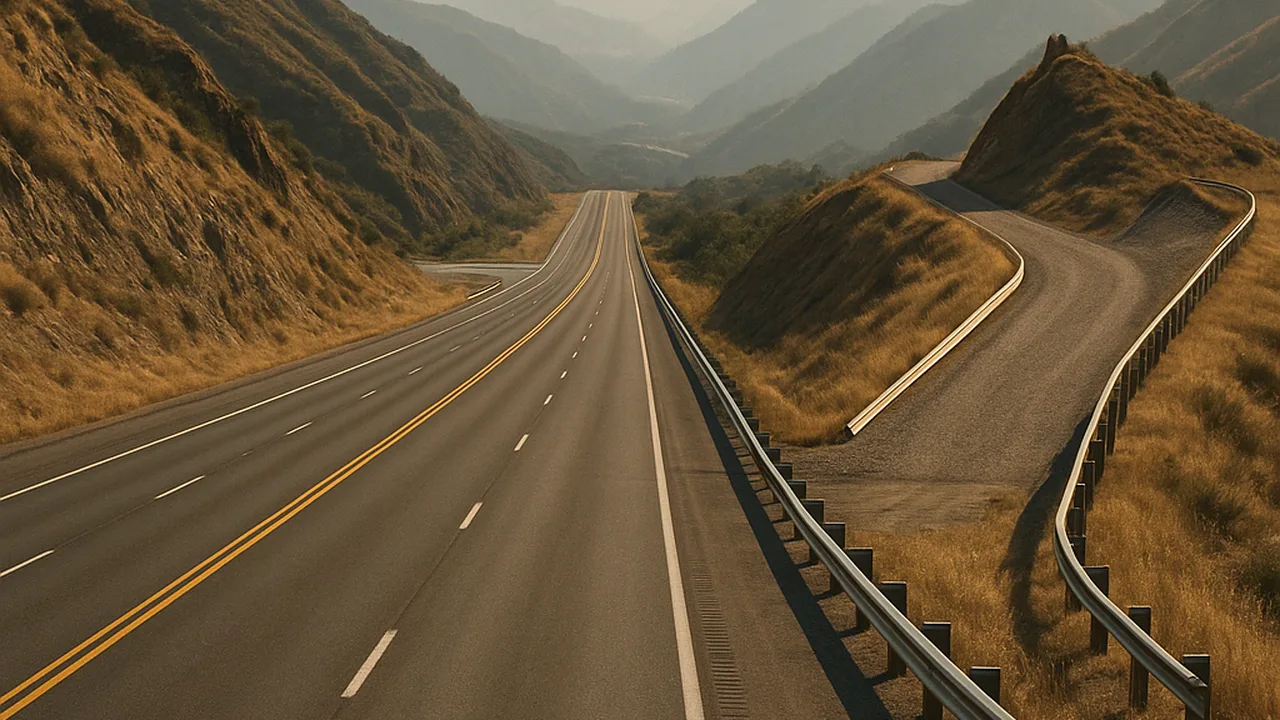
The Runaway-Truck Escape Ramp
How should a highway department design an escape ramp that safely stops a truck whose brakes have failed on a steep mountain highway grade?
The mystery: On a steep mountain highway grade, a loaded truck whose brakes have overheated keeps speeding up, while beside the road a lane of deep loose gravel climbs uphill: how can gravel stop a truck the brakes could not? Client: a state highway department’s design team.
Questions we will figure out together in this unit:
- Why do the brakes stop working on a long downhill?
- How can loose gravel stop a truck the brakes could not?
- Does a heavier truck need a longer ramp?
- Why do the ramps go uphill?
- How long does a ramp need to be?
- Does it matter if the gravel is wet or packed down?
- How hard is the stop for the driver?
- Who decides where a ramp goes?
break the escape-ramp design into sub-problems, describe the criteria and constraints for one of them, and organize the team’s need-to-knows.
- I can break down a complex real-world problem into two or more smaller sub-problems and show this in writing, a diagram, or a flow chart.
- I can describe the criteria that a solution for a selected sub-problem must meet, as well as any constraints or limitations.
Phase 1: Spark
Warm-Up ~5 min
Do Now. Read the client’s letter. List every number you see and every word that sounds like a limit.
An escape ramp is too complex to design all at once. What do engineers do first?
Instruction ~10 min
The client’s letter. “To the physics class: Our highway department is planning a new runaway-truck escape ramp beside a long, steep mountain highway grade. We need a recommended grade, bed material and length for the ramp, with a clear explanation of the physics and the safety margin. Land beside the road is limited, and every ramp must be maintained after use. Please show your reasoning so our engineers can check it. — The Highway Design Team”
Driving question. How should a highway department design an escape ramp that safely stops a truck whose brakes have failed on a steep mountain highway grade?
Worked example 1: decomposing the problem. Ava’s team draws a flow chart with four sub-problems: (1) Design speed: how fast will a runaway truck be moving at the ramp? (2) Deceleration: what grade and bed material slow it, and how hard is too hard? (3) Length: how long must the bed be, with what safety margin? (4) Site: how much land is there, and how steep can it be built? Arrows show the links: the design speed and the deceleration together set the length, and the length must fit the site.
Worked example 2: criteria and constraints for one sub-problem. For Deceleration: criteria: stop the truck within the available bed; keep the deceleration firm but survivable for a belted driver (the team proposes about 0.3 g or less, an assumption to justify); the truck must not roll back. Constraints: available grades on the hillside, bed materials the department can buy, and raking the bed loose after every use.
Need-to-knows. How does a gravel bed slow a truck? Does a heavier truck need a longer ramp? What does “friction” depend on? How does the slope add to the stopping force? Each question maps onto a lesson ahead: the cart lab (2.03), the friction lab (2.04) and the incline model (2.05).
Teams and roles. Rotate each phase: Project Manager, Force Modeler (free-body diagrams), Data Analyst (graphs and spreadsheet), Communicator (report and defense).
Guided Exercises ~15 min
Build the team flow chart and Wonder Board as you work.
Independent Practice ~10 min
Record the brief in your notebook.
Choose one sub-problem. Write its criteria (at least two) and constraints (at least two), and the need-to-know questions you must answer to solve it.
Closure ~5 min
The problem is broken into parts. Next, we test Newton’s second law in the cart lab.
Exit ticket: name the four sub-problems and explain how solving one of them helps solve the whole ramp design.
Teacher notes
Materials: printed client letter, chart paper for flow charts and the Wonder Board, role cards.
Setup: the client and site are generic. If a civil engineer can visit or send a short video, it strengthens the launch.
Listen for: sub-problems that are just steps (“buy gravel”) rather than problems; flow charts with no links.
Support / stretch: provide a four-box flow-chart frame. Stretch: add a fifth sub-problem (signs and the driver’s view of the entrance) and link it.