3.10 Unit 3 Checkpoint: Momentum, Impulse and Designed Materials
show what I learned about momentum and its conservation, impulse and collision-force design, and how a material’s molecular structure sets its function.
- I can use calculations of total momentum to support the claim that the system’s momentum is the same before and after the interaction.
- I can design a device that reduces the force on an object during a collision by increasing the time over which the collision occurs.
- I can explain how changing the collision time affects the force on an object, using the relationship FΔt = mΔv.
- I can apply the idea of increasing collision time to make sure my device reduces the net force on the object.
- I can identify and explain how the molecular-level structure and atomic interactions of a designed material determine its function.
- I can communicate how the properties of a material make it suitable for its intended use.
Phase 5: Prove It
Warm-Up ~5 min
Do Now. Back to our phenomenon: a few centimeters of foam protect a rider’s head. In two sentences, explain why, using impulse and one word about the foam’s structure.
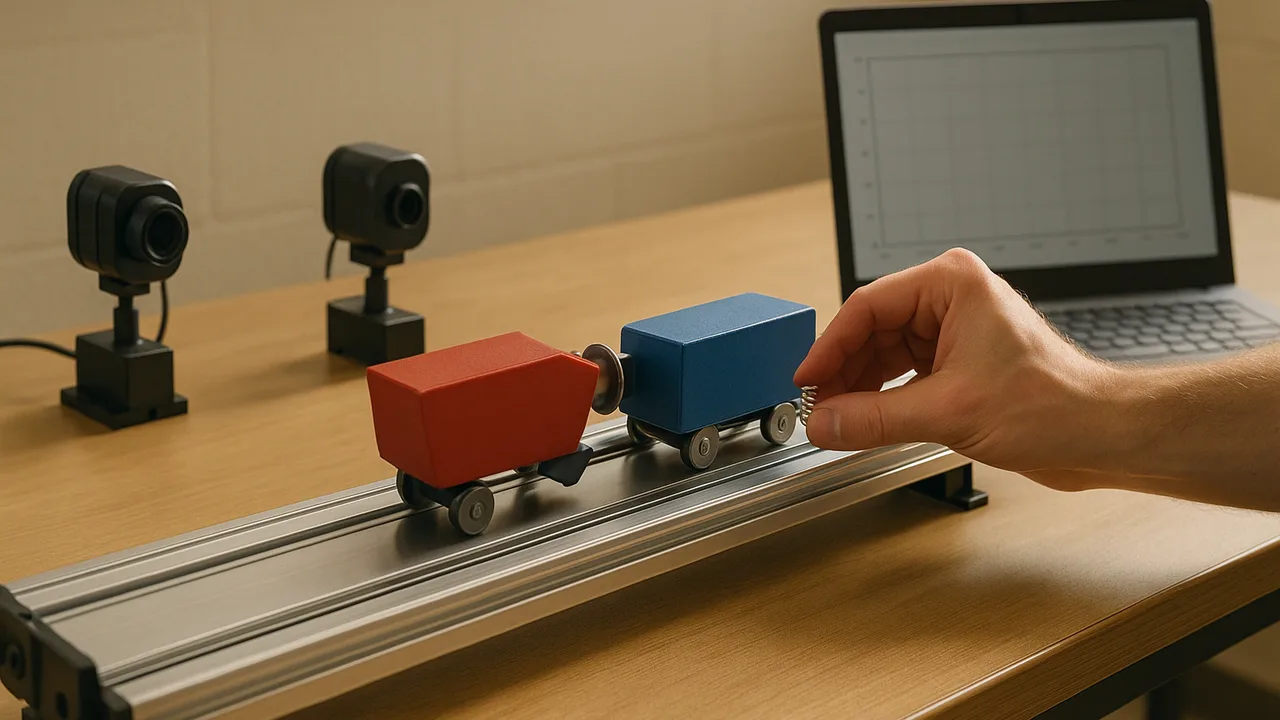
In an inelastic collision of two carts on a level track, momentum is lost.
Instruction ~10 min
Physicists, this is the unit checkpoint. Part A is multiple choice with data and a scenario set where several questions share one situation. Part B is four short constructed responses scored 0–3. Show units, signs and reasoning.
How a 0–3 answer is scored. 3: a correct claim, accurate evidence or calculation with units, and reasoning that names the physics or design idea. 2: correct claim and evidence with weak or missing reasoning, or one small error. 1: a partly correct claim with little support. 0: incorrect or blank.
Worked example: from 2 points to 3. Question: “Why does a goalkeeper pull the hands back while catching?” “So it hurts less” earns 1. “It makes the catch take longer” earns 2. Ava wrote: “The ball’s change in momentum is fixed, and F = Δp/Δt, so stretching the stopping time lowers the average force on the hands.” That earns 3.
Data for questions 1–5 (sample data). Carts on a level, low-friction track; positive is to the right.
| Trial | Type | mA (kg) | vA (m/s) | mB (kg) | vB (m/s) | v′A (m/s) | v′B (m/s) |
|---|---|---|---|---|---|---|---|
| 1 | stick | 0.80 | +0.50 | 0.40 | 0 | +0.33 | +0.33 |
| 2 | bounce | 0.50 | +0.60 | 0.50 | −0.20 | −0.20 | +0.60 |
| 3 | stick | 1.00 | +0.40 | 0.50 | −0.20 | ? | ? |
Scenario set for questions 8–12 (illustrative). The bike-share youth-safety team compares two liners in a lab drop test with a 5.0 kg headform landing at 5.0 m/s. Liner X is EPS foam that crushes 2.0 cm and stays crushed. Liner Y is a rubbery foam; the headform rebounds from it at 2.0 m/s. The program’s limits: each liner adds no more than 300 g and costs no more than a set amount per helmet.
Guided Exercises ~15 min
Part A: answer on your own. Your teacher reviews answers after everyone finishes.
Independent Practice ~10 min
Part B: constructed responses, each scored 0–3.
18. Trial 3: define the system and its boundary, give the initial conditions, calculate each cart's momentum and the total before and after, and show that each cart's change in momentum is balanced by the other's. Explain why the net external force on the system is essentially zero. (0–3)
19. Describe a device that reduces the force on a 60 g egg in a 1.5 m drop. Give a quantitative criterion and two constraints, calculate the crush distance needed to keep the average force under 20 N, justify your material and structure, and name one trade-off. (0–3)
20. Sample test log: version 1 (cup cage) crushed 2.4 cm at 1.0 m and the egg cracked; version 2 (straw array) crushed 4.9 cm and the egg survived, but it added 70 g. Evaluate both against the criteria and constraints, identify one unexpected effect, and propose and justify a version 3. (0–3)
21. Communicate why EPS foam suits a helmet liner in TWO formats: a labeled molecular and cellular diagram, and a written or graphical explanation. Include the material's function, how attractive and repulsive forces between its chains set its structure and its contact forces, and where your information comes from. (0–3)
Closure ~5 min
Finished. Unit 4 asks how a satellite can stay up without an engine.
Exit ticket: which question was hardest, and what idea do you want to practice next?
How confident are you that you can I can analyze collisions with momentum and impulse and explain how a designed material's structure sets its function.
Teacher notes
Materials: printed checkpoint with the data table and scenario, calculators, the 0–3 scoring guide.
Setup: about 35 minutes for Parts A and B, then a short review. Item tags: 1 PS2-2:1b, 3b; 2 PS2-2:2b; 3 PS2-2:2a, 2b; 4 PS2-2:3c, 2a; 5 PS2-2:3a; 6 PS2-2:1c; 7 and 8 PS2-3:1a; 9 PS2-3:1a, 1b; 10 PS2-6:2a, 2d; 11 PS2-3:2a; 12 PS2-3:4a, 3b; 13 PS2-6:2f; 14 PS2-6:2d; 15 PS2-6:2e; 16 PS2-6:2b; 17 PS2-6:2c; 18 PS2-2:1a, 1b, 1c, 2a, 2b, 3a, 3b, 3c; 19 PS2-3:1a, 1b, 2a; 20 PS2-3:3a, 3b, 4a; 21 PS2-6:1a, 2a, 2b, 2c, 2e, 2f. Use the tags to plan reteaching.
Listen for: dropped signs in momentum; “bouncy is safer”; material explanations with no structure.
Support / stretch: read items aloud on request and allow a formula card. Stretch: for item 9, estimate the average force on liner Y if the rebound contact also lasts 0.0080 s.