3.02 Project Brief and Wonder Board: Protect the Rider
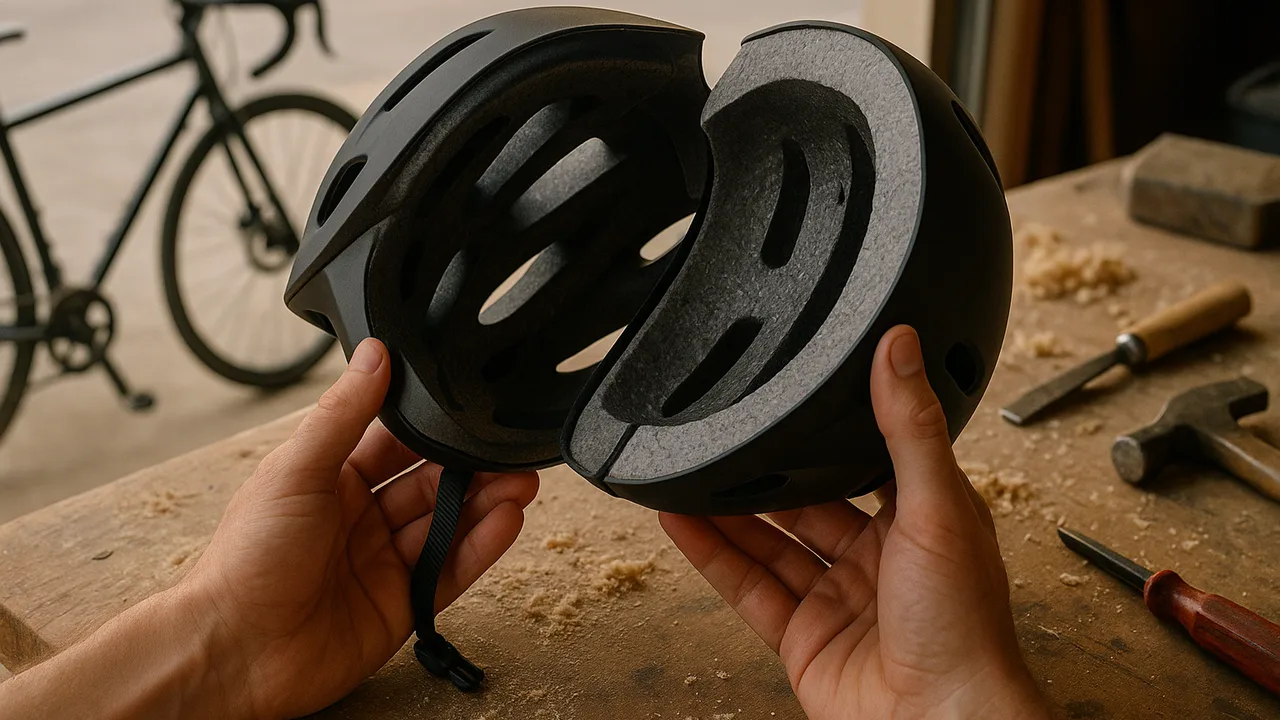
Protect the Rider: A Better Helmet Liner
How should a helmet liner be designed, and from what material, so that it keeps the force on a rider’s head as low as possible in a fall?
The mystery: Many communities require young riders to wear a helmet, and every new car carries crumple zones and airbags: how can a few centimeters of white foam make the difference when a head meets the pavement? Client: a community bike-share program’s youth-safety team.
Questions we will figure out together in this unit:
- How thick does a liner need to be to keep the force low enough?
- Why is helmet foam white and stiff instead of soft and squishy?
- Does a bouncy material help or hurt the rider?
- Why must a helmet be replaced after one crash?
- Do heavier objects hit harder when they fall the same height?
- Where does the energy go when foam crushes?
- Can a phone video measure a collision that lasts a few milliseconds?
- Is a reusable liner ever as safe as a single-use one?
describe the helmet-liner problem as an engineering problem, define the head-liner-ground system and its initial conditions, and list the criteria, constraints and trade-offs the client cares about.
- I can define the boundaries and initial conditions of a system made up of two interacting objects.
- I can describe and, when possible, quantify the criteria and constraints for my device, including tradeoffs such as cost, mass, maximum force, and safety requirements.
Phase 1: Spark
Warm-Up ~5 min
Do Now. Read the client’s letter below. Underline every number and circle every person or group it mentions.
Which statement is written as an engineering problem, not a complaint?
Instruction ~10 min
The client’s letter. “To the physics class: Our city’s community bike-share program lends a free helmet with every ride to riders aged 14 to 18. Helmets come back dropped, sat on and left in the sun, and a liner that has taken a hard hit must be thrown away. Before we order 500 new loaner helmets, we want an independent recommendation: what liner thickness and material keep the force on a rider’s head lowest in a typical fall, and is a cheaper or reusable option good enough? Please test scale models and send us a report we can share with families. — The Youth-Safety Team”
Driving question. How should a helmet liner be designed, and from what material, so that it keeps the force on a rider’s head as low as possible in a fall?
Worked example 1: defining the system. Mei draws the system for one fall. Inside the boundary: the head (mass about 5 kg, illustrative), the liner and shell, and the small patch of ground it hits. Initial conditions just before contact: the head’s speed and direction (for example 6.0 m/s straight down, so p = 30 kg·m/s), the liner’s thickness and its temperature. Outside the boundary but acting on it: Earth’s gravity, the rider’s neck and body, and the weather. During the very short impact, the force from the ground is far larger than any of the outside forces, which is why we can model the collision with impulse alone.
Worked example 2: a scale model. Testing real heads is impossible and testing real helmets takes a certified lab, so the class tests a scale model: a 60 g raw egg is the “head,” and the liner is a crush zone the team designs. Dropped from 1.0 m, the egg lands at √(2 × 9.8 × 1.0) = 4.43 m/s with momentum 0.266 kg·m/s. The physics, F = Δp/Δt, is the same at both scales, so lessons from the egg carry over to the liner.
Criteria, constraints and trade-offs. Criteria (what success means): the egg survives; the average force is as small as possible; the liner is light and thin enough to wear. Constraints (limits): at most 100 g of added material, no more than 25 cm on any side, everyday low-cost materials, and goggles at every test. Trade-offs: a thicker liner lowers the force but adds mass and bulk riders may refuse to wear; a reusable material saves money and waste but may bounce more. The client cares about all of them.
Teams and roles. Teams of four rotate roles each phase: Project Manager (timeline and criteria list), Test Engineer (runs drops and films them), Data Analyst (momentum, impulse and force calculations), Communicator (writes and presents to the client).
Guided Exercises ~15 min
Work in your new team. Build the Wonder Board as you go.
Independent Practice ~10 min
Write the team’s problem statement and need-to-knows.
Write a problem statement for the client in three or four sentences. Name who is affected, what must happen, one quantitative criterion and one constraint, and one trade-off the program must accept.
List five need-to-knows (for example: How long does foam take to crush? Does a bouncy material help or hurt?). Star the two your team thinks matter most.
Closure ~5 min
The project is launched. Next, we test whether momentum is conserved when objects collide.
Exit ticket: name the system's boundary and its initial conditions for the egg-drop model, and one criterion and one constraint. Which trade-off worries you most, and why?
Teacher notes
Materials: printed client letter, chart paper for the Wonder Board and system diagrams, role cards, one or two retired helmets to pass around.
Setup: the client and its numbers are generic and illustrative. If a local bike shop, bike-share program or school nurse can send a short video, it strengthens the launch.
Listen for: problem statements with no measurable goal; systems that leave out the ground; initial conditions given as speeds with no direction.
Support / stretch: provide the frame “___ need a liner that ___, without ___.” Stretch: estimate the head’s speed after a 1.5 m fall from a bike seat and its momentum.