2.07 Prototype Day: A Scale-Model Arrester Bed and a Decision Matrix
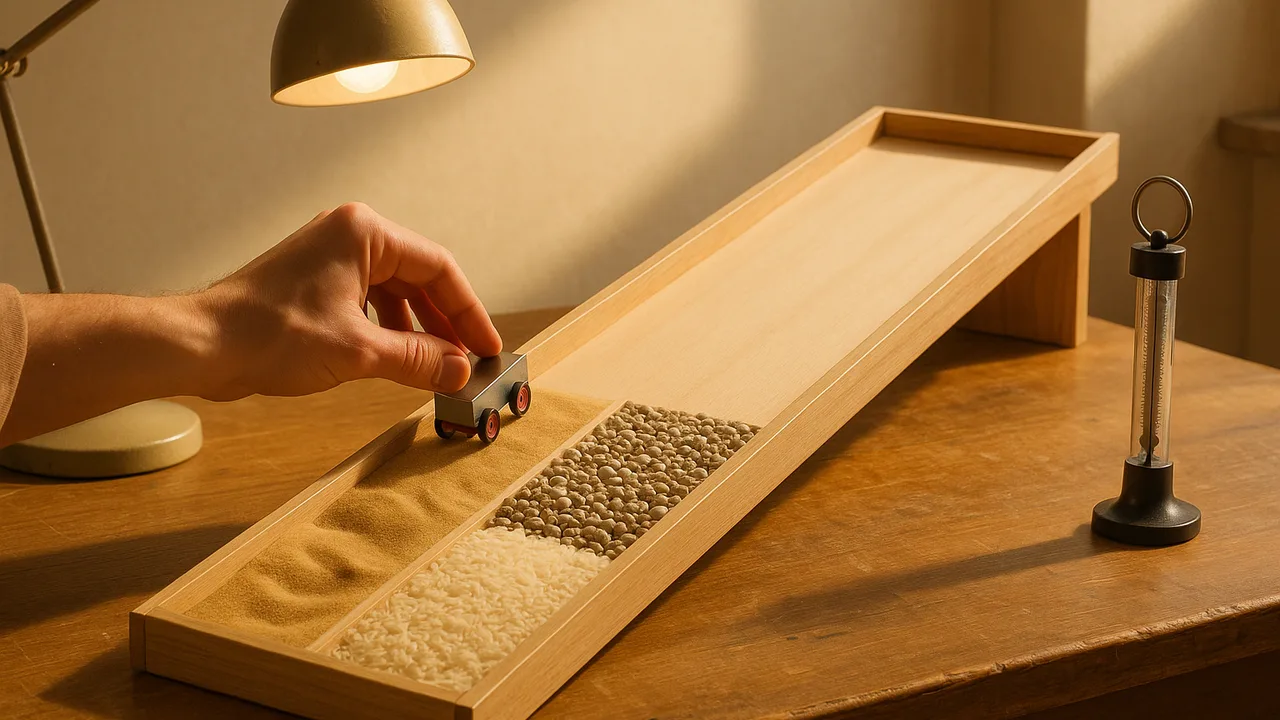
test bed materials on a scale-model escape ramp, measure their effective friction, and choose a full-scale ramp concept by solving the sub-problems in order with a weighted decision matrix.
- I can describe the criteria that a solution for a selected sub-problem must meet, as well as any constraints or limitations.
- I can explain the order in which the sub-problems should be solved and justify which criteria are most important if tradeoffs are needed.
- I can use data I have collected or scientific information from other sources to propose at least two possible solutions for one of the sub-problems.
Phase 4: Build
Warm-Up ~5 min
Do Now. Put the four sub-problems in the order you would solve them, and explain why the first one has to come first.
Why must the design speed be chosen before the ramp length?
Instruction ~10 min
Engineers, today you build two prototypes. The first is physical: a scale-model arrester bed that tests which material slows a toy truck best. The second is mathematical: your ramp spreadsheet, used to compare full-scale concepts.
Scale model. A toy truck rolls down a launch ramp (the “downgrade”), crosses a 0.20 m timing zone, and enters a bed tray 0.30 m long (the “available land”). From the entry speed and the stopping length, the effective coefficient on a level bed is μ = v2/(2gL), because a = μg and L = v2/(2a). Sample results at an entry speed of 1.20 m/s:
| Bed (sample data) | Stopping length (m) | Effective μ | Stops within 0.30 m? |
|---|---|---|---|
| Bare board, level | runs off the end | — | No |
| Dry sand, level | 0.12 | 0.61 | Yes |
| Aquarium gravel, level | 0.18 | 0.41 | Yes |
| Aquarium gravel, 10% upgrade | 0.15 | 0.41 (model predicts 0.145 m) | Yes |
The upgrade result checks the model: a = 9.8(sin 5.71° + 0.41 cos 5.71°) = 4.95 m/s2, so L = 1.202/(2 × 4.95) = 0.145 m, close to the 0.15 m measured.
Full-scale concepts (illustrative site). Design entry speed 31 m/s; land available 220 m; required safety factor 1.25.
| Concept | Grade, bed | a (m/s2) | L (m) | L × 1.25 (m) | Fits 220 m? |
|---|---|---|---|---|---|
| A. Gravity ramp | 15% up, paved (rolling resistance 0.01) | 1.55 | 310 | 388 | No; truck may roll back |
| B. Ascending arrester bed | 5% up, gravel μ = 0.25 | 2.94 | 164 | 205 | Yes |
| C. Level arrester bed | 0%, gravel μ = 0.25 | 2.45 | 196 | 245 | No |
Worked example 1: solving the sub-problems in order. Mei’s team fixes the design speed (31 m/s) first, because every later number depends on it. Next, the deceleration (grade plus bed), then the length with the safety factor, and last the site check. When concept C failed the site check, they went back one step and changed the deceleration, not the land.
Worked example 2: the decision matrix. Scores 1–5, times the weight:
| Criterion (weight) | A | B | C |
|---|---|---|---|
| Fits the land with the safety factor (×3) | 1 → 3 | 4 → 12 | 2 → 6 |
| Stops the truck with no roll-back (×3) | 1 → 3 | 5 → 15 | 5 → 15 |
| Cost and maintenance (×2) | 4 → 8 | 3 → 6 | 3 → 6 |
| Driver can see and enter it (×1) | 3 → 3 | 4 → 4 | 4 → 4 |
| Total | 17 | 37 | 31 |
Safety criteria carry the highest weights because a ramp that fails to stop a truck has failed completely; a ramp that costs more has not. That is how you justify which criteria win when trade-offs appear.
Guided Exercises ~15 min
Run three trials per bed, then answer.
Independent Practice ~10 min
Record version 1.
Write your team's version 1: the concept, the criteria and constraints for each sub-problem, the order you solved them in, the numbers from your model, and the matrix totals. Explain which criterion you would protect first if a trade-off forced a choice, and why.
Closure ~5 min
Version 1 is chosen. Next lesson: critique, a harder test and version 2.
Exit ticket: why did safety criteria get weight 3 and cost weight 2? Would you change either weight? Defend your answer.
Teacher notes
Materials: per team: a launch ramp (board and books), a toy truck with free-rolling wheels, a 0.30 m bed tray, dry play sand, aquarium gravel, a phone for timing, goggles, towel, stop block; devices with the ramp spreadsheet.
Setup: 25 min scale tests, 20 min concepts and matrix. All values are sample or illustrative; toy wheels sink differently from truck tires.
Listen for: fixing the land instead of the design; weights chosen after the totals; trusting the scale model as a full-scale prediction.
Support / stretch: give the μ formula and a filled first row. Stretch: find the grade at which concept C’s level bed would just fit 220 m with the safety factor.