3.09 Performance Task: Design, Test and Defend a Crash-Safety Liner
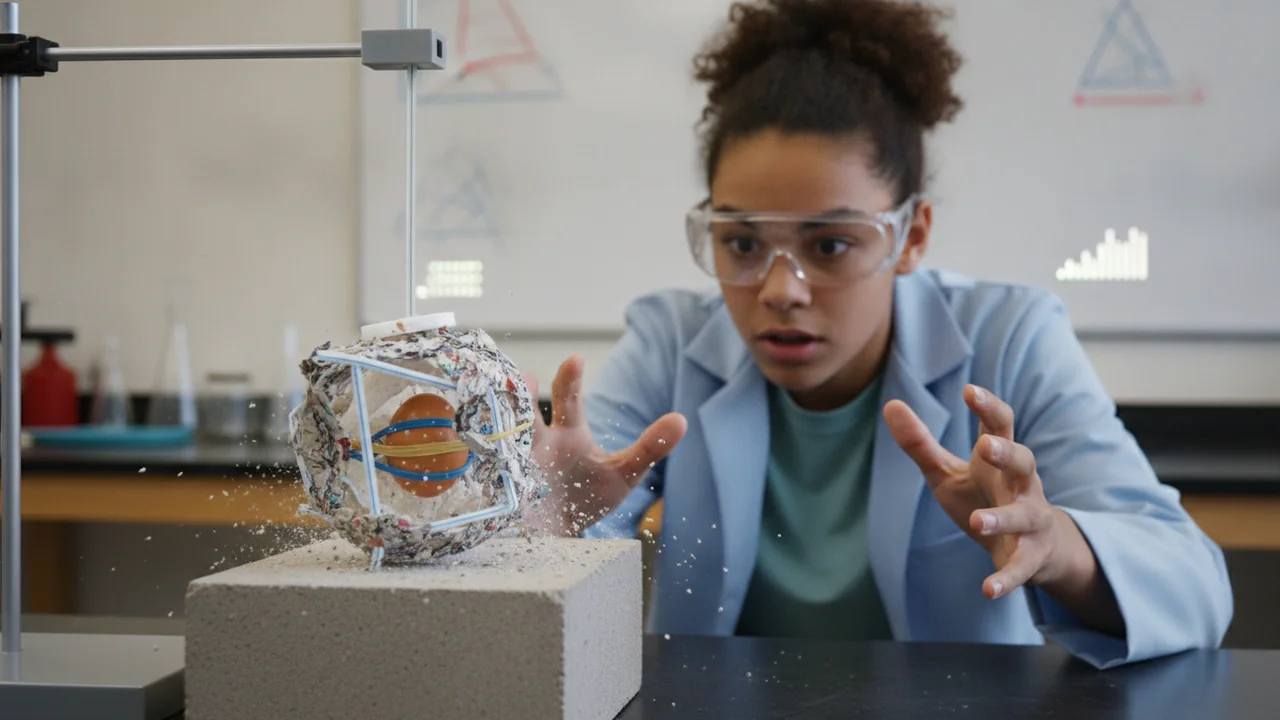
design, test and refine a device that minimizes the force on a passenger in a collision, evaluate it against weighted criteria and trade-offs, and explain my material choice.
- I can design a device that reduces the force on an object during a collision by increasing the time over which the collision occurs.
- I can explain how changing the collision time affects the force on an object, using the relationship FΔt = mΔv.
- I can apply the idea of increasing collision time to make sure my device reduces the net force on the object.
- I can use my test results to improve my device by increasing the impact time, reducing mass, or considering cost versus benefits.
- I can communicate scientific and technical information about a designed material using at least two different formats, such as oral, graphical, textual, or mathematical methods.
- I can fully describe the structure, properties, and design of a chosen material and cite where my information comes from.
Phase 5: Prove It
Warm-Up ~5 min
Do Now. Your client will read your report at a family meeting. Write the one sentence you most want them to remember about why your liner works.
Using the weights 0.40, 0.20, 0.15, 0.25, what is the weighted total for a design scored 4, 4, 3, 3?
Instruction ~10 min
The design problem. You now have the physics (impulse, stopping distance, conservation of momentum) and the materials science (structures that crush at a steady force). The task is an engineering one: design, build, test and refine a device that minimizes the force on a raw-egg passenger in a collision, then defend your choice of material to the bike-share program’s youth-safety team. You may build an egg-drop liner or a crumple zone for the crash-test cart from 3.05.
Criteria and constraints. Criteria are what success looks like; constraints are limits you cannot break. Class criteria: the egg survives; the average force estimate is as small as possible; the device is light; it is cheap; and, ideally, it can be reused. Class constraints: at most 100 g of added material, no more than 25 cm on any side, only everyday materials that cost little or nothing (paper, card, cups, straws, tape, string, packing foam, balloons, cotton wool), no parachutes (so the test is about the impact, not the fall), and every test run in goggles.
Break the problem into sub-problems. A complex design is easier when you split it: (1) how will the egg be held so it cannot slide and hit a hard edge? (2) what will crush, and over how many centimeters? (3) how will you make the crush force steady rather than spiking at the end? Solve each part, test it, then combine them.
Using your model to set a target. Estimate before you build. For a 1.0 m drop, the egg arrives at 4.43 m/s. If you want the average force under about 20 N, you need F = mv2/(2d) ≤ 20 N, so d ≥ 0.060 × 4.432 / (2 × 20) = 2.9 cm of crush. Your crush zone must be thicker than that, because it cannot compress to zero thickness and because the peak force is above the average.
Evaluating trade-offs. No design wins on every criterion. A weighted decision matrix makes your priorities explicit. Score each design 1–5 on each criterion, multiply by the weight, and add. Illustrative example:
| Design | Protection (weight 0.40) | Mass (weight 0.20) | Cost (weight 0.15) | Reusability (weight 0.25) | Weighted total |
|---|---|---|---|---|---|
| A: foam-cup cage | 4 | 3 | 5 | 2 | 3.45 |
| B: straw crumple zone | 5 | 4 | 4 | 1 | 3.65 |
| C: balloon airbag | 3 | 5 | 2 | 4 | 3.50 |
For design B: 0.40 × 5 + 0.20 × 4 + 0.15 × 4 + 0.25 × 1 = 3.65. Design B wins (3.65 against 3.50 and 3.45) because protection carries the most weight, even though it cannot be reused. If a team weighted reusability more heavily, the balloon airbag might win. Your report must say why you chose your weights, and what social, cost or environmental considerations (for example, single-use foam waste) affected them.
Iteration. Keep an iteration log: for each version, what you changed, why, the test result (survived or not, crush distance, estimated force) and what you learned. Change one thing at a time so you know what caused the improvement. At least three tested versions are expected.
Communicating the material choice. Your final report explains, at the molecular or structural level, why your chosen material works: what its cells, tubes, folds or chains do when they are loaded, and why that gives a long, steady crush instead of a bounce or a shatter. Use at least two formats (for example a labeled structure diagram and a force-distance graph) and cite where your material information comes from.
Guided Exercises ~15 min
Check your method before you draft.
Independent Practice ~10 min
Draft, review and revise across the build and test sessions.
Peer review: recompute two of your partner's force estimates, check their matrix arithmetic and challenge one weight. Write two specific notes.
Final: submit your 4–6 page report with the iteration log, the force-time comparison, the materials explanation and the trade-off evaluation, then present or record your five-minute defense.
Submit: Crash-Safety Liner design report (4–6 pages with data and diagrams) + 5-minute design defense
Task: Design, build, test and refine a device that protects a raw-egg passenger in a collision, as a scale model of a helmet liner for the bike-share program’s youth-safety team: either an egg-drop package dropped from a measured height of at least 1.5 m (no parachutes), or a crumple zone on the crash-test cart released from a marked ramp position. Your report must include: (1) the criteria and constraints and your weighted decision matrix with justified weights; (2) a sketch of each version with its materials; (3) an iteration log of at least three tested versions with speed, crush distance, stopping time, average force (Δp/Δt) and survival for each run; (4) a force-time sketch comparing your best design with an unprotected egg, with equal areas; (5) an explanation of why your chosen material works, based on its structure at the molecular or cellular level, in at least two formats with sources cited; and (6) an evaluation of trade-offs, including cost, reusability and waste, and one change you would make for a real bicycle helmet. Wear goggles for every test and clean up broken egg immediately.
Choose where your test data come from. All three earn full credit and are the same difficulty.
Option A — build and test. As described above: at least three versions, each tested at least three times, with your own measurements.
Option B — the illustrative data set in this lesson. No materials needed. Four devices were dropped from 1.50 m, so every egg arrived at v = √(2 × 9.8 × 1.50) = 5.42 m/s, and every egg was 60 g. Stopping time is 2d/v and average force is mv2/(2d). These numbers are constructed to show the method; they are not real measurements.
| Design | Added mass (g) | Crush distance d (m) | Stopping time 2d/v (s) | Average force on the egg (N) | Egg survived? |
|---|---|---|---|---|---|
| No device (control) | 0 | 0.003 | 0.0011 | 294 | no |
| A: foam-cup cage | 85 | 0.045 | 0.0166 | 19.6 | yes |
| B: straw crumple zone | 62 | 0.075 | 0.0277 | 11.8 | yes |
| C: balloon airbag | 40 | 0.030 | 0.0111 | 29.4 | yes, but the shell cracked on one run in three |
Treat these as three tested versions plus a control. Recompute every stopping time and force yourself, build the iteration log from what changed between the designs (cup walls, straw tubes, trapped air), score them in your weighted matrix, and recommend and defend one. Then answer two extra questions: why design C is marginal at 29.4 N, and what would happen to each force if the drop were raised to 2.00 m.
Option C — PhET Collision Lab. The PhET Collision Lab simulation, at phet.colorado.edu/sims/html/collision-lab/latest/collision-lab_all.html, has an Explore 1D screen for this. Send a 0.060 kg ball into a much heavier ball at 5.4 m/s, and record its velocity change at 0% elasticity (it stops) and at 100% (it bounces). Use Δp = mΔv with three stopping times you choose (0.001 s, 0.010 s and 0.030 s) to build your force-time comparison and your iteration log, and say which real design change buys each stopping time. Cite the sim and the date you used it.
Submission workflow
- Stage 1, Plan: criteria and constraints, three sub-problems, two candidate designs with sketches, a target crush distance calculated from your drop height or cart speed, and a draft decision matrix with weights.
- Stage 2, Peer-reviewed draft: after at least two tested versions, a partner recomputes two of your force estimates, checks your matrix arithmetic and challenges one weight; you respond in a revision note.
- Stage 3, Revised final: 4–6 pages with the full iteration log (at least three versions), the force-time comparison, the materials explanation and the trade-off evaluation.
- Stage 4, Five-minute design defense: demonstrate or show video of your final test, justify your material choice and answer two questions about your model. A recorded defense is an equal-credit alternative.
How it is scored
| Criterion | What proficient looks like |
|---|---|
| Design and refinement (HS-PS2-3) | The device is built and tested in at least three versions; each change is justified by data and the final design measurably reduces the force. |
| Impulse model (HS-PS2-2, HS-PS2-3) | Speed, stopping time and average force are computed correctly from measurements, with units, and the force-time sketch shows equal areas. |
| Criteria, constraints and sub-problems (HS-ETS1-2) | Criteria and constraints are specific and measurable, and the problem is broken into sub-problems that are solved and tested. |
| Trade-off evaluation (HS-ETS1-3) | The weighted matrix is computed correctly; weights are justified, including cost, reusability and environmental impact. |
| Materials explanation (HS-PS2-6) | The material’s performance is explained from its molecular or cellular structure in at least two formats with sources, distinguishing crushing, elastic rebound and brittle fracture. |
| Communication | Data tables, graphs and sketches are integrated with the text; the defense answers questions accurately. |
Closure ~5 min
Your recommendation is in the client’s hands. Next: the unit checkpoint.
Exit ticket: which Wonder Board question can you now answer with a number? Write the question and your answer.
Teacher notes
Timing: Poly ran this over about five class periods plus build time. Here: plan and first build; tests and peer review; final tests; report writing; defenses. Defenses may run into the checkpoint day’s warm-up.
Materials: rubric copies, sealed eggs, construction materials, a kitchen scale, meter sticks, phones, goggles, trays and paper towels.
Setup: invite a staff member, school nurse or family volunteer to play the youth-safety team; a video call works. All Option B data are illustrative.
Listen for: forces computed without units; matrices whose weights were chosen after seeing totals; materials explanations that describe but do not explain.
Support / stretch: provide a report outline with section headings and one completed iteration-log row. Stretch: add a rotational-impact idea and explain why some helmets add a low-friction layer.
Reading: OpenStax Physics (high school), chapter 8; OpenStax College Physics 2e, chapter 8.