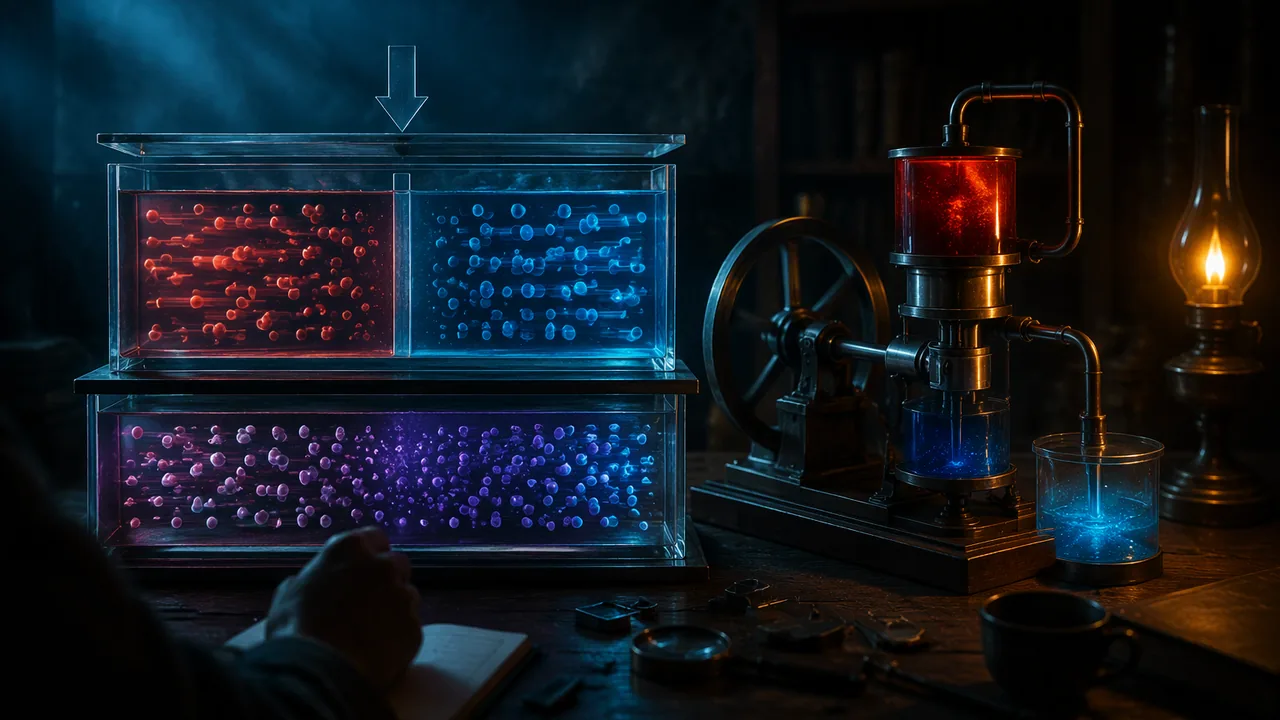
argue from mixing data that thermal energy flows from hot to cold toward a uniform distribution, explain entropy at a conceptual level, and use 1 − Tc/Th to show why no engine is 100% efficient.
Instruction
A pattern you have never seen broken. Pour 0.20 kg of water at 80 °C into 0.20 kg of water at 20 °C and you get 0.40 kg at 50 °C. The hot water lost 25,116 J and the cold water gained the same 25,116 J, so energy was conserved. But nobody has ever watched a cup of 50 °C water separate on its own into a hot half and a cold half. That would also conserve energy. Something beyond energy conservation decides the direction. In your mixing lab the same thing happened: the metal always cooled and the water always warmed, never the other way.
The second law of thermodynamics. In words: thermal energy flows spontaneously from a hotter object to a colder one, never the reverse, and an isolated system moves toward a more uniform distribution of energy. This is the claim of 9-12.PS3.B.1, and your mixing data are evidence for it: in every trial the temperatures converged.
Why, at the particle level. When fast (hot) and slow (cold) particles collide, energy is shared randomly. There are vastly more ways to share energy evenly among trillions of trillions of particles than to keep it concentrated, so random collisions almost certainly spread it out. Entropy is a measure of how many microscopic arrangements match what we observe; the second law says the total entropy of an isolated system does not decrease. For a transfer of heat Q at absolute temperature T, the entropy change is Q/T. Worked example: 1000 J flows from an object at 350 K to one at 300 K. The hot object loses 1000/350 = 2.857 J/K; the cold one gains 1000/300 = 3.333 J/K. The total change is +0.476 J/K. Reverse the flow and the total would be negative, which the second law forbids.
Heat engines. A heat engine (a car engine, a steam turbine, a geothermal plant) takes in heat Qh from a hot source, does work W, and must reject heat Qc to a cold sink: W = Qh − Qc. Efficiency is e = W/Qh. In the diagram, e = 250/1000 = 25%.
No engine is 100% efficient. If an engine turned all of Qh into work with nothing rejected, entropy would leave the hot source and none would arrive anywhere else, so total entropy would fall. The best any engine can do between absolute temperatures Th and Tc is the Carnot efficiency:
emax = 1 − Tc/Th (temperatures in kelvin)
Worked example 1: between 800 K and 300 K, emax = 1 − 300/800 = 0.625, or 62.5%. Real engines reach well under their Carnot limit because of friction and non-ideal cycles. Worked example 2: Ameren’s Callaway nuclear plant near Fulton, Missouri, is a steam engine. Its reactor heats water to about 590 °F (310 °C), the hottest water in the plant. With an illustrative 40 °C for the cooling water, Th = 583.15 K, Tc = 313.15 K and emax = 1 − 313.15/583.15 = 46.3%. The real plant turns 3,565 MW of reactor heat into a nominal 1,284 MW of electricity (gross), an efficiency of 36.0%, below its ceiling as the second law requires; the other 2,281 MW is rejected through a 555-foot cooling tower that draws its makeup water from the Missouri River. Low-temperature sources have low limits, whatever the engineering.
Common mistakes. Using Celsius in the Carnot formula (1 − 40/310 = 87% is wrong). Treating “energy is conserved” as the same claim as “heat flows hot to cold”; they are two different laws. Thinking a refrigerator breaks the second law: it moves heat from cold to hot only because work is done on it, and it dumps even more heat out the back than it removes from inside.
Arguing from evidence. In this lab you make a claim about the direction of heat flow using your own mixing data and the pooled data set in this lesson’s reading (eight recorded trials), answer a counterclaim, and support or rebut two sample arguments. A strong argument cites specific temperatures, names the system and its surroundings, and explains why energy conservation alone cannot decide the direction.
📖 Read for this lesson
The reading opens over the lesson; close it to come back to exactly where you were. The checks below draw on it.
Formative check
Work through these before moving on. They are not graded — they tell you whether the standard below has landed yet.
A student argues: “When the metal cooled and the water warmed, the metal was pushing cold into the water.” Which response is the best rebuttal?
The Carnot efficiency of an engine between 800 K and 300 K is %. Between 310 °C and 40 °C it is about %.
An advertisement claims a new engine with no cooling system turns 100% of its fuel’s heat into work. The claim conserves energy, so physics allows it.
Argument from evidence (recorded 2-minute talk or written post of about 250 words; equal credit). Claim: in an isolated system, thermal energy moves toward a more uniform distribution. Use at least three temperature readings from your lab or the pooled data set in the reading as evidence, explain the reasoning at the particle level, and answer this counterclaim: “Energy conservation already explains the mixing result, so no second law is needed.” Then write a short response to each of these two sample arguments, supporting the first with one more piece of evidence and challenging the second: (a) “In every trial the final temperature fell between the two starting temperatures, so energy moved toward a uniform distribution.” (b) “Trial 8’s frozen steel warmed up, so in that trial cold flowed out of the steel into the water.”
How confident are you that you can argue from mixing data that heat flows from hot to cold toward uniform temperature, and explain why no heat engine can be 100% efficient?
Practice
Work these on paper or in your notebook, then open Check your answer. Aim for all of Fluency and Application; try at least one Challenge.
Printable version: this unit’s practice workbook (PDF)
Fluency
Build speed and accuracy with the core skill.
- A device takes in 1200 J and delivers 852 J of useful energy. What is its efficiency, and where did the rest go?
Check your answer
Answer: 71.0%; the other 348 J was transferred mostly as thermal energy to the surroundingsEfficiency = useful output / input × 100%. - A device takes in 1200 J and delivers 854 J of useful energy. What is its efficiency, and where did the rest go?
Check your answer
Answer: 71.2%; the other 346 J was transferred mostly as thermal energy to the surroundingsEfficiency = useful output / input × 100%. - A device takes in 2000 J and delivers 1647 J of useful energy. What is its efficiency, and where did the rest go?
Check your answer
Answer: 82.3%; the other 353 J was transferred mostly as thermal energy to the surroundingsEfficiency = useful output / input × 100%. - What is the Carnot efficiency of an engine between 550 °C and 30 °C?
Check your answer
Answer: 63.2%Convert to kelvin: 1 − 303.15/823.15. - An engine takes in 5,000 J of heat per cycle and is 32% efficient. How much work does it do and how much heat does it reject?
Check your answer
Answer: 1,600 J; 3,400 JW = eQh; Qc = Qh − W. - 2,000 J flows from a reservoir at 400 K to one at 300 K. Find the total entropy change.
Check your answer
Answer: +1.67 J/K−2000/400 + 2000/300.
Application
Use the skill in context. Show your reasoning.
- A geothermal plant uses steam at 180 °C and cooling water at 35 °C (illustrative). What is its maximum possible efficiency? Why is it low?
Check your answer
Answer: 32.0%The source is not very hot compared with the sink. - An inventor claims an engine running between 400 K and 300 K with 40% efficiency. Evaluate the claim.
Check your answer
Answer: Impossible: the Carnot limit is 25%1 − 300/400 = 0.25; no engine can beat this. - A student says: “When hot and cold water mix, energy conservation already predicts they reach the same temperature, so no second law is needed.” Rebut this.
Check your answer
Answer: Energy conservation would also allow the reverse (lukewarm water separating into hot and cold); only the second law rules it out.The second law gives the direction: heat flows spontaneously from hot to cold, and total entropy increases.
Challenge
Stretch problems. Expect to think before you write.
- A power plant with 38% efficiency delivers 500 MW of electricity. How much heat does it reject each second, and what does that mean for the river or ocean that cools it?
Check your answer
Answer: 816 MW of heatInput = 500/0.38 = 1,316 MW; rejected = 816 MW, which warms the cooling water.
Review
Keep earlier skills sharp.
- A motor does 12000 J of work in 30 s. What is its power output?
Check your answer
Answer: 400.0 WP = W/t. - What net force gives a 5 kg object an acceleration of 1.5 m/s2?
Check your answer
Answer: 7.50 NFnet = ma.
Eight Trials, One Direction: Pooled Mixing Data and the Carnot Limit at Missouri’s Callaway Plant
SLS constructed pooled data set (illustrative, not laboratory measurements) for eight method-of-mixtures trials; Callaway Plant Unit 1 Environmental Report for License Renewal (Union Electric Co., submitted to the U.S. NRC) and NRC reactor information page for Callaway Plant Unit 1; retrieved Nov. 5, 2026 · SLS original, with U.S. government (NRC) public records
Why this reading. Your argument must use “at least three temperature readings from your lab or the pooled data set in the reading.” Here is that data set: eight mixing trials of the same at-home procedure, including one that started with cold metal, so that the claim can be tested in both directions. The trials are SLS teaching data constructed to behave like real foam-cup calorimetry and labeled illustrative; the first three are the Lesson 2.2 record. After the data comes the one real engine the lesson names, Missouri’s Callaway nuclear plant, with the reactor power, electrical output and water temperature its owner reported to the U.S. Nuclear Regulatory Commission, so the Carnot limit can be checked against a real plant’s real efficiency.
Table 1. Pooled mixing data, eight trials
Water and metal were sealed in a foam-cup calorimeter and the highest steady temperature was recorded. Trial 8 used steel chilled in a freezer and dropped it into warm water. Q is the energy the water gained or lost, mwcw|ΔTw| with cw = 4186 J/(kg·K); c is the metal’s specific heat computed from the trial.
| Trial | Metal | mm (kg) | Tm (°C) | mw (kg) | Tw (°C) | Tf (°C) | Q (J) | c (J/(kg·K)) |
|---|---|---|---|---|---|---|---|---|
| 1 | steel | 0.300 | 88.0 | 0.200 | 21.0 | 30.0 | 7,535 | 433 |
| 2 | aluminum | 0.150 | 87.5 | 0.200 | 21.0 | 30.5 | 7,953 | 930 |
| 3 | copper | 0.250 | 88.0 | 0.200 | 21.0 | 27.7 | 5,609 | 372 |
| 4 | steel | 0.250 | 85.2 | 0.180 | 22.4 | 30.6 | 6,179 | 453 |
| 5 | aluminum | 0.120 | 86.0 | 0.200 | 22.0 | 29.0 | 5,860 | 857 |
| 6 | copper | 0.300 | 84.5 | 0.150 | 21.5 | 30.9 | 5,902 | 367 |
| 7 | steel | 0.200 | 86.8 | 0.220 | 20.6 | 26.7 | 5,618 | 467 |
| 8 | steel (from a freezer) | 0.300 | -14.0 | 0.200 | 24.0 | 19.2 | 4,019 | 403 |
Read the pattern before the numbers. In trials 1 through 7 the metal started hot and ended cooler; the water started cool and ended warmer; the final temperature lies between the two starts every time, and much closer to the water’s because water’s heat capacity is larger. In trial 8 the metal started cold and warmed while the water cooled. In all eight, energy moved from the hotter body to the colder one and the two temperatures converged. No trial recorded a metal that got hotter while the water got colder, though energy conservation alone would allow it.
Why energy conservation is not enough
Pour 0.20 kg of water at 80 °C into 0.20 kg at 20 °C: you get 0.40 kg at 50 °C. The hot water lost (0.20)(4186)(30) = 25,116 J and the cold gained 25,116 J. Now imagine the reverse: 0.40 kg at 50 °C separating into a hot half and a cold half. That also conserves energy exactly, and it never happens. Something else decides direction. Entropy does: for heat Q leaving a body at absolute temperature T, the entropy change is −Q/T; arriving, +Q/T. When 1,000 J flows from 350 K to 300 K, the hot body loses 1,000/350 = 2.857 J/K and the cold gains 1,000/300 = 3.333 J/K: a total of +0.476 J/K. Run it backward and the total is −0.476 J/K, which the second law forbids. Apply this to trial 1: 7,535 J left steel whose temperature ran from 361 K down to 303 K and entered water running from 294 K up to 303 K. Using average temperatures of about 332 K and 298.5 K, the steel lost roughly 22.7 J/K and the water gained roughly 25.2 J/K, a net gain of about +2.5 J/K. Every row of Table 1 gives a positive total.
Engines: the Carnot limit on a real Missouri plant
Between 800 K and 300 K, emax = 1 − 300/800 = 62.5%. Now a real engine. The Callaway Energy Center near Fulton, operated by Ameren Missouri (licensee Union Electric Co.), is a single Westinghouse pressurized-water reactor. Its license-renewal environmental report to the U.S. Nuclear Regulatory Commission states that the reactor produces “a reactor core power of 3,565 megawatts-thermal” and that “the nominal gross electrical capacity is 1,284 megawatts-electric”; the NRC’s own reactor page lists the same 3,565 MWt. The report says “the reactor core heats water to approximately 590 degrees Fahrenheit,” kept liquid by a pressure above 2,200 psi, and that this water boils separate water into steam in four steam generators.
The real efficiency. e = 1,284/3,565 = 36.0% (gross; the plant uses some of that electricity itself). The heat rejected is 3,565 − 1,284 = 2,281 MW, which the circulating water system (530,000 gallons per minute, the report says) carries to a 555-foot natural-draft cooling tower; makeup water comes from the Missouri River.
The ceiling. 590 °F is 310 °C, or 583.15 K, the hottest water anywhere in the plant. With an illustrative 40 °C (313.15 K) for the condenser, emax = 1 − 313.15/583.15 = 46.3%. The steam that reaches the turbine is cooler than the reactor water, so the true ceiling is lower still. Callaway’s 36.0% is 78% of even this generous ceiling. That is the second law at work: even perfect machinery could not turn more than about half of the reactor’s heat into electricity, because the rest must be rejected to cooler surroundings to keep the total entropy from falling, and Callaway’s cooling tower is that rejection made visible.
The common mistake in Celsius: 1 − 40/310 = 87% is wrong by almost a factor of two. The formula needs kelvin because entropy does.
Your turn
- Choose three trials from Table 1 (one must be trial 8) and write, for each, the direction energy moved and the evidence in the row that shows it.
- For trial 8, compute the energy the water lost and the steel’s specific heat. Then answer: does the second law say heat flows into metal or out of it? What does it actually say?
- Compute the entropy change for trial 5 using average temperatures as in the worked example above, and show that the total is positive.
- Answer the counterclaim “energy conservation already explains the mixing result” in three sentences, using the 50 °C water example and one row of Table 1.
- Recompute Callaway’s Carnot limit with a 30 °C condenser instead of 40 °C, and say whether a cool day or a hot Missouri summer day should let the plant run closer to its ceiling. Then state in one sentence what the limit does and does not say about the real plant’s 36.0%.