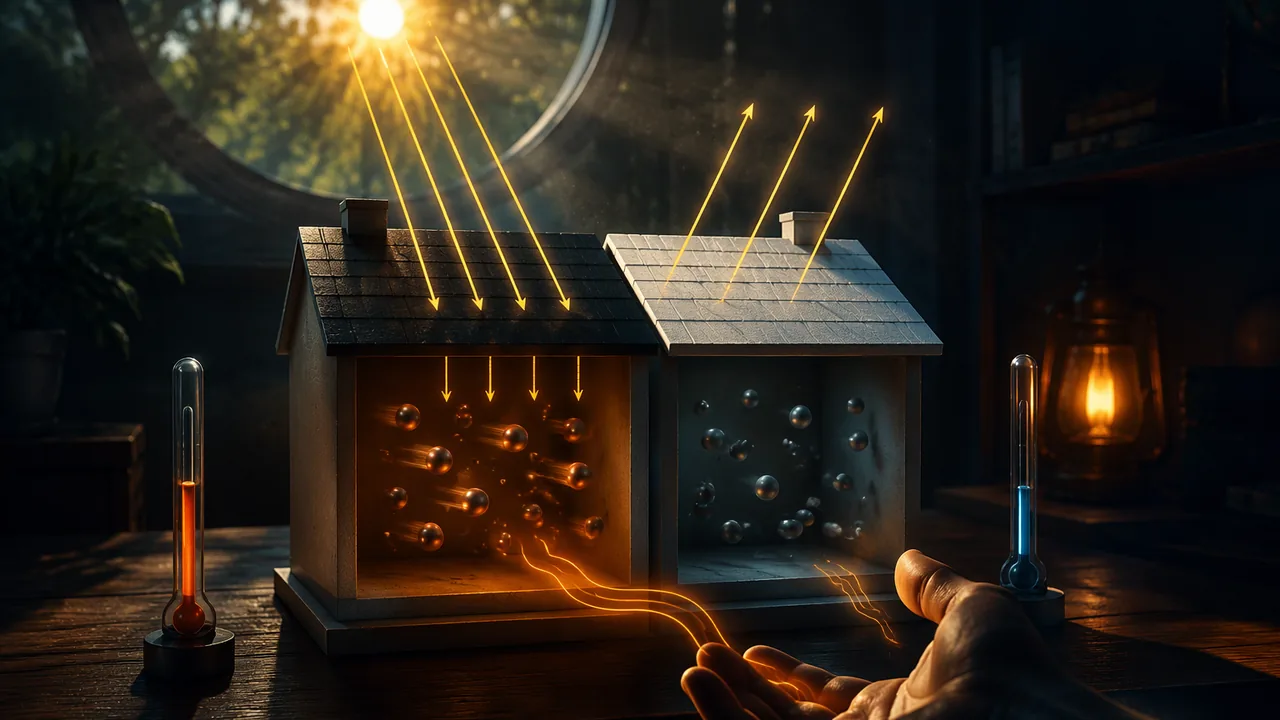
distinguish temperature, thermal energy and heat with the particle model, convert Celsius to kelvin, calculate energy with Q = mcΔT, and explain why a dark roof gets hotter than a cool roof.
Instruction
The phenomenon. On a July afternoon in St. Louis or Kansas City, put your hand on a black car hood and then on a white one parked beside it. Both sit in the same sunlight and the same air, yet the dark one can be painful to touch. Rooftops do the same thing. A dark roof absorbs most of the sunlight that hits it; a light-colored “cool roof” reflects much of it. Roofing products are rated by solar reflectance and thermal emittance. Missouri has no statewide building energy code (cities and counties adopt their own), and the U.S. Department of Energy recommends cool roofs most strongly for the hot Climate Zones 1–3; 85 of Missouri’s 115 counties (including the City of St. Louis) are in Zone 4A and the 30 northern counties in Zone 5A. So in Missouri a cool roof is a trade-off: less sunlight absorbed in a summer heat wave, but less free solar heating in winter. This unit gives you the physics to weigh it.
Temperature, thermal energy and heat are three different things. Matter is made of particles in constant random motion. Temperature measures the average kinetic energy of that random motion. Thermal energy is the total kinetic and potential energy of all the particles’ random motion, so it depends on how much material there is as well as how hot it is. Heat (Q) is energy in transfer from a hotter object to a cooler one because of their temperature difference. An object does not “contain heat”; it contains thermal energy, and heat is the name for the flow.
The kelvin scale. Particle kinetic energy is proportional to absolute temperature: for a gas, the average kinetic energy per molecule is (3/2)kBT, where kB = 1.381 × 10⁻²³ J/K and T is in kelvin. T(K) = T(°C) + 273.15, and a change of 1 °C equals a change of 1 K. Worked example: a St. Louis heat-wave afternoon of 38 °C (100 °F) is 311.15 K and a mild 20 °C morning is 293.15 K. The ratio is 311.15/293.15 = 1.061, so the air molecules’ average kinetic energy is only about 6% higher on the hot afternoon, not “nearly twice” as the Celsius numbers suggest.
How much energy does a temperature change take? For a substance that does not change phase, Q = mcΔT, where c is the specific heat capacity. Water’s is unusually large, 4186 J/(kg·K); aluminum’s is 900 and iron’s 452 (OpenStax College Physics 2e, Table 14.1). Worked example: warming 2.0 kg of water from 20 °C to 38 °C takes Q = (2.0)(4186)(18) = 150,696 J. The same 150,696 J put into 2.0 kg of aluminum would raise it by 150,696 ÷ (2.0 × 900) = 83.7 K. Same energy, very different temperature change.
Three ways thermal energy moves. Conduction is transfer by particle collisions through a material (the hot roof deck warming the attic air through the plywood). Convection is transfer by the bulk motion of a fluid (hot attic air rising, the afternoon breeze carrying heat off the roof). Radiation is transfer by electromagnetic waves, which needs no material at all (sunlight reaching the roof; the roof glowing in infrared back at the sky).
Why the dark roof gets hotter. On a clear summer noon, roughly 1000 W reaches each square meter of ground-level surface facing the Sun. Suppose (illustrative values) a dark roof absorbs 90% and a cool white roof 30%. Absorbed power per square meter is 900 W against 300 W. Over a 150 m2 roof that is 135 kW against 45 kW. The roof warms until it sheds energy (by radiation, convection and conduction) as fast as it absorbs it, and the dark roof must be much hotter to shed three times as much. Some of that extra energy conducts into the building and the air conditioner has to pump it back out.
Common misconceptions. (1) “Cold flows in.” Only energy flows, and it flows from hot to cold. (2) “A bigger object at the same temperature is hotter.” It has more thermal energy but the same temperature. (3) “Metal is colder than wood at room temperature.” Both are at room temperature; metal feels colder because it conducts energy away from your hand faster.
📖 Read for this lesson
The reading opens over the lesson; close it to come back to exactly where you were. The checks below draw on it.
Formative check
Work through these before moving on. They are not graded — they tell you whether the standard below has landed yet.
A black tile and a white tile of the same material sit side by side in full Missouri July sun for an hour. What happens?
A full bathtub at 40 °C and a mug of coffee at 90 °C sit in a 20 °C room. Which statement is correct?
38 °C is K. Warming 2.0 kg of water from 20 °C to 38 °C takes J.
Start the unit’s driving-question board. Write three questions about dark and cool roofs that physics could answer (at least one must be answerable with a measurement you could make at home). For each, name the quantity you would measure and the instrument you would use.
How confident are you that you can distinguish temperature, thermal energy and heat, convert to kelvin, use Q = mcΔT, and name the three transfer mechanisms on a sunny roof?
Practice
Work these on paper or in your notebook, then open Check your answer. Aim for all of Fluency and Application; try at least one Challenge.
Printable version: this unit’s practice workbook (PDF)
Fluency
Build speed and accuracy with the core skill.
- Convert 25 m/s to km/h.
Check your answer
Answer: 90.00 km/h - Convert 25 kPa to atm.
Check your answer
Answer: 0.2467 atm - Convert 60 g to kg.
Check your answer
Answer: 0.0600 kg - How much energy warms 1.5 kg of water from 20 °C to 80 °C?
Check your answer
Answer: 376,740 JQ = mcΔT = 1.5 × 4186 × 60. - 50,000 J goes into 0.80 kg of aluminum (c = 900 J/(kg·K)). By how much does its temperature rise?
Check your answer
Answer: 69.4 KΔT = Q/(mc). - How much energy does a 1.2 kg cast-iron pan need to go from 25 °C to 200 °C (c = 452 J/(kg·K))?
Check your answer
Answer: 94,920 JQ = mcΔT.
Application
Use the skill in context. Show your reasoning.
- A 120 m2 roof receives 950 W/m2 of sunlight. Compare the power absorbed by a dark roof (absorbs 85%) and a cool roof (absorbs 25%), illustrative values.
Check your answer
Answer: 96.9 kW vs 28.5 kWAbsorbed power = fraction × intensity × area. - On a 42 °C (108 °F) St. Louis afternoon, the July 2012 heat-wave peak, versus a 15 °C morning, by what factor is the average kinetic energy of air molecules larger?
Check your answer
Answer: 1.094KE ∝ absolute temperature: 315.15/288.15. - A metal bench and a wooden bench sit in the same shade at 25 °C. Explain why the metal one feels colder to touch.
Check your answer
Answer: They are at the same temperature; metal conducts energy away from your hand faster.Feel depends on the rate of heat flow, not on temperature alone.
Challenge
Stretch problems. Expect to think before you write.
- A 2.0 L pot of water at 15 °C sits on a 1,200 W electric burner that transfers 70% of its power into the water. How long until the water reaches 100 °C?
Check your answer
Answer: 14.1 minQ = 2.0 × 4186 × 85 = 711,620 J; useful power 840 W; t = Q/P = 847 s.
Review
Keep earlier skills sharp.
- Find the kinetic energy of a 0.5 kg object moving at 5 m/s.
Check your answer
Answer: 6.2 JKE = ½mv2. - Find the kinetic energy of a 1000 kg object moving at 8 m/s.
Check your answer
Answer: 32,000 JKE = ½mv2.
Dark Roof, Cool Roof: The DOE Measurements, Missouri’s Climate Zones and a St. Louis Heat-Wave Afternoon
DOE Building Technologies Program, Guidelines for Selecting Cool Roofs (July 2010, v1.2); DOE Building Energy Codes Program, Missouri state code status; DOE Building America, Guide to Determining Climate Regions by County (Vol. 7.3, Aug. 2015); NOAA NCEI 1991-2020 U.S. Climate Normals and Global Summary of the Month, St. Louis Lambert Intl (USW00013994) and Kansas City Intl (USW00003947); NIST Chemistry WebBook (water) and CODATA 2022 (Boltzmann constant); retrieved Nov. 5, 2026 · Public domain (works of the United States government), with SLS original illustrative tile record
Why this reading. The lesson says a dark roof absorbs “90%” and a cool roof “30%” of sunlight and calls the numbers illustrative. The driving-question board asks you for questions physics could answer with measurements. Here are the published measurements and rules that the phenomenon actually rests on: the U.S. Department of Energy’s cool-roof guide, what Missouri’s building codes and climate zones say about cool roofs, and the NIST reference value behind the specific heat of water. A short illustrative temperature record follows so the roof-energy comparison can be worked with numbers.
1. What the Department of Energy measured
From Guidelines for Selecting Cool Roofs (DOE Building Technologies Program, July 2010, prepared with Oak Ridge and Lawrence Berkeley National Laboratories):
- “Traditional dark roofs can reach temperatures of 150°F (66°C) or more in the summer sun. A cool roof under the same conditions could stay more than 50°F (28°C) cooler.”
- “Solar Reflectance is the fraction of sunlight that a surface reflects. Sunlight that is not reflected is absorbed as heat.” “Most dark roof materials reflect 5 to 20% of incoming sunlight, while light-colored roof materials typically reflect 55 to 90%.”
- “Thermal Emittance describes how efficiently a surface cools itself by emitting thermal radiation,” on a scale of 0 to 1. “Nearly all nonmetallic surfaces … have high thermal emittance, usually between 0.80 and 0.95.” Bare shiny metal has low emittance and “will stay warmer in the sun” than a white surface that reflects the same amount.
- The guide’s reference roofs: a clean black roof with solar reflectance 0.05 and emittance 0.90; a clean white roof with reflectance 0.80 and emittance 0.90. Weathering lowers reflectance; the guide’s rule of thumb is aged reflectance = 0.7 × (initial − 0.2) + 0.2, so a new 0.80 roof is expected to age to 0.62.
2. What Missouri requires, and why it is a closer call here
Missouri has no statewide building energy code. The U.S. Department of Energy’s Building Energy Codes Program lists Missouri’s status as “Home Rule” for both homes and commercial buildings, with enforcement “Jurisdictional”: each city or county decides which code, if any, applies. So no Missouri state rule requires a cool roof.
Climate is the physics reason the question is closer in Missouri than in a desert. The DOE guide says cool roofs “achieve the greatest cooling savings in hot climates (Climate Zones 1-3)” but “can increase energy costs in colder climates due to reduced beneficial winter time heat gains.” DOE’s Guide to Determining Climate Regions by County (Building America, 2015) places 85 of Missouri’s 115 counties and the City of St. Louis (115 entries in all) in IECC Climate Zone 4A, mixed-humid, including St. Louis County, Jackson County (Kansas City) and Callaway County, and the 30 northern counties, such as Atchison, Buchanan and Adair, in Zone 5A, cold. A roof that reflects July sunlight also reflects January sunlight, and St. Louis’s normal January daily high is only 40.4 °F (4.7 °C) (NOAA 1991–2020 normals). The guide also notes that insulation matters more than color: cool roofs “are never a substitute for using sufficient thermal insulation.”
How hot does a Missouri summer get? NOAA’s 1991–2020 normals give a July mean daily maximum of 89.6 °F (32.0 °C) at St. Louis Lambert International Airport and 88.3 °F (31.3 °C) at Kansas City International Airport. In the 31 Julys from 1995 to 2025, St. Louis reached 100 °F (37.8 °C) or more in 13 of them; in July 2012 its daily highs averaged 98.6 °F (37.0 °C) and peaked at 108 °F (42.2 °C).
3. Absorbed power, from the published reflectances
Take the lesson’s figure of about 1,000 W of sunlight per square meter facing the Sun at a clear summer noon. Absorbed power per square meter is (1 − reflectance) × 1,000 W.
| Roof | Solar reflectance | Absorbed (W/m2) | Absorbed by a 150 m2 roof (kW) |
|---|---|---|---|
| DOE reference black roof | 0.05 | 950 | 142.5 |
| Lesson’s dark roof | 0.10 | 900 | 135 |
| DOE white roof after weathering (0.7 rule) | 0.62 | 380 | 57 |
| Lesson’s cool roof | 0.70 | 300 | 45 |
| DOE reference white roof, new | 0.80 | 200 | 30 |
The lesson’s 900 and 300 W/m2 and 135 and 45 kW sit inside the DOE range. Even after three years of weathering, the white reference roof (aged to 0.62) absorbs 380 W/m2, 60% less than the black reference.
4. An illustrative afternoon record
These are SLS teaching numbers, not measurements from any agency: surface temperatures of three 30 cm tiles laid on a flat roof in St. Louis on a clear afternoon during a July heat wave, read with an infrared thermometer every half hour, air temperature 38 °C (100 °F) at 15:00, a level St. Louis reached in 13 of the last 31 Julys. They are constructed to match the DOE statements above (a dark surface near 66 °C, a white one roughly 28 K cooler).
| Time | Air (°C) | Black tile (°C) | Red clay tile (°C) | White cool tile (°C) |
|---|---|---|---|---|
| 12:00 | 34 | 58 | 49 | 39 |
| 12:30 | 35 | 61 | 51 | 40 |
| 13:00 | 36 | 63 | 53 | 41 |
| 13:30 | 37 | 65 | 54 | 42 |
| 14:00 | 37 | 66 | 55 | 42 |
| 14:30 | 38 | 66 | 55 | 43 |
| 15:00 | 38 | 66 | 55 | 43 |
| 15:30 | 38 | 64 | 54 | 42 |
| 16:00 | 37 | 61 | 52 | 41 |
Each tile settles at the temperature where its losses to the air (convection), to the roof deck (conduction) and to the sky (infrared radiation) equal the power it absorbs. The black tile must run 28 K above air to shed 950 W/m2; the white tile sheds 200 W/m2 at only 5 K above air. Same sun, same air, same specific heat: the difference is absorbed power, not heat capacity. Notice that the black tile peaks at 14:00 while the air is still warming; it has reached balance.
5. The reference value behind Q = mcΔT
The NIST Chemistry WebBook gives the heat capacity of liquid water at 298 K as 75.37 J/(mol·K) (Shomate equation, from the NIST-JANAF tables). Dividing by water’s molar mass, 18.015 g/mol, gives 4,184 J/(kg·K). The lesson’s 4,186 J/(kg·K) is the older conventional value; the two differ by 0.05%, far less than any thermometer you will use. Kelvin and Celsius: the CODATA 2022 value of the Boltzmann constant is 1.380 649 × 10−23 J/K exactly, and absolute zero is −273.15 °C, so 38 °C = 311.15 K and 20 °C = 293.15 K, a ratio of 1.061.
Your turn
- Using the 15:00 row, compute how far above air temperature each tile ran, and check that the ordering matches the absorbed-power column in section 3.
- A 150 m2 flat roof in St. Louis is being re-covered. Compute the absorbed power for a black roof and for a white roof that has weathered to 0.62, and the difference in kilowatts. If an air conditioner must remove one quarter of that difference from the building, how many joules is that over a six-hour afternoon?
- Warming 2.0 kg of water from 20 to 38 °C takes (2.0)(4186)(18) = 150,696 J. Redo it with the NIST value and state the percentage change. Then explain why the black tile, with a specific heat about a fifth of water’s, does not simply keep getting hotter all afternoon.
- DOE recommends cool roofs most strongly for Zones 1–3, and nearly all of Missouri is Zone 4A or 5A. Using the absorbed-power idea, explain what the white roof gives up on a sunny January day in St. Louis, and name two numbers you would need to decide whether the summer saving outweighs the winter penalty.
- Write one driving-board question that the tile record could answer and one that it could not, and name the extra instrument the second would need.
Sources: DOE, Guidelines for Selecting Cool Roofs (July 2010), hosted by the LBNL Heat Island Group (heatisland.lbl.gov); DOE Building Energy Codes Program, Missouri: current energy code status (energycodes.gov); DOE Building America, Guide to Determining Climate Regions by County (Vol. 7.3, Aug. 2015) (energy.gov); NOAA NCEI, 1991-2020 monthly normals, St. Louis Lambert Intl Airport (USW00013994) (ncei.noaa.gov); NOAA NCEI, 1991-2020 monthly normals, Kansas City Intl Airport (USW00003947) (ncei.noaa.gov); NOAA NCEI, Global Summary of the Month, St. Louis and Kansas City, July and August 1995-2025 (ncei.noaa.gov); NIST Chemistry WebBook, Water, condensed phase thermochemistry data (webbook.nist.gov); NIST CODATA 2022, Boltzmann constant (physics.nist.gov)