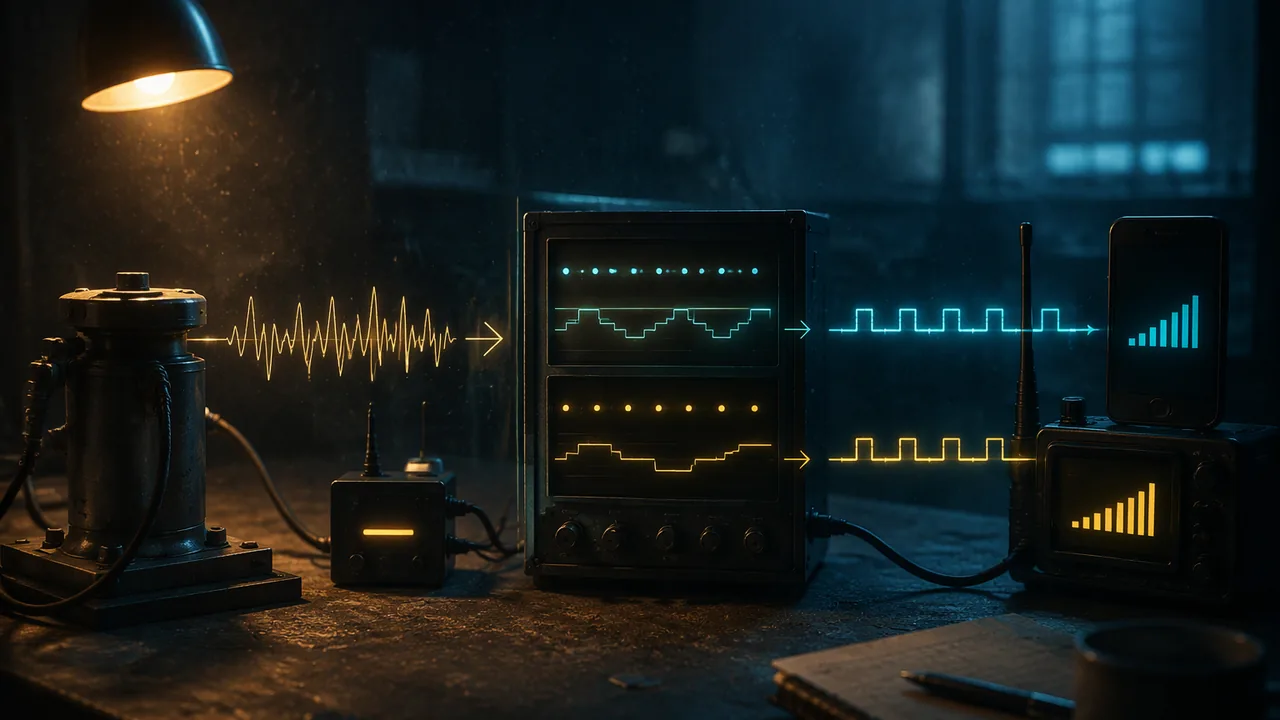
explain how analog signals are digitized, compute bit rates, and argue from evidence about the advantages and limits of digital transmission and storage.
Instruction
The question. When the National Weather Service in St. Louis issues a tornado warning, the message reaches Missouri phones as a Wireless Emergency Alert (up to 360 characters on 4G LTE and later networks) and switches on NOAA Weather Radios programmed for the affected county. An earthquake warning on the West Coast travels the same way: a seismic station’s data reaches a processing center, and then your phone, fast and without errors. Every step uses digital signals. Why digital, and what are the trade-offs?
Analog and digital. An analog signal is a continuously varying quantity, such as a voltage that rises and falls exactly as the ground moves. A digital signal represents the same information as a sequence of numbers, each stored as bits (0s and 1s). To digitize, a device samples the analog signal at regular times and quantizes each sample to the nearest of 2b levels, where b is the number of bits per sample.
Worked example 1: sampling and bit rate. Bit rate = sample rate × bits per sample × channels. CD audio uses 44,100 samples/s, 16 bits and 2 channels: 44,100 × 16 × 2 = 1,411,200 bits/s. One minute is 1,411,200 × 60 / 8 = 10.58 million bytes. Sixteen bits give 216 = 65,536 levels. A seismic station (typical figures, labeled illustrative) might record 100 samples/s with 24 bits on 3 channels (up-down, north-south, east-west): 100 × 24 × 3 = 7,200 bits/s, about 77.8 million bytes a day.
How fast must you sample? You need at least two samples per cycle of the highest frequency you want to keep (the Nyquist rate). A telephone channel that keeps frequencies up to 4000 Hz needs at least 8,000 samples/s. Human hearing reaches about 20,000 Hz, which is why CD audio samples at 44,100 Hz. Sample too slowly and a fast wave masquerades as a slow one (aliasing).
Worked example 2: Missouri’s weather-radio code. NOAA Weather Radio’s forecast voice is analog, but every warning starts with a short digital code (SAME) that names the event, the counties and how long the warning lasts. Federal rule 47 CFR 11.31 sets its physics: 520.83 bits per second, sent as two audio tones, 2083.3 Hz for a 1 and 1562.5 Hz for a 0, each bit lasting 1.92 ms (1/520.83 s). A tornado-warning header for St. Louis County such as ZCZC-WXR-TOR-029189+0045-3092130-KLSX/NWS- is 42 characters; with the 16-byte preamble that is 58 bytes = 464 bits, which takes 464/520.83 = 0.89 s, and the rule sends it three times: 2.67 s. A slow, simple code that is easy to decode through static and repeated so the radio can compare copies is a design choice, not a weakness.
Quantization error. With only 3 bits there are 8 levels; on a 0-1 V range each step is 0.125 V, so a reading can be off by up to half a step, 0.0625 V. Each extra bit halves the step. This is a design choice: more bits mean more accuracy but a higher bit rate.
Why digital wins on noise. Every cable, amplifier and radio link adds a little random noise. An analog signal cannot tell noise from signal, so noise piles up with each copy or relay stage. A digital receiver only has to decide “0 or 1” for each bit; as long as the noise is smaller than half the gap between the two levels, it rebuilds a perfect copy and sends it on clean. Error-detecting codes add check bits so that the rare wrong bit is caught and resent. That is why a digital copy of a copy is identical, while a cassette copy of a copy gets hiss.
Compression. Digital data can be compressed. Lossless compression (ZIP, FLAC) removes redundancy and restores every bit. Lossy compression (MP3, JPEG) throws away detail people are unlikely to notice: a 128 kbit/s MP3 is 11.0 times smaller than CD audio.
The costs of digital. Digitizing loses information between samples and between levels, compressed files can be damaged by a few wrong bits, stored formats become unreadable when software disappears, and all of it depends on power and networks. A good argument weighs these against the benefits.
Speed of delivery. Light in glass fiber (index about 1.47) travels at c/1.47 = 2.04 × 10⁸ m/s, so a 500 km fiber path takes 2.45 ms, and a radio wave crosses 100 km of air in 0.33 ms. Compared with the 22.9 s an S wave needs to cross the 80 km from New Madrid to Cape Girardeau, travel time is almost nothing; the real delays are processing, the time it takes to send the bits (2.67 s for three copies of a weather-radio header) and the time networks take to push alerts to phones.
Misconceptions. “Digital means higher quality.” Not automatically: a low sample rate or few bits can sound worse than good analog. “Digital signals are not waves.” They travel as electromagnetic waves or light pulses; digital describes how information is coded, not what carries it.
📖 Read for this lesson
The reading opens over the lesson; close it to come back to exactly where you were. The checks below draw on it.
Formative check
Work through these before moving on. They are not graded — they tell you whether the standard below has landed yet.
A recorder takes 48,000 samples per second at 24 bits on 2 channels. What is its bit rate?
A digital signal relayed through 20 stations can arrive identical to the original, while an analog signal relayed the same way collects noise at every stage.
A seismic station in southeast Missouri samples ground motion 100 times per second. A vibration at 70 Hz is recorded. What does the digital record most likely show?
Evaluate each claim with evidence and one calculation, then give a verdict (supported, partly supported, unsupported): (1) “Vinyl records are better than digital because digital throws information away.” (2) “A NOAA Weather Radio tornado warning reaches a radio late mainly because radio waves take time to travel from the transmitter.” (3) “Storing a family’s photos only as digital files is safer than prints.” Then pick the verdict you are least sure of, write the strongest counterargument to it in two sentences, and answer that counterargument with evidence. Submit in writing or as a recording; both earn equal credit.
How confident are you that you can compute bit rates and argue from evidence about when digital transmission and storage are better, and when they are not?
Practice
Work these on paper or in your notebook, then open Check your answer. Aim for all of Fluency and Application; try at least one Challenge.
Printable version: this unit’s practice workbook (PDF)
Fluency
Build speed and accuracy with the core skill.
- Convert 300 km to m.
Check your answer
Answer: 300,000.00 m - Convert 300 cm3 to mL.
Check your answer
Answer: 300.00 mL - A recorder takes 48,000 samples/s at 24 bits on 2 channels. Find the bit rate and the storage for one minute in megabytes.
Check your answer
Answer: 2,304,000 bit/s; 17.28 MBrate × 60 s / 8 bits per byte. - How many levels does a 10-bit converter have, and what is the step size on a 0-5 V range?
Check your answer
Answer: 1024 levels; 4.88 mV210; 5.0 V/1,024. - What minimum sample rate captures frequencies up to 12 kHz?
Check your answer
Answer: 24,000 samples/sNyquist: twice the highest frequency. - How long does a 2.0 GB file take to send at 100 Mbit/s?
Check your answer
Answer: 160 s2.0 × 109 bytes × 8 / 108 bit/s.
Application
Use the skill in context. Show your reasoning.
- A station samples at 100 samples/s. A 60 Hz hum from nearby power lines reaches the sensor unfiltered. At what false frequency does it appear?
Check your answer
Answer: 40 HzAbove half the sample rate (50 Hz), a signal aliases to |fs − f| = 40 Hz. - An analog signal relayed through 10 stations picks up noise at each. A digital signal relayed the same way arrives identical. Explain why, and state one condition for it to work.
Check your answer
Answer: Each digital relay only decides 0 or 1 and regenerates a clean signalIt works as long as the noise stays below half the gap between the two levels. - Evaluate the claim: “An earthquake alert for Missouri would be slow mainly because the signal takes time to travel through fiber.” Use light in glass at 2.0 × 10⁸ m/s over 400 km.
Check your answer
Answer: Unsupported: fiber delay is 2 msProcessing and delivery to phones take seconds; travel time is milliseconds. - NOAA Weather Radio sends a tornado warning for New Madrid County as the SAME header ZCZC-WXR-TOR-029143+0030-3092130-KPAH/NWS- (42 characters), each copy preceded by a 16-byte preamble, at 520.83 bits/s with 8 bits per character. How many bits is one copy, and how long do the three required copies take?
Check your answer
Answer: 464 bits; 2.67 s (0.89 s per copy)(42 + 16) × 8 = 464 bits; 3 × 464/520.83 s. The one-second pauses between copies come on top.
Challenge
Stretch problems. Expect to think before you write.
- A 3-minute song is stored as CD audio (1,411,200 bit/s) and as a 256 kbit/s file. Find both sizes in MB and the compression ratio. Is the compressed file lossless?
Check your answer
Answer: 31.8 MB and 5.76 MB; ratio 5.5; lossy (a codec at this rate removes detail)size = rate × time / 8.
Review
Keep earlier skills sharp.
- A motor does 3000 J of work in 2 s. What is its power output?
Check your answer
Answer: 1,500.0 WP = W/t. - A device draws 8 A from a 120 V supply. What power does it use, and how much energy in 1 hour?
Check your answer
Answer: 960.00 W; 3,456,000 J (0.960 kWh)P = VI; energy = Pt.
What the Bit Rate Actually Buys You: A Reference Table, Missouri’s Alert Codes and the Evidence Behind the Three Claims
NARA, Introduction to Digital Preservation at NARA (2023); NWS, Wireless Emergency Alerts; NWS, NOAA Weather Radio All Hazards and Using NWR SAME; 47 CFR 11.31, EAS protocol (eCFR current text); all retrieved November 5, 2026; standard published sampling specifications for CD audio, telephone, DVD audio and MP3 encoding; SLS worked table and computations; the decoded header is an illustrative example in the rule’s format · Public domain (NARA, NWS and federal-regulation text), with SLS original worked table and industry-standard reference figures
Why this reading. The lesson’s open question asks for a verdict on three specific claims, each backed by “evidence and one calculation.” The mini-lecture gives worked bit-rate examples (CD audio, a seismic station and Missouri’s weather-radio code) and one general statement about noise and copying. That is not enough material to responsibly judge all three claims. Below is a wider table of real coding standards to calculate from, plus the U.S. National Archives’ own account of what threatens digital storage and the National Weather Service’s description of the alerts Missouri receives, the evidence the second and third claims need.
Table 1. Bit rate = sample rate × bits per sample × channels, for real standards
| Format | Sample rate | Bits/sample | Channels | Bit rate | 1 minute, bytes |
|---|---|---|---|---|---|
| Telephone (G.711, the long-standing digital-phone standard) | 8,000/s | 8 | 1 | 64,000 bits/s | 480,000 |
| CD audio (Red Book standard) | 44,100/s | 16 | 2 | 1,411,200 bits/s | 10,584,000 |
| DVD audio (typical high-resolution setting) | 96,000/s | 24 | 2 | 4,608,000 bits/s | 34,560,000 |
| MP3, 128 kbit/s (a common lossy setting) | — | — | — | 128,000 bits/s | 960,000 |
| Illustrative seismic station (this unit’s mini-lecture) | 100/s | 24 | 3 | 7,200 bits/s | 54,000 |
| NOAA Weather Radio SAME code (47 CFR 11.31), carried with every Missouri weather-radio warning | — | — | 1 | 520.83 bits/s | 3,906 (if sent for a whole minute) |
Missouri’s two alert channels, in bits. A Wireless Emergency Alert is “up to 360 characters on 4G LTE networks and beyond” (National Weather Service): 360 × 8 = 2,880 bits. A 3-minute CD-quality song is 1,411,200 × 180 = 254,016,000 bits, 88,200 times as much. NOAA Weather Radio, which has “more than 1000 transmitters, covering all 50 states” (NWS), opens every warning with a digital SAME code; the NWS says it “may be heard as a very brief static burst” and that it “contains the type of message, county(s) affected, and message expiration time.” Federal rule 47 CFR 11.31: “Audio Frequency Shift Keying at a rate of 520.83 bits per second”; “Mark frequency is 2083.3 Hz and space frequency is 1562.5 Hz. Mark and space time must be 1.92 milliseconds.” A 16-byte preamble “must be transmitted before each header,” and the header is sent three times. A 42-character header such as ZCZC-WXR-TOR-029189+0045-3092130-KLSX/NWS- (tornado warning, St. Louis County, 45 minutes, NWS St. Louis; an illustrative example in the rule’s format) plus its preamble is 58 bytes = 464 bits: 0.89 s per copy, 2.67 s for three. That is the slowest bit rate in the table by far, and it is deliberate: two well-separated audio tones survive static that would wreck a fast code.
From the table: CD audio is 1,411,200/64,000 = 22.05 times the bit rate of a phone call, because it samples 5.5 times faster and keeps twice the bits per sample on two channels instead of one. A 128 kbit/s MP3 is 1,411,200/128,000 = 11.0 times smaller than the CD audio it is compressed from, entirely by throwing away detail a listener is unlikely to notice (lossy compression), not by sampling less often. The seismic station’s 7,200 bits/s is tiny by comparison — slower even than a telephone call — because ground motion changes far more slowly than sound pressure does; that is why a whole day of three-channel seismic data (7,200 × 86,400 / 8 = 77.8 million bytes) fits comfortably on hardware that could never hold a day of CD audio (1,411,200 × 86,400 / 8 = 15.2 billion bytes).
Evidence for claim 1: is vinyl “better” because digital throws information away?
It is true that digitizing discards information between samples and between quantization levels — that is not in dispute. What the claim leaves out is how much: at CD’s 16-bit depth there are 216 = 65,536 levels, and at 44,100 samples/s the Nyquist limit (half the sample rate) is 22,050 Hz, above the roughly 20,000 Hz upper edge of human hearing. The information CD audio discards is, by design, above what a human ear can register and finer than a human ear can distinguish between adjacent levels. Vinyl has its own, different limits: high-frequency loss from the stylus and groove wear, audible surface noise, and a channel separation and dynamic range that depend on the specific pressing. “Better” is not settled by the general fact that digitizing discards something; it depends on whether what is discarded is audible, which is a different, testable question.
Evidence for claim 3: is all-digital photo storage safer than prints?
The U.S. National Archives (NARA), in “Introduction to Digital Preservation at NARA” (2023), defines its digital-preservation work as what is needed “to maintain access beyond the limits of media failure or technology obsolescence.” Those are the two risks: the drive, disc or card can fail, and the file format or the hardware to read it can disappear. NARA’s working rule is that “Changes to files must be detectable and repairable. This is accomplished through replicated storage and recorded fixity information. Fixity refers to a file being unchanged.” In practice, fixity is checked with a checksum, a short number computed from every bit of the file; if one bit flips, the checksum changes. None of this makes digital storage worse than a paper print, which has its own failure modes (fire, flood, fading dyes, a single copy). It does mean that “digital” alone is not a safety guarantee: a family’s photos kept as a single copy on one aging drive, in a format no current program opens, face exactly the risks NARA names. The evidence-based position is comparative and conditional: digital is safer only when there are several copies in different places and someone checks that they are unchanged.
Evidence for claim 2: what actually delays a NOAA Weather Radio tornado warning?
A radio wave travels at 3.00 × 10⁸ m/s, so even a listener 100 km from the transmitter receives it 0.33 ms after it leaves the antenna (at 162.475 MHz, one of the service’s seven frequencies, the wavelength is 3.00 × 10⁸ / 1.62475 × 108 = 1.85 m). Compare the digital code that must be sent before the radio can even decide whether the warning is for its county: three copies of a 464-bit header at 520.83 bits/s take 2.67 s, plus one-second pauses, before the 1050 Hz alarm sounds. The SAME code takes about 8,000 times as long to send as the wave takes to travel 100 km (2.67 s ÷ 0.33 ms). Before any of that, a forecaster has to decide to issue the warning. A claim that the warning is late “mainly because radio waves take time to travel” is contradicted by the arithmetic: the travel time is a third of a millisecond out of several seconds. The same holds for fiber: light in glass (index about 1.47) moves at 2.04 × 10⁸ m/s, so 500 km of fiber takes 2.45 ms. The seconds go to deciding, encoding and repeating, not to travel.
Your turn
- Using Table 1, compute how many times larger a DVD-audio minute is than an MP3 minute, and state which factors (sample rate, bits per sample, channels, compression) account for the difference.
- Write the claim-1 verdict (supported, partly supported or unsupported) using the Nyquist and quantization numbers above, and name one condition under which a listener could actually hear the difference CD audio discards.
- Write the claim-2 verdict using the 0.33 ms travel time and the 2.67 s SAME code, and state what fraction of the code’s sending time the travel time is.
- Write the claim-3 verdict using NARA’s own words, and describe one practice based on fixity checks that a family could use for its own photos.
- The SAME code runs at 520.83 bits/s while a phone call uses 64,000 bits/s. Give one physics reason a warning system would choose the slow code.
Sources: National Archives, Introduction to Digital Preservation at NARA (2023) (archives.gov); National Weather Service, Wireless Emergency Alerts (weather.gov); National Weather Service, NOAA Weather Radio All Hazards (weather.gov); National Weather Service, Using NWR SAME (weather.gov); 47 CFR 11.31, EAS protocol (eCFR) (ecfr.gov)