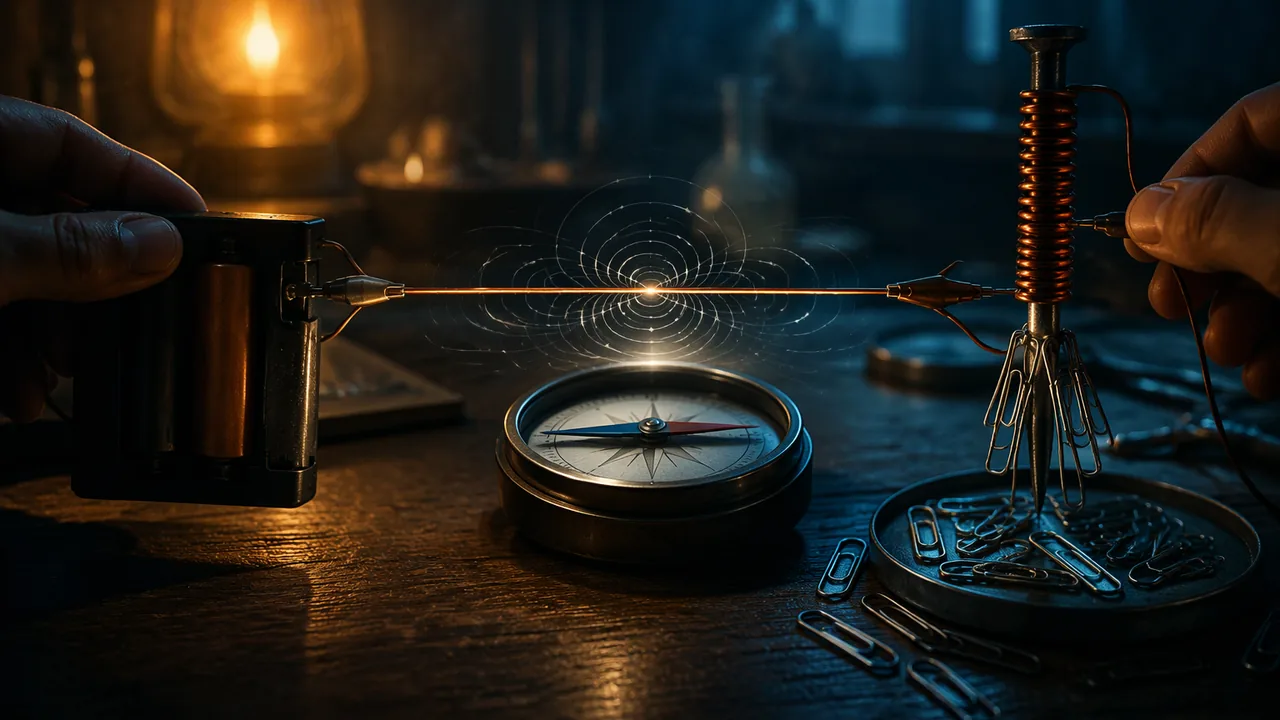
build an electromagnet and a compass test, calculate the magnetic field of a wire and a coil, and argue from controlled evidence that an electric current produces a magnetic field.
Instruction
The claim to argue. In 1820 Hans Christian Oersted noticed that a compass needle swung when a nearby wire carried current. The claim you will defend with your own evidence (9-12.PS2.B.2): an electric current produces a magnetic field. Every motor, speaker, hard-drive head and wind-turbine generator depends on it.
Magnetic fields. A magnetic field is the region around a magnet or a current where another magnet or moving charge feels a force. We draw it with field lines that run from a magnet’s north pole to its south pole outside the magnet; a compass needle lines up along them. Field strength is measured in teslas (T). Earth’s field at the surface is roughly 50 μT (NOAA’s World Magnetic Model, WMM2025, gives about 50-52 μT across Missouri in 2026, of which only about 20-22 μT is horizontal, the part that turns a compass needle).
The field of a straight wire. Field lines around a long straight wire are circles centered on the wire. The right-hand rule: point your right thumb along the current; your fingers curl the way the field circles. The field strength falls off with distance: B = μ0I/(2πr), with μ0 = 4π × 10−7 T·m/A. Worked example: 2.0 A, 1.0 cm from the wire, gives B = (4π × 10−7)(2.0)/(2π × 0.010) = 4.00 × 10⁻⁵ T = 40 μT. That is comparable to Earth’s field, which is why a compass near a current-carrying wire swings noticeably.
Coils multiply the effect. Wind the wire into a coil (a solenoid) and the fields of all the loops add up inside it. For a long coil, B = μ0nI, where n is turns per meter. Worked example: 200 turns on a 5.0 cm length (n = 4,000 turns/m) carrying 1.0 A gives B = (4π × 10−7)(4,000)(1.0) = 5.03 mT, about 100 times Earth’s field. Put an iron nail inside and the iron’s atomic magnets line up with the coil’s field, multiplying it hundreds of times more: an electromagnet. Unlike a permanent magnet, it switches off when the current stops.
Evidence from an electromagnet (illustrative).
| Turns of wire | 10 | 20 | 30 | 40 |
|---|---|---|---|---|
| Paper clips lifted, 1 cell | 2 | 5 | 7 | 10 |
| Paper clips lifted, 2 cells | 5 | 9 | 14 | 19 |
Both rows rise roughly in proportion to the number of turns (best-fit slopes through the origin: 0.24 and 0.47 clips per turn), and doubling the cells roughly doubles the clips. Paper-clip counts are a coarse measure: a clip either hangs or it does not, so each count is uncertain by about ±1 clip.
Building an argument that rules out alternatives. A skeptic could say: “The nail was magnetic anyway,” or “Batteries are magnetic.” Controls answer them. With the circuit open, the same nail lifts no clips. A compass beside a straight wire swings only while current flows, and reversing the battery reverses the swing. A coil with no nail still deflects a compass. The only thing that changed in every case was the current. That is how an argument from evidence isolates a cause (CCC.2).
Misconceptions. (1) “Electricity and magnetism are separate forces.” A current makes a magnetic field, and (Lesson 3.4) a changing magnetic field makes a current. (2) “Only iron makes magnetic fields.” Any current does; iron concentrates the field. (3) “More turns always means more clips.” Beyond some point the iron saturates and the extra wire adds resistance, lowering the current.
📖 Read for this lesson
The reading opens over the lesson; close it to come back to exactly where you were. The checks below draw on it.
Lab: Electromagnet and compass: does a current make a magnetic field?
Question. Does a current in a wire produce a magnetic field, and how does the field of a coil depend on the number of turns and the current?
Materials
- About 3 m of insulated (enamelled or plastic-coated) copper wire, 22-24 gauge, with the ends stripped
- A large iron nail or bolt (8-10 cm)
- One or two D or AA cells in holders with a push-button or tape switch
- A small magnetic compass and a box of small steel paper clips
- A coil connected straight across a cell draws a large current: close the circuit for no more than 10 seconds at a time, and let the wire and cell cool between trials.
- Use only 1.5 V cells, never a wall outlet or a rechargeable lithium pack; disconnect at once if the wire or cell becomes hot to the touch.
- Keep the compass and magnets away from phones, laptops and bank cards.
Procedure
- Oersted test: lay a straight section of wire north-south over the compass. Close the circuit briefly and record the needle’s deflection. Reverse the cell and repeat. Record what happens with the circuit open.
- Control: touch the bare nail to the paper clips and record how many it lifts.
- Wind 10 tight turns of wire around the nail. Close the circuit, dip the nail tip into the clips, lift, and count the clips held. Open the circuit and record what happens. Do three trials.
- Repeat with 20, 30 and 40 turns (wind more wire; keep the same total wire length connected so the current stays about the same).
- Repeat the 40-turn trial with two cells in series.
- Graph clips lifted against turns for one and two cells.
Data
| Turns of wire | 10 | 20 | 30 | 40 |
|---|---|---|---|---|
| Paper clips lifted, 1 cell | 2 | 5 | 7 | 10 |
| Paper clips lifted, 2 cells | 5 | 9 | 14 | 19 |
| Illustrative data; record three trials per row and the compass observations with the circuit open, closed and reversed. | ||||
Analysis
- Claim-evidence-reasoning: does a current produce a magnetic field? Use the compass test, the open-circuit controls and the turns data as evidence.
- Describe how the number of clips depends on the number of turns and on the number of cells. Is the pattern consistent with B = μ0nI?
- Clip counts are coarse. Estimate your uncertainty and say whether your trend is larger than it. Suggest a better way to measure the field strength.
If you cannot do this lab in person: Use PhET Magnets and Electromagnets (Electromagnet screen): record the field meter reading for 1-4 loops and for battery voltages from 2 to 10 V, and test the compass as you reverse the battery. The illustrative data table also supports the analysis.
Formative check
Work through these before moving on. They are not graded — they tell you whether the standard below has landed yet.
Which observation best rules out the claim that the nail was already a magnet?
A wire carrying 2.0 A produces a field of μT at 1.0 cm. Doubling the distance to 2.0 cm makes it μT.
Reversing the battery reverses the direction the compass needle swings near a current-carrying wire.
Record a 2-minute argument (or write 200-250 words) for the claim “An electric current produces a magnetic field.” Use at least three pieces of your own evidence, including a control, explain the reasoning, and answer the counterclaim “The battery itself is magnetic.” Then, a day later, reread your argument as a skeptical reviewer would and add a short reply that supports, qualifies or challenges it with one more piece of evidence. A written argument earns equal credit.
How confident are you that you can argue from controlled evidence that a current produces a magnetic field and calculate the field of a wire or coil?
Practice
Work these on paper or in your notebook, then open Check your answer. Aim for all of Fluency and Application; try at least one Challenge.
Printable version: this unit’s practice workbook (PDF)
Fluency
Build speed and accuracy with the core skill.
- A 9 V source is connected across a 5 Ω resistor. What current flows?
Check your answer
Answer: 1.800 AI = V/R. - A 3 V source is connected across a 2 Ω resistor. What current flows?
Check your answer
Answer: 1.500 AI = V/R. - Find the magnetic field 2.0 cm from a long wire carrying 5.0 A.
Check your answer
Answer: 5.00 × 10⁻⁵ T (50 μT)B = μ0I/(2πr). - A solenoid has 300 turns over 10 cm and carries 0.50 A. Find the field inside.
Check your answer
Answer: 1.88 × 10−3 TB = μ0nI with n = 3,000 turns/m. - If the current in a long straight wire doubles and you move twice as far away, what happens to the field?
Check your answer
Answer: It stays the sameB ∝ I/r. - Use the right-hand rule: current flows north in a wire lying on a table. Just above the wire, which way does a compass needle’s north end point?
Check your answer
Answer: EastThumb north; above the wire your fingers point east (B is along I × r̂, north × up = east). Below the wire the needle would swing west.
Application
Use the skill in context. Show your reasoning.
- At what distance from a wire carrying 10 A is the wire’s field equal to Earth’s field of about 50 μT?
Check your answer
Answer: 4.0 cmr = μ0I/(2πB). - How many turns per meter does an air-core solenoid need to make a 10 mT field with 2.0 A?
Check your answer
Answer: 3,979 turns/mn = B/(μ0I). - A student’s electromagnet lifts 4 clips with 20 turns and 9 clips with 40 turns, but also lifts 1 clip with the circuit open. What does the open-circuit result mean, and does it weaken their claim that the current makes the field?
Check your answer
Answer: The nail kept a little magnetism; the claim still holdsThe large change with current and turns, plus a compass test with a straight wire (no iron), still isolates the current as the cause. The residual clip shows the iron became slightly magnetized.
Challenge
Stretch problems. Expect to think before you write.
- Two long parallel wires 5.0 cm apart carry 8.0 A each in the same direction. Find the field one wire makes at the other, and the force per meter on the second wire (F/L = BI). Do they attract or repel?
Check your answer
Answer: 3.20 × 10⁻⁵ T; 2.56 × 10⁻⁴ N/m; attractB = μ0I/(2πr); F/L = BI. Parallel currents attract.
Review
Keep earlier skills sharp.
- Find the gravitational potential energy gained when a 70 kg object is lifted 1.5 m (g = 9.8 m/s2).
Check your answer
Answer: 1,029 JPE = mgh. - A +3.0 μC charge is 0.20 m from a −2.0 μC charge. Find the force and its direction.
Check your answer
Answer: 1.35 N, attractiveF = k|q1q2|/r2.
Does a Current Make a Field? The Compass Tests, the Controls and the Clip Counts
SLS constructed teaching data set (illustrative, not laboratory measurements) following the Lesson 3.3 procedure: Oersted compass tests with controls, clip counts at four turn counts and two currents; field calculations with the CODATA 2022 value of the vacuum magnetic permeability; retrieved Sept. 23, 2026 · SLS original, with public-domain NIST CODATA data
Why this reading. The argument you record needs “at least three pieces of your own evidence, including a control.” The lesson gives averaged clip counts and describes the controls in words. Here is the full record of one run of the lesson’s procedure: the compass tests with the circuit open, closed and reversed, the bare-nail and bare-battery controls, three trials at each number of turns for one and two cells, the measured currents, and the coil-without-nail test. It is an SLS teaching data set constructed to behave like a nail electromagnet and labeled illustrative; it is not a measurement from any named laboratory. The field calculations use the CODATA 2022 value of μ0.
Setup
Wire: 3.0 m of 24-gauge enameled copper, ends sanded bare. Core: 9 cm iron nail. Cells: fresh alkaline D cells, 1.5 V, in holders with a push-button switch. Compass: 25 mm liquid-filled, needle settling within 3 s. Clips: small steel paper clips, 0.4 g each. Current measured with the multimeter on its 10 A range while the circuit was closed for 5 s. The total wire length in the circuit was kept at 3.0 m at every turn count, with the unused wire lying straight, so that the resistance and the current stayed nearly the same as turns were added.
Table 1. The Oersted test (straight wire laid north-south over the compass)
| Condition | Needle deflection from north | Notes |
|---|---|---|
| circuit open | 0° | needle points north; wire in place |
| circuit closed, 1 cell | about 35° toward west | swing begins the instant the switch closes |
| cell reversed, circuit closed | about 35° toward east | same size, opposite direction |
| circuit open again | 0° | returns to north within 3 s |
| bare cell held 2 cm from compass, no wire | 0° | control: a battery alone does nothing |
| circuit closed, wire 5 cm above compass instead of touching | about 12° toward west | farther from the wire, smaller field |
| 40-turn coil with no nail, 1 cell, end of coil 2 cm from compass | about 40° | current in a coil deflects the needle without any iron |
Table 2. Clips lifted, one cell (measured current 1.9 A)
| Turns | Clips, trials 1-3 | Mean | Reported (rounded) |
|---|---|---|---|
| 10 | 2, 2, 3 | 2.3 | 2 |
| 20 | 5, 4, 5 | 4.7 | 5 |
| 30 | 7, 8, 7 | 7.3 | 7 |
| 40 | 10, 9, 10 | 9.7 | 10 |
Table 3. Clips lifted, two cells in series (measured current 3.6 A)
| Turns | Clips, trials 1-3 | Mean | Reported (rounded) |
|---|---|---|---|
| 10 | 5, 5, 6 | 5.3 | 5 |
| 20 | 9, 10, 9 | 9.3 | 9 |
| 30 | 14, 13, 14 | 13.7 | 14 |
| 40 | 19, 20, 18 | 19.0 | 19 |
Controls for the clip test: the bare nail, before any wire was wound, lifted 0 clips; the 40-turn nail with the circuit open lifted 0 clips in three tries; the instant the switch opened during a lift, every clip fell.
Reading the record
Proportional to turns. Fitting a line through the origin to the reported means: slope Σ(turns × clips)/Σ(turns)2 = 730/3,000 = 0.24 clips per turn for one cell and 1,410/3,000 = 0.47 for two. Doubling the cells raised the current from 1.9 to 3.6 A (a factor of 1.9, not 2, because the cells’ internal resistance is now a larger share of the loop) and the slope by a factor of 1.9. Both agree with B = μ0nI: field proportional to turns per meter and to current.
Uncertainty. A clip either hangs or it does not, so each count is uncertain by about ±1 clip; the three-trial spreads in Tables 2 and 3 are all 1 clip. Between 10 and 40 turns the count rises by 8 (one cell) and 14 (two cells), many times that uncertainty, so the trend is real. A better instrument would be a magnetometer app on a phone, reading the field in microtesla directly at a fixed distance.
The calculations, with CODATA μ0 = 1.256 637 061 27 × 10−6 N/A2. A straight wire at 2.0 A, 1.0 cm away: B = μ0I/(2πr) = (1.2566 × 10⁻⁶)(2.0)/(2π × 0.010) = 4.00 × 10⁻⁵ T = 40 µT; at 2.0 cm, 20 µT. That is the size of Earth’s field, which is why the needle in Table 1 swings about 35° rather than all the way to west: it settles along the vector sum of Earth’s field and the wire’s. A 200-turn, 5.0 cm coil (4,000 turns per meter) at 1.0 A: B = μ0nI = 5.03 mT, about a hundred times Earth’s field. The nail multiplies that again, which is why 40 turns at 1.9 A lifts ten clips.
The counterclaims, answered from the record
“The nail was magnetic anyway.” Bare nail, 0 clips; 40 turns with the switch open, 0 clips; switch closed, 10. The only change is the current. “The battery is magnetic.” A bare cell 2 cm from the compass: 0°. The same cell driving a wire: 35°, and reversing the cell reverses the swing, which a lump of magnetic material could not do. “It is the iron, not the current.” The coil with no nail deflected the compass 40°. Each control removes one alternative cause and leaves the current.
Your turn
- Recompute both slopes from the means, then from the raw trials (use all twelve points for each cell count). Do the two fits agree within the clip uncertainty?
- Which rows of Table 1 are controls, and what alternative explanation does each rule out?
- Compute the field 1.0 cm from a wire carrying the measured 1.9 A and 3.6 A, and explain why the compass swing in Table 1 is not simply proportional to the current.
- Write the 200–250 word argument with three pieces of evidence from Tables 1–3, including one control, and answer “the battery itself is magnetic” with the specific row that refutes it.
Sources: NIST CODATA 2022, vacuum magnetic permeability (physics.nist.gov)