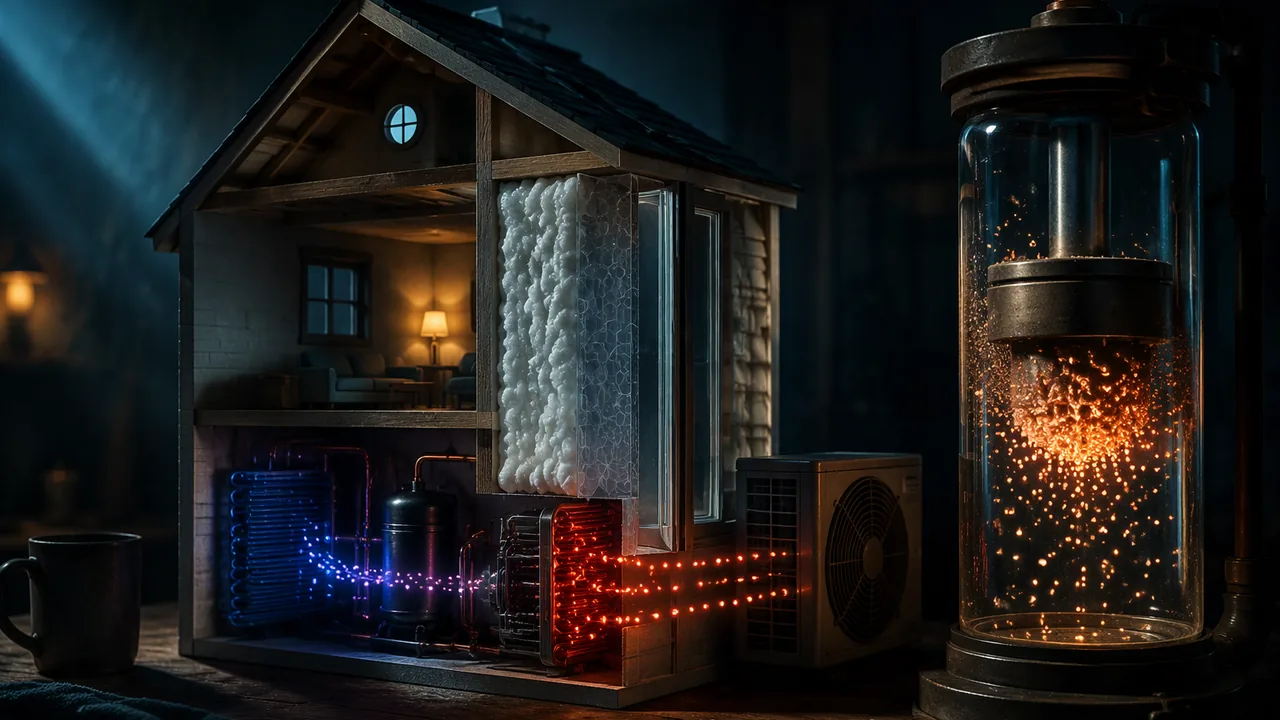
explain gas pressure and the gas laws with the particle model, describe how heat pumps move heat with work, and explain from molecular structure why foam, aerogel and double-pane glass insulate.
Instruction
Gas pressure is a particle model. A gas is mostly empty space with molecules moving fast in random directions. Each molecule that bounces off a wall reverses its momentum, and the wall must push on it; by Newton’s third law, the molecule pushes back on the wall. Billions of such collisions every nanosecond add up to a steady force per area: pressure. Raise the temperature and the molecules move faster, so they hit harder and more often, and the pressure rises. Worked example: at 300 K the average kinetic energy of a molecule is (3/2)kBT = 6.21 × 10⁻²¹ J. For nitrogen (mass 4.65 × 10⁻²⁶ kg per molecule) that corresponds to a root-mean-square speed vrms = √(3kBT/m) ≈ 517 m/s, faster than the speed of sound in air.
The ideal gas law. Counting the collisions leads to PV = nRT, with R = 8.314 J/(mol·K) and T in kelvin. Its special cases: Boyle’s law (constant T: P1V1 = P2V2), Charles’s law (constant P: V/T constant) and the pressure law (constant V: P/T constant). Worked example: a tire reads 220 kPa on its gauge at 20 °C. A gauge reads pressure above the atmosphere, so the absolute pressure is 220 + 101.3 = 321.3 kPa. Parked on a sun-baked Missouri parking lot in July, the air inside reaches 50 °C. At constant volume, P2 = 321.3 × 323.15/293.15 = 354.2 kPa absolute, or 252.9 kPa on the gauge. Forgetting either the kelvin conversion or the atmosphere gives a wrong answer.
Refrigerators and heat pumps. Run a heat engine backward and you get a device that uses work W to move heat Qc out of a cold space and deliver Qh = Qc + W to a warm one. A refrigerator and an air conditioner pump heat out of the cold side; a heat pump heating a home pumps it into the warm side. Its performance is the coefficient of performance, COPheat = Qh/W, and the ideal limit is Th/(Th − Tc). Heating a house to 21 °C from 5 °C outdoor air (about a typical St. Louis January afternoon; the normal daily high is 40.4 °F, 4.7 °C): ideal COP = 294.15/16 = 18.4. Real heat pumps reach far less (a COP of about 3 is illustrative), but even that delivers three joules of heat per joule of electricity, which a resistance heater (COP 1) cannot.
Conduction and the structure of insulating materials (9-12.PS1.A.4). The conduction rate through a slab is P = kAΔT/d, where k is the thermal conductivity. Approximate room-temperature values: copper about 390, aluminum about 220, glass about 0.84, water about 0.6, still air about 0.026, polystyrene foam about 0.033 W/(m·K). Metals conduct well because free electrons carry energy quickly. Gases conduct poorly because their molecules are far apart and collide rarely. Good insulators are therefore solids that trap still air: foam is mostly tiny closed gas cells separated by thin plastic walls, so the air cannot circulate (no convection) and the solid path is thin and twisted. Silica aerogel takes the idea further: a network of nanometer-scale silica strands whose pores are smaller than the distance an air molecule travels between collisions, which cuts conduction through the gas below that of still air. Double-pane windows put a sealed gas layer between two sheets of glass.
Worked example: for 1 m2 of window, the thermal resistance d/(kA) of 4 mm of glass is 0.0048 K/W, and of a 12 mm still-air gap is 0.462 K/W. Resistances in series add, so a double pane (glass + gap + glass) has 0.471 K/W, almost all of it from the gas. (This slab model ignores the air films on each surface and convection inside the gap, so real windows differ; the comparison is the point.) A foam cooler wall (k = 0.033, A = 0.25 m2, d = 2.5 cm) with a 30 K difference conducts only 9.9 W.
Newton’s law of cooling. The rate of transfer is proportional to the temperature difference, so a cold drink warms quickly at first and then more slowly: T(t) = Troom + (T0 − Troom)e−kt. Insulation lowers k. In the illustrative curves below, 5 °C water in a 24 °C room reaches 10 °C after 6.8 min in a bare cup (k = 0.045/min) but 25.4 min in a foam cup (k = 0.012/min). You will measure your own curves in the mini-lab.
📖 Read for this lesson
The reading opens over the lesson; close it to come back to exactly where you were. The checks below draw on it.
Lab: Mini-Lab: Warming Curves of Insulated and Uninsulated Cups
Question. How much does an insulating layer slow the warming of cold water, and does Newton’s law of cooling model the warming curve?
Materials
- Three identical thin plastic or paper cups, plus foam sleeves, a foam cup, or cardboard and cloth for wrapping
- Cold tap water chilled with ice (remove the ice before starting)
- Digital thermometer or temperature probe (one per cup if possible)
- Timer, measuring cup, spreadsheet or graph paper
- Wear safety goggles and wipe up spills at once so no one slips; keep water away from any electrical outlets or chargers.
Procedure
- Record the room temperature. Prepare three cups: bare, one layer of insulation, and your best insulated design, each with the same volume (150 mL) of cold water.
- Record each starting temperature, then start the timer. Keep the cups out of direct sunlight and away from vents.
- Record every cup’s temperature every 2 minutes for at least 30 minutes, stirring gently before each reading.
- Plot temperature against time for all three cups on one set of axes.
- For each cup, compute ln[(Troom − T)/(Troom − T0)] and plot it against time; if Newton’s law holds, the points fall on a line with slope −k.
Data
| Time (min) | Bare cup (°C) | One layer (°C) | Best design (°C) |
|---|---|---|---|
| 0 (illustrative) | 5.0 | 5.0 | |
| 20 (illustrative) | 16.3 | 9.1 | |
| 0 | |||
| 2 | |||
| 4 | |||
| 6 | |||
| 8 | |||
| 10 | |||
| 12 | |||
| 14 | |||
| 16 | |||
| 18 | |||
| 20 | |||
| 22 | |||
| 24 | |||
| 26 | |||
| 28 | |||
| 30 |
The illustrative rows use a 24 °C room and k = 0.045/min (bare) and 0.012/min (foam); they are not real measurements.
Illustrative warming curves (Option B). Room 24.0 °C, 150 mL of water starting at 5.0 °C in each cup. These temperatures are generated from Newton’s law of cooling with k = 0.045, 0.025 and 0.012 per minute; they are not real measurements.
| Time (min) | Bare cup (°C) | One layer (°C) | Best design, foam (°C) |
|---|---|---|---|
| 0 | 5.0 | 5.0 | 5.0 |
| 2 | 6.6 | 5.9 | 5.5 |
| 4 | 8.1 | 6.8 | 5.9 |
| 6 | 9.5 | 7.6 | 6.3 |
| 8 | 10.7 | 8.4 | 6.7 |
| 10 | 11.9 | 9.2 | 7.1 |
| 12 | 12.9 | 9.9 | 7.5 |
| 14 | 13.9 | 10.6 | 7.9 |
| 16 | 14.8 | 11.3 | 8.3 |
| 18 | 15.5 | 11.9 | 8.7 |
| 20 | 16.3 | 12.5 | 9.1 |
| 22 | 16.9 | 13.0 | 9.4 |
| 24 | 17.5 | 13.6 | 9.8 |
| 26 | 18.1 | 14.1 | 10.1 |
| 28 | 18.6 | 14.6 | 10.4 |
| 30 | 19.1 | 15.0 | 10.7 |
Each cup warms by 5 °C (from 5.0 to 10.0 °C) after about 6.8, 12.2 and 25.4 minutes respectively. Work those times out from the table rather than taking them on trust.
Analysis
- Claim, evidence, reasoning: which insulation slowed the warming most? Compare the times each cup took to warm by 5 °C and your fitted k values, and explain the difference using conduction, convection and the structure of the insulating material.
- Is your ln plot a straight line? Identify where it curves and name a reason (evaporation, stirring, the cup’s own heat capacity, a thermometer that lags).
- Uncertainty: estimate the uncertainty in your fitted k from the scatter of the points about the line.
If you cannot do this lab in person: Choose one. All three earn full credit and end in the same three curves, the same ln plot and the same fitted k values. Option A — run the three cups. The procedure above. Any three identical cups and a kitchen thermometer will do; ice water from the tap is cold enough. Option B — the illustrative warming curves in the data section above. No equipment and no internet needed. Plot all three, compute ln[(24.0 − T)/(24.0 − 5.0)] against time for each, fit a line and report each k with the scatter about the line as its uncertainty. Because these numbers come from the model itself, your ln plots will be straight; the analysis question about where a real curve bends becomes a prediction, so name the effect you would expect and say where on the curve it would show. Option C — a phone and a window. Measure real cooling instead of warming, which needs no ice: pour equally hot tap water into a bare cup and into a cup wrapped in a towel, and record both temperatures every 2 minutes for 30 minutes with a kitchen thermometer. The law is the same, with Troom below the starting temperature instead of above it, so use ln[(T − Troom)/(T0 − Troom)] and fit k the same way. Two cups instead of three is enough on this route; say in your write-up why the direction of heat flow does not change the model. Safety for Options A and C: hot tap water only, never boiling, and wipe spills at once.
Formative check
Work through these before moving on. They are not graded — they tell you whether the standard below has landed yet.
Simulation & tools
Pressure from particle collisions
Open the Ideal screen. Pump in 100 heavy particles. Under Hold Constant choose Volume. Record the temperature (K) and pressure (kPa) once the pressure gauge settles.
- Use the heater to raise the temperature in four steps to about twice the starting kelvin temperature. Record T and P each time.
- Plot P against T. Is it a straight line through the origin (in kelvin)? What does that say about P/T at constant volume?
- Return to the start, choose Temperature as constant, and halve the width of the box with the handle. What happens to P? Explain both results with collisions: how often and how hard particles hit the walls.
Choose how you get the numbers. All three earn full credit and answer the same three questions.
Option A — the simulation above.
Option B — the readings in this table. No internet and no equipment needed. These are illustrative readings of the kind the simulation produces for 100 heavy particles. The simulation’s pressure and volume scales are its own, so treat these as a data set to analyze, not as laboratory measurements.
| Question | Held constant | Box volume (sim units) | T (K) | P (kPa) |
|---|---|---|---|---|
| 1 and 2 | Volume | 10.0 | 300 | 1,260 |
| 1 and 2 | Volume | 10.0 | 375 | 1,575 |
| 1 and 2 | Volume | 10.0 | 450 | 1,890 |
| 1 and 2 | Volume | 10.0 | 525 | 2,205 |
| 1 and 2 | Volume | 10.0 | 600 | 2,520 |
| 3 | Temperature | 15.0 | 300 | 840 |
| 3 | Temperature | 10.0 | 300 | 1,260 |
| 3 | Temperature | 5.0 | 300 | 2,520 |
Check yourself as you go: P/T should come out as the same 4.20 kPa/K in all five constant-volume rows, and PV should be the same 12,600 in all three constant-temperature rows.
Option C — measure a real gas. Block the tip of a clean plastic syringe (no needle) with a blob of modeling clay or firm tape. Measure the plunger’s diameter d and compute its area A = πd2/4. Stand the syringe upright on a kitchen scale, press the plunger down until the trapped air reaches 75% and then 50% of its starting volume, and read the scale (in kg) each time. The absolute pressure inside is 101 kPa + (scale reading in kg × 9.8) ÷ A. Check whether PV stays constant: that is question 3. For questions 1 and 2, use a tire gauge on a bicycle or car tire in the cool morning and again after it has stood in the sun, recording the air temperature both times, convert gauge pressure to absolute by adding 101 kPa, and test whether P/T is the same in kelvin. If you have no gauge, take the constant-volume rows from Option B’s table and say that you did.
Open in a new tab ↗ · PhET Interactive Simulations, University of Colorado Boulder · CC BY 4.0
Why is polystyrene foam a much better insulator than a solid block of the same plastic?
A tire at 220 kPa (gauge) and 20 °C warms to 50 °C. Its absolute pressure becomes about kPa, so the gauge reads about kPa.
Write a one-paragraph technical explanation (about 200 words) for a homeowner comparing a single-pane and a double-pane window. Explain at the molecular level why the gas layer insulates, use the thermal-resistance numbers from the lesson, and state one limitation of the simple slab model.
How confident are you that you can explain gas pressure with the particle model, use the gas laws in kelvin, describe heat pumps, and explain why foam, aerogel and double-pane glass insulate?
Practice
Work these on paper or in your notebook, then open Check your answer. Aim for all of Fluency and Application; try at least one Challenge.
Printable version: this unit’s practice workbook (PDF)
Fluency
Build speed and accuracy with the core skill.
- A balloon holds 2.0 L at 0 °C. At constant pressure, what is its volume at 100 °C?
Check your answer
Answer: 2.73 LCharles’s law with absolute temperature: convert to kelvin (add 273.15) before dividing. - A gas at 101.3 kPa and 25 °C occupies 5.0 L. What volume does it occupy at 202.6 kPa and 77 °C?
Check your answer
Answer: 2.94 LCombined gas law: P1V1/T1 = P2V2/T2, with T in kelvin. - A gas at 101.3 kPa and 25 °C occupies 10.0 L. What volume does it occupy at 80.0 kPa and 0 °C?
Check your answer
Answer: 11.60 LCombined gas law: P1V1/T1 = P2V2/T2, with T in kelvin. - Find the pressure of 2.0 mol of an ideal gas in 24.5 L at 298.15 K (R = 8.314 L·kPa/(mol·K)).
Check your answer
Answer: 202.4 kPaPV = nRT. - A tire reads 230 kPa (gauge) at 15 °C and warms to 45 °C at constant volume. What does the gauge read?
Check your answer
Answer: 264 kPaUse absolute pressure and kelvin: (331.3)(318.15/288.15) − 101.3. - Find the conduction rate through a 1.5 m2 single-pane window 4.0 mm thick (k = 0.84 W/(m·K)) with a 25 K difference (slab model).
Check your answer
Answer: 7,875 WP = kAΔT/d.
Application
Use the skill in context. Show your reasoning.
- A foam cooler wall (k = 0.033 W/(m·K), area 0.30 m2, 3.0 cm thick) has 30 K across it. Find the heat flow and explain the role of the foam’s structure.
Check your answer
Answer: 9.9 WClosed cells trap still gas, which conducts poorly and cannot convect. - What is the ideal coefficient of performance of a heat pump warming a house to 20 °C from 5 °C outdoor air?
Check your answer
Answer: 19.5COP = Th/(Th − Tc) in kelvin. - Find the rms speed of nitrogen molecules (4.65 × 10⁻²⁶ kg) at body temperature, 310 K.
Check your answer
Answer: 526 m/sv = √(3kBT/m).
Challenge
Stretch problems. Expect to think before you write.
- A real heat pump with COP 3.2 delivers 9.0 kW of heat. How much electrical power does it use, and how much heat does it pull from the outdoor air?
Check your answer
Answer: 2.81 kW; 6.19 kWW = Qh/COP; Qc = Qh − W.
Review
Keep earlier skills sharp.
- Find the gravitational potential energy gained when a 70 kg object is lifted 10 m (g = 9.8 m/s2).
Check your answer
Answer: 6,860 JPE = mgh. - Find the gravitational potential energy gained when a 55 kg object is lifted 3 m (g = 9.8 m/s2).
Check your answer
Answer: 1,617 JPE = mgh.
Constants, Check Columns and Slab Resistances: A Reference for the Particle Model and the Window
NIST CODATA 2022 recommended values (Boltzmann constant, molar gas constant); SLS original worked tables built on the Lesson 2.4 illustrative readings and conductivity values; retrieved Sept. 23, 2026 · Public domain (NIST CODATA), with SLS original worked tables
Why this reading. This lesson already carries its evidence: the gas-property readings for Option B, the warming curves for the mini-lab, and the conductivity values for the window paragraph. What it leans on without showing is the reference data behind them. This short reading supplies the CODATA constants the particle model uses, works the Option B check columns so you can verify your own, and collects the thermal-resistance arithmetic for the homeowner paragraph in one place. It adds nothing you must memorize; it is a reference to compute against.
1. The constants, from NIST CODATA 2022
| Constant | Value | Status |
|---|---|---|
| Boltzmann constant kB | 1.380 649 × 10−23 J/K | exact (defining constant of the SI) |
| Molar gas constant R | 8.314 462 618 J/(mol·K) | exact |
| Absolute zero | −273.15 °C, so T(K) = T(°C) + 273.15 | definition of the Celsius scale |
Checks on the lesson’s particle numbers. Average kinetic energy per molecule at 300 K: (3/2)(1.380649 × 10−23)(300) = 6.21 × 10⁻²¹ J. Root-mean-square speed of nitrogen (4.65 × 10⁻²⁶ kg): √(3kBT/m) = √(1.2426 × 10⁻²⁰/4.65 × 10−26) = 517 m/s. The tire: 220 kPa gauge is 321.3 kPa absolute; at 50 °C, 321.3 × 323.15/293.15 = 354.2 kPa absolute, 252.9 kPa gauge.
2. Option B readings with the check columns filled in
The lesson’s illustrative simulation readings for 100 heavy particles, with P/T and PV computed. The pressure and volume scales are the simulation’s own.
| Box volume (sim units) | T (K) | P (kPa) | P/T (kPa/K) | PV |
|---|---|---|---|---|
| 10.0 | 300 | 1,260 | 4.20 | 12,600 |
| 10.0 | 375 | 1,575 | 4.20 | 15,750 |
| 10.0 | 450 | 1,890 | 4.20 | 18,900 |
| 10.0 | 525 | 2,205 | 4.20 | 22,050 |
| 10.0 | 600 | 2,520 | 4.20 | 25,200 |
| 15.0 | 300 | 840 | 2.80 | 12,600 |
| 10.0 | 300 | 1,260 | 4.20 | 12,600 |
| 5.0 | 300 | 2,520 | 8.40 | 12,600 |
Rows 1–5 (volume held at 10.0): P/T is 4.20 kPa/K in every row, so P against T is a straight line through the origin in kelvin; in Celsius it would cross the axis at −273 °C. Rows 6–8 (temperature held at 300 K): PV is 12,600 in every row; halving the volume doubles the pressure because each particle hits the walls twice as often. Rows 5 and 8 have the same pressure for different reasons: faster particles hitting harder and more often, or the same particles hitting a wall half as far away twice as often.
3. Thermal resistance for the homeowner paragraph
The lesson’s approximate room-temperature conductivities, in W/(m·K): copper 390, aluminum 220, glass 0.84, water 0.6, still air 0.026, polystyrene foam 0.033. For 1 m2 the slab resistance is d/(kA):
| Layer | d | k (W/(m·K)) | Resistance for 1 m2 (K/W) |
|---|---|---|---|
| one pane of glass | 4 mm | 0.84 | 0.0048 |
| sealed still-air gap | 12 mm | 0.026 | 0.462 |
| double pane: glass + gap + glass | — | — | 0.471 |
| single pane alone | 4 mm | 0.84 | 0.0048 |
| foam cooler wall (0.25 m2) | 2.5 cm | 0.033 | 3.03 (for that area) |
The gap supplies 98% of the double pane’s resistance; the two sheets of glass together supply 2%. With a 20 K indoor-outdoor difference, 1 m2 of single pane conducts 20/0.0048 = 4,170 W in this slab model and the double pane 20/0.471 = 42 W. Real single panes conduct far less than 4,170 W, because the model leaves out the thin films of nearly still air that cling to both faces of the glass and add resistance of their own; that is the limitation the open question asks you to name. The cooler wall with a 30 K difference conducts 30/3.03 = 9.9 W.
4. Heat pumps and cooling curves
Ideal heating COP between 5 °C outdoors and 21 °C indoors: Th/(Th − Tc) = 294.15/16 = 18.4. For the mini-lab’s model curves, the time for 5 °C water in a 24 °C room to reach 10 °C is t = −ln[(24 − 10)/(24 − 5)]/k = 0.3054/k: 6.8 min for k = 0.045/min, 12.2 min for 0.025/min and 25.4 min for 0.012/min, which are the times the lesson states.
Your turn
- From the Option B table, plot P against T and read the intercept in kelvin; then state what a plot against Celsius would show.
- Compute the resistance of a 16 mm air gap and the double pane it makes, and say what fraction of the improvement over 12 mm the extra 4 mm buys.
- Write the 200-word homeowner paragraph using the 0.0048, 0.462 and 0.471 K/W figures, and end with the model’s limitation stated as a physical mechanism.
Sources: NIST CODATA 2022, Boltzmann constant (physics.nist.gov); NIST CODATA 2022, molar gas constant (physics.nist.gov)