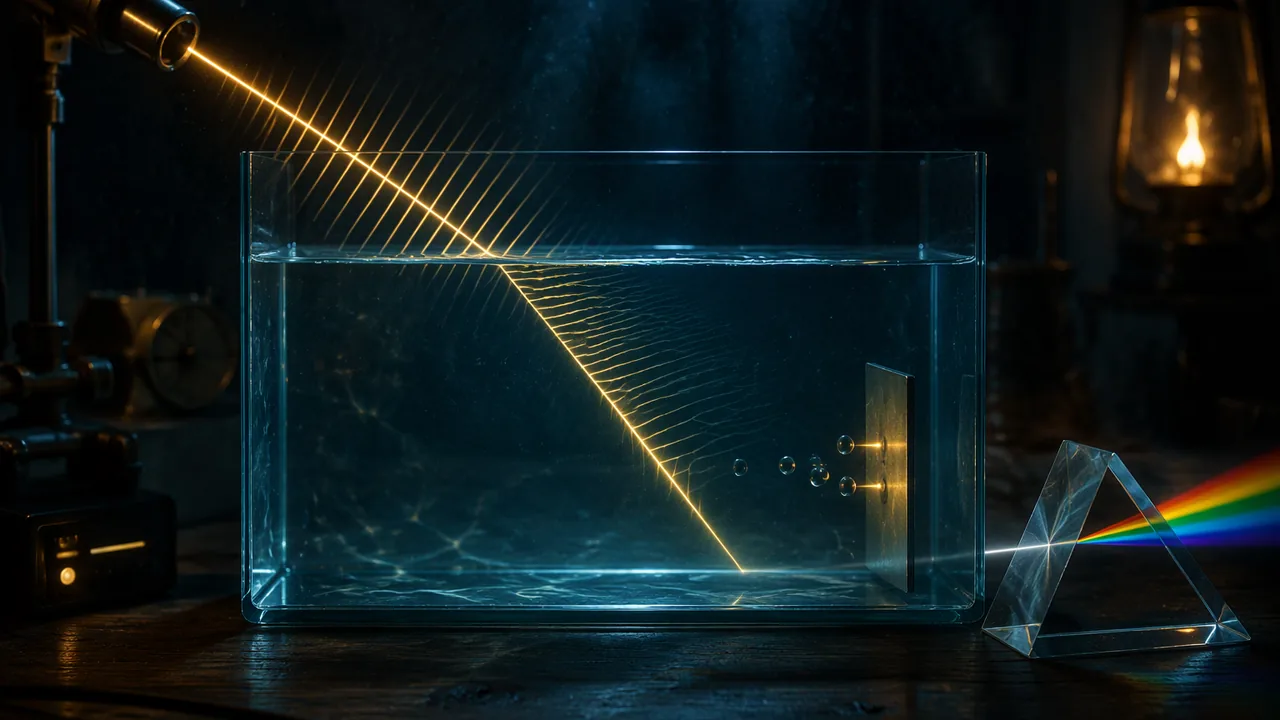
measure refraction angles and apply Snell’s law, compute photon energies with E = hf, explain when the wave or particle model of light is more useful, and evaluate claims about how different frequencies of electromagnetic radiation affect matter.
Instruction
Light is an electromagnetic wave. Light, radio, microwaves, infrared, ultraviolet, X-rays and gamma rays are all electromagnetic (EM) waves: linked electric and magnetic fields that need no medium and travel at c = 3.00 × 10⁸ m/s in a vacuum. They differ only in frequency and wavelength, with c = fλ. A red laser pointer at 650 nm has f = c/λ = 4.62 × 10¹⁴ Hz.
Refraction. Light slows down in matter. The index of refraction is n = c/v; water has n ≈ 1.33, so light travels at 2.26 × 10⁸ m/s in water. When light crosses a boundary at an angle, it bends. Snell’s law gives the angles, measured from the normal (the line perpendicular to the surface): n1 sin θ1 = n2 sin θ2.
Worked example 1. A beam in air hits water at 40°. sin θ2 = (1.00 × sin 40°)/1.33, so θ2 = 28.9°. In acrylic (n ≈ 1.49, typical) the same beam bends to 25.6°. Light bends toward the normal entering a slower medium. The frequency stays the same, so the wavelength shrinks: 650 nm in air becomes 650/1.33 = 489 nm in water.
Total internal reflection. Going the other way, from water into air, light bends away from the normal. At the critical angle the refracted ray skims along the surface: sin θc = n2/n1 = 1/1.33, so θc = 48.8° (acrylic: 42.2°). Beyond it, all the light reflects. Optical fibers trap light this way: a glass core surrounded by cladding of slightly lower index. With a core of 1.48 and cladding of 1.46 (typical values), θc = 80.6°, so light running nearly parallel to the fiber stays inside for kilometers.
When the wave model is not enough. Refraction, interference and diffraction are explained by waves. But in the photoelectric effect, light shining on a metal ejects electrons, and the results defy a pure wave picture: dim violet light ejects electrons immediately, while bright red light ejects none at all from the same metal. Einstein’s explanation: light arrives in packets, photons, each with energy E = hf = hc/λ, where h = 6.626 × 10⁻³⁴ J·s. One photon gives its energy to one electron. If that energy is less than the metal’s work function W (the minimum energy to free an electron), nothing happens, however bright the light.
Worked example 2. A red 650 nm photon has E = (6.626 × 10⁻³⁴)(3.00 × 10⁸)/(650 × 10−9) = 3.06 × 10⁻¹⁹ J = 1.91 eV (1 eV = 1.602 × 10⁻¹⁹ J). A 405 nm violet photon has 3.06 eV. Sodium’s work function is about 2.3 eV (approximate). Red cannot eject electrons from sodium; violet can, with at most 3.06 − 2.3 = 0.76 eV of kinetic energy left over. Brighter light means more photons, so more electrons, not faster ones. Which model is “right”? Both: the wave model predicts where light goes, the particle model predicts how it trades energy with matter.
Frequency decides the effect on matter. Photon energy rises with frequency. A 300 nm UV-B photon carries 4.14 eV, enough to alter bonds in DNA, which is why UV causes sunburn and raises skin-cancer risk; NOAA and EPA publish a daily UV Index (3-5 moderate, 6-7 high, 8-10 very high, 11+ extreme). A 2.45 GHz microwave-oven photon carries only 1.01 × 10⁻⁵ eV, about 410,000 times less; microwaves heat food by making water molecules rotate, not by breaking bonds. A 28 GHz 5G photon carries 1.16 × 10⁻⁴ eV. Radiation that can knock electrons out of atoms (roughly 10 eV and up: far UV, X-rays, gamma rays) is called ionizing. Radio, microwaves, infrared and visible light are non-ionizing; their main absorbed effect is heating, which depends on intensity and exposure time.
Misconceptions. “Radiation” does not always mean dangerous; the word covers sunlight and radio. “More intense microwaves become ionizing.” No: intensity adds photons, it never raises the energy of each one.
📖 Read for this lesson
The reading opens over the lesson; close it to come back to exactly where you were. The checks below draw on it.
Lab: Bending a Laser Beam: Measuring the Index of Refraction
Question. What is the index of refraction of water (or acrylic), found from measured angles, and at what angle does total internal reflection begin?
Materials
- Class 2 red laser pointer (the label says Class 2 or Class II; under 1 mW preferred, never above 5 mW). No laser at home: a small flashlight shining through a 1-2 mm slit cut in a piece of card makes a narrow beam that works in a darkened room
- Clear rectangular plastic food container half-filled with water, with a few drops of milk to make the beam visible, or a clear acrylic block or clear plastic box
- Paper protractor printed on card, sheet of paper, pencil and ruler
- Paper towels
- Never aim the laser at anyone’s eyes, and never look into the beam or its reflection; keep the beam below eye level, parallel to the table.
- No mirrors or shiny objects pointed toward faces; block the far side of the table with a sheet of card. Keep the laser away from younger children and pets, and have a parent or guardian nearby while it is in use.
- Keep water away from the laser and any electrical device; wipe up spills at once.
- Use only a pointer labeled Class 2 or Class II (under 1 mW preferred, never above 5 mW); if the label is missing or says Class 3 or higher, use the flashlight slit or the PhET route instead.
Procedure
- Trace the container or block on paper and draw a normal line at the point where the beam will enter.
- Aim the laser along the table at the entry point at 20° from the normal. Mark the beam’s path inside with two dots and measure the refracted angle.
- Repeat for 30°, 40°, 50° and 60°. Record each pair of angles.
- For each pair compute n = sin θ1/sin θ2. Graph sin θ1 against sin θ2; the slope is n.
- Send the beam from inside the water or block toward the far surface and increase the angle until the beam no longer escapes. Record that critical angle and compare it with sin−1(1/n).
Data
| θ1 in air | θ2 inside | sin θ1 | sin θ2 | n |
|---|---|---|---|---|
| 20° | 0.342 | |||
| 30° | 0.500 | |||
| 40° | 0.643 | |||
| 50° | 0.766 | |||
| 60° | 0.866 | |||
| Illustrative check: for water (n = 1.33), 40° in air gives 28.9° inside; the critical angle is 48.8°. | ||||
Analysis
- Claim-evidence-reasoning: state your value of n from the slope, compare it with the accepted value (water 1.33, acrylic about 1.49) and give the percent difference.
- Your predicted and measured critical angles: do they agree within your angle-reading uncertainty (about ±1°)?
- Sources of error: the container wall, the width of the beam, and reading the protractor. Which affects large angles most, and why?
If you cannot do this lab in person: PhET Bending Light (Intro screen): Air above, Water below, use the protractor to record five angle pairs and find the critical angle by moving the laser underneath. Or use the recorded five-angle run in this lesson’s reading, or the illustrative check values in the table.
Formative check
Work through these before moving on. They are not graded — they tell you whether the standard below has landed yet.
Simulation & tools
Snell’s law and total internal reflection
On the Intro screen, set the top material to Air and the bottom to Water, turn on the Normal, and drag out the protractor. Record the refracted angle for incident angles of 20°, 40° and 60° and compute n = sin θ1/sin θ2 each time. Then set the top to Water and the bottom to Air, and find the angle at which the refracted ray disappears. Question: does your critical angle match sin−1(1/1.33) = 48.8°? No device: use Snell’s law to compute the three refracted angles and the critical angle by hand.
Open in a new tab ↗ · PhET Interactive Simulations, University of Colorado Boulder · CC BY 4.0
Bright red light ejects no electrons from a metal, but dim violet light does. Which explanation fits?
A 300 nm ultraviolet photon carries about eV, while a 2.45 GHz microwave photon carries about × 10−5 eV.
Find a published claim about 5G or cell-phone radiation causing harm (a news story, video or website). Evaluate its validity and reliability: who published it, what evidence it offers, and whether it agrees with photon-energy physics and with reliable sources (FCC, FDA, WHO, peer-reviewed studies). Compute the photon energy of the frequency involved and compare it with the roughly 10 eV needed to ionize atoms. Then name the effect radio waves do have when absorbed (heating) and explain why exposure limits are set on absorbed power.
How confident are you that you can apply Snell’s law, compute photon energies and use them to explain effects of electromagnetic radiation on matter and judge published claims?
Practice
Work these on paper or in your notebook, then open Check your answer. Aim for all of Fluency and Application; try at least one Challenge.
Printable version: this unit’s practice workbook (PDF)
Fluency
Build speed and accuracy with the core skill.
- A wave has frequency 2 Hz and wavelength 0.5 m. What is its speed?
Check your answer
Answer: 1.00 m/sv = fλ. - A wave has frequency 256 Hz and wavelength 2 m. What is its speed?
Check your answer
Answer: 512.00 m/sv = fλ. - Light in air hits water (n = 1.33) at 30° from the normal. Find the refraction angle.
Check your answer
Answer: 22.1°n1 sin θ1 = n2 sin θ2. - Find the critical angle for glass (n = 1.52) to air.
Check your answer
Answer: 41.1°sin θc = 1/1.52. - Find the energy of a 532 nm green laser photon in joules and eV.
Check your answer
Answer: 3.74 × 10⁻¹⁹ J = 2.33 eVE = hc/λ; divide by 1.602 × 10⁻¹⁹. - Find the speed of light in glass with n = 1.52.
Check your answer
Answer: 1.97 × 10⁸ m/sv = c/n.
Application
Use the skill in context. Show your reasoning.
- In the refraction lab, a beam at 45° in air bends to 32° in a block. What is the block’s index of refraction, and which material could it be?
Check your answer
Answer: 1.33; acrylic (about 1.49) is closen = sin 45°/sin 32°. - Sodium’s work function is about 2.28 eV. Will 400 nm violet light eject electrons? If so, with what maximum kinetic energy? What is the longest wavelength that works?
Check your answer
Answer: Yes; 0.82 eV; about 544 nmE = hc/λ = 3.10 eV; KEmax = E − W; cutoff λ = hc/W. - A website claims 5G signals at 3.5 GHz break DNA bonds like ultraviolet light. Compute the photon energy and evaluate the claim.
Check your answer
Answer: 1.45 × 10⁻⁵ eV; unsupportedA 320 nm UV photon carries 3.88 eV; bonds need a few eV and ionization about 10 eV. Radio photons carry hundreds of thousands of times too little energy; their absorbed effect is heating.
Challenge
Stretch problems. Expect to think before you write.
- Light enters an optical fiber whose core has n = 1.48 and cladding n = 1.46. Find the critical angle at the core-cladding boundary and explain why the fiber must keep light nearly parallel to its axis.
Check your answer
Answer: 80.6°sin θc = 1.46/1.48; only rays hitting the wall at more than this angle from the normal (nearly grazing) are totally reflected.
Review
Keep earlier skills sharp.
- Resistors of 15 Ω and 5 Ω are in series across 120 V. Find the total resistance, the current and the voltage across each resistor.
Check your answer
Answer: 20 Ω; 6.000 A; 90.00 V and 30.00 VSeries: resistances add, the current is the same everywhere, and the voltages add to the source voltage. - Find the kinetic energy of a 2 kg object moving at 5 m/s.
Check your answer
Answer: 25.0 JKE = ½mv2.
Five Angle Pairs, Real Constants: The Recorded Refraction Trials and a Photon-Energy Spectrum Table
SLS constructed teaching data set (illustrative, not laboratory measurements) following the Lesson 4.4 procedure: five incidence angles in a water-filled container, plus the critical-angle trial; NIST CODATA fixed values of h, c and e (public domain); U.S. EPA UV Index scale (public domain) · Public domain (NIST CODATA, U.S. EPA), with an SLS original recorded refraction trial and worked photon-energy table
Why this reading. The lab table gives sin θ1 for five incidence angles and leaves every refracted angle blank — nothing to check a measurement against. And the photon-energy quiz and fill-in only exercise two points on the spectrum (650 nm red and a 300 nm UV photon). Below is a full recorded run of the lesson’s own five-angle procedure plus the critical-angle trial, and a photon-energy table that runs from radio to gamma rays using the constants’ fixed NIST values, so the wave/particle boundary and the ionizing/non-ionizing line can be checked across the whole spectrum, not just the two points the lesson works.
Table 1. Refraction trials, air into water (nwater taken as 1.33)
| θ1 in air | sin θ1 | θ2 measured | sin θ2 | n = sinθ1/sinθ2 |
|---|---|---|---|---|
| 20° | 0.342 | 15.2° | 0.262 | 1.31 |
| 30° | 0.500 | 22.3° | 0.380 | 1.32 |
| 40° | 0.643 | 29.1° | 0.486 | 1.32 |
| 50° | 0.766 | 34.9° | 0.572 | 1.34 |
| 60° | 0.866 | 40.4° | 0.649 | 1.33 |
Slope of sin θ1 against sin θ2 (least-squares through the origin): Σ(sinθ2·sinθ1)/Σ(sinθ22) = 1.592/1.198 = 1.33, a 0.04% difference from the accepted 1.33. The five individual ratios scatter from 1.31 to 1.34, protractor-reading noise (±1° on a 30 cm ray path is about ±0.3° of angular uncertainty); the slope, using all five points, is the more trustworthy estimate.
Table 2. Critical-angle trial
Sending the beam from inside the water toward the surface, the refracted ray grew fainter and stretched toward the surface as the angle increased, and vanished (all light reflected) at a measured angle of 49.1°, against the prediction sin−1(1/1.33) = 48.8° — a difference of 0.3°, inside the ±1° reading uncertainty. Three repeat trials at the same setup gave 48.6°, 49.1° and 49.4°, mean 49.0°.
Table 3. Photon energy across the electromagnetic spectrum, from fixed constants
Using NIST’s exact defined values h = 6.62607015 × 10⁻³⁴ J·s, c = 299,792,458 m/s and e = 1.602176634 × 10⁻¹⁹ C (fixed by the 2019 SI redefinition, so these are not measured with any uncertainty): E = hc/λ, then divided by e to convert joules to electron-volts.
| Radiation | λ or f | Photon energy (eV) | Ionizing? (roughly 10 eV+) |
|---|---|---|---|
| FM radio | 100 MHz | 4.14 × 10⁻⁷ | No |
| Microwave oven | 2.45 GHz | 1.01 × 10⁻⁵ | No |
| 5G (28 GHz band) | 28 GHz | 1.16 × 10⁻⁴ | No |
| Infrared (heat lamp) | 1000 nm | 1.24 | No |
| Red laser (lesson’s lab) | 650 nm | 1.91 | No |
| Violet light | 405 nm | 3.06 | No |
| UV-A (tanning, sunlight) | 350 nm | 3.54 | No |
| UV-B (sunburn range) | 300 nm | 4.14 | No (but alters DNA bonds) |
| UV-C (germicidal) | 250 nm | 4.96 | No |
| Soft X-ray | 1 nm | 1,240 | Yes |
| Gamma ray (typical) | 0.001 nm | 1,240,000 | Yes |
The pattern the quiz and fill-blank draw from a single pair of rows is visible across the whole table: photon energy rises smoothly with frequency (falls with wavelength) across ten and a half decades, from radio at 4 × 10⁻⁷ eV to gamma rays above a million eV, and the roughly 10 eV ionizing threshold falls between UV-C and soft X-rays — visible light and every radio band sit far below it, however bright the source.
The U.S. EPA’s UV Index, and where photon energy fits it
The EPA’s published UV Index scale runs 0-2 (Low), 3-5 (Moderate), 6-7 (High), 8-10 (Very High) and 11+ (Extreme), with protection guidance at each level. The index measures the intensity (how much UV energy per second reaches the ground), not the photon energy of any single UV photon, which is set by wavelength alone (3.5 to 4.96 eV across UV-A to UV-C in Table 3, regardless of how sunny or cloudy the day is). A UV Index of 11 does not mean each photon carries more energy than at a UV Index of 3; it means far more UV-B and UV-A photons are arriving per second, which is why the EPA’s sun-protection advice scales with index, while the physics reason UV damages skin (breaking chemical bonds) does not change from one index level to the next.
Your turn
- Use Table 1’s slope method to compute n and its percent difference from 1.33, and compare that with the largest single-row difference (which row is farthest from 1.33, and by how much)?
- Using Table 3, find the two rows that bracket the ionizing threshold and state the wavelength range (in nm) where a photon crosses from non-ionizing to ionizing.
- A tanning lamp emits mostly UV-A (350 nm). Using Table 3’s photon energy, explain why UV-A causes gradual skin damage over years rather than immediate sunburn the way UV-B does, in terms of photon energy compared with UV-B’s.
- Explain, using the EPA’s own definition of the Index, why a physics claim that “higher UV Index means each photon is more dangerous” is not quite right, and state what actually changes between index levels.
Sources: NIST, CODATA Value: Planck constant (fixed, 2019 SI) (physics.nist.gov); NIST, CODATA Value: elementary charge (fixed, 2019 SI) (physics.nist.gov); U.S. EPA, UV Index Scale (epa.gov)