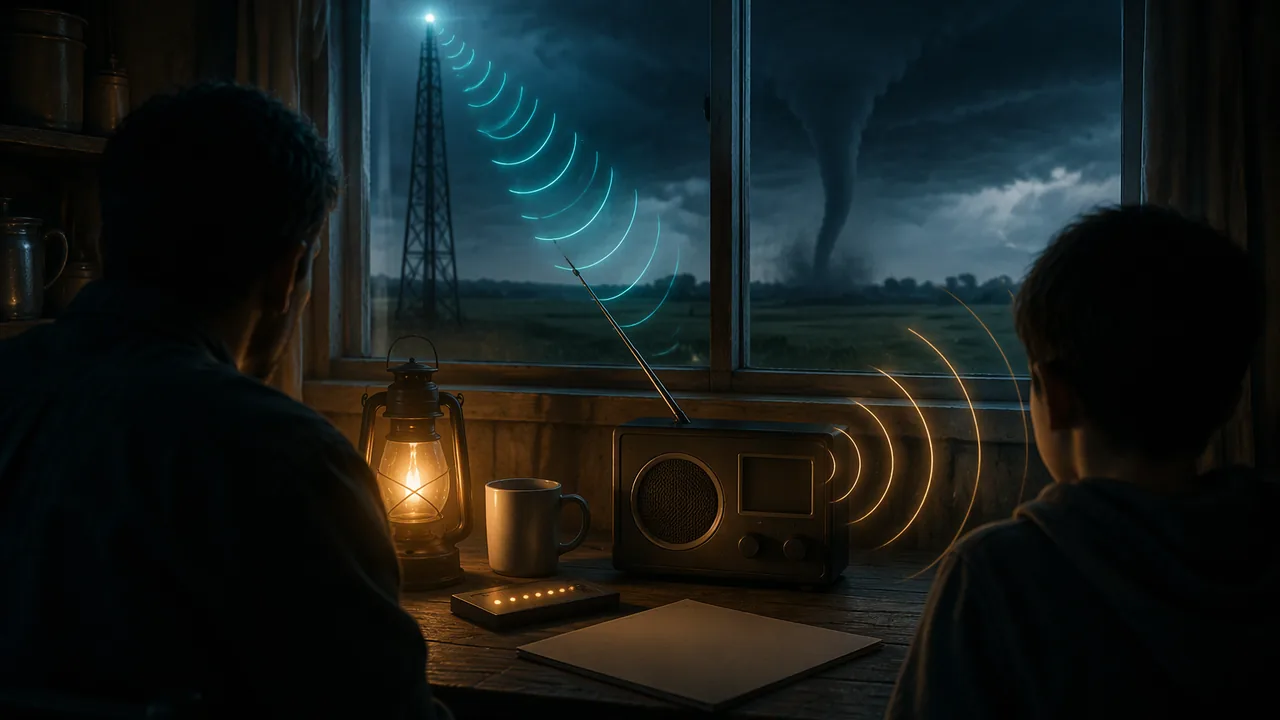
write and defend a technical brief that explains, with calculations and cited evidence, how a device uses wave behavior and wave interactions with matter to transmit and capture information and energy.
Instruction
Your task. Write a technical brief that explains, for an informed non-specialist reader such as a county emergency manager in southeast Missouri or a family deciding whether to buy a weather radio, how one real device uses wave behavior to transmit and capture information and energy. Choose a warning chain for Missouri (an earthquake alert for the New Madrid Seismic Zone modeled on the West Coast’s ShakeAlert, or the Wireless Emergency Alerts and NOAA Weather Radio that carry Missouri tornado warnings), fiber-optic internet, solar cells, or a medical imaging method (ultrasound or X-ray). The brief must contain at least three calculations from this unit and an evaluation of one published claim about your device.
What a strong technical brief does. It states the problem the device solves, explains the wave physics step by step, uses numbers to show why the design works, names the limits, and cites sources. Each paragraph should answer one question. Diagrams do real work: a labeled ray diagram or a time-distance graph can replace a page of text.
Calculations you can build on.
- Missouri warning chain: warning time from typical P and S speeds (6 and 3.5 km/s) for a New Madrid earthquake: the unit model gives 16.2 s at Cape Girardeau (80 km) and 60.7 s at St. Louis (236 km); a late-alert zone of about 23 km; digital delivery by fiber (2.45 ms per 500 km); the NOAA Weather Radio SAME header (464 bits at 520.83 bits/s, 0.89 s per copy, 2.67 s for three) and a Weather Radio wavelength (162.475 MHz gives 1.85 m).
- Fiber optics: critical angle at a core-cladding boundary, 80.6° for indices 1.48 and 1.46 (typical), speed of light in the core c/n, bit rate and the time to send a file.
- Solar cells: silicon’s band gap of about 1.12 eV means only photons with λ below hc/E = 1108 nm can free an electron; compute photon energies across the spectrum and explain why excess photon energy becomes heat.
- Ultrasound imaging: sound travels about 1540 m/s in soft tissue (OpenStax); at 5.0 MHz, λ = 0.308 mm, which sets the smallest detail the image can resolve. Echo time gives depth: d = vt/2.
Evaluating a claim. Pick one published claim about your device, for example that 5G towers cause illness, that solar panels do not work on cloudy days, that an earthquake early-warning system would warn everyone before any shaking, or that a phone alert makes a weather radio unnecessary. Ask: Who published it, and what is their evidence? Does it agree with the physics (photon energy, intensity, wave speed)? Does it agree with other reliable sources such as USGS, NOAA, the FCC, NIH or peer-reviewed studies? State whether the claim is supported, partly supported or unsupported, and why.
Process. Plan, draft, check every number yourself against this lesson’s source packet, revise, then defend your brief in a short recorded presentation. Keep a log of every source and every number you use.
📖 Read for this lesson
The reading opens over the lesson; close it to come back to exactly where you were. The checks below draw on it.
Formative check
Work through these before moving on. They are not graded — they tell you whether the standard below has landed yet.
Why can a silicon solar cell not use photons of wavelength 1500 nm?
Stage 1 plan: name your device, the three calculations you will include (with the formula and data source for each), the diagram you will draw, and the published claim you will evaluate with at least two sources you will check it against.
How confident are you that you can communicate, with calculations and evidence, how a device uses waves to transmit and capture information and energy?
Unit 4 checkpoint
Do this before you start the task. It covers the whole unit and tells you what to review first.
A 500 Hz sound in water (1,480 m/s) has a wavelength of m.
When a wave passes from air into water, which stays the same?
With P at 6.0 km/s and S at 3.5 km/s, the S-minus-P lag 100 km away is s.
On a string fixed at both ends, one loop of a standing wave is one full wavelength.
Quadrupling the tension on a string the wave speed.
A digital signal can be relayed many times without degrading because
A 16-bit sample has possible levels.
Light at 30° in air enters glass (n = 1.50). The refracted angle is °.
Why does bright red light eject no electrons from a metal that dim violet light affects?
Making microwaves more intense raises the energy of each microwave photon.
A 300 nm UV photon carries about eV.
A solar cell uses which wave interaction to capture energy?
Submit: Waves at Work technical brief (1,000-1,400 words, one diagram, three calculations) + five-minute recorded presentation
Task: Choose one device: a warning chain for Missouri (an earthquake alert for the New Madrid Seismic Zone modeled on the West Coast’s ShakeAlert, or the Wireless Emergency Alerts and NOAA Weather Radio that carry Missouri tornado warnings), fiber-optic internet, a solar cell, or an ultrasound or X-ray imaging system. Write a technical brief for a county emergency manager in southeast Missouri or a family deciding whether to buy a weather radio that explains how the device uses wave behavior and wave interactions with matter to transmit and capture information and energy. Include (1) a labeled diagram (ray diagram, time-distance graph or signal chain); (2) at least three calculations from this unit (v = fλ, t = d/v, Snell’s law or critical angle, E = hf, bit rate), each shown step by step with units and a cited data source; (3) an explanation of why the device uses digital information or a particular frequency band; (4) an evaluation of one published claim about the device for validity and reliability; and (5) the device’s limits. Label every number as sourced (USGS, NWS, NIST, OpenStax, FCC) or illustrative.
Submission workflow
- Stage 1 — Plan. Device, three planned calculations with their formulas and data sources, a sketch of the diagram, and the claim you will evaluate with two sources to check it against.
- Stage 2 — Self-checked draft. Recompute every calculation a second way (a different order of steps, a unit check, or the worked numbers in this lesson’s source packet), open each source again and confirm the number you used, and mark any step a non-specialist could not follow; record each check and each fix in a revision log. A parent, guardian or other adult may read the draft for clarity, but every check is yours.
- Stage 3 — Revised final. 1,000-1,400 words with the diagram, the calculations, the claim evaluation, the limits and a source list.
- Stage 4 — Recorded defense. A five-minute video or audio recording with your diagram on screen, explaining your device and then answering two defense questions: (a) Which of your three numbers would change most if your largest input were 20% wrong, and by how much? (b) What is the strongest evidence against your claim verdict, and why does your verdict still stand (or not)?
How it is scored
| Criterion | What proficient looks like |
|---|---|
| Wave explanation (9-12.PS4.B.1) | Explains accurately how the device uses wave behavior and wave interactions with matter to transmit and capture information and energy. |
| Calculations (9-12.PS4.A.1, MP.4) | At least three correct calculations, set up from the physics, with units, sourced inputs and a sentence interpreting each result. |
| Radiation and matter (9-12.PS4.B.2) | Relates frequency or photon energy to the effect on matter, correctly distinguishing ionizing from non-ionizing radiation where relevant. |
| Evaluating claims (SEP.8, RST.11-12.9) | Judges one published claim’s validity and reliability against physics and at least two reliable sources, with a clear verdict. |
| Structure and function (CCC.6) | Links the device’s design features (fiber indices, sample rate, band gap, frequency) to what they let it do, and states its limits. |
| Communication (RST.11-12.2) | Clear for a non-specialist; diagram labeled; sources cited; both defense questions answered accurately in the recording. |
Four Devices, Every Calculation Worked: A Source Packet for the Waves-at-Work Technical Brief (Missouri Edition)
SLS worked calculations for all four device choices in the RLP Lesson 4.5 task, built from NIST fixed constants, typical published fiber values, OpenStax College Physics 2e Table 17.1 (tissue), the Ioffe Institute silicon data, USGS New Madrid and ShakeAlert pages, NWS and 47 CFR 11.31 alert specifications, 47 CFR 1.1310, FCC 19-126 and the FDA cell-phone page; all retrieved November 5, 2026 · Public domain (USGS, NWS, FCC, FDA and federal-regulation material), with SLS original worked calculations; OpenStax figure CC BY 4.0
Why this reading. The task lets a student pick any one of four devices, but the mini-lecture only sketches the calculation for each — one line per device, no worked numbers to check a first attempt against, and no sourced claim to evaluate beyond the single 5G example already used in Lesson 4.4. This packet works all three required calculations for each of the four devices from real, cited figures, and gives the actual government statement behind the claim each device’s brief is most likely to raise, with Missouri’s own earthquake and tornado warning chain as the first route, so a student can check their own numbers before submitting a stage.
Route 1: A warning chain for Missouri (extends the Lesson 4.1 model)
Earthquake option. For a model earthquake under the town of New Madrid (distances from the Census Bureau’s 2024 place coordinates): Cape Girardeau, 80 km, gets tS − 6.7 = 80/3.5 − 6.7 = 16.16 s of warning; St. Louis, 236 km, gets 236/3.5 − 6.7 = 60.73 s. Late-alert zone: d = 3.5 × 6.7 = 23.45 km. Digital delivery over 500 km of fiber (core index 1.47): 500,000/(299,792,458/1.47) = 2.45 ms, about 24,770 times shorter than St. Louis’s 60.73 s of warning. USGS describes the West Coast’s ShakeAlert as giving “seconds to tens of seconds of warning” (Fact Sheet 2023–3033); Missouri has no public earthquake early-warning system, so a brief on this option explains what one would do here. Tornado option. NOAA Weather Radio at 162.475 MHz: λ = 3.00 × 10⁸/1.62475 × 108 = 1.85 m. Its SAME header (42 characters plus a 16-byte preamble, 464 bits) at 520.83 bits/s (47 CFR 11.31) takes 0.89 s per copy and 2.67 s for the three required copies. A Wireless Emergency Alert of up to 360 characters is 2,880 bits. Claims to evaluate: that an earthquake early-warning system “will warn everyone before any shaking” (USGS’s own “seconds to tens of seconds” and the 23 km late-alert zone contradict it), or that a phone alert makes a weather radio unnecessary (WEA rides the mobile carrier’s network, while NOAA Weather Radio has its own “more than 1000 transmitters,” so the two fail in different ways; partly supported at best).
Route 2: Fiber-optic internet
Using a typical single-mode fiber core index of 1.48 and cladding index of 1.46 (typical manufacturer values), the critical angle at the core-cladding boundary is sin−1(1.46/1.48) = 80.6°; light entering the core steeper than 9.4° from the fiber’s axis stays trapped by total internal reflection. Speed of light in the core: c/1.48 = 2.03 × 10⁸ m/s, so a signal crosses 500 km in 2.47 ms. At a residential 1 Gbit/s (1 × 109 bits/s) service, a 4.7 GB (4.7 × 109 byte, 3.76 × 1010 bit) file downloads, ignoring overhead, in 37.6 s. Claim to evaluate: that fiber is “basically instant” regardless of distance. The 2.47 ms transit time over 500 km is not zero, and the download-time calculation shows that for most files the bit rate, not the speed of light, is what a user actually experiences — a brief should distinguish transit delay (light speed, tiny) from transfer time (bit rate, often the larger number).
Route 3: Solar cells
Crystalline silicon’s band gap is 1.12 eV at 300 K (Ioffe Institute semiconductor database, “Energy gap 1.12 eV”). The longest wavelength a silicon cell can use is λ = hc/E = (4.136 × 10⁻¹⁵ eV·s × 3.00 × 10⁸ m/s)/1.12 eV = 1108 nm (infrared, just past the visible range). A 550 nm green photon (2.25 eV) frees an electron and hands over 1.12 eV of that to the cell; the remaining 1.13 eV becomes heat in the silicon, which is why panels lose efficiency as they get hotter. A 1500 nm infrared photon (0.83 eV, from Table 3 of the companion refraction-and-photon reading) carries less than the band gap and passes through the cell doing no electrical work at all. Claim to evaluate: that solar panels “do not work on cloudy days.” Clouds reduce the number of photons reaching the panel (intensity), not the energy of each photon (set by wavelength, unaffected by clouds), so panels keep converting the photons that do arrive, at reduced output rather than zero output — a distinction the band-gap physics makes precisely, the same intensity-versus-photon-energy distinction the UV Index reading makes for sunlight.
Route 4: Ultrasound imaging
Sound in soft tissue travels at about 1540 m/s (OpenStax College Physics 2e, Table 17.1, “Human tissue 1540”). At a diagnostic frequency of 5.0 MHz, λ = v/f = 1540/(5.0 × 106) = 0.308 mm, which sets roughly the smallest structure the image can resolve (finer detail needs a higher frequency, which in turn penetrates less deeply — the same trade-off every wave-imaging method makes). Depth from echo timing: a reflection returning after 26 μs round-trip corresponds to d = vt/2 = 1540 × (26 × 10−6)/2 = 0.0200 m = 20.0 mm. Claim to evaluate: that ultrasound and X-ray imaging carry the same radiation risk. Ultrasound is a mechanical pressure wave, not an electromagnetic one, and carries no photon energy at all in the sense Lesson 4.4 defines it; X-ray photons (around 1,240 eV at 1 nm, see the companion photon table) are well above the roughly 10 eV ionizing threshold. The two methods are not comparable on an ionizing-radiation basis, which is exactly why ultrasound is preferred for imaging during pregnancy and X-ray is not used without a specific clinical reason.
The FCC and FDA’s own statements on RF safety (for a 5G, phone or fiber-adjacent claim)
The FCC’s rule, 47 CFR 1.1310, sets the limit on absorbed power, not on photon energy: for the general public, “a peak spatial-average SAR of 1.6 W/kg, averaged over any 1 gram of tissue.” In its December 2019 decision (FCC 19-126) the Commission reviewed the record and wrote: “we find no appropriate basis for and thus decline to propose amendments to our existing limits at this time,” relying on the Food and Drug Administration as the expert health agency. The FDA’s current cell-phone page states: “The weight of scientific evidence has not linked cell phone radio frequency radiation with any health problems.” RF photons (roughly 10−7 to 10−4 eV in the companion photon table) are non-ionizing at any power, which is why the limit is written in watts absorbed per kilogram. A brief evaluating a 5G-harm claim should compare it with these agencies’ own published positions, not with an assumption about what “radiation” generally means.
Your turn
- Pick the device you are not writing about and redo its three calculations from the figures above, checking your arithmetic against the worked numbers.
- For your chosen device, restate its claim-to-evaluate as a testable question, and say which piece of evidence above (a number, or an agency’s own words) would decide it.
- Every device route above distinguishes two things that are easy to conflate: transit time vs. transfer time (fiber), or photon energy vs. intensity (solar, RF, UV). State the analogous pair of ideas for your own chosen device.
Sources: USGS Fact Sheet 2023-3033 (ShakeAlert warning times) (pubs.usgs.gov); USGS, Earthquake Early Warning: ShakeAlert System Overview (usgs.gov); U.S. Census Bureau, 2024 Gazetteer Files (place file) (www2.census.gov); National Weather Service, NOAA Weather Radio All Hazards (weather.gov); National Weather Service, Wireless Emergency Alerts (weather.gov); 47 CFR 11.31, EAS protocol (eCFR) (ecfr.gov); 47 CFR 1.1310, Radiofrequency radiation exposure limits (eCFR) (ecfr.gov); FCC 19-126, Resolution of Notice of Inquiry on Human Exposure to Radiofrequency Electromagnetic Fields (Dec. 2019) (docs.fcc.gov); FDA, Scientific Evidence for Cell Phone Safety (fda.gov); OpenStax, College Physics 2e, 17.2 Speed of Sound, Frequency, and Wavelength (Table 17.1) (openstax.org); Ioffe Institute, Basic Parameters of Silicon (band structure) (ioffe.ru)