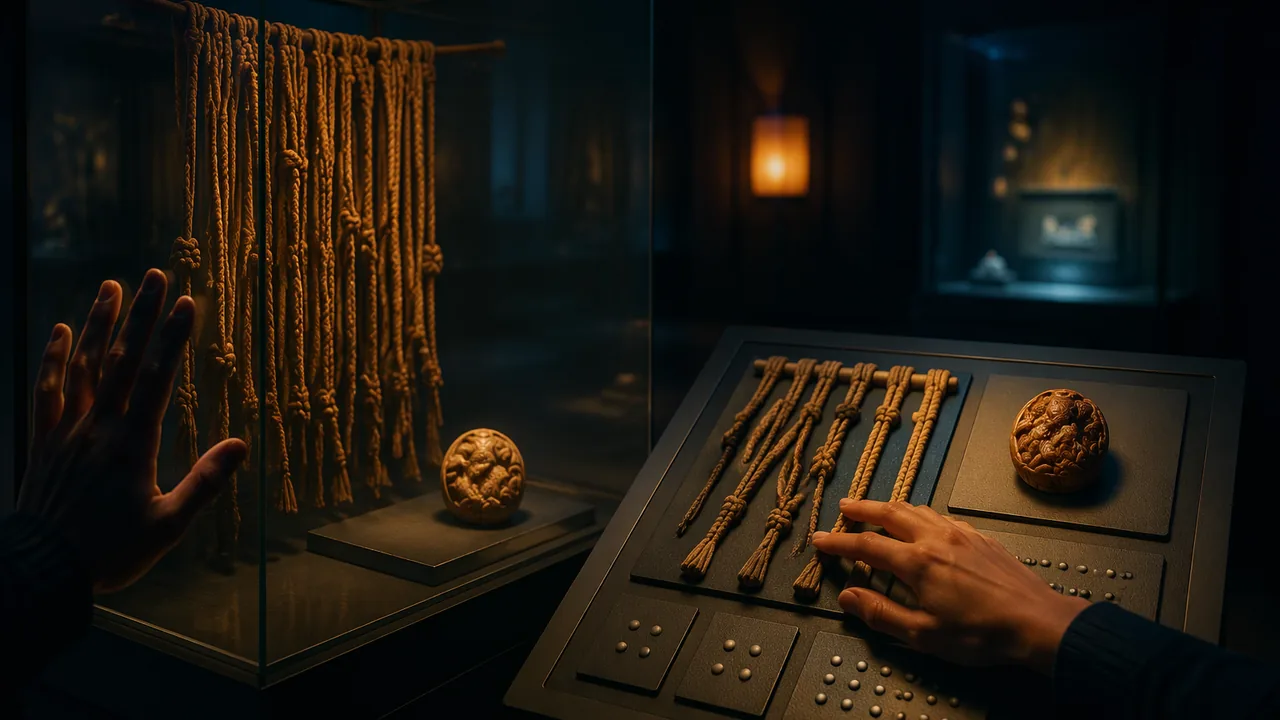
analyze how museums’ rules about touch shape who can experience art, and explain how objects such as the khipu and netsuke, and systems such as braille and tactile graphics, carry meaning through the hand.
Instruction
“Please do not touch” is the most common sign in any museum. It protects fragile objects, and it also means that for a visitor who is blind, most of a museum’s collection is available only through someone else’s words. This unit asks how art can be made, shown and shared for the hand as well as the eye.
Objects made for the hand. Many cultures made objects that were meant to be handled, and some that were meant to be read by touch. The Inka Khipu (about 1400-1532, Cleveland Museum of Art) is a set of knotted cotton and wool cords. The Inka state kept records on khipus: the type and position of knots on a cord recorded numbers in a base-ten system, and color, spin and cord attachment carried further information. Trained specialists read khipus with eyes and fingers. Scholars agree about the number system; whether khipus also recorded language or stories is still debated, and it is fair to say so. A small Japanese Netsuke (18th century, The Metropolitan Museum of Art) is a carved toggle used to hang a pouch or box from the sash of a kimono. Netsuke were made to be handled every day, and carvers rounded their forms so they would not snag — sculpture designed for the palm.
Braille. Braille is a tactile writing system of raised dots, each character made from a cell of up to six dots in two columns of three. It was developed in the 1820s by Louis Braille, who lost his sight as a young child and created the system as a student in Paris. Braille is a system of letters and contractions, not a picture language, and not every blind person reads it; audio description matters too. Braille reached American schools first in Missouri: the Missouri School for the Blind in St. Louis, which opened in 1851, became in 1860 the first school in the United States to adopt the braille system (City of St. Louis preservation plan; American Foundation for the Blind chronology).
Tactile graphics. A tactile graphic is an image redesigned so it can be read by touch: raised lines, textures and symbols, usually with braille or large-print labels and a key. They are made on special swell paper that puffs up where it is printed black, by molding plastic sheets, or by hand collage from card, string and textured materials. The Braille Authority of North America published Guidelines and Standards for Tactile Graphics in 2010; its core advice matches what you learned in Units 1 and 2 — simplify, keep only what the reader needs, make every line and texture distinct, and provide a key.
A Missouri museum’s answer. The Nelson-Atkins Museum of Art in Kansas City offers Verbal Description and Tactile Tours: guests who are blind or partially sighted explore the museum with trained docents, with approved touch of objects in the collection, verbal description of works in the galleries and optional art-making workshops led by teaching artists (museum tours page, retrieved 9 November 2026). So “please do not touch” has exceptions, arranged by the museum, for selected objects. Ask who chooses the objects, and how a visitor finds out the tours exist.
Why a picture is hard to read by touch. Sight takes in a whole image at once; touch builds it part by part. Perspective, overlapping shapes and fine detail, which sight decodes instantly, become confusing. A tactile version of Hokusai’s Great Wave (1830-33, Art Institute of Chicago) cannot simply raise every line of the print; it must decide what the image is about — a huge wave, small boats, a distant mountain — and present those parts in a clear order.
AI and access. Some apps now use AI to describe photos aloud for blind users. These descriptions can be useful and can also be confidently wrong, just like generated images. Access that depends on accuracy needs people checking it — including blind and low-vision people themselves. The disability rights principle “nothing about us without us” applies to this unit: you are designing for an audience you must consult, not imagine.
📖 Read for this lesson
The reading opens over the lesson; close it to come back to exactly where you were. The checks below draw on it.
Formative check
Work through these before moving on. They are not graded — they tell you whether the standard below has landed yet.
What is well established about how Inka khipus recorded information?
A tactile graphic should raise every line of the original image so nothing is lost.
All people who are blind read braille.
Look up the accessibility and tours pages of one art museum (the Nelson-Atkins Museum of Art in Kansas City is a Missouri example, summarized in the reading; any museum will do). What does it offer visitors who are blind or have low vision? Then compare the khipu and the netsuke: how does each carry meaning through the hand? End with one change the museum could make and why.
How confident are you that you can explain how access to touch shapes who can experience art?
Who Gets to Touch Art: Two Objects, Braille in Missouri, the Federal Rules and Two Museum Access Pages
SLS original dossier; records from Cleveland, Metropolitan and Art Institute of Chicago open-access data; 28 CFR via eCFR; 2010 ADA Standards (Access Board); LOC/NLS pages (retrieved 26 Sept 2026); City of St. Louis preservation plan, American Foundation for the Blind chronology and Nelson-Atkins Museum of Art tours and accessibility pages (retrieved 9 Nov 2026) · SLS original, with CC0 museum metadata, U.S. government text (public domain), short facts from an arXiv paper and the BANA guidelines (one short quotation), and short facts and quotations from City of St. Louis, AFB and Nelson-Atkins pages
Why this reading. The lesson asks you to analyze one museum’s access practices, compare two touch-read objects (the khipu and the netsuke), and explain how braille and tactile graphics carry meaning. Museum websites change and some may not load for you, so this reading carries the two objects described by form and surface, the braille cell, the federal rules and the standards, and a real Missouri museum’s access pages, summarized, beside a constructed one you can analyze. Museum records are open-access CC0 data; federal text is public domain; the constructed page is SLS original and describes no real museum. Retrieved 26 September 2026.
Inka Khipu (Fiber Recording Device)
Record: Peru, Inca period, c. 1400–1532; cords, knotted and twisted; cotton and wool; 113 × 137.2 cm overall; Cleveland Museum of Art, accession 1940.469 (CC0). The photograph: mounted on a cream cloth, dozens of thin cords hang like a fringe or a fan from a short horizontal main cord, each pendant a different length, in browns, tans, creams, grays and black; some cords are twisted from two colors. A few long cords loop free above the main cord. Small knots sit along many pendants as tiny beads at intervals, clustered in groups. How it reads by touch: a hand runs down each pendant and counts. A survey of khipu numeration (Pilgaonkar, arXiv:1405.6093, 2014) says the numbers are decimal: knots on a pendant record place values, the units at the bottom of the cord and tens, hundreds and thousands successively nearer the main cord; a single knot in a group counts one at that place, a long knot (several turns) records the units digit, and a figure-eight knot stands for 1 in the units place. Worked example (illustrative): on one pendant, reading from the main cord downward, three single knots, a gap, two single knots, a gap, then a long knot of four turns means 324. The same paper says the numerical basis is well understood but that more recent theories suggest khipus may also have encoded narrative information; that remains debated, so say “debated” when you write about it.
Netsuke (Japan, Edo period)
Record: Japan, Edo period (1615–1868), 18th century; wood; height 5.8 cm open and 3.7 cm closed, width 3.4 cm, depth 2.3 cm; Metropolitan Museum of Art, accession 10.211.2061; public domain (Gift of Mrs. Russell Sage, 1910); subject tags “Human Figures” and “Animals.” The photograph: a small box-like block of polished, reddish-brown wood, square in section, with a slightly worn, lustrous finish. Above it, on four slim posts under a flat roof, a tiny figure in a hat sits on an animal and plays a pipe. A thin curved line at one side of the box may be a cord loop; the photograph does not make it certain. The two heights in the record (open and closed) suggest a part that lifts. Why it suits a palm: the object is 3.7 cm high (closed) and 3.4 cm wide, small enough to close in a fist, with a smooth polished body, few sharp points and one detailed miniature scene. In the lesson’s account, a netsuke is a toggle that hangs a pouch from a kimono sash, so it was handled every day; the Met record does not say this, so credit it to the lesson.
Braille: the cell and the numbers
Louis Braille was born in 1809 and lost his sight in childhood; the Library of Congress says he lost it at age three after an accident in his father’s workshop. Its National Library Service says his system was devised by 1821, when he was twelve, from a military “night writing” code that needed a twelve-dot cell too large for one fingertip, and that he published his code in 1829. A braille cell has six positions, numbered 1, 2, 3 down the left column and 4, 5, 6 down the right. The first ten letters:
| Letter | Raised dots | Cell |
|---|---|---|
| a | 1 | ⠁ |
| b | 1, 2 | ⠃ |
| c | 1, 4 | ⠉ |
| d | 1, 4, 5 | ⠙ |
| e | 1, 5 | ⠑ |
| f | 1, 2, 4 | ⠋ |
| g | 1, 2, 4, 5 | ⠛ |
| h | 1, 2, 5 | ⠓ |
| i | 2, 4 | ⠊ |
| j | 2, 4, 5 | ⠚ |
The National Library Service gives an average braille reading speed of about 125 words per minute, with up to 200 possible. The 2010 ADA Standards (U.S. Access Board, public domain) set dimensions for braille on signs: dot base diameter 0.059 to 0.063 inch (1.5 to 1.6 mm), dot height 0.025 to 0.037 inch (0.6 to 0.9 mm), distance between two dots in one cell 0.090 to 0.100 inch (2.3 to 2.5 mm), and 0.241 to 0.300 inch (6.1 to 7.6 mm) between corresponding dots in adjacent cells (Table 703.3.1). Do not copy braille from memory; transcribers use these tables.
Braille in Missouri. The City of St. Louis preservation plan says the Missouri School for the Blind opened in 1851, that the state took over its operation four years later, and that in 1860 it was the first school in the United States to adopt the braille system; the American Foundation for the Blind’s chronology gives the same 1860 date. Braille reached the rest of the country’s schools only later, which is worth remembering when you read that a system “was invented” in one year: adoption is a separate story.
Tactile graphics and the standard
The Braille Authority of North America publishes Guidelines and Standards for Tactile Graphics (2010; a 2022 edition is now free online at brailleauthority.org; BANA holds the copyright). Its Unit 2 opens: a tactile graphic “is not an exact reproduction” of the print graphic. It says clutter occurs when components are too close or too alike to tell apart by touch, and is fixed by adding blank space between adjacent textures.
Hokusai’s Great Wave, as a test. Katsushika Hokusai, Under the Wave off Kanagawa (Kanagawa oki nami ura), also known as The Great Wave, from the series Thirty-Six Views of Mount Fuji, 1830/33; color woodblock print, oban, 25.4 × 37.6 cm; Art Institute of Chicago, accession 1925.3245; public domain. The museum says the series was begun when the artist was 70, that Hokusai used the newly affordable Berlin blue pigment for sky and water, and that a small Mount Fuji is seen in the distance under the crest of the giant wave. The photograph shows a great curling wave at left and center whose crest breaks into claw-like fingers of white foam over a deep-blue face, long narrow boats caught in the troughs, a small white-capped mountain far back under a stained brown-gray sky, and a printed title label in the upper left. It cannot be reproduced line for line; deciding what it is about (the huge wave, the small boats, the distant mountain) and the order a hand should meet them is the design task.
Federal rules on access (public domain)
28 CFR 36.104 lists among the places of public accommodation “a museum, library, gallery, or other place of public display or collection.” 28 CFR 36.303 requires a public accommodation to take the steps necessary so that no individual with a disability is excluded or treated differently for lack of auxiliary aids and services, unless doing so would fundamentally alter the goods or services or be an undue burden; its examples for people who are blind or have low vision include Brailled materials, audio recordings, and large print materials. For public entities, such as museums run by state or local governments, 28 CFR 35.160 similarly requires communications that are as effective as those with others and, where necessary, auxiliary aids and services. (eCFR, version of 20 September 2026.) None of these rules says a museum must let visitors touch original works; they require effective access to what is offered.
A real Missouri museum’s access pages (Nelson-Atkins Museum of Art, Kansas City)
Retrieved 9 November 2026; museum pages change, so check the date when you cite them. Tours page: “Verbal Description and Tactile Tours” invite guests who are blind or partially sighted to explore the museum through guided tours with trained docents; experiences include “the approved touch of objects in the collection,” verbal description of artworks in the galleries, and options for art-making workshops led by teaching artists; inquiries go to a community-programs email address. Accessibility page: lists wheelchair access, assistive listening devices, communication aid cards, color-blindness glasses, live captioning at some programs, noise-cancelling headphones, portable stools, social stories, service animals, American Sign Language interpretation (two weeks’ notice), Low Sensory Mornings, Minds in Motion tours for people with memory loss, and Access Tours for people with disabilities. What the pages, as retrieved, do not mention: braille or large-print gallery guides, or how many objects can be touched. That does not prove the museum lacks them; it shows what a visitor planning from the website can find. Use the same analysis frame below on this real page as on the constructed one.
A constructed museum access page (illustrative)
“Example Museum of Art” (not a real museum). Visitors are asked not to touch works of art. The museum offers: a monthly touch tour, on the first Saturday, of eight sculptures handled with gloves by trained guides, booked two weeks ahead; large-print gallery guides at the front desk; a phone audio tour describing 40 of the 2,000 works on display; two tabletop tactile reproductions of paintings, in the entrance hall; braille labels for the entrance and restrooms only; guide dogs welcome; a form to request other accommodations 72 hours ahead.
Analysis frame: (1) Which of the 2,000 works can a blind visitor reach, and by which route? (2) Which offerings need advance booking, and who is excluded by that? (3) Who described the works, and were blind consultants involved? (Nothing says so.) (4) One change, with the rule above that supports it.
Sources: eCFR, 28 CFR 36.104 and 36.303 (ADA Title III); 28 CFR 35.160 (Title II) (ecfr.gov); U.S. Access Board, 2010 ADA Standards, section 703 (access-board.gov); Library of Congress NLS, About Braille (loc.gov); Library of Congress, Louis Braille: His Legacy and Influence (loc.gov); BANA, Guidelines and Standards for Tactile Graphics (brailleauthority.org); Pilgaonkar, The Khipu-Based Numeration System (arXiv:1405.6093) (arxiv.org); Cleveland Museum of Art, Inka Khipu, 1940.469 (clevelandart.org); Metropolitan Museum of Art, Netsuke, 10.211.2061 (metmuseum.org); Art Institute of Chicago, The Great Wave, 1925.3245 (artic.edu); City of St. Louis, A Preservation Plan for St. Louis, Part I: Education (stlouis-mo.gov); American Foundation for the Blind, History of Education of People Who Are Visually Impaired (chronology) (afb.org); Nelson-Atkins Museum of Art, Tours (Verbal Description and Tactile Tours) (nelson-atkins.org); Nelson-Atkins Museum of Art, Accessibility (nelson-atkins.org)