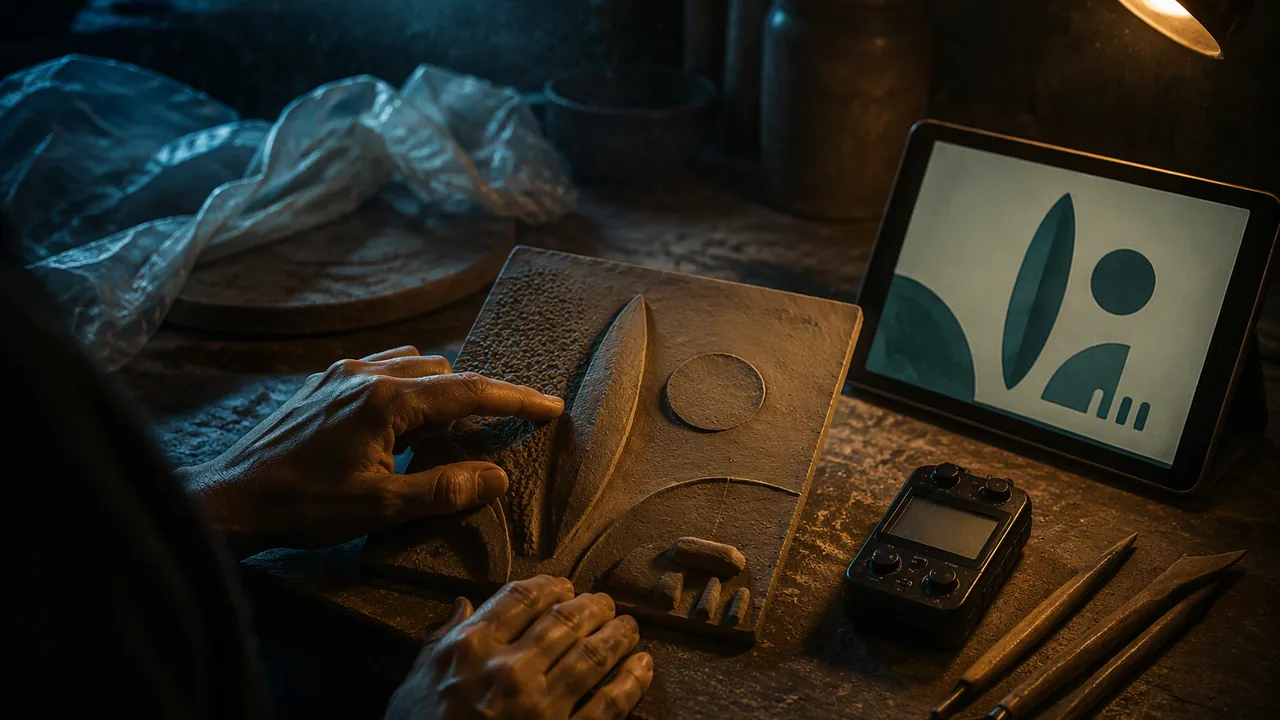
create, revise and defend a clay relief or small sculpture that interprets an AI-generated image through touch.
Instruction
This is the first portfolio work of the year and the course’s signature assignment: an AI-generated image translated into clay. It is scored on the quality of your interpretation and craft, not on how closely it copies the image.
Building. Work from your level map. Roll the ground slab first and keep it under loose plastic between sessions so it does not dry before you finish. Build the top-level forms early, because they carry the composition, and join every addition by scoring and slipping. Save texture for last; it is easy to crush while you are still building.
The touch test. Halfway through, the work is read by touch alone, with no hints and no sight of it. The reader’s script is three sentences long: Tell me everything you find, and where it is on the tile. Which form is the most important, and how do you know? What is this a picture of? Record the answers word for word. If the reader cannot find your main form, it is not yet high enough, sharp enough or isolated enough. This is the critiqued-draft stage, and you can run it two ways for the same credit. Option A, another reader: a family member or other adult reads the work with eyes closed or with the tile under a cloth, using the same three-sentence script; no art training is needed, which is the point of the test. Option B, yourself, with a gap: put the work away for at least a full day, then read it with your eyes closed and your non-dominant hand, answering the three questions out loud into a voice recorder before you look at it, and transcribe what you said. The day’s gap is what makes this a real test rather than a memory check. A photograph in raking light can add notes to either route, but it never replaces the reading by touch.
Revision. Revise in response to the touch test and to one principle from Lesson 1.3. Note in your sketchbook what you changed and why — this is the evidence your statement will cite.
Statement. Write 250-350 words. Name the source image by its label (tool, prompt, date). Explain what you kept, simplified, exaggerated and left out, and why. Explain one way your work says something the machine image does not. Close with one thing the touch test taught you.
Authorship. The U.S. Copyright Office’s position is that material generated purely by AI is not protected by copyright, while a person’s own creative contributions — selecting, arranging and substantially modifying — can be. Your clay work is your own creative expression; the AI image you started from is credited as a source, not claimed as yours.
Defense. In two minutes, recorded (or given live to a family member), present your work and answer one question about a choice you made. If nobody is there to ask you one, take whichever of these three you have the least ready answer to: why did you leave out what you left out; what would a person reading only by touch get wrong about your piece; and which single change would you make if you rebuilt it tomorrow?
📖 Read for this lesson
The reading opens over the lesson; close it to come back to exactly where you were. The checks below draw on it.
Formative check
Work through these before moving on. They are not graded — they tell you whether the standard below has landed yet.
Under the U.S. Copyright Office’s current position, an image generated entirely by an AI system from a prompt is protected by copyright as the prompt writer’s work.
Record your reader’s touch-test words exactly (another reader’s, or your own after a full day away). Then list two revisions you made in response and the reason for each.
How confident are you that you can revise a tactile work in response to critique and explain my choices?
Submit: The Clay Translation — finished work, statement (250-350 words) and two-minute defense
Task: Take the image you chose in Lesson 1.1, by any of that lesson’s three routes, and create a tactile representation of it in air-dry clay (relief tile at least 15 × 15 cm, or a small sculpture that fits in two hands). Your work must interpret the image through touch — keeping, simplifying, exaggerating and leaving out with purpose — rather than copy it.
Submission workflow
- Stage 1 — Plan. The Lesson 1.4 translation plan: image label, one-sentence test answer, three thumbnails, level map and keep / simplify / exaggerate / leave-out list.
- Stage 2 — Touch-tested work in progress. The work is read by touch without being seen, by either of the lesson’s two touch-test routes; record the reader’s words and your revision plan.
- Stage 3 — Final work and statement. Finished clay piece photographed in raking light from three angles, with a 250-350 word statement that credits the source image.
- Stage 4 — Defense. A two-minute recorded presentation (or one given live to a family member), answering one question about a choice.
How it is scored
| Criterion | What proficient looks like |
|---|---|
| Interpretation of the AI image (VA:Cr1B.I) | Keeps what matters in the image and transforms it deliberately; omissions and exaggerations are purposeful. |
| Craft and technique (VA:Cr2A.I) | Joins are sound, levels are distinct, textures are controlled and the work survives handling. |
| Readability by touch (VA:Re9A.I) | The main forms can be found and told apart without sight. |
| Revision (VA:Cr3A.I) | Changes respond clearly to the touch test and critique. |
| Process documentation (VA:Cn10A.I) | Sketchbook shows dated plans, tests and reasons for changes. |
| Statement and defense (VA:Re8A.I) | Credits the source, explains choices with evidence from the work, and answers the question directly. |
Portfolio Task 1: Touch-Test Script, Exemplar Entry and Reader’s Sheet
SLS original (exemplar is illustrative); guidance from 88 FR 16190, retrieved 26 Sept 2026 · SLS original, with a quotation from a U.S. government document (public domain)
Why this reading. Portfolio Task 1 gives you the assignment, the stages and the rubric. What it cannot give you on its own is a model of finished work, a script for the touch test, and a sheet for a reader to fill in. Those are here. The exemplar is constructed for this course (SLS original, illustrative); it is not any real student’s work.
Touch-test script and record form
Give the reader the tile with no hints. Say only: “Tell me everything you find, and where it is on the tile. Which form is the most important, and how do you know? What is this a picture of?” Write their words down exactly, and note the time they take and anywhere their hand hesitates. Do not help, not even by nodding. If you are your own reader, put the tile away for at least a full day, then read it with your eyes closed and your non-dominant hand, answer the three questions out loud into a voice recorder before you look, and transcribe your words into the form. Form:
| Question | Reader’s exact words | Hesitations, seconds | Matches my test sentence? (yes / partly / no) |
|---|---|---|---|
| Everything you find, and where | |||
| Most important form and why | |||
| What is it a picture of? |
Exemplar entry (illustrative)
Source image label: a panel from Zarya of the Dawn, Kris Kashtanova, images made with Midjourney, 2022 (wide red-rock desert under a pale sky, distant vehicle on a track); reproduced in the U.S. Copyright Office letter of 21 February 2023.
Touch-test record: Reader: “A big rough area at the bottom, a flat area at the top, and a tiny bump on a line in the middle.” Most important form: “the bump, because it is the only thing standing up.” A picture of: “maybe a road in a desert.” Matched the test sentence: partly. Revision: the bump was found only after 40 seconds, so I raised it from 4 mm to 9 mm and added a smooth pad around it.
Statement (about 250 words, illustrative):
My source is a desert panel from Zarya of the Dawn, made with Midjourney in 2022. The picture is mostly red rock under a pale sky, with a small vehicle on a track far away. Because a hand feels actual size, I could not keep the perspective: a track that narrows to the horizon feels like a wedge. I kept the vehicle and the empty space around it, because the loneliness comes from the tiny thing in the huge place. I simplified the rock into three impressed bands of cord marks, each deeper than the last, so the land seems to step away from the reader. I exaggerated the vehicle, raising it well above the ground so it is the first thing a hand finds. I left out the sky’s color and the cloud streaks, because on clay they would only be noise.
The machine image gives me only the look of roughness. Its texture is implied; it is a flat grid of pixels. My tile gives the hand real roughness, and it says something the image does not: that the small thing is findable, that someone can be reached across the emptiness. My first reader found the vehicle only after forty seconds and called the tile a road in a desert. I raised the vehicle, added a smooth pad around it to isolate it, and the second reader found it first. The touch test taught me that a clear picture in my head is not the same as a clear tile in someone else’s hand.
Authorship: what the federal guidance says
The U.S. Copyright Office’s registration guidance (Federal Register, 88 FR 16190, 16 March 2023; a U.S. government document, public domain, retrieved 26 September 2026) says: “If a work’s traditional elements of authorship were produced by a machine, the work lacks human authorship and the Office will not register it.” It adds that a human may select or arrange AI-generated material in a sufficiently creative way, or modify it enough that the changes meet the standard for copyright. In the Zarya of the Dawn letter, the Office found the author’s text and her selection and arrangement of the elements protected, and the Midjourney images not the product of human authorship. Your clay is your own authorship; the machine image beside it is not.
Reader’s sheet (for a family member or other adult, or for you after a day away)
- The reader’s first find: __________. Is it the form the maker meant? yes / no
- One texture or level the reader confused with another: __________
- Is the tile still standing after handling? Any cracks, lifted joins? __________
- One change that would help the reader most: __________
- One thing that already works: __________
Sources: Copyright Registration Guidance: Works Containing Material Generated by AI, 88 FR 16190 (federalregister.gov); U.S. Copyright Office letter on Zarya of the Dawn, 21 Feb 2023 (copyright.gov)