distinguish actual from implied texture, and explain how makers in five different cultures used surface to carry meaning, using evidence from museum records.
Instruction
Every surface is a record of how it was made. This lesson studies five makers who used that fact deliberately, and it introduces the key distinction of the unit: actual texture, which you can feel, and implied texture, which is only an appearance. A photograph of velvet has implied texture. So does every AI-generated image: the model has learned how rough things look, but its images are perfectly flat grids of pixels.
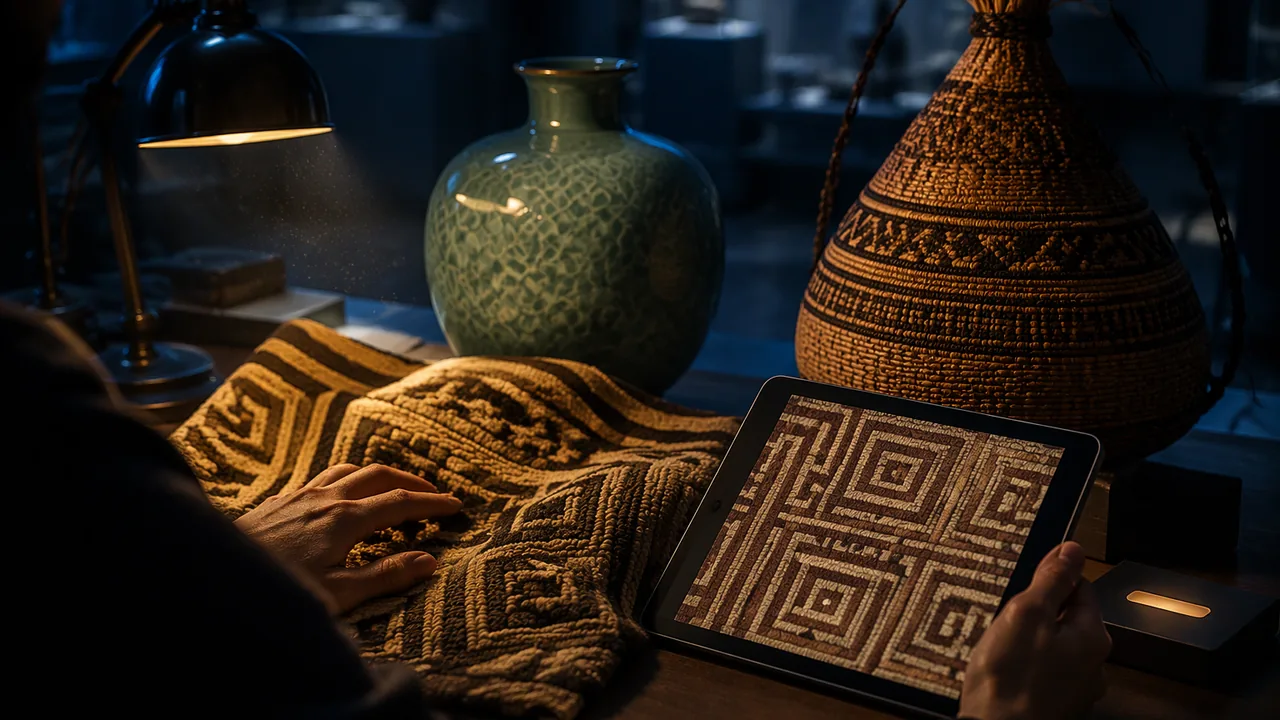
Kuba raffia cloth (Central Africa). Look at the Embroidered Raffia Pile Cloth made by Kuba artists in the Democratic Republic of the Congo (1900s, Cleveland Museum of Art). The base is woven from raffia palm fiber. Makers embroidered it with raffia thread and cut the stitches close to the surface, leaving a soft pile like velvet, arranged in geometric patterns that shift and break their own rules. The texture is doubled: a flat weave and a raised plush, side by side. Kuba cloth was valued as wealth and exchanged on important occasions; its surface is part of its value.
Goryeo inlaid celadon (Korea). The Vase with Inlaid Lotus, Plum, and Bamboo Design (1300s, Cleveland Museum of Art) uses a Korean technique called sanggam inlay: the potter carved the design into the clay, filled the grooves with white or black slip, and covered the whole with a glossy green glaze. The finished surface is smooth to the touch — the texture is sealed under glass. The museum’s own record notes that this late example shows rougher clay and less careful inlay than earlier celadon. That is useful evidence: a surface also records changes in skill, materials and circumstances.
Pomo basketry (California). The Pomo peoples of Northern California are renowned basket makers. The Burden Basket (1870-80, Art Institute of Chicago), a cone-shaped carrying basket made for everyday use, is twined on a diagonal, with triangular motifs that grow larger toward the rim. The pattern and the texture are the same thing: each design is built stitch by stitch into the structure. Pomo basketry is a living tradition, and many Pomo weavers today still gather and prepare their own plant materials.
Osage ribbonwork (Missouri). The Osage people, who called themselves Ni-U-Ko’n-Ska, “children of the middle waters,” lived along the Osage and Missouri Rivers, and by 1804 they controlled western Missouri, northern Arkansas and eastern Kansas (National Park Service, Gateway Arch National Park). The Nelson-Atkins Museum of Art in Kansas City holds an Osage Skirt (late 19th century) of wool decorated with cut silk ribbonwork appliqué in geometric motifs, with a sawtooth edge at the top, in white, yellow, green, purples and blue. In appliqué, cut pieces are sewn onto a base cloth, so the pattern sits in layers: a hand would find the edge of each ribbon shape as a slight step on the wool, and the smooth silk against the softer, rougher wool. The record notes some fading, which is the surface recording its own history.
Van Gogh’s paint (France). Vincent van Gogh painted The Large Plane Trees (Road Menders at Saint-Rémy) in 1889 (Cleveland Museum of Art). His paint is thick — a technique called impasto — and each stroke keeps the ridges of the brush. On screen that texture becomes implied; in the museum, it is actual, and raking light makes it cast shadows.
Reading the evidence. For each work, ask: How was the surface made? What would it feel like? What does the texture do — carry value, show a design, record a gesture, protect a pattern under glaze? Then ask what an AI image of the same subject would lose. Your answers will guide your texture library in Lesson 2.2.
📖 Read for this lesson
The reading opens over the lesson; close it to come back to exactly where you were. The checks below draw on it.
Formative check
Work through these before moving on. They are not graded — they tell you whether the standard below has landed yet.
An AI-generated image shows a rough stone wall. Its texture is:
On the Goryeo inlaid celadon vase, the lotus and bamboo designs can be felt as raised lines on the surface.
Complete the comparison chart for the five works: how the surface was made, what it would feel like, the evidence from the museum record, and what the texture means or does. Finish with two sentences on what an AI image of one of these works would lose.
How confident are you that you can explain the difference between actual and implied texture using museum works as evidence?
Five Surfaces From Five Cultures: Museum Records and What They Look Like
SLS original descriptions; records from the Cleveland Museum of Art Open Access API and the Art Institute of Chicago API (retrieved 26 Sept 2026) and the Nelson-Atkins Museum of Art online collection and NPS Gateway Arch National Park (retrieved 9 Nov 2026) · SLS original, with CC0 museum metadata (Cleveland Museum of Art, Art Institute of Chicago), factual catalog data from the Nelson-Atkins Museum of Art and U.S. government text (National Park Service, public domain)
Why this reading. The lesson asks for a chart of five works: how each surface was made, what it would feel like, the evidence in the museum record, and what the texture means. A student cannot touch these objects through a screen, so each is described here by its surface, with its record. Museum facts come from the open-access records of the Cleveland Museum of Art and the Art Institute of Chicago (metadata CC0), retrieved 26 September 2026, and from the Nelson-Atkins Museum of Art collection record, retrieved 9 November 2026. Statements about how a surface would feel are drawn from what the photograph shows and are marked as such; where a record is silent, this reading says so.
1. Embroidered Raffia Pile Cloth (Kuba peoples, Democratic Republic of the Congo)
Record: 1900s; raffia and dye; 64 × 58.7 cm; Cleveland Museum of Art, accession 1991.224 (CC0). Museum text: none beyond the title, which names it an embroidered pile cloth. What the photograph shows: a nearly square cloth with a tan ground and a narrow tan border. Dark brown lines fill the whole field in a maze of right-angled zigzags, nested diamonds and small squares; the pattern shifts direction and breaks its own rhythm from one area to the next, and no two neighboring areas match. Along the left edge a row of solid dark brown triangles interrupts the tan border. For your chart: the title says pile, so the surface is a raised plush over a flatter woven base; the record does not say how tall the pile is, so do not invent a height. Actual texture: the title implies a soft plush that may feel different stroked one way than the other (the record does not say, so state it as your inference).
2. Vase with Inlaid Lotus, Plum, and Bamboo Design (Korea, Goryeo dynasty)
Record: 1300s; celadon with inlaid design; 30.3 cm high; Cleveland Museum of Art, accession 1918.471 (CC0). Museum text: flattened jars like this appear from the late 1200s; each flat side has a lotus pond in a lobed panel and the protruding sides show bamboo and plum blossom; this example was probably made in the late 1300s, when celadon quality “sharply deteriorated”; the glaze is gray-green because of less refined clay and the inlaid design is “rather roughly executed.” What the photograph shows: a tall, rounded jar with a small flared mouth and two small molded animal-head lugs at the shoulder. The glaze is glossy and pale gray-green with fine crackle lines. White inlay lines outline the lobed panel and draw the lotus stems, leaves and buds; black lines draw the bamboo leaves; a band of petal shapes circles the shoulder, a row of small ringed dots below it, and a band of upright petals near the base. For your chart: the designs were carved into the clay, filled with white or black slip and covered with glaze, so the surface is glossy and smooth; the pattern is a visual effect sealed under glass. Implied texture on the surface of an actual, hard, cool object. The lugs are the only parts a hand would find standing out.
3. Burden Basket (Pomo, Northern California)
Record: 1870–80; plant fibers; 53.3 × 61 cm; Art Institute of Chicago, accession 2003.172; public domain. Museum text: a cone-shaped basket made for everyday use; “beautifully woven with a diagonal twine”; dark brown and light tan triangular motifs grow in size “from the narrowest, lower point to the wide, open rim,” separated by serrated lines of uniformly smaller triangles, giving a spiraling diagonal movement; it is in excellent condition despite use. What the photograph shows: a tall cone that widens toward the top, with a rolled rim of pale, bound fiber; the surface is a fine, tight weave; the brown diamonds and pale ground meet along a zigzag of tiny triangles. For your chart: the pattern and the structure are one thing. Each dark stitch is part of the weave, so a hand sweeping the surface finds no step between pattern and ground. Actual texture (fine, regular, slightly ridged along the twining) with the pattern felt only faintly, since it is carried by color.
4. The Large Plane Trees (Road Menders at Saint-Rémy), Vincent van Gogh
Record: 1889; oil on fabric; unframed 73.4 × 91.8 cm; Cleveland Museum of Art, accession 1947.209 (CC0). Museum text: Van Gogh painted it while living in a psychiatric hospital near Saint-Rémy, and described it to his brother Theo: “The last study I did is a view of the village, where they were at work under some enormous plane trees—repairing the pavements.” What the photograph shows: two huge gray-blue and gray-green trunks fill the left and center, outlined in dark; heaps of sand and stone in the foreground; small figures, a lamp post and a house front behind. The paint is applied in short, thick, directional strokes: on the trunks they run along the wood; in the pale heaps they curve in loose rings around each stone. For your chart: the strokes are ridged. In the museum, raking light would cast tiny shadows from each ridge (actual texture); on a screen or in a print, the ridges are only appearance (implied).
5. Skirt (Osage)
Record: Osage; late 19th century; wool and silk ribbon appliqué; 144.46 × 226.38 cm (56 7/8 × 89 1/8 inches); Nelson-Atkins Museum of Art, Kansas City, Missouri, object number F83-57/9 (Gift of Donald and Fifi White in honor of the Fiftieth Anniversary of the Nelson-Atkins Museum of Art); retrieved 9 November 2026. Museum text: a skirt “with decoration of cut ribbonwork appliqué in geometric motifs, a sawtooth edge at the top,” with ribbonwork in white, yellow, green, purples and blue, and “some fading.” Context: the National Park Service (Gateway Arch National Park) says the Osage, who called themselves Ni-U-Ko’n-Ska, “children of the middle waters,” had moved to western Missouri before the eighteenth-century fur trade; their two main bands lived on the Osage River and the Missouri River, and by 1804 they ruled western Missouri, northern Arkansas and eastern Kansas. What the record does not say: how many layers of ribbon there are, or how the pieces were cut and sewn; it gives no photograph description, so build your chart from the words above. For your chart: appliqué means cut pieces sewn onto a base cloth, so the pattern is built in layers: the edges of the ribbon shapes would stand as slight steps above the wool, and smooth silk would meet a softer, rougher wool ground. That is actual texture, and the sawtooth edge is a line a fingertip could follow (state the feel as your inference from the medium, since the record does not describe it). The fading the record notes is evidence of use and age.
Chart template, with one worked row
| Work | How the surface was made | What it would feel like | Evidence from the record | What the texture means or does |
|---|---|---|---|---|
| Deep Vessel, Jomon (Cleveland 1998.32) | Coils, then twisted cord pressed into wet clay, wavy lines incised | Fine slanted hatching, two wavy grooves, smooth neck band | Museum: “diagonal impressed cord patterns create texture” | Names the whole period: the texture is the record of a hand and a tool |
| Kuba cloth | (yours) | |||
| Goryeo vase | (yours) | |||
| Pomo basket | (yours) | |||
| Osage skirt | (yours) | |||
| Van Gogh painting | (yours) | |||
Two closing sentences to write: pick one of the five and say what an AI image of it would lose (start from: the image would keep the ___ but would have no ___).
Sources: Cleveland Museum of Art, Embroidered Raffia Pile Cloth, 1991.224 (clevelandart.org); Cleveland Museum of Art, Vase with Inlaid Lotus, Plum, and Bamboo Design, 1918.471 (clevelandart.org); Art Institute of Chicago, Burden Basket, 2003.172 (artic.edu); Cleveland Museum of Art, The Large Plane Trees (Road Menders at Saint-Rémy), 1947.209 (clevelandart.org); Nelson-Atkins Museum of Art, Skirt (Osage), F83-57/9 (art.nelson-atkins.org); National Park Service, Gateway Arch National Park: The Osage (nps.gov)