explain in plain words how a text-to-image diffusion model is trained and how it generates a new image, and compare that process with rule-based computer art and with Seurat’s dot-built painting.
Instruction
When you type a sentence into an image generator and a picture appears seconds later, it can feel like magic or like theft. It is closer to statistics: a model trained on a very large number of pictures. Knowing how it works lets you use it as an artist instead of being used by it.
Step 1: training data. A text-to-image model learns from pairs: an image and a caption describing it. Stable Diffusion, released in 2022, was trained on images drawn from LAION-5B, a public dataset of about 5.85 billion image-text pairs collected automatically from the web. Most of the artists, photographers and institutions whose pictures were collected were never asked. Keep that fact in mind; we return to it in Semester B.
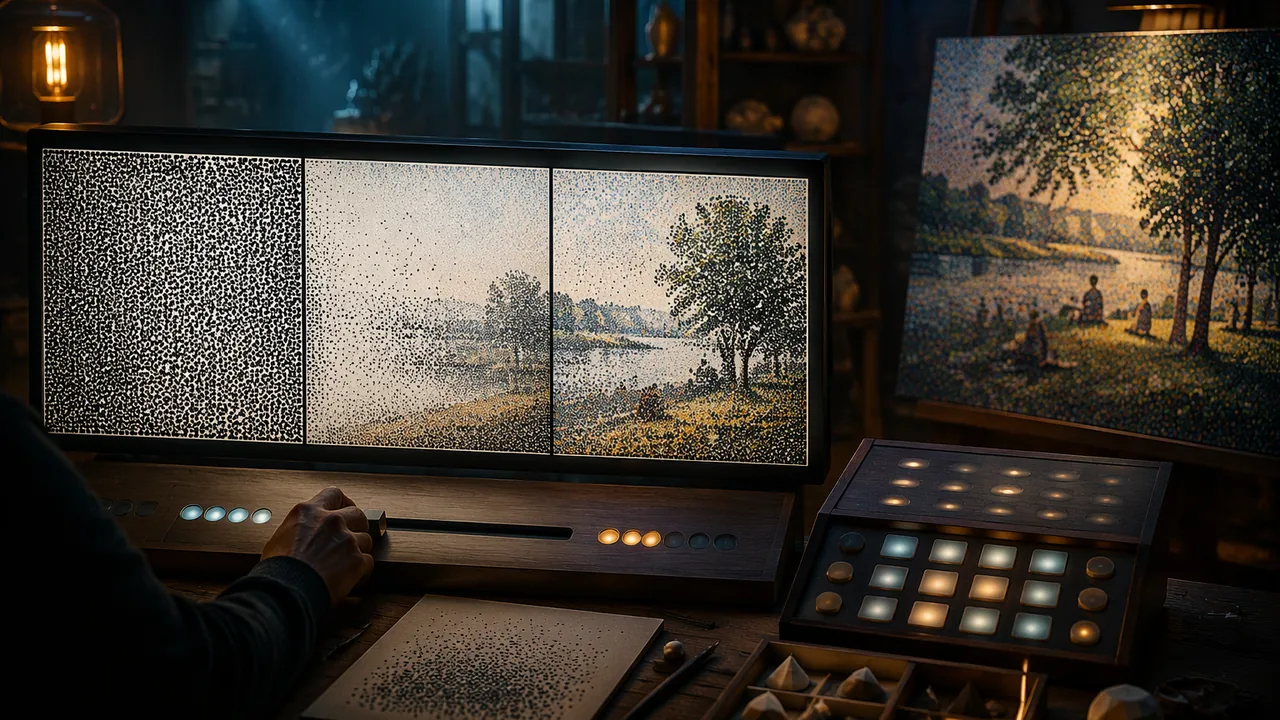
Step 2: learning to remove noise. Most current image generators are diffusion models. During training, the computer takes a real image and adds random noise to it, a little at a time, until nothing is left but static. The model is trained to do the reverse: given a noisy image and its caption, predict the noise so it can be subtracted. Repeated across millions of images, the model learns statistical patterns of what things look like — how fur catches light, how a horizon divides a landscape.
Step 3: generating. To make a new picture, the model starts from pure random noise and removes predicted noise in a series of steps, steered by your prompt, which a separate text encoder has turned into numbers. Because the starting noise is random, the same prompt gives a different image each time. That is why generators are good at variations and poor at producing exactly what you pictured.
What it does and does not do. The model does not search a folder of stored pictures and paste pieces together. But “it doesn’t store images” is not the whole story: researchers have shown that diffusion models can sometimes reproduce near-copies of training images, especially ones that appeared many times in the data. And because a model learns what is common in its data, it repeats that data’s habits — who is shown doing which jobs, which places look “normal”, whose art styles are imitated.
Machines made art before this. Harold Cohen, a British-born painter who settled in the United States, spent from the early 1970s until his death in 2016 developing AARON, a program that made drawings by following rules Cohen wrote himself. AARON’s images came from an artist’s explicit instructions; a diffusion model’s come from patterns learned from other people’s images. That difference will matter when we discuss authorship.
An analogy in paint. Look closely at Georges Seurat’s A Sunday on La Grande Jatte — 1884 (1884-86, Art Institute of Chicago). Up close it is a field of separate dabs of color; step back and people, parasols and a river resolve. The analogy is loose — Seurat placed every dot deliberately, following a theory of color — but it captures the moment a diffusion model repeats over and over: structure emerging from scattered marks.
How we will use AI here. You will not need an account on any AI service, and nothing in this course asks you to sign up for anything. What you need is one machine-made image to answer with your hands, and there are three ways to get one. All three earn full credit, all three give you an image you can credit honestly by tool and date, and you will keep using the one you choose in Lessons 1.4 and 1.5.
Option A, the image set in this lesson. Three AI-generated works are reproduced inside free U.S. Copyright Office documents. Those documents are U.S. federal publications and so are in the public domain, and in each case the Office decided that the AI-generated material itself carries no copyright because no human authored it. Each work is described below in enough detail to plan a translation from the description alone, so this route works even with no internet and no printer.
- Théâtre D’opéra Spatial (Jason M. Allen, made with Midjourney, 2022). A tall, dark, heavily ornamented interior like an opera house or a palace hall, in golds, browns and deep oranges. At the center is an enormous bright circle, a round opening filled with pale haze, with a faint crowd and a landscape far beyond it. Three figures in long, heavy gowns stand on a wet-looking reflective floor with their backs to us, facing the circle; two more stand at the right-hand edge. Every architectural edge is crusted with ornament that dissolves into smears when you look closely. Reproduced in the Copyright Review Board’s decision letter of 5 September 2023 (copyright.gov, rulings-filings, review-board, Theatre-Dopera-Spatial.pdf).
- A Recent Entrance to Paradise (generated by Steven Thaler’s Creativity Machine). Railway tracks run straight away from the viewer and through a low stone arch smothered in leaves and purple blossom. A second, smaller arch shows through the first, and past that a green glow. The whole picture is mottled and grainy, as though built from tiny broken dabs, and the color runs from dark violet at the left to warm pink at the right. Reproduced in the Copyright Review Board’s decision letter of 14 February 2022 (copyright.gov, rulings-filings, review-board, a-recent-entrance-to-paradise.pdf).
- Zarya of the Dawn (Kris Kashtanova, images made with Midjourney, 2022). The comic’s panels are reproduced through the Copyright Office’s letter of 21 February 2023 (copyright.gov/docs/zarya-of-the-dawn.pdf). Two images repeat: a young woman with dark curly hair standing in a city park at golden hour, holding a small handwritten card, with a lit skyline behind her; and wide red-rock desert scenes under a pale sky, with a distant vehicle on a track. Choose one panel, not a whole page.
Option B, Wikimedia Commons. Commons hosts thousands of AI-generated images carrying its PD-algorithm tag, which states that the file is in the public domain because it is the work of a computer algorithm or artificial intelligence and does not contain enough human authorship to support a copyright claim. Browse Category:AI-generated images at commons.wikimedia.org and choose one with a strong main shape. Copy the file name, the tool and the date from the file page, and the prompt if the uploader recorded one.
Option C, make the image yourself. Run a generative sketch in the p5.js editor (editor.p5js.org), which needs no sign-in, and keep the frame you like. Be honest about what it is: this is rule-based generative art, the AARON tradition rather than the diffusion tradition, and saying so is part of your credit line. Record it as a p5.js sketch, your parameters and the date. The comparison between the two traditions is exactly what this lesson is about.
The machine image is where you start; your hands make the art.
📖 Read for this lesson
The reading opens over the lesson; close it to come back to exactly where you were. The checks below draw on it.
Formative check
Work through these before moving on. They are not graded — they tell you whether the standard below has landed yet.
Simulation & tools
Forward diffusion: burying an image in noise
Open the p5.js editor (no sign-in needed to run a sketch). Delete the starter code and paste this sketch, then press the play button:
function setup() {
  createCanvas(300, 300);
  pixelDensity(1);
  noStroke();
}
function draw() {
  background(255);
  fill(0);
  ellipse(150, 150, 160, 160);
  let amt = map(mouseX, 0, width, 0, 1, true);
  loadPixels();
  for (let i = 0; i < pixels.length; i += 4) {
    let v = pixels[i] * (1 - amt) + random(255) * amt;
    pixels[i] = v; pixels[i + 1] = v; pixels[i + 2] = v;
  }
  updatePixels();
}
Move your mouse slowly from the left edge to the right. The left edge is the clean image; the right edge is pure noise. Record the rough fraction of the way across (for example one half, three quarters) at which you can no longer tell there is a circle. Answer: a diffusion model is trained to undo exactly this process. Why would undoing the last few steps (near pure noise) be harder than undoing the first few? Without a computer, do the same thing on paper: draw a circle in pencil, then cover it with five successive layers of random dots and note when it disappears.
Open p5.js Web Editor ↗ · p5.js Web Editor, Processing Foundation · LGPL-2.1 open source
Why does the same prompt produce a different image each time in a diffusion model?
Because a diffusion model does not store its training images as files, it can never produce a near-copy of one.
Draw and label the three stages of a diffusion model (training data, learning to remove noise, generating from noise). Then write one paragraph comparing that process with how Seurat built La Grande Jatte and with how AARON made drawings: where is the human decision-making in each?
How confident are you that you can explain how a diffusion model makes an image and where human choices enter the process?
How a Diffusion Model Makes a Picture: The Papers, the Numbers and Seurat
SLS original explainer; checked against arXiv abstract pages and the Art Institute of Chicago API, retrieved 26 Sept 2026 · SLS original, with short quotations from arXiv papers (arXiv non-exclusive license; LAION-5B is CC BY 4.0), a U.S. Copyright Office letter (public domain) and Art Institute of Chicago open-access metadata (CC0)
Why this reading. The lesson asks you to draw and label the three stages of a diffusion model, to say why undoing the last noisy steps is harder than undoing the first, and to compare the process with Seurat and with AARON. Here are the real numbers and records to do that from. Everything below was checked against the paper or museum record named, on 26 September 2026.
1. The papers behind the pictures
- Sohl-Dickstein, Weiss, Maheswaranathan and Ganguli, “Deep Unsupervised Learning using Nonequilibrium Thermodynamics,” arXiv:1503.03585, submitted 12 March 2015. Their idea, in their words: “systematically and slowly destroy structure in a data distribution,” then learn the reverse process that restores it.
- Ho, Jain and Abbeel, “Denoising Diffusion Probabilistic Models,” arXiv:2006.11239, submitted 19 June 2020. On the small CIFAR10 image set the authors report a Fréchet Inception Distance (FID, a score where lower is better) of 3.17.
- Rombach, Blattmann, Lorenz, Esser and Ommer, “High-Resolution Image Synthesis with Latent Diffusion Models,” arXiv:2112.10752, submitted 20 December 2021. The model works in the compressed “latent space” of a pretrained autoencoder, which cuts the computing cost, and cross-attention layers let it be steered by a text prompt.
- Schuhmann and 15 co-authors, “LAION-5B,” arXiv:2210.08402, 16 October 2022 (CC BY 4.0): a dataset of 5.85 billion CLIP-filtered image-text pairs, 2.32 billion of them with English text. The paper reports replicating and fine-tuning Stable Diffusion on it.
- Carlini and eight co-authors, “Extracting Training Data from Diffusion Models,” arXiv:2301.13188, 30 January 2023. For Stable Diffusion v1.4 they took the 350,000 most-duplicated training examples, generated 500 candidate images for each caption, and after checking found 109 near-copies of training images. Their abstract reports over a thousand extracted examples across the models tested.
All but LAION-5B carry arXiv’s non-exclusive license, so only short phrases are quoted here.
2. The forward process, with numbers
Ho et al. add noise in 1,000 steps (T = 1000). Step t mixes the image with a little noise; the amount, called βt, rises in a straight line from 0.0001 at step 1 to 0.02 at step 1000 (their Section 4). Because of how the steps combine, you can jump straight to any step: the noisy picture is xt = √(ᾱt) · x0 + √(1 − ᾱt) · ε, where x0 is the clean image, ε is random noise, and ᾱt is the product of (1 − β) over steps 1 to t (their Equation 4). The two square roots are how much clean image and how much noise are in the mix. Computed from that schedule (SLS calculation; three lines of Python reproduce it):
| Step t | Weight on clean image | Weight on noise |
|---|---|---|
| 1 | 0.9999 | 0.0100 |
| 10 | 0.9991 | 0.0435 |
| 50 | 0.9854 | 0.1702 |
| 100 | 0.9471 | 0.3209 |
| 250 | 0.7239 | 0.6899 |
| 500 | 0.2803 | 0.9599 |
| 750 | 0.0579 | 0.9983 |
| 1000 | 0.0064 | 1.0000 |
Reading the table. Around step 250 image and noise weigh about the same, and by step 500 the image is under a third of the mix. The network is trained to predict ε from xt; subtracting its guess is one denoising step. Your p5.js sketch blends in a straight line instead (the mix is 1 − amt of image and amt of noise), so its halfway point differs from the paper’s schedule; compare your recorded fraction with the row where the two weights match. For the lesson’s question: near step 1 the image weight is 0.9999, so undoing that step only tidies grain that is already sitting on a finished picture. Near step 750 the weight is 0.058, so the model must decide from almost nothing what large shapes and what layout the picture will have. That is why the noisy end is the hard end.
3. What goes in each box of your diagram
- Training data: image and caption pairs, on the scale of billions (LAION-5B: 5.85 billion). The pairs were gathered automatically; most creators were not asked.
- Learning to remove noise: take a real image, apply the forward schedule to a random step t, ask the network to predict the noise that was added, and adjust the network when it is wrong. The caption reaches the network through the text encoder and cross-attention (Rombach et al.).
- Generating: start from pure random noise (xT), then remove the predicted noise step by step, steered by the prompt, until an image remains. A different starting noise gives a different picture.
Label arrows for the places a person still decides: which data go in, what the prompt says, which output to keep, and what to edit afterward. On that last point there is a documented case. Jason Allen told the U.S. Copyright Office that he entered prompts and revisions “at least 624 times” to reach the first version of Théâtre D’opéra Spatial, then used Adobe Photoshop to remove flaws and upscaled the result (Review Board letter, 5 September 2023, U.S. government, public domain).
4. Seurat and AARON, for the comparison paragraph
Georges Seurat, A Sunday on La Grande Jatte — 1884, 1884–86 (border added 1888–89), oil on canvas, 207.5 × 308.1 cm, Art Institute of Chicago, accession 1926.224, public domain (record retrieved from the museum’s open API, 26 September 2026). The museum’s text says that up close the figures “dissolve into dots and dashes of complementary colors laid side by side,” that he applied tiny dabs of different colors so the viewer’s eye would blend them, that he returned to the canvas two years after starting to amplify some figures and add others (a monkey on a leash; a man with a rolled newspaper far in the distance), and that to him “every decision was essential.” Every mark was placed by his hand, following a theory of color.
AARON is the drawing program Harold Cohen developed from the early 1970s until his death in 2016: its drawings follow rules Cohen wrote himself.
| Seurat | AARON | Diffusion model | |
|---|---|---|---|
| Who sets the rules? | The painter, from color theory | The programmer, in explicit instructions | Learned from other people’s images; nobody wrote them down |
| Who places each mark? | The painter | The program | The model, from noise |
| Where do people decide? | Every dab; later additions | In writing the rules | Data, prompt, choosing, editing |
Use the last row for your paragraph, and say which of the three you think leaves the person the most control over the final surface.
Sources: Ho, Jain, Abbeel, Denoising Diffusion Probabilistic Models (arXiv:2006.11239) (arxiv.org); Sohl-Dickstein et al. (arXiv:1503.03585) (arxiv.org); Rombach et al., Latent Diffusion Models (arXiv:2112.10752) (arxiv.org); Schuhmann et al., LAION-5B (arXiv:2210.08402) (arxiv.org); Carlini et al., Extracting Training Data from Diffusion Models (arXiv:2301.13188) (arxiv.org); U.S. Copyright Office Review Board letter on Théâtre D’opéra Spatial, 5 Sept 2023 (copyright.gov); Art Institute of Chicago, A Sunday on La Grande Jatte, 1926.224 (artic.edu)