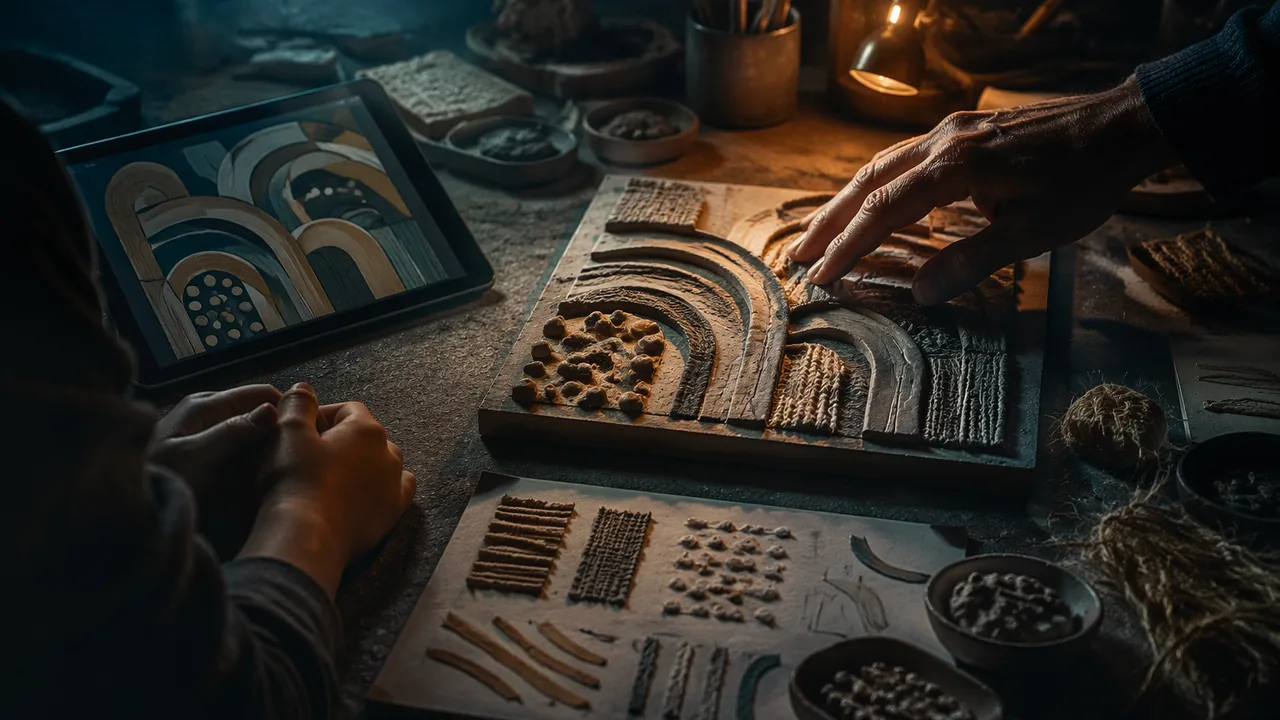
create, revise and defend a finished tactile artwork in a chosen medium, inspired by an AI-generated image, and explain how the medium shaped my interpretation.
Instruction
This is the course’s signature assignment: choose a tactile medium and create a tactile artwork inspired by an AI-generated image. You have tested media, argued for one, and rehearsed its layering. Now you make the work.
Scale and time. Work at least 25 × 30 cm for a panel, or a sculpture that fits in two hands for clay. Plan your sessions backward from the due date: layered paste and thick clay need drying time you cannot rush. Build the structure in the first two sessions, texture in the third, surface treatments in the fourth, and leave the last for finishing and documentation.
Critique of the work in progress. At the halfway point, put the work away for a full day, then give it a four-step critique yourself (Lesson 1.3), stating your criteria before you judge, and run a touch test: a family member or other adult reads it with eyes closed, or you read it with your non-dominant hand. Record the words exactly. The most useful critique usually comes in the analysis step: where does the hand go first, and what repeats?
Revision. Revise with evidence. For each change, write what the critique said, what you changed and whether it worked. If you decide not to follow a suggestion, say why; that is also a decision.
Statement. In 300-400 words: credit the source image (tool, prompt, date); state how far you departed from it and why; explain how your medium shaped the interpretation — what it made possible and what it prevented; name one surface treatment and its effect; and describe one revision. Use the vocabulary of the unit accurately.
A note on the source image. Some students ask whether they can use an AI image they generated themselves. You may, if you made it with a tool you are allowed to use (with a parent’s permission and within the tool’s age rules), with no photos of real people in the prompt or upload, and you record the tool, prompt and date exactly as the course images are labeled. No one is required to have an account on any AI service to complete this task.
Defense. In about two minutes, recorded, present the work and defend one technical decision, then answer one question (if nobody is there to ask, use the question in the reading).
📖 Read for this lesson
The reading opens over the lesson; close it to come back to exactly where you were. The checks below draw on it.
Formative check
Work through these before moving on. They are not graded — they tell you whether the standard below has landed yet.
Record your four-step self-critique and the touch test, including the criteria stated before judging. Then list each revision: what the critique said, what you changed and whether it worked.
If you decide not to follow a critique suggestion, you should explain why in your process notes.
How confident are you that you can complete a tactile work in a chosen medium and explain how the medium shaped it?
Submit: The Medium Study — finished work, statement (300-400 words) and defense
Task: Choose a tactile medium (clay, paint with modeling paste, oil pastel, embossed paper or mixed media) and create a finished tactile artwork inspired by an AI-generated image of your choice. Use at least two surface treatments. The work must reward touch as well as sight.
Submission workflow
- Stage 1 — Plan. Medium rationale, layer plan, AI image label and the 10 × 10 cm sample from Lesson 3.4.
- Stage 2 — Critiqued work in progress. Your four-step self-critique after a day away and a touch test (by a family member or other adult, or by you with the non-dominant hand), with your revision plan.
- Stage 3 — Final work and statement. Finished work photographed in raking light (full view and three details) with a 300-400 word statement.
- Stage 4 — Defense. About two minutes defending one technical decision, recorded.
How it is scored
| Criterion | What proficient looks like |
|---|---|
| Technical skill in the medium (VA:Cr2A.II) | Controlled, well-crafted use of the medium and at least two surface treatments. |
| Medium choice and planning (VA:Cr1B.II) | Choice justified against criteria and wear-test evidence; layering order works. |
| Interpretation of the AI image (VA:Cn10A.I) | The departure from the source is deliberate and explained. |
| Tactile and visual effect (VA:Re9A.I) | Surfaces are readable, durable and expressive. |
| Revision (VA:Cr3A.II) | Changes respond to critique with evidence; declined suggestions are explained. |
| Statement, presentation and defense (VA:Pr4A.II) | Credits the source; explains how the medium shaped meaning; photos selected to show decisions. |
Portfolio Task 3: Session Plan, Self-Critique Form, Exemplar Entry and Reader’s Sheet
SLS original (exemplar is illustrative) · SLS original (illustrative exemplar)
Why this reading. Portfolio Task 3 gives you the assignment and rubric. This reading supplies a session plan, a self-critique and touch-test form, an exemplar and a reader’s sheet. The exemplar is constructed for this course (SLS original, illustrative).
Session plan, working backward from a due date
| Session | Work | Drying gap |
|---|---|---|
| 1 | Base and structure | overnight |
| 2 | Structure finished; joins checked | 24–48 h for clay |
| 3 | Texture; then put the work away | a full day |
| 3b | Midpoint self-critique and touch test | — |
| 4 | Glaze, dry brush, seal | 24 h before handling |
| 5 | Photograph, caption, statement, defense | — |
Self-critique and touch-test form
After at least a full day away, state your criteria first. Then write, step by step, before moving on: 1 Describe (at least five facts) 2 Analyze (where the hand goes first; what repeats) 3 Interpret (a claim with evidence) 4 Judge (criterion stated, then verdict). Then the touch test, by a family member or other adult with eyes closed, or by you with the non-dominant hand: what the reader finds first, what they mistake for something else, what they say the work is about.
Exemplar entry (illustrative)
Source label: Théâtre D’opéra Spatial, Jason M. Allen, Midjourney, 2022; U.S. Copyright Office letter, 5 September 2023. Departure: far (only the hollow circle and a few figures remain). Medium: impasto paste on 25 × 30 cm board, glaze, dry brush, seal.
Critique record (self-critique after a day away): Criteria: clarity to a hand and emotional effect. Describe: “a smooth round hollow, upper center; a ridged frame around it; five small bumps below.” Analyze: “my hand went to the hollow first; the ridges repeat around it.” Interpret: “it feels like looking into a well, because everything slopes toward the hollow.” Judge: “clear to a hand: yes; emotional effect: strong.” Touch test (a family member, eyes closed): found the hollow first; mistook the five bumps for buttons. Revision: bumps raised and given a smooth pad; retested, read as people.
Statement (about 300 words, illustrative): I began with Théâtre D’opéra Spatial, an image made with Midjourney in 2022, but I departed far from it. The image is about a crowd facing an enormous light; my piece keeps only the light, as a smooth hollow, and a few small figures. Impasto paste made that possible. Because paste holds a ridge, I could build the ornament as a combed, repeating frame that leads the hand inward. What paste prevented was the crisp, glassy floor of the original: paste cannot be perfectly smooth or reflective, so I let the floor become a plain, low field.
The surface treatment that mattered was dry brushing. A pale gray brushed only over the high ridges made the frame visible to a low-vision viewer without changing how it feels, while the hollow stayed matte and dark. One revision changed the piece: my reader mistook the five figures for buttons, so I raised them and put a smooth pad under each, and the second reader called them people. I did not follow one suggestion, to add a gold color to the frame, because color does nothing for the hand and would have made the piece harder to seal. The medium shaped the meaning: a machine image is all implied surface, and here the surface is real, worn by the touching it asks for. It taught me that a medium is not a container for an idea; it is where the idea is decided.
Reader’s sheet (for a family member or other adult, or for you after a day away)
- What did your hand find first? __________
- Which layer or treatment worked best? __________
- Where does the surface already show wear? __________
- Did the seal dull a texture you wanted? __________
- One suggestion. (The maker may decline it, with a reason.) __________
Sources: U.S. Copyright Office Review Board letter on Théâtre D’opéra Spatial, 5 Sept 2023 (copyright.gov)