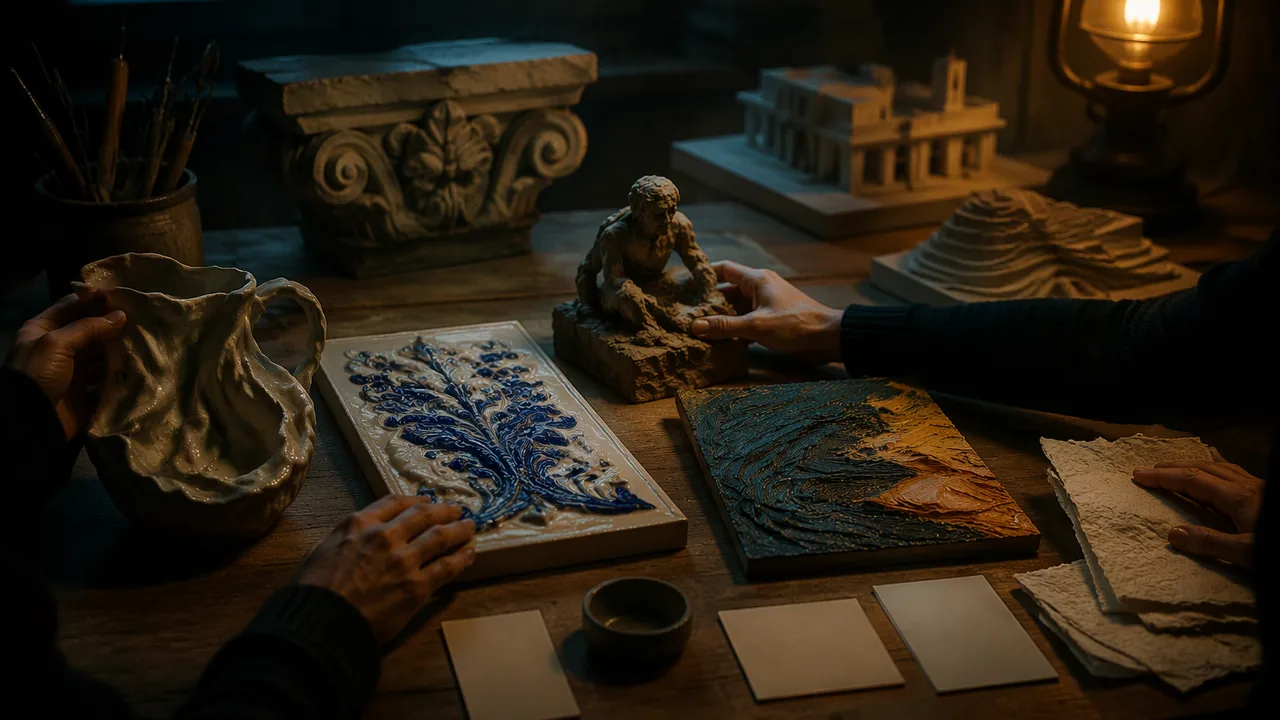
explain how five artists or workshops used the physical properties of clay, glaze, paint and paper to create surfaces that invite touch, and connect each to its time and place.
Instruction
Every medium has habits. Clay slumps and cracks, paint levels out as it dries, paper tears. The artists in this lesson worked against those habits — or with them — to make surfaces that ask to be touched. Studying them shows you what each medium can do before you choose your own.
George Ohr’s clay (Mississippi). George E. Ohr (1857-1918) worked in Biloxi, Mississippi. Look at his Pitcher (about 1900, Cleveland Museum of Art). Ohr threw pots with extremely thin walls on the wheel and then pinched, folded, dented, twisted and crumpled them while the clay was still soft. Most potters of his time aimed for smooth, symmetrical forms; Ohr made the movement of the clay itself the subject. Much of his work went unsold in his lifetime and became widely known only decades later. His pots are a lesson in letting a medium’s softness show.
Della Robbia glazed terracotta (Florence). In fifteenth-century Florence, Luca della Robbia developed a way to cover terracotta (fired clay) sculpture with a tin glaze — an opaque, glossy, usually white and blue coating — making relief sculpture that was colorful, relatively inexpensive and durable enough for outdoor walls. His nephew Andrea continued the workshop. Andrea della Robbia’s Madonna and Child (The Lehman Madonna) (about 1470-75, The Metropolitan Museum of Art) shows the result: soft modeled forms under a glassy skin. The relief carries the form; the glaze makes it smooth, cool and protected.
Thomas Hart Benton’s clay models (Missouri). Thomas Hart Benton (1889-1975) was born in Neosho, Missouri, and became famous for paintings and murals of ordinary people at work. In 1935 the Missouri legislature commissioned him to paint the House Lounge on the third floor of the State Capitol in Jefferson City, and the result, A Social History of the State of Missouri, completed in 1936, covers three walls of the room with scenes of farming, mining, industry, the courts and Missouri legends, and has been open for public viewing ever since. Benton was a painter who reached for clay: Missouri State Parks says he spent several years perfecting a method of planning his paintings with clay models “to help with the spatial organization of the design,” and the State Historical Society of Missouri says he built small clay models, or maquettes, for each painting and then painted while looking at them. He also used real people as models; a Missouri House news story tells of a baby who posed for the mural and visited his likeness decades later. Benton went from clay to a flat wall; this course asks you to go the other way, from a flat machine image to a surface you can touch. The models let him see where light falls on rounded forms before he painted them, so the mural’s people look solid even though the wall is flat.
Van Gogh’s brushwork (France). In The Bedroom (1889, Art Institute of Chicago), one of three versions of the painting of his room in Arles, Van Gogh laid paint on thickly in short, broken strokes. Oil paint that thick holds the mark of the brush after it dries. Acrylic paint, which you will use, dries faster and flatter, so artists add modeling paste or gel medium to make it hold a ridge.
Embossed paper (Japan). Okumura Masanobu’s woodblock print Boys Masquerading as Chinese (about 1748, Art Institute of Chicago) is a benizuri-e, an early color print in a few colors, and the museum’s record notes that it includes embossing. Japanese printmakers used uninked carved blocks to press raised patterns into damp paper — texture you see only in raking light but can feel with a fingertip. Paper, the flattest medium, can carry relief too.
Connecting medium and context. Each surface answers the needs of its place and time: Ohr rebelled against factory smoothness; the della Robbia workshop needed durable color for churches and streets; Benton needed his mural figures to look solid on a flat wall, so he modeled them in clay first; Van Gogh wanted energy and speed; printmakers competed with added luxury effects. When you choose a medium for your AI-inspired work, ask the same questions: what does it need to survive, and what should it say?
📖 Read for this lesson
The reading opens over the lesson; close it to come back to exactly where you were. The checks below draw on it.
Formative check
Work through these before moving on. They are not graded — they tell you whether the standard below has landed yet.
What made George Ohr’s pots unusual for their time?
The della Robbia workshop’s tin-glazed terracotta was durable enough to be used on outdoor walls.
Choose two of the five works. For each: describe the surface, explain how the maker exploited the medium’s physical properties, and connect that choice to the maker’s time and place using evidence from the museum record. End with which approach you would like to test and why.
How confident are you that you can explain how an artist used a medium’s physical properties and connect it to context?
Five Medium Studies: Ohr, della Robbia, Benton, Van Gogh and Masanobu, Described
SLS original descriptions; records from open-access APIs of the Cleveland Museum of Art, the Metropolitan Museum of Art and the Art Institute of Chicago (retrieved 26 Sept 2026); Missouri State Capitol Commission, Missouri House Newsroom, State Historical Society of Missouri (incl. Joan Stack via NPS) and Missouri State Parks (retrieved 9 Nov 2026) · SLS original, with CC0 museum metadata and short facts and quotations from Missouri state government (Capitol Commission, House, State Parks) and State Historical Society of Missouri sources
Why this reading. The lesson asks you to choose two of five works and, for each, describe the surface, explain how the maker used the medium’s physical properties, and tie that to time and place using the museum record. Here are the five records and what each surface looks like, with a plain line between what the museum says and what only the photograph shows. Records are from the Cleveland Museum of Art, the Metropolitan Museum of Art and the Art Institute of Chicago open-access data (CC0), retrieved 26 September 2026; the Benton mural facts are from the Missouri State Capitol Commission, the Missouri House Newsroom, the State Historical Society of Missouri and Missouri State Parks, retrieved 9 November 2026.
George E. Ohr, Pitcher
Record: American, 1857–1918; c. 1900; stoneware; 10.6 × 12.5 × 9.1 cm; Cleveland Museum of Art, accession 1997.274 (CC0). Museum text: none in the open-access record. The photograph: a small pitcher in dark, lustrous glaze with brown-gold speckling. Its mouth is not a circle: the thin rim is folded over and pinched into a wide, wavy lip that swoops up at one side and curls down at the other. The body is dented and pushed sideways so it leans; a small handle at the lower right looks pinched on rather than pulled. The walls look thin where the rim folds. From your lesson: Ohr threw thin-walled pots and then pinched, folded and dented them while soft, and Biloxi, Mississippi was his workshop; the lesson’s further claims (that he rebelled against factory smoothness, and that his work was little sold in his lifetime) are not in this record, so treat them as the lesson’s context, not the museum’s evidence.
Andrea della Robbia, Madonna and Child (The Lehman Madonna)
Record: Italian, 1435–1525; ca. 1470–75; glazed terracotta; 94.9 × 54.9 cm; Metropolitan Museum of Art, accession 69.113; public domain (Gift of Edith and Herbert Lehman Foundation, 1969). The photograph: an upright panel with a rounded top, about 95 cm tall. The background is a deep, glossy blue. Against it the figures are glazed white: the Virgin, with a veil pulled over her hair and a halo, bends her head toward the Child, who sits in her lap facing us, with a halo and one hand raised. Above them a bearded figure in a crown and small winged heads (cherubs) float among clouds. The forms are modeled in high, rounded relief, so folds and limbs stand well away from the ground, and the whole surface has the sheen of glaze. What the record does not say: the type of glaze or the maker’s method; the lesson says the workshop used a tin glaze that made terracotta durable outdoors, which you may use as lesson context.
Vincent van Gogh, The Bedroom
Record: 1889; oil on canvas; 73.6 × 92.3 cm; Art Institute of Chicago, accession 1926.417; public domain. Museum text: the second of three versions, painted in September 1889 at Saint-Rémy, of the artist’s bedroom in the Yellow House in Arles; its “bold colors, thick and broken brushwork, and sharply receding lines” might suggest nervous energy, but he saw it as calm and restful. In an 1888 letter to his brother Theo he described “the walls pale lilac, the floor in a broken and faded red, the chairs and the bed chrome yellow, the pillows and the sheet very pale lemon green, the bedspread blood-red.” The photograph: lilac-blue walls, a golden-yellow bed with a red cover, two yellow rush-seated chairs, a green window, and a floor of short, flat strokes in pink-red and green, each stroke separate like a paving stone. The paint is thick and stiff enough to hold the brush’s track.
Okumura Masanobu, Boys Masquerading as Chinese
Record: Japanese, 1686–1764; c. 1748; woodblock print, oban benizuri-e with embossing; 41 × 30.2 cm; Art Institute of Chicago, accession 1925.1842; public domain. The photograph: four boys in costume crowded together: one at the top under a large decorated parasol, one at left in a hat with a feather plume, two more in the center and right in patterned robes; robes patterned in pale pink-red and green over black outlines on a cream, slightly mottled sheet; a few lines of poem in the upper right. Museum text: only the medium line above; the embossing it names is a pressed-in relief that a photograph flattens, so it can be seen only in raking light in person and felt with a fingertip. Benizuri-e, in the lesson’s account, is an early color print made with few colors.
Thomas Hart Benton, A Social History of the State of Missouri
Record: Thomas Hart Benton, American, 1889–1975; mural commissioned by the Missouri legislature in 1935 for the House of Representatives’ Lounge on the third floor of the Missouri State Capitol, Jefferson City (Missouri House Newsroom); completed in 1936 and open for public viewing since then (Missouri State Capitol Commission, which in 2015 approved a condition assessment of it). Joan Stack of the State Historical Society of Missouri describes it as “a monumental mural covering three walls of the room”; the National Park Service lesson that carries her paper lists scenes of farmers, industry, logging and mining, a courtroom, Jesse James, Tom Sawyer and Huck Finn, the Kansas City stockyards and the political boss Tom Pendergast. Retrieved 9 November 2026. Benton’s method, from Missouri sources: the State Historical Society of Missouri says Benton was born in Neosho, Missouri, on April 15, 1889, and died on January 19, 1975, and that he “built small clay models, or maquettes, for each painting” and painted while looking at them. Missouri State Parks says he spent several years perfecting this method of planning paintings with clay models “to help with the spatial organization of the design,” and that from 1939 until his death he lived in a limestone house in Kansas City that is now a state historic site. He also used real people as models: the Missouri House Newsroom tells how a man who posed as a baby in the mural visited his likeness as an adult. What the sources do not say: none of them lists which clay models were made for this mural, or says that any survive, so write “his method” rather than claiming a particular model. For the organizer: the physical property Benton used was clay’s ability to stand in space and catch light, which let him see where shadows and overlaps fall before painting a flat wall. Here the tactile medium is the hidden planning step, not the finished surface.
Organizer for your two-work answer
| Work 1 | Work 2 | |
|---|---|---|
| Surface, described (height, gloss, edge, pattern) | ||
| Physical property the maker exploited (softness, glaze, thickness, pressability) | ||
| Time and place (record fact, plus the lesson’s context) |
End with which approach you would test and why (for example: “I would test Ohr’s folded rim in slab clay, because it turns softness into a rim a finger can follow”).
Sources: Cleveland Museum of Art, Pitcher, George E. Ohr, 1997.274 (clevelandart.org); Metropolitan Museum of Art, Madonna and Child (The Lehman Madonna), 69.113 (metmuseum.org); Art Institute of Chicago, The Bedroom, 1926.417 (artic.edu); Art Institute of Chicago, Boys Masquerading as Chinese, 1925.1842 (artic.edu); Missouri State Capitol Commission, mural condition assessment notice (2015) (capitol.mo.gov); Missouri House of Representatives Newsroom, Benton Mural model bids ‘fond farewell’ to his likeness (newsroom.house.mo.gov); Joan Stack (State Historical Society of Missouri), Who’s at Home in Missouri? (NPS lesson materials) (nps.gov); State Historical Society of Missouri, Historic Missourians: Thomas Hart Benton (historicmissourians.shsmo.org); Missouri State Parks, Thomas Hart Benton Home and Studio State Historic Site: General Information (mostateparks.com)