establish criteria for choosing a tactile medium and use them to argue for the best medium for a given AI image, responding to an opposing position with evidence.
Instruction
Choosing a medium is a decision, and decisions can be argued. In this lab you take one image from the AI image set and recommend the medium that would translate it best. The skill being practiced is setting criteria and using them honestly, which is the judgment step of critique turned toward your own work.
Setting criteria. A criterion is a question every option can be measured against. For a tactile work, five are useful:
- Readability: can a hand find and tell apart the important parts?
- Durability: will it survive the touching it invites? (Use your wear-test data.)
- Expressive fit: does the medium’s character — soft, hard, glossy, rough, fragile — match what the work should say?
- Practicality: can it be made with the time, space and materials available?
- Health and environment: what are the costs of the material, from dust and fumes to waste?
Criteria can be weighted. A work for a museum’s touch table weights durability heavily; a personal expressive piece may weight expressive fit higher.
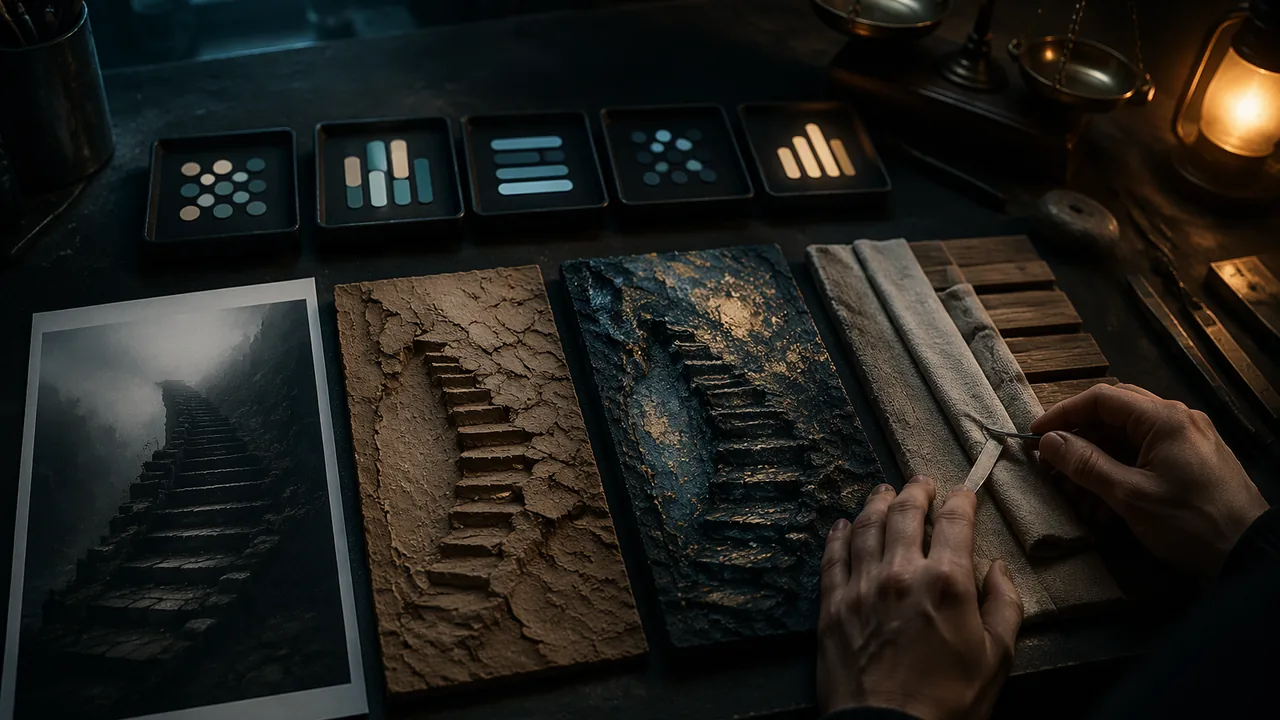
A worked example. A student takes an AI image of a crumbling stone staircase in mist. Clay scores high on expressive fit (it can actually crumble and crack) and readability (steps are strong levels), medium on durability (air-dry clay chips at edges), and it creates silica dust if handled carelessly. Impasto paint scores high on durability once sealed and on texture, lower on readability of the steps as levels. She recommends clay relief, sealed with PVA, with the mist as a smooth, low field — and states the durability risk openly. That is a good argument: criteria named, evidence given, weakness admitted.
The environmental question, fairly. Materials are not the only environmental cost in this course. Training and running large AI models uses substantial electricity, and data centers also use water for cooling; published estimates vary widely and change as the technology changes, so be cautious with any single number. It is fair to ask about those costs, and equally fair to note that generating a handful of images for a course project is a small use. Weigh claims by their evidence.
Argument protocol. Record your recommendation in two minutes (audio or video) using the criteria matrix. Then answer it from the other side. The reading supplies an opposing recommendation from a constructed critic; you may instead ask a family member to play the critic with the reading’s response frame, or write the critic’s response yourself the next day. The response first restates your recommendation in its own words, then asks one question, then offers one alternative with a criterion attached. Finally, reply to the critic. Positions may change in response to evidence; writing “that changes my ranking” is a strength, not a loss.
📖 Read for this lesson
The reading opens over the lesson; close it to come back to exactly where you were. The checks below draw on it.
Formative check
Work through these before moving on. They are not graded — they tell you whether the standard below has landed yet.
A work is meant for a museum touch table used by hundreds of visitors. Which criterion should be weighted most heavily?
Because estimates of AI’s energy and water use vary widely, the question should not be discussed at all.
Complete your criteria matrix (at least three media against the five criteria, with weights). Record your recommendation in 100-150 words. Then respond to the opposing recommendation in the reading (or one a family member offers): restate it, ask one question and offer one alternative with a criterion, and say whether it changes your ranking.
How confident are you that you can set criteria and use them to argue for a medium choice?
Choosing a Medium: Image Features, a Scored Matrix, an Opposing View and the Argument Protocol
SLS original dossier (scores illustrative); figures from the LBNL 2024 U.S. Data Center Energy Usage Report, retrieved 26 Sept 2026 · SLS original (illustrative scores); facts and figures from a national-laboratory report for the U.S. Department of Energy, quoted as figures only
Why this reading. The lab asks you to set criteria, fill a matrix for at least three media, argue for one and answer an opposing position, using your wear-test data and one image from the course set. The wear data are in the reading “Four Surface Techniques”. This reading supplies the image features that bear on the choice, a scoring rule with a worked calculation, and the protocol. The scores are illustrative (SLS original) and you should disagree with them where your evidence differs. One published figure is added for the environmental question.
The course images, as a medium chooser sees them
| Image | What matters for medium |
|---|---|
| Théâtre D’opéra Spatial | A hollow circle against heavy ornament; strong levels (frame, floor, figures); glossy reflective floor; dark, warm palette. |
| A Recent Entrance to Paradise | Grainy, mottled everywhere; stone arches, foliage; a glow at the end of a track; violet-to-pink color shift. |
| Zarya of the Dawn desert panel | Wide red rock and empty sky; a tiny vehicle on a track; little structure to build in levels. |
Scoring rule and worked calculation
Score each medium 1 (poor) to 5 (excellent) on each criterion, then multiply by the weight (weights add to 10). Worked example for a museum touch table, with the lesson’s staircase-in-mist image (illustrative):
| Criterion (weight) | Air-dry clay, sealed | Impasto paste | Fabric collage |
|---|---|---|---|
| Readability (3) | 5 | 3 | 3 |
| Durability (3) | 3 | 4 | 2 |
| Expressive fit (2) | 5 | 4 | 2 |
| Practicality (1) | 3 | 4 | 5 |
| Health and environment (1) | 3 | 4 | 4 |
| Weighted total (max 50) | 15 + 9 + 10 + 3 + 3 = 40 | 9 + 12 + 8 + 4 + 4 = 37 | 9 + 6 + 4 + 5 + 4 = 28 |
Clay wins by three points, but only because readability carries weight 3; change the weight on durability to 5 (taking two from readability) and clay scores 5×1 + 3×5 + 10 + 3 + 3 = 36 against impasto 3 + 20 + 8 + 4 + 4 = 39, and the ranking flips. Say which weights you chose and why.
The environmental question, with one real figure
The Lawrence Berkeley National Laboratory’s 2024 United States Data Center Energy Usage Report (December 2024, prepared for the U.S. Department of Energy) estimates that U.S. data centers used 176 terawatt-hours of electricity in 2023, about 4.4% of all U.S. electricity, and 6.7% to 12.0% is forecast for 2028. That is all data centers, not only AI image generators, and the report does not give a per-image figure, which is why the lesson warns against trusting any single number. The report’s own words are the honest summary: these are estimates. Use it for scale, and weigh one student generating a handful of images against the materials you actually buy.
An opposing recommendation to answer (constructed, illustrative)
A constructed critic answers the worked example: “You recommend air-dry clay for the staircase because it scores highest on readability and expressive fit. My question: how will the step edges survive hundreds of hands when your own wear test shows unsealed clay shedding powder and chipping? An alternative is impasto paste over stepped card, which scores higher on durability because the card holds a crisp edge and the paste lost almost nothing in the wear test.” Your reply: say what the critic got right, whether it changes any score or weight, and your final ranking.
Protocol, with timing
- Present: record a 2-minute recommendation, matrix in view.
- The critic (the constructed one above, a family member using the frame below, or you writing as the critic the next day) restates the recommendation in their own words (30 seconds).
- One question (30 seconds).
- One alternative, with a named criterion (1 minute).
- You reply; you may write “that changes my ranking” and rescore one cell.
Response frame: “You recommend ___ because ___. My question: ___? An alternative is ___, which scores higher on ___ because ___.”
Sources: Lawrence Berkeley National Laboratory, 2024 United States Data Center Energy Usage Report (eta.lbl.gov)