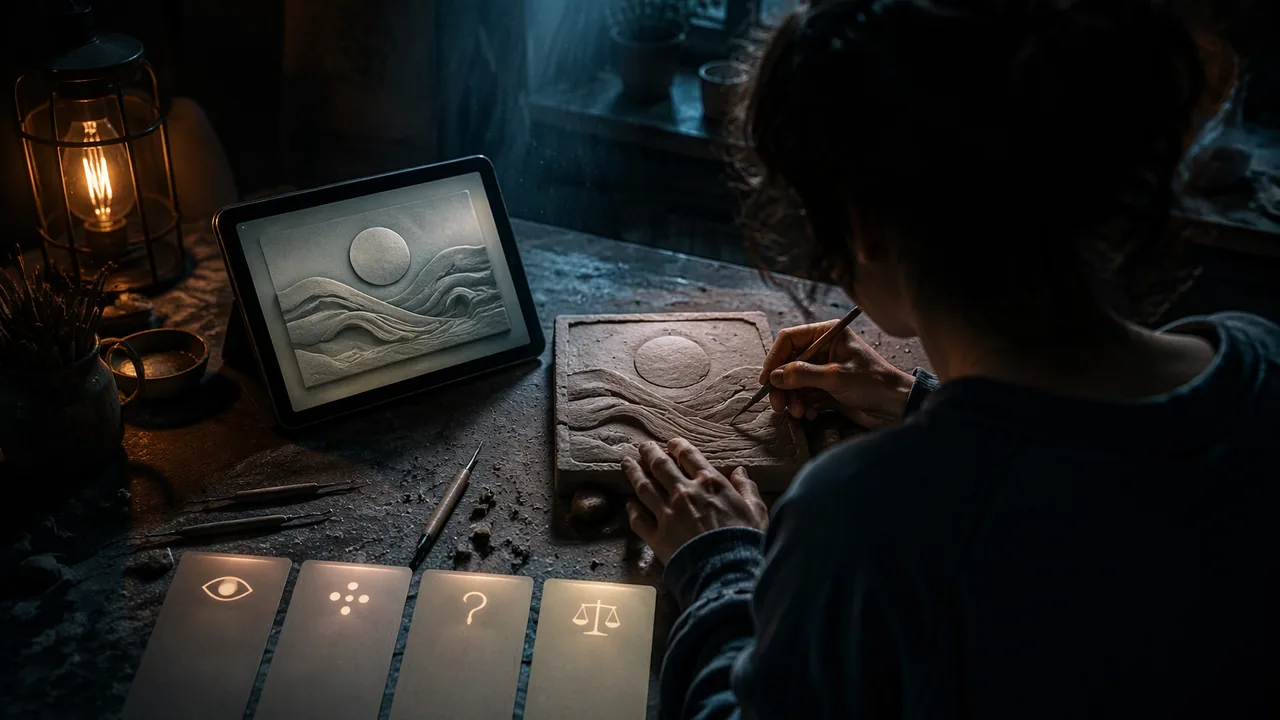
use a four-step critique (describe, analyze, interpret, judge) to discuss an AI-generated image and a clay tile, backing each interpretation with evidence I can see or feel.
Instruction
Most people react to art in one step: “I like it” or “I don’t.” Critique slows that down. The method we use this year has four steps, adapted from the art educator Edmund Feldman: describe, analyze, interpret, judge. The order matters, because judging too early stops you from seeing.
1. Describe. List what is there, without opinions. For an image: subject, colors, shapes, the size of things. For a tactile work: height, edges, textures, temperature, weight. “A round raised form in the upper left, smooth, about 1 cm high” is description. “A beautiful sun” is already interpretation.
2. Analyze. Explain how the parts are organized, using the elements (line, shape, form, texture, space, value, color) and principles (balance, rhythm, emphasis, proportion, contrast, unity). Where does your eye — or your hand — go first? What repeats?
3. Interpret. Say what the work means or expresses, and give evidence from steps 1 and 2. A claim like “the tile feels calm because its textures run in the same direction and nothing is sharp” is supported; “it’s about peace” is not, until you say why.
4. Judge. Evaluate the work against criteria you state. Criteria are the rules of the game: is the goal realism, emotional power, clarity to a hand, originality? A tactile graphic for a blind reader and an expressive clay sculpture should be judged by different criteria.
Critiquing an AI image. Machine images have recognizable habits. They are often very smooth and evenly lit, with the subject in the center. Details can fall apart on close inspection: hands with the wrong number of fingers, text that is not quite letters, objects that merge into each other. Describing these honestly is part of reading the image — and it tells you what you will need to decide when you translate it into clay. The image is all surface appearance; it has no real texture at all.
Critiquing by touch. When you read a tile with your eyes closed, you explore in sequence, part by part, rather than taking in the whole at a glance. People who read by touch build the whole from parts, so a tactile work needs a clear starting point, clear edges and textures that can be told apart. Touch the edges first to learn the size, then sweep with flat fingers, then explore details with fingertips.
Norms. Critique here is about the work, not the person. Use “I notice” and “I wonder” before “I think.” Every judgment must name its criterion. You may always choose not to close your eyes; covering the work with a cloth and reaching under it works just as well.
Critiquing your own work. You will often be your own first critic. Put your tile away for at least a full day before you critique it, so you meet it fresh rather than remembering what you meant; read it with your non-dominant hand and your eyes closed, and write each step down before moving to the next. A family member or other adult can read it too, if one is willing, using the same four steps. The reading also supplies a test tile described in words, so you can practice on a work that is not yours.
📖 Read for this lesson
The reading opens over the lesson; close it to come back to exactly where you were. The checks below draw on it.
Formative check
Work through these before moving on. They are not graded — they tell you whether the standard below has landed yet.
Which statement is description rather than interpretation?
Describe
Tap to revealWhat is there? Subject, size, edges, textures, colors — no opinions.
Analyze
Tap to revealHow is it organized? Elements and principles; where the eye or hand goes first.
Interpret
Tap to revealWhat does it mean or express? Evidence from description and analysis.
Judge
Tap to revealHow successful is it, measured against named criteria?
Complete the four-step critique for one image from the AI image set and for one test tile, read by touch first: your own Lesson 1.2 tile after a full day away, or Tile T1 described in the reading. For the AI image, include at least one detail that falls apart on close inspection. For the judgment step, name your criteria before you judge.
How confident are you that you can critique a work in four steps and support my interpretation with evidence?
Two Works to Critique: An AI Image and a Test Tile
SLS original dossier; Work A facts from the U.S. Copyright Office letter of 5 Sept 2023, retrieved 26 Sept 2026 · SLS original (Work B and the worked example are constructed and illustrative); facts from a U.S. government document (public domain)
Why this reading. The lab asks you to complete a four-step critique of one AI image and one test tile. Your own tile may still be drying, and you may have no printer, so this reading supplies both works in words, a worked example on a third piece, and the sheet. Tile T1 and the worked example are constructed for this course (SLS original, illustrative); they are not anyone’s real work.
Work A: an AI image, with its record
Théâtre D’opéra Spatial, Jason M. Allen, made with Midjourney, 2022. The U.S. Copyright Office Review Board affirmed the refusal to register it as submitted on 5 September 2023 (registration file SR # 1-11743923581; U.S. government document, public domain; retrieved 26 September 2026). Three facts from that letter matter to a critic. The letter notes the image had drawn national attention as the first AI-generated image to win the 2022 Colorado State Fair’s annual fine art competition. Allen told the Office he entered prompts and revisions “at least 624 times” to reach the initial version. And he then used Photoshop “to remove flaws” (the letter’s wording) and another program to upscale it, so the version people see has already been retouched.
What is in it, by position. Format: tall. Palette: golds, browns and deep oranges, dark at the corners. Top and sides: a heavily ornamented hall, like an opera house or a palace, with a ceiling and walls built of repeating carved forms. Center: one very large, bright circle, an opening filled with pale haze; through it, a faint crowd and a far landscape. Below the circle: a wet-looking, reflective floor. On the floor, three figures in long, heavy gowns stand with their backs to us facing the circle; two more stand at the right-hand edge. Edges: every architectural edge is crusted with ornament that, looked at closely, dissolves into smears rather than into distinct carved shapes. Texture: entirely implied; the file is a flat grid of pixels. Lighting: the brightest area is the circle, so the eye goes there first, then down to the figures.
Work B: Tile T1 (illustrative test tile)
A square tile of air-dry clay, 10 cm on a side, on a smooth ground slab about 6 mm thick, dry and unglazed. Read in the order a hand would: edges are rough and uneven, torn rather than cut. Upper left: a smooth raised disc 3 cm across and 1 cm above the ground, with a crisp edge that drops straight down. Lower right: a block of parallel horizontal grooves, each 2 mm deep and 5 mm apart, about 4 cm wide; fingers dragged up and down catch on the ridges, fingers dragged sideways glide. Lower left to center: a diagonal band 4 mm wide made by pressing a cord into the clay, giving a fine twisted-rope pattern, 1 mm deep. Everything else is the smooth ground, slightly powdery and room-temperature. Nothing else rises above the disc, and there is no hint of what the tile is meant to show.
The four steps, with a worked example on a different piece
Worked example, on a constructed tile T0 (a sun over a field): Describe: “A round raised form in the upper left, smooth, about 1 cm high; below it, a field of short vertical grooves.” Analyze: “The hand goes to the disc first because it is the highest and the only smooth form; the grooves repeat evenly, which creates a steady rhythm.” Interpret: “The tile feels calm: the grooves all run one direction and nothing is sharp; the smooth disc reads like a sun set over ridged soil.” Judge, criterion stated first: “By the criterion of clarity to a hand, it succeeds because the two forms differ in height and feel; it does less well on expressive power because there is only one contrast.”
| Sort these as description (D) or interpretation (I) | Answer |
|---|---|
| “A raised oval about 2 cm wide sits in the lower right corner.” | D |
| “The figures look lonely.” | I |
| “The floor is reflective and the figures stand with their backs to us.” | D |
Your sheet (one per work)
- Describe (at least six facts, with positions and sizes, no opinions).
- Analyze (where the eye or hand goes first; what repeats; which element and principle you are naming).
- Interpret (a claim plus the fact from steps 1–2 that supports it).
- Judge (name the criterion, then judge).
For Work A, include one detail that falls apart on close inspection (the smeared ornament, or the fact that flaws had to be retouched out). For Work B, explore in the order edges, flat-finger sweep, fingertip details, and say what you would want a reader told before starting. If you critique your own tile instead, wait at least a full day after finishing it, read it with your eyes closed and your non-dominant hand, and write each step before you look; a family member or other adult may read it as well, using the same four steps.
Sources: U.S. Copyright Office Review Board letter on Théâtre D’opéra Spatial, 5 Sept 2023 (copyright.gov)