complete and user-test a tactile graphic, install a touchable exhibit at home, run a formal structured critique of my own work and a course exemplar, and reflect in writing on my growth across the semester.
Instruction
The semester ends with a formal critique and a reflection. Here the critique happens in front of real work, installed for real visitors, and the reflection looks back over four tactile projects.
Finishing the tactile graphic. Make the three revisions you listed after user testing in Lesson 4.3, then test again with a new reader: a family member or other adult who has not read it before, or, if no one else is available, yourself after a full day away. Record whether each revision solved its problem. A graphic that improves between tests is strong evidence of growth.
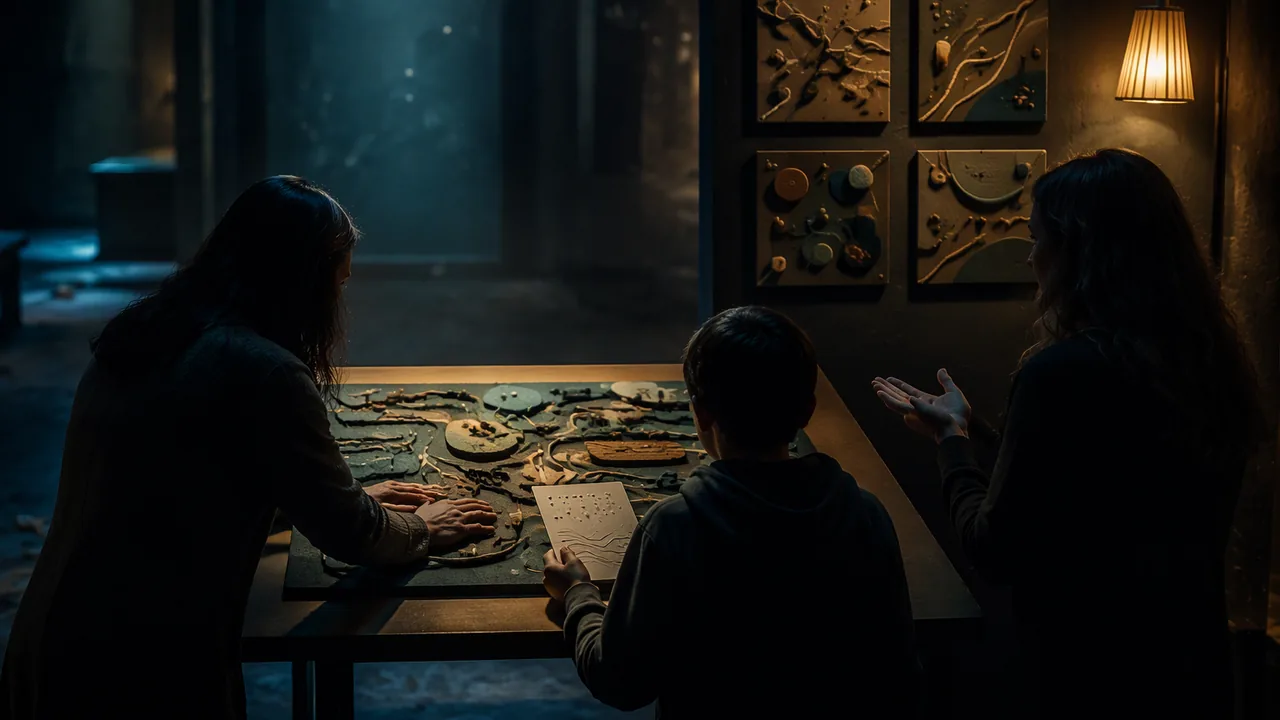
Installing. Follow your plan. Fix works to the table, place labels in consistent positions, test every spoken-description link, and walk the route with your eyes closed (with an adult beside you) to check it is clear and safe.
Visitor feedback. If household members or invited guests visit, leave feedback cards with three prompts: What did your hands find first? What did the work make you think or feel, and what in the work caused that? What one change would make it clearer or stronger? No visitors is not a failure; the formal critique below does not depend on them.
The formal critique: Critical Response Process. The choreographer Liz Lerman developed the Critical Response Process for giving feedback on work in progress. It has three roles (the artist, one or more responders, and a facilitator who keeps the steps in order) and four steps. 1. Statements of meaning: the responder says what was meaningful, evocative, interesting, exciting or striking in the work. 2. Artist as questioner: the artist asks questions about the work, and the responder answers on topic. 3. Neutral questions: the responder asks questions with no opinion hidden inside them (“What were you thinking about when you chose the felt?” rather than “Why is the felt so ugly?”). 4. Permissioned opinions: the responder offers an opinion only with the artist’s permission, in the form “I have an opinion about ___; would you like to hear it?”, and the artist may say no. Run it twice: once on your own strongest exhibited work, and once on one of the course’s exemplar works from the portfolio-pack readings, where you are the responder. For your own work, a family member can be the responder while you are the artist and facilitator; working alone, write it as a self-dialogue, playing the artist on one day and the responder the next, so you meet the work fresh. Then sort everything you gathered by relevance (Lesson 4.3) and write a short response to the most useful comment.
The reflection. Write 500-700 words about your artistic growth this semester. Cite at least three specific works and at least two specific pieces of critique or test results, and say what you changed because of them. Answer honestly: What can you do now that you could not do in week 1? What was hardest? How has your thinking about AI images changed? End with two concrete goals for Semester B, where the course turns to composition, meaning and your own themes.
Gallery talk. In about two minutes, recorded, talk about one work: what it began from, what you decided, and what a reader’s or visitor’s feedback, or your own critique, taught you.
Selecting for your portfolio. Choose the documentation (photos, test records, critique records) that best shows your growth, and caption it. Your semester portfolio is now a record you can build on.
📖 Read for this lesson
The reading opens over the lesson; close it to come back to exactly where you were. The checks below draw on it.
Formative check
Work through these before moving on. They are not graded — they tell you whether the standard below has landed yet.
Record your second user test after revision: did each of your three revisions solve its problem? Then summarize your Critical Response Process record (and any visitor feedback cards), sorted by relevance, and write your response to the most useful comment.
Which reflection sentence gives the strongest evidence of growth?
How confident are you that you can present my work, respond to critique and reflect on my growth with evidence?
Submit: The Touchable Exhibit and Semester Reflection — tactile graphic, exhibit, critique response, reflection (500-700 words) and gallery talk
Task: Complete and user-test a tactile graphic of a labeled AI image or a CC0 museum work. Install a small touchable exhibit at home of two or three of your works, with large-print labels, spoken descriptions and handling instructions. Run the formal critique (Liz Lerman’s Critical Response Process) on your own work and on one course exemplar, respond to it, and write a reflection on your growth across the semester.
Submission workflow
- Stage 1 — Plan. Your exhibit plan and your user-test records and revision list from Lessons 4.3-4.4.
- Stage 2 — Tested revision. The revised tactile graphic with a second user test by a new reader, and the installed exhibit checked by a route walk.
- Stage 3 — Critique response and reflection. The Critical Response Process record (and any visitor feedback cards) sorted by relevance with a written response, and a 500-700 word reflection citing specific works and critiques, with two goals for Semester B.
- Stage 4 — Gallery talk. About two minutes on one work, recorded.
How it is scored
| Criterion | What proficient looks like |
|---|---|
| Tactile graphic design (VA:Cr2C.II) | Simplified, distinct, well-spaced symbols with a key and orientation mark; the purpose is met. |
| Testing and revision (VA:Cr3A.II) | Revisions respond to user tests, and a second test shows the effect. |
| Selection and presentation (VA:Pr4A.II) | Works selected and documented to show decisions and growth; labels complete and accurate. |
| Exhibit design for access (VA:Pr5A.II) | Layout, labels, spoken descriptions and handling instructions serve touch, sight and hearing. |
| Critique response (VA:Re9A.I) | Critical Response Process run in order; feedback sorted by relevance with reasons; response is specific. |
| Reflection and gallery talk (VA:Cn10A.I) | Specific evidence of growth across works, honest challenges and concrete goals. |
Portfolio Task 4: Second-Test Form, Installation Checklist, Critical Response Process and an Exemplar Reflection
SLS original (exemplars illustrative); Critical Response Process steps from lizlerman.com, retrieved 9 Nov 2026 · SLS original (illustrative exemplars), with the steps of the Critical Response Process summarized and briefly quoted from lizlerman.com
Why this reading. Portfolio Task 4 gives you the assignment, stages and rubric. This reading supplies a second-test form, an installation checklist, a Critical Response Process form with a worked example, a worked way of sorting feedback, an exemplar reflection and a gallery-talk outline. The exemplar is constructed (SLS original, illustrative), not any real student’s work.
Second user test: record form
| Revision made after Lesson 4.3 | Problem it aimed at | Task and time, test 1 | Task and time, test 2 | Solved? (yes / partly / no) |
|---|---|---|---|---|
| Replaced mountain texture | Boat and mountain felt alike | Task 2: not found in 60 s | Task 2: 30 s, found | Yes |
| (yours) |
Installation checklist
- Every work fixed to its table and does not slide.
- Labels in the same position at every work, 24-point or larger.
- Every spoken-description link or QR code tested on a second device, or by a family member.
- Route at least 92 cm wide; no cables or bags on the floor; a textured start strip.
- Walk the route with eyes closed only with an adult beside you.
- Handling card at the start of the route; feedback cards and pencils beside the table for any visitors.
The Critical Response Process: record form and a worked example
Liz Lerman’s Critical Response Process (lizlerman.com, retrieved 9 November 2026) has three roles (artist, responder, facilitator) and four steps: 1. Statements of meaning (what was meaningful, evocative, interesting, exciting or striking); 2. Artist as questioner (the artist asks; the responder answers on topic); 3. Neutral questions (questions with no opinion inside them); 4. Permissioned opinions (“I have an opinion about ___; would you like to hear it?”; the artist may say no). Run it on your own strongest exhibited work (a family member as responder, or a self-dialogue written over two days: artist one day, responder the next) and on one exemplar from this course’s portfolio packs, where you are the responder.
| Step | Words, exactly | Relevance to the work’s purpose (high / some / none) and why |
|---|---|---|
| 1 Meaning | ||
| 2 Artist’s questions and answers | ||
| 3 Neutral questions and answers | ||
| 4 Opinions offered (and whether accepted) |
Worked example (illustrative), you as responder on the Portfolio 3 exemplar, “Hollow Well”: Meaning: “The smooth hollow pulls the hand in; it felt like reaching into still water.” Artist as questioner (taking the maker’s part from the exemplar statement): “Did the five figures read as people?” “Only after the smooth pads; before that they felt like buttons.” Neutral question: “What decided the height of the frame?” (not “Why is the frame so high?”). Permissioned opinion: “I have an opinion about the floor strip; would you like to hear it?” “Yes.” “It is so plain that my hand skipped it; one directional texture could lead toward the hollow.”
Sorting feedback, with an example
Sort the Critical Response Process record the same way as any visitor cards. Feedback card prompts: What did your hands find first? What did the work make you think or feel, and what in it caused that? What one change would make it clearer or stronger? Sort each answer as highly, somewhat or not relevant to the work’s purpose. Illustrative cards for a texture panel whose purpose is “a reader finds the green glow first”: “I found the smooth spot first” (highly relevant: it confirms the purpose); “the string line helped me tell the arch from the ground” (highly relevant: it credits a revision); “I would like more color” (not relevant to a touch purpose, but useful for low-vision visitors, so note it). Write a response to the most useful card: what you will change, or why you will not.
Exemplar reflection excerpt (about 200 of the 500–700 words; illustrative)
In week one I could not have said why my clay translation failed its first touch test. My reader found a rough area and a smooth one and said the tile showed “a beach,” when I had meant a stage. I had kept the picture’s layout and lost its meaning. In Unit 2, working from A Recent Entrance to Paradise, I made the green glow the only smooth region and lowered it, and my second reader found it first. The hardest work was Unit 3, because impasto paste would not give me the crisp edge I wanted, and my wear test showed unsealed clay shedding powder. My thinking about AI images changed the most: I began by thinking a machine image was either magic or theft, and I now think of it as a very detailed appearance with no surface at all, which is exactly what my hands can supply. Two goals for Semester B: to write my own artist statement before I look at any source image, and to test every work with a reader I have not met before I finish it.
Gallery talk outline (about two minutes)
What it began from (one sentence and its label); what you decided (one keep, one leave out); what a reader’s or visitor’s feedback, or your Critical Response Process, taught you (one quotation and what you did with it).
Sources: U.S. Access Board, 2010 ADA Standards for Accessible Design (access-board.gov); Liz Lerman, Critical Response Process (lizlerman.com)