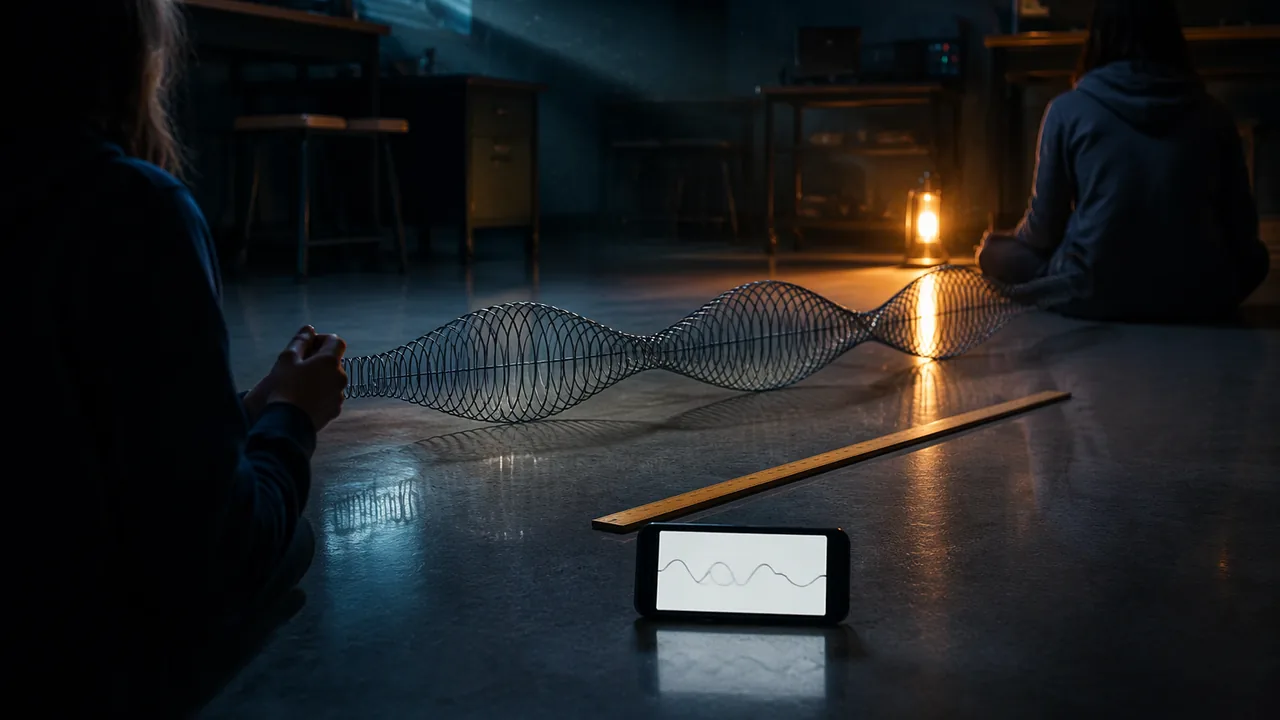
measure the speed of a pulse on a stretched spring, measure the frequency and wavelength of standing waves, and test whether v = fλ holds and how the medium affects speed.
Instruction
The investigation question. Does v = fλ really describe waves you can make? And what sets a wave’s speed: how hard you shake, or the medium? A long spring toy stretched along the floor lets you see waves travel and measure them with a meter stick and a phone.
Two kinds of wave on one spring. Flick one end sideways and a transverse pulse travels along, the coils moving at right angles to the direction of travel, like an S wave. Push one end forward sharply and a longitudinal (compressional) pulse travels, the coils bunching and spreading along the direction of travel, like a P wave or sound. On most springs the longitudinal pulse is easier to see as a moving bunch of coils.
Method 1: pulse speed. Stretch the spring to a measured length, for example 5.0 m, on a smooth floor. Send a single transverse pulse and time how long it takes to travel to the far end and back (10.0 m in total), filming with a phone to reduce reaction-time error. Speed = distance ÷ time. Illustrative result: 10.0 m in 1.70 s gives 5.9 m/s. Repeat with a larger flick (bigger amplitude): the speed stays about the same. Then stretch the spring farther (more tension) and repeat: the speed increases. The medium, not the amplitude, sets the speed.
Method 2: standing waves. With the far end held still, shake your end steadily from side to side. At certain frequencies the reflected wave and the incoming wave combine into a standing wave with points that do not move (nodes) and points that swing the most (antinodes). With one loop, the spring’s length is half a wavelength; with two loops, one wavelength. Count the shakes in 10 seconds to get the frequency. Illustrative result: two loops on a 5.0 m spring (λ = 5.0 m) at 12 shakes in 10 s (f = 1.2 Hz) gives v = 1.2 × 5.0 = 6.0 m/s, agreeing with method 1 to within about 2%.
Comparing methods. Two independent methods that agree are much stronger evidence than one. The percent difference is |v1 − v2| ÷ average × 100%: here |5.9 − 6.0| ÷ 5.95 × 100% ≈ 1.7%. If yours differ by more than about 10%, look for a cause: a miscounted loop, uneven tension, or timing error.
Connecting to the phenomenon. The same spring carries longitudinal and transverse waves at different speeds, and in rock P waves always outrun S waves. The difference in speed between the two wave types is exactly what gives an earthquake early-warning system its warning time. Seismologists also use it in reverse: the time gap between P and S arrivals at a station tells them how far away the earthquake was.
Safety. Stretched springs snap back hard if released; always walk the ends together before letting go, and never let go of a stretched end. Wear safety glasses or goggles, because a metal spring end can whip toward faces. Tie the far end firmly to the leg of a heavy table or sofa, work on a clear floor away from doors, stairs, pets and younger children, and keep the spring low.
📖 Read for this lesson
The reading opens over the lesson; close it to come back to exactly where you were. The checks below draw on it.
Lab: Measuring Wave Speed Two Ways on a Stretched Spring
Question. Do pulse timing and standing-wave measurements give the same wave speed, as v = fλ predicts, and does the speed depend on amplitude or on the medium’s tension?
Materials
- A long coil spring toy that stretches to about 5 m (or a metal or plastic Slinky stretched only as far as it springs back without kinking; if yours is too short, use a 5 m rope or clothesline for the transverse-pulse and standing-wave trials)
- A measuring tape, and masking tape to mark the ends and the midpoint
- A phone with a stopwatch and slow-motion video, and a chair or shelf to prop it on
- Safety glasses or goggles
- A heavy table or sofa leg to tie the far end to, and string if needed
- Wear safety glasses or goggles; a released spring end can whip toward the face.
- Never let go of a stretched spring: walk your end back to the tied end before releasing, and untie it only when the spring is slack.
- Work on a clear floor away from doors, stairs, pets and younger children, keeping the spring low to the ground.
Procedure
- Tie the far end of the spring firmly to the leg of a heavy table or sofa (or have a family member hold it still), stretch the spring along the floor to 5.0 m and mark both ends with tape.
- Send a single sideways pulse and time the round trip (10.0 m). Film it if possible. Repeat three times and average; calculate speed.
- Repeat step 2 with a pulse of about twice the amplitude, and record the speed.
- Prop the phone so it films the whole spring. Shake your end steadily to make a standing wave with one loop, then two loops. For each, count the shakes in 10 s from the video to find the frequency, and record the wavelength (2 × length for one loop, 1 × length for two loops).
- Calculate v = fλ for each standing wave and compare it with the pulse speed (percent difference).
- Stretch the spring to 6.0 m (more tension) and repeat step 2. No spring long enough? Complete steps 2-6 with the recorded run in this lesson’s reading.
Data
| Trial | Spring length (m) | Distance or λ (m) | Time (s) or frequency (Hz) | Speed (m/s) |
|---|---|---|---|---|
| Pulse, normal amplitude | 5.0 | 10.0 | ||
| Pulse, double amplitude | 5.0 | 10.0 | ||
| Standing wave, 1 loop | 5.0 | 10.0 | ||
| Standing wave, 2 loops | 5.0 | 5.0 | ||
| Pulse, more tension | 6.0 | 12.0 |
Analysis
- Claim: does v = fλ hold for your spring? Evidence: compare standing-wave speeds with pulse speeds, with the percent difference. Reasoning: explain why both methods measure the same property of the medium.
- Did changing the amplitude change the speed? Did changing the tension? What does this tell you about what determines wave speed?
- Identify the largest source of uncertainty in each method and one way to reduce it.
- Explain how the difference in speed between P and S waves lets seismologists estimate how far away an earthquake was.
If you cannot do this lab in person: Use the PhET Wave on a String simulation (fixed end, no damping) with its ruler and timer to measure pulse speed and standing-wave frequency and wavelength at two tensions, or use the complete recorded run in this lesson’s reading, and complete the same analysis.
Formative check
Work through these before moving on. They are not graded — they tell you whether the standard below has landed yet.
A pulse travels 10.0 m in 1.60 s. Its speed is
A standing wave with two loops on a 4.0 m spring has λ = m; at 1.5 Hz its speed is m/s.
Shaking the spring harder (larger amplitude) makes the wave travel faster.
Write your claim-evidence-reasoning paragraph on whether v = fλ holds. Include both speeds, the percent difference, and what you found about amplitude and tension.
How confident are you that you can measure wave speed two ways and test the relationship among frequency, wavelength and speed?
Practice
Work these on paper or in your notebook, then open Check your answer. Aim for all of Fluency and Application; try at least one Challenge.
Printable version: this unit’s practice workbook (PDF)
Fluency
Build speed and accuracy with the core skill.
- A sound in air (speed 343 m/s) has wavelength 1.0 m. What is its frequency?
Check your answer
Answer: 343.0 Hzf = v/λ. - A wave has frequency 256 Hz and wavelength 3.4 m. What is its speed?
Check your answer
Answer: 870.40 m/sv = fλ. - A sound in air (speed 343 m/s) has wavelength 1.56 m. What is its frequency?
Check your answer
Answer: 219.9 Hzf = v/λ. - A pulse travels 10.0 m in 1.70 s. What is its speed?
Check your answer
Answer: 5.9 m/s10.0 ÷ 1.70 = 5.88. - A standing wave with one loop on a 5.0 m spring has what wavelength? With two loops?
Check your answer
Answer: 10.0 m; 5.0 mOne loop is half a wavelength; two loops are one wavelength. - Is a sound wave transverse or longitudinal? An S wave?
Check your answer
Answer: Sound is longitudinal; an S wave is transverse.
Application
Use the skill in context. Show your reasoning.
- You measure 5.9 m/s by pulse timing and gets 12 shakes in 10 s with two loops on a 5.0 m spring. Find the standing-wave speed and the percent difference between the methods.
Check your answer
Answer: 6.0 m/s; about 1.7%f = 1.2 Hz; v = 1.2 × 5.0 = 6.0. |5.9 − 6.0| ÷ 5.95 × 100 = 1.7%. - After stretching the spring from 5.0 m to 6.0 m, a pulse’s round trip (12.0 m) takes 1.60 s. Compare the new speed with 5.9 m/s and explain the change.
Check your answer
Answer: 7.5 m/s, faster. More tension makes the spring pull back harder on each displaced coil, so the disturbance passes along more quickly; the medium changed.12.0 ÷ 1.60 = 7.5 m/s. - A student stands 50 m from a large wall and claps. Using 343 m/s, how long until the echo returns? Explain why timing a single echo by hand gives a poor measurement of the speed of sound.
Check your answer
Answer: About 0.29 s. That is close to human reaction time, so the timing error is as large as the time being measured; clapping in rhythm with the echoes and timing many cycles is better.Round trip 100 m ÷ 343 = 0.29 s.
Challenge
Stretch problems. Expect to think before you write.
- On the same spring, you make a standing wave with three loops at 1.8 Hz on a 5.0 m spring. Is this consistent with a speed of 6.0 m/s? Show your reasoning.
Check your answer
Answer: Yes. Three loops means 1.5 wavelengths in 5.0 m, so λ = 3.33 m; v = 1.8 × 3.33 = 6.0 m/s.λ = 5.0 ÷ 1.5 = 3.33 m.
Review
Keep earlier skills sharp.
- A net force of 120 N gives an object an acceleration of 2 m/s2. What is its mass?
Check your answer
Answer: 60.00 kgm = Fnet/a. - A device takes in 3600 J and delivers 3210 J of useful energy. What is its efficiency, and where did the rest go?
Check your answer
Answer: 89.2%; the other 390 J was transferred mostly as thermal energy to the surroundingsEfficiency = useful output / input × 100%.
Waves on a Spring, Recorded at Home: Pulse Timings, Standing Waves, and the P-Minus-S Rule Seismologists Use
One recorded run of the Lesson 4.2 procedure at home (5.0 m coil spring toy on a hallway floor, far end tied to a table leg, round-trip pulse timings from 240 frame-per-second phone video, standing-wave shake counts over 10 s counted from video, repeated at 6.0 m), constructed for this course and illustrative; sensor-spacing quotation from USGS Fact Sheet 2014-3083 and St. Louis-New Madrid distance from U.S. Census Bureau 2024 Gazetteer coordinates, retrieved November 5, 2026 · SLS original (constructed teaching data, with computed values); quoted USGS text is public domain
Why this reading. The lab’s open question needs “both speeds, the percent difference, and what you found about amplitude and tension.” A student without a spring has none of those. This is a complete run of the procedure, every trial recorded, so the analysis can be done from it, or your own run checked against it. It is constructed teaching data and is labeled illustrative. The last section turns the lab’s final analysis question, how the P-minus-S gap gives a distance, into a rule with a number.
Procedure that produced the record
A long coil spring toy stretched along a hallway floor at home to 5.0 m between tape marks, the far end tied firmly to the leg of a heavy table. Pulses: a single sideways flick, filmed at 240 frames per second from above the midpoint, round-trip time read as frames from the flick to the pulse’s return to the hand, divided by 240. Standing waves: the free end shaken steadily side to side until a stable pattern formed; the phone, propped on a chair, filmed the whole spring, and the shakes in 10 s were counted afterward from the video; wavelength from the pattern (one loop = half a wavelength). Then the spring was stretched to 6.0 m and the pulse and two-loop measurements repeated. Safety glasses worn; the free end walked back to the table and the knot untied only after the spring was slack.
Table 1. Pulse timings
| Trial | Spring length (m) | Round-trip distance (m) | Time 1 (s) | Time 2 (s) | Time 3 (s) | Average (s) | Speed (m/s) |
|---|---|---|---|---|---|---|---|
| Pulse, normal amplitude | 5.0 | 10.0 | 1.68 | 1.72 | 1.70 | 1.70 | 5.88 |
| Pulse, double amplitude | 5.0 | 10.0 | 1.71 | 1.67 | 1.69 | 1.69 | 5.92 |
| Pulse, more tension | 6.0 | 12.0 | 1.53 | 1.57 | 1.55 | 1.55 | 7.74 |
Table 2. Standing waves
| Pattern | Spring length (m) | Wavelength λ (m) | Shakes in 10 s | Frequency f (Hz) | v = fλ (m/s) |
|---|---|---|---|---|---|
| Standing wave, 1 loop | 5.0 | 10.00 | 6 | 0.6 | 6.00 |
| Standing wave, 2 loops | 5.0 | 5.00 | 12 | 1.2 | 6.00 |
| Standing wave, 3 loops | 5.0 | 3.33 | 18 | 1.8 | 5.99 |
| Standing wave, 2 loops, more tension | 6.0 | 6.00 | 13 | 1.3 | 7.80 |
Reading the record
Method 1 against method 2. The pulse gave 5.9 m/s (10.0 m in 1.70 s, the lesson’s worked figure); the two-loop standing wave gave 1.2 Hz × 5.0 m = 6.0 m/s. Percent difference: |5.9 − 6.0| ÷ 5.94 × 100% = 2.0%. The one-loop and three-loop patterns give the same 6.0 m/s from different frequencies and wavelengths: as the frequency tripled from 0.6 to 1.8 Hz, the wavelength fell from 10.0 to 3.33 m, and their product did not move. That is v = fλ holding on a real spring, with two independent methods agreeing to about 2%. Both methods measure a property of the spring, its tension against its mass per meter, and neither measures anything about how you shook it.
Amplitude. Doubling the flick changed the round-trip time from 1.70 to 1.69 s, well inside the spread of the trials. Amplitude does not set the speed; it sets how much energy the pulse carries. This is the true-false statement, and it matters for earthquakes: a bigger quake sends bigger waves, not faster ones, so the warning-time arithmetic is the same for a magnitude 5 and a magnitude 7.
Tension. Stretching the spring from 5.0 to 6.0 m raised the pulse speed from 5.9 to 7.7 m/s, and the two-loop standing wave at 6.0 m gave 1.3 Hz × 6.0 m = 7.8 m/s, 0.7% from the pulse. The medium changed, so the speed changed. Rock does the same: stiffer, denser rock carries seismic waves faster, which is why the lesson calls 6.0 and 3.5 km/s “typical” rather than fixed.
Uncertainty. In method 1, the largest uncertainty is judging the exact frame of the flick and of the return; one frame is 0.004 s, about 0.25% of the trip, so the spread in Table 1 (0.04 s) comes mostly from the spring not being perfectly uniform in tension from trial to trial. In method 2, the count over 10 s is uncertain by about half a shake, which is 0.05 Hz, or 4% at 1.2 Hz: the larger of the two. Counting for 30 s would cut it to about 1.5%.
From the gap to the distance: the rule seismologists use
The lab’s last analysis question asks how the P-minus-S difference tells seismologists how far away an earthquake was. Write both arrival times for a distance d: tP = d/6.0 and tS = d/3.5. Subtract: tS − tP = d(1/3.5 − 1/6.0) = d × 0.119 s/km. Turn it around: d = (tS − tP) × 8.4 km/s. With the lesson’s speeds, every second of gap between the P and S arrivals means the earthquake was about 8.4 km away.
| S minus P at a station (s) | Distance to the earthquake (km) |
|---|---|
| 2 | 17 |
| 5 | 42 |
| 7.1 | 60 |
| 11.9 | 100 |
| 20 | 168 |
One station gives a distance but not a direction; three stations give three circles, and the earthquake is where they cross. The West Coast’s ShakeAlert network has sensors, in the USGS fact sheet’s words, “positioned about 6-12 miles apart,” so the nearest ones see the P wave within a few seconds and the location follows. Missouri example: a station in St. Louis that recorded the S wave 28.1 s after the P wave would put the earthquake about 28.1 × 8.4 = 236 km away, the distance to the town of New Madrid.
The same rule works on the spring. If someone at the far end could feel a longitudinal pulse arrive before a transverse one sent at the same instant, the delay times a constant would tell them how far along the spring you are. On a 5 m spring the delay is too short to time by hand; in rock over 100 km it is 12 s, and that is the whole point of Unit 4.
The lesson’s checks, worked
A pulse traveling 10.0 m in 1.60 s: 6.25 m/s. Two loops on a 4.0 m spring: λ = 4.0 m, and at 1.5 Hz, v = 6.0 m/s. Compare Table 2’s second row: the same 6.0 m/s from a 5.0 m wavelength at 1.2 Hz, a different spring at a different frequency arriving at the same speed by coincidence of the numbers, not of the physics.
Your turn
- Compute the percent difference between each standing-wave speed in Table 2 and the pulse speed for the same spring length. Which pattern agrees best, and why might a three-loop count be less reliable than a two-loop count?
- A station records the P wave at 10:41:07 and the S wave at 10:41:19. How far away was the earthquake, using the 8.4 km/s rule? What would change if the waves traveled through softer rock at 4.8 and 2.8 km/s?
- Write the claim-evidence-reasoning paragraph the lesson asks for, with both speeds, the percent difference, and the amplitude and tension results from Tables 1 and 2.
Sources: USGS Fact Sheet 2014-3083, ShakeAlert: An Earthquake Early Warning System for the United States West Coast (pubs.usgs.gov); U.S. Census Bureau, 2024 Gazetteer Files (www2.census.gov)