model energy as kinetic energy of motion or potential energy stored in fields, calculate both, and ask questions about how energy can be stored and recovered.
Instruction
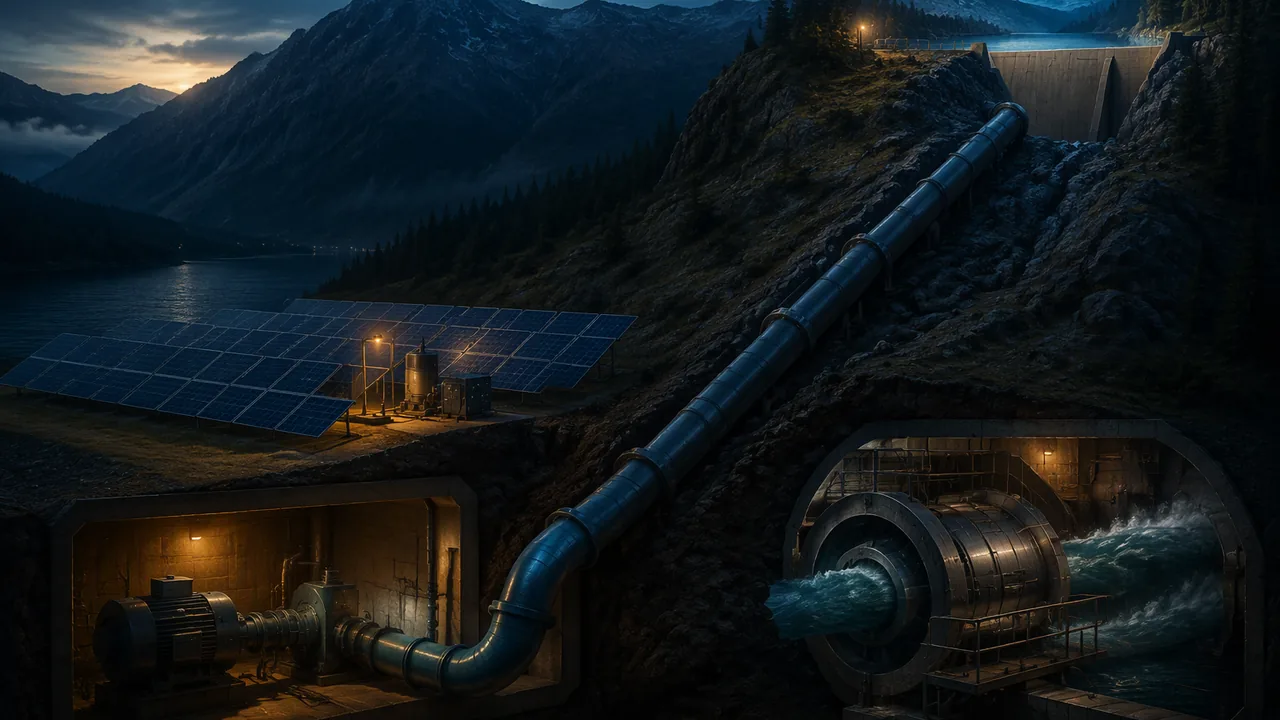
The phenomenon. On top of Proffit Mountain in Reynolds County, in the St. Francois Mountains of the Missouri Ozarks, sits a reservoir that no river flows into. Ameren Missouri fills it by pumping water up from a lower reservoir on the East Fork of the Black River when electricity is plentiful, then lets the water rush back down through the same machines, now running as turbines and generators, when demand is greatest. Ameren calls its Taum Sauk Energy Center “a giant battery.” It was built in 1963 to save electricity made at night for the next day’s peak. Today Missouri is adding large solar farms, such as Ameren’s 200-megawatt Huck Finn Solar Project on the border of Audrain and Ralls counties, and solar power peaks around midday, hours before demand peaks in the early evening when people get home, cook and turn on lights. Pumping water uphill is one way to store that sunshine for after sunset. Where is the energy while the water waits at the top?
Two big categories. At the scale of objects you can see, all energy is one of two kinds (9-12.PS3.A.2):
- Kinetic energy, energy of motion: KE = ½mv2, in joules (J). A 1,000 kg car at 20 m/s has ½ × 1,000 × 202 = 200,000 J. Doubling the speed quadruples the kinetic energy, which is why speed matters so much in crashes.
- Potential energy, energy stored in the arrangement of objects that interact through a field. Near Earth’s surface, gravitational potential energy is PE = mgh. Lifting 1,000 kg of water (1 cubic meter) up 262 m stores 1,000 × 9.8 × 262 = 2,567,600 J (about 2.57 MJ). Elastic energy in a stretched spring and chemical energy in fuel are also field energy: stretched bonds and rearranged electrons, electric fields at the particle scale.
Thermal energy is kinetic energy too. The “heat” in hot water is the kinetic energy of randomly moving particles, plus the energy stored in their interactions. When friction warms your hands, ordered motion becomes disordered particle motion. So even thermal energy fits the two categories once you look at the particle scale.
Worked example: pumped storage. Taum Sauk’s maximum operating head, the drop from the full upper reservoir to the turbines, is 860 ft, or 262 m. How much electricity does 1 m3 of water store when lifted that far? 2.57 MJ. One kilowatt-hour is 3.6 MJ, so that is 2.5676 ÷ 3.6 = 0.71 kWh, enough to run a 1,000 W microwave for about 43 minutes. A plant must move enormous volumes of water to matter to the grid: Ameren says the upper reservoir holds about 1.5 billion gallons. And not all of the energy comes back: pumps, turbines, generators and tunnel friction all turn some of it into thermal energy. Round-trip efficiencies of roughly 70-80% are commonly cited for pumped storage, and Ameren has reported a pump-back efficiency of 0.714 for Taum Sauk, so about 71 kWh returns for every 100 kWh spent pumping.
Stored energy is real energy: the 2005 breach. Before dawn on December 14, 2005, Taum Sauk’s original upper reservoir was overfilled during pumping and its wall failed. About 4,300 acre-feet of water (roughly 5.3 million m3) poured down the mountain in about 25 minutes and destroyed 281 acres of Johnson’s Shut-Ins State Park before the lower reservoir caught it; a family was injured, and no one was killed. The potential energy you calculate with mgh is exactly what made that flood so destructive. The rebuilt reservoir, back in service in 2010, has redundant water-level sensors and an overflow structure, because engineers must control where stored energy goes.
Conservation. Energy is never created or destroyed; it is transferred between objects and transformed between forms. As water falls, its potential energy becomes kinetic energy, then the kinetic energy of the turbine, then electrical energy, with some thermal energy at every step. If you account for every part of the system, the total stays the same. That accounting is what you will do all unit.
Worked example: a skateboarder. A 50 kg skateboarder drops into a 5.0 m deep half-pipe from rest. At the top: PE = 50 × 9.8 × 5.0 = 2,450 J, KE = 0. At the bottom, ignoring friction: PE = 0, so KE = 2,450 J, and ½ × 50 × v2 = 2,450 gives v = 9.9 m/s. Mass cancels, so a heavier rider reaches the same speed.
Your questions. What could you measure at home about energy changing form? What needs data from Ameren, the Energy Information Administration or the Department of Energy? What needs a model?
📖 Read for this lesson
The reading opens over the lesson; close it to come back to exactly where you were. The checks below draw on it.
Formative check
Work through these before moving on. They are not graded — they tell you whether the standard below has landed yet.
A pumped-storage plant uses 100 kWh of electricity to pump water uphill. How much electricity can it get back later?
What is the kinetic energy of a 2.0 kg ball moving at 3.0 m/s?
Lifting 1,000 kg of water 300 m stores J, which is about kWh (1 kWh = 3.6 × 10⁶ J).
Simulation & tools
Watch energy change form
Open the Intro screen with the Energy bar graph and Speed on. (1) Release the skater from the top of the U-shaped track with friction off, and describe how the kinetic and potential bars change during one pass. (2) Record the total energy at the top and bottom. (3) Turn friction on and describe what happens to the thermal bar and to the height the skater reaches each pass. (4) Explain in two sentences whether energy is conserved in each case. No device? Draw energy bar charts (KE, PE, thermal) for the top, middle and bottom of a half-pipe with and without friction.
Open in a new tab ↗ · PhET Interactive Simulations, University of Colorado Boulder · CC BY 4.0
How confident are you that you can model energy as kinetic energy or energy stored in fields and calculate each?
Practice
Work these on paper or in your notebook, then open Check your answer. Aim for all of Fluency and Application; try at least one Challenge.
Printable version: this unit’s practice workbook (PDF)
Fluency
Build speed and accuracy with the core skill.
- Find the kinetic energy of a 1000 kg object moving at 20 m/s.
Check your answer
Answer: 200,000 JKE = ½mv2. - Find the kinetic energy of a 60 kg object moving at 20 m/s.
Check your answer
Answer: 12,000 JKE = ½mv2. - Find the gravitational potential energy gained when a 2 kg object is lifted 3 m (g = 9.8 m/s2).
Check your answer
Answer: 58.8 JPE = mgh. - Find the gravitational potential energy gained when a 55 kg object is lifted 25 m (g = 9.8 m/s2).
Check your answer
Answer: 13,475 JPE = mgh. - A ball is released from rest 45 m above the ground. Use conservation of energy (ignore air resistance) to find its speed just before impact.
Check your answer
Answer: 29.7 m/smgh = ½mv2, so v = √(2gh); mass cancels. - A ball is released from rest 20 m above the ground. Use conservation of energy (ignore air resistance) to find its speed just before impact.
Check your answer
Answer: 19.8 m/smgh = ½mv2, so v = √(2gh); mass cancels.
Application
Use the skill in context. Show your reasoning.
- A 1,200 kg car’s speed doubles from 15 m/s to 30 m/s. Find its kinetic energy at each speed and the factor by which it increases.
Check your answer
Answer: 135,000 J and 540,000 J; four times½ × 1,200 × 152 = 135,000; ½ × 1,200 × 302 = 540,000; 540,000 ÷ 135,000 = 4. - At Taum Sauk, 1,000 kg of water (1 m3) is pumped up the plant’s 262 m maximum head. How much energy is stored, in joules and kWh? Using Ameren’s pump-back efficiency of 0.714, how much electrical energy comes back?
Check your answer
Answer: 2,567,600 J (about 0.71 kWh); about 1,833,000 J (about 0.51 kWh) returns1,000 × 9.8 × 262 = 2.5676 × 10⁶ J; ÷ 3.6 × 106 = 0.713 kWh. 0.714 × 2.5676 × 106 = 1.833 × 10⁶ J = 0.509 kWh. - A roller-coaster car starts from rest at the top of a 40 m drop. Ignoring friction, how fast is it moving at the bottom? Does the answer depend on the car’s mass?
Check your answer
Answer: 28 m/s; no, the mass cancels.mgh = ½mv2, so v = √(2 × 9.8 × 40) = √784 = 28 m/s.
Challenge
Stretch problems. Expect to think before you write.
- Explain why the chemical energy in gasoline and the thermal energy in hot water can both be described as kinetic energy or energy stored in fields when you look at the particle scale.
Check your answer
Answer: Chemical energy is energy stored in the electric fields between electrons and nuclei in molecules (the arrangement of bonds). Thermal energy is mostly the kinetic energy of randomly moving particles plus the energy of their interactions. So at the particle scale both reduce to motion and field energy.
Review
Keep earlier skills sharp.
- A 0.5 kg object moving at 0.6 m/s collides and sticks to a 1.0 kg object moving at −0.3 m/s (same line; positive is the first object’s direction). Find the total momentum and the velocity just after the collision.
Check your answer
Answer: total momentum 0.00 kg·m/s; final velocity 0.00 m/sMomentum is conserved: m1v1 + m2v2 = (m1 + m2)v. - If the distance between two charges triples, by what factor does the electric force change?
Check your answer
Answer: It becomes 1/9 as large.
Taum Sauk by the Numbers: The Mountaintop Reservoir, the Drop, the Round Trip and the 2005 Breach
Ameren Missouri, Taum Sauk Pumped Storage Energy Center (W. A. Witt, presentation filed with the Missouri Public Service Commission, EFIS document 268949); Ameren Missouri 2011 Integrated Resource Plan, chapter 5, Renewable and Storage Resources (EFIS document 55215); Ameren Missouri, Taum Sauk Energy Center web page; Ameren news releases of October 2, 2006 (SEC Exhibit 99.1) and February 8, 2023; Association of State Dam Safety Officials, Dam Failure Case Study: Taum Sauk Dam (Missouri, 2005); National Weather Service St. Louis, Taum Sauk Dam Failure overview; EIA, Today in Energy, July 8, 2013; DOE Water Power Technologies Office, Pumped Storage Hydropower; retrieved November 5, 2026 · Public domain (works of the United States government) and published facts quoted from Ameren Missouri, Missouri Public Service Commission filings and the Association of State Dam Safety Officials, with SLS computations
Why this reading. The mini-lecture works its pumped-storage example at 262 m and asks which of your questions “need data from Ameren, the Energy Information Administration or the Department of Energy.” Here are the data. The plant’s size, drop and efficiency come from Ameren Missouri’s own documents, two of them filed with the Missouri Public Service Commission. The national round trip comes from the U.S. Energy Information Administration. The 2005 breach comes from the Association of State Dam Safety Officials, the National Weather Service and Ameren’s own news release. Every figure has its source; every calculation from them is shown.
Table 1. The Taum Sauk Energy Center, as Ameren describes it
| Item | As published | Source |
|---|---|---|
| Location | Reynolds County, Missouri; “approximately 120 miles southwest of St. Louis in the scenic Ozark highlands” | Ameren PSC presentation; 2011 IRP |
| Production capacity | 440 MW, from 2 pump turbines | Ameren PSC presentation |
| Maximum operating head (the drop) | 860 ft | Ameren PSC presentation |
| Began operation | 1963 | Ameren PSC presentation |
| Reservoir areas | Upper 51 acres; lower 370 acres | Ameren PSC presentation |
| Water stored in the upper reservoir | “1.5 billion gallons of water” | Ameren, Taum Sauk Energy Center page |
| How it is used | “used primarily on a peaking basis and is put into operation when the demand for electricity is greatest” | Ameren 2011 IRP |
| Round trip | “The Taum Sauk facility has a pump back efficiency of 0.714.” | Ameren 2011 IRP |
| Rebuilt upper reservoir | First filled February 27, 2010; plant returned to commercial operation April 15, 2010 | Ameren PSC presentation |
Table 2. Computed from Table 1
| Quantity | Computation | Result |
|---|---|---|
| The drop in meters | 860 ft × 0.3048 m/ft | 262 m |
| Energy stored per cubic meter lifted the full drop | mgh = 1,000 kg × 9.8 m/s2 × 262 m | 2,567,600 J ≈ 2.57 MJ = 0.71 kWh |
| Volume of the upper reservoir | 1.5 billion gal × 0.003785 m3/gal | 5.68 million m3 |
| Energy stored in a full upper reservoir, at most | 5.68 × 10⁶ m3 × 2.5676 × 106 J/m3 | 1.46 × 10¹³ J ≈ 4,050 MWh |
| Hours the plant could run at 440 MW on that energy | 4,050 MWh ÷ 440 MW | about 9.2 hours |
| Electricity needed to pump it all back up | 4,050 MWh ÷ 0.714 | about 5,672 MWh (about 1,622 MWh lost) |
Why “at most.” 860 ft is the maximum operating head: the drop from a full upper reservoir to the turbines. Water near the bottom of the upper reservoir falls less far, and turbines and generators are not perfect, so the real electricity from one full reservoir is smaller than 4,050 MWh. The lesson’s sentence “a plant must move enormous volumes of water to matter to the grid” is this table: one cubic meter is worth only 0.71 kWh, about 43 minutes of a 1,000 W microwave, so Taum Sauk needs millions of cubic meters to run for an evening.
Table 3. The round trip, Taum Sauk and the nation
EIA, Today in Energy, July 8, 2013: “In 2011, pumped storage plants produced 23 billion kilowatthours (kWh) of gross generation” and “consumed 29 billion kilowatthours (kWh) of electricity in 2011 to refill their storage reservoirs, resulting in a net generation loss of 6 billion kWh.” The article counts “40 pumped storage plants operating in the United States … totaling more than 22 gigawatts (GW) of storage capacity, roughly 2% of U.S. generating capacity.” The Department of Energy’s current page counts “43 PSH plants” and states that “PSH currently accounts for 88% of all utility-scale energy storage in the United States.”
| Round trip | Energy in | Energy back | Fraction returned |
|---|---|---|---|
| U.S. pumped storage, 2011 (EIA) | 29 billion kWh | 23 billion kWh | 23 ÷ 29 = 79% |
| Taum Sauk (Ameren, 2011 IRP) | 100 kWh | 71.4 kWh | 71.4% |
Both sit inside the lesson’s “roughly 70–80%” range, Taum Sauk near the bottom and the national fleet near the top. The prediction question’s answer is in this table: put 100 kWh into Taum Sauk and about 71 kWh comes back. The missing 29 kWh is thermal energy in pumps, turbines, generators, the tunnel walls and the water. Nothing was destroyed; it was spread out, which Lesson 3.2 measures directly in a cup.
Table 4. Stored energy out of control: the breach of December 14, 2005
The Association of State Dam Safety Officials’ case study reports that the original upper reservoir failed by overtopping in the final minutes of a pumping cycle, releasing its 4,300 acre-feet of stored water through a breach 656 ft wide in 25 minutes, with a peak flow of 273,000 cubic feet per second; the flood destroyed 281 acres of Johnson’s Shut-Ins State Park before the lower reservoir contained it. The National Weather Service in St. Louis wrote that “More than a billion gallons of water rushed down Profit Mountain,” that “the water level was at least 20 feet high as the wall of flood water passed through Johnson’s Shut-Ins State Park,” and that “Some residents were alerted through NOAA Weather Radio All Hazards and headed for higher ground.” Ameren’s news release of October 2, 2006, says the breach “injured a family of five—all of whom recovered,” and that the company agreed to pay a $10 million civil penalty and fund $5 million in project enhancements.
| Quantity | Computation | Result |
|---|---|---|
| Water released | 4,300 acre-ft × 1,233.48 m3/acre-ft | 5.30 million m3 |
| Potential energy released, falling about the plant’s head | 5.30 × 10⁶ m3 × 1,000 kg/m3 × 9.8 × 262 | about 1.36 × 10¹³ J |
| Average power of the flood | 1.36 × 10¹³ J ÷ (25 × 60 s) | about 9.1 × 10⁹ W, about 21 times the plant’s 440 MW |
The engineering lesson. The energy a pumped-storage plant stores is the same mgh whether it leaves through the turbines over nine hours or over a mountainside in 25 minutes. The difference is control. Ameren’s presentation to the Public Service Commission lists what the rebuilt reservoir uses to keep the water level in check: low and high level probes, separate high-level and high-high-level probes, a mechanical float switch, a continuous video camera and staff gauge, an overflow release structure, and redundant power including an uninterruptible power supply. Every one of those is a constraint written in response to a failure, which is how Lesson 3.5’s criteria and constraints work too.
Table 5. The solar half of the puzzle
Ameren’s news release of February 8, 2023, announced “the company’s largest-ever solar facility, a 200 megawatt (MW) solar installation in central Missouri,” the Huck Finn Solar Project “on the border of Missouri’s Audrain and Ralls counties,” designed “to generate more than 25 times the amount of energy of Missouri’s largest existing solar facility,” and part of a “planned addition of 2,800 MW in new, clean renewable generation by 2030.” Solar output peaks at midday; the IRP describes Taum Sauk as running “when the demand for electricity is greatest.”
| Illustrative comparison | Computation | Result |
|---|---|---|
| A 200 MW solar farm running at full output for 4 midday hours (illustrative; real output varies with sun and cloud) | 200 MW × 4 h | 800 MWh |
| How many such midday blocks one full Taum Sauk upper reservoir could hold | 4,050 MWh ÷ 800 MWh | about 5 |
| What comes back after sunset from 800 MWh pumped | 800 × 0.714 | about 571 MWh |
Taum Sauk was built in 1963 to store electricity from large power plants at night for the next day’s peak. The physics does not care where the pumping energy comes from: midday sunshine stored as mgh on Proffit Mountain is the same joules, at the same 71 cents on the dollar.
Kinetic energy: the other half of the model
Water leaving the upper reservoir falls up to 262 m through the tunnel. If nothing slowed it, it would arrive at the turbines at v = √(2gh) = √(2 × 9.8 × 262) = 72 m/s, and its kinetic energy per cubic meter, ½ × 1,000 × 71.72, would equal the 2.57 MJ of potential energy it started with. The skateboarder in the lesson is the same calculation at 5.0 m: √(2 × 9.8 × 5.0) = 9.9 m/s, and the mass cancels in both cases. In the real tunnel the water does not reach that speed; friction with the walls has already turned part of the energy into thermal energy before the turbine sees it. That is one of the places the missing 29% goes.
Your turn
- Suppose the upper reservoir has been drawn down so that the drop is only 800 ft. Compute the energy stored per cubic meter at that drop, in joules and kWh, and explain in one sentence why the plant gets less energy from its last cubic meters than from its first.
- Using Ameren’s 0.714, find how much electricity must be spent pumping to get back 1,000 MWh, and how much is lost as thermal energy.
- Sort your question board: which questions do Tables 1–5 answer, which could you measure at home (Lessons 3.2 and 3.3), and which need a model that no table here supplies?
Sources: Ameren Missouri, Taum Sauk Pumped Storage Energy Center (presentation filed with the Missouri Public Service Commission, EFIS 268949) (efis.psc.mo.gov); Ameren Missouri, 2011 Integrated Resource Plan, Chapter 5: Renewable and Storage Resources (EFIS 55215) (efis.psc.mo.gov); Ameren Missouri, Taum Sauk Energy Center (ameren.com); Ameren news release, October 2, 2006: FERC approves stipulation and consent agreement on fines over Taum Sauk dam breach (SEC Exhibit 99.1) (sec.gov); Ameren news release, February 8, 2023: Ameren Missouri expanding solar generation in Show-Me State with largest project in company history (ameren.mediaroom.com); Association of State Dam Safety Officials, Dam Failure Case Study: Taum Sauk Dam (Missouri, 2005) (damsafety.org); National Weather Service St. Louis, Taum Sauk Dam Failure, December 2005 (event overview) (weather.gov); EIA, Today in Energy: Pumped storage provides grid reliability even with net generation loss (July 8, 2013) (eia.gov); U.S. Department of Energy, Pumped Storage Hydropower (energy.gov)