model how information is encoded as digital signals, evaluate the advantages and limitations of digital transmission and storage, and explain how devices use waves and their interactions with matter to carry information.
Instruction
From a warning to a message. An earthquake alert from the West Coast’s ShakeAlert system, or a tornado warning on a Missouri phone, is information: what is happening, where, and what to do. It travels from sensors or forecasters to processing centers and then to millions of phones and radios in seconds. How is information carried by waves, and why is almost all of it now sent as digital signals?
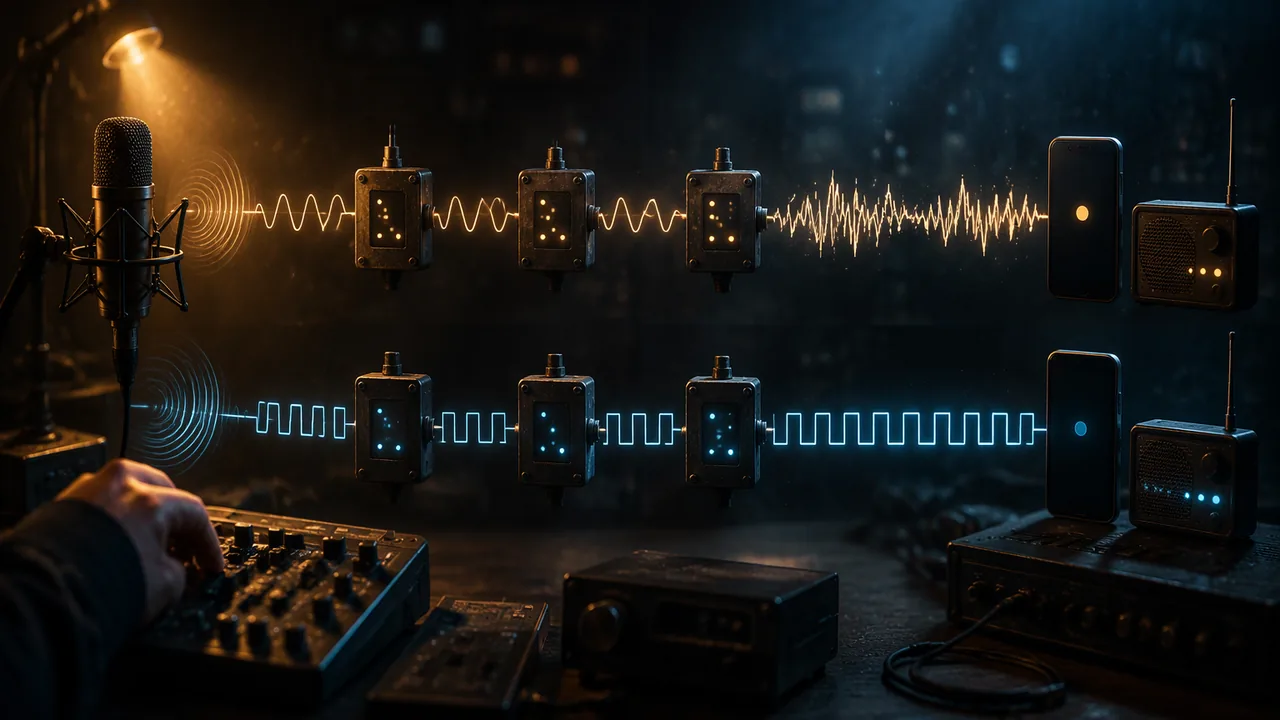
Analog and digital. An analog signal varies smoothly, like the changing voltage from a microphone that copies the shape of a sound wave. A digital signal represents information as a sequence of whole numbers, usually written in binary: 0s and 1s called bits. To digitize a sound, you sample it many times a second and record each sample as a number. With 8 bits you can represent 28 = 256 different levels; with 16 bits, 65,536.
Worked example: how much data? CD-quality audio samples 44,100 times per second, with 16 bits per sample, for two stereo channels: 44,100 × 16 × 2 = 1,411,200 bits per second. A 3-minute song (180 s) is 254,016,000 bits, or about 31.8 megabytes (8 bits = 1 byte). Streaming services compress this to much less by leaving out detail the ear barely notices.
Why digital wins for transmission (enrichment). Every signal picks up noise, random disturbances, as it travels. An analog receiver cannot tell the noise from the signal, so every copy and every relay adds noise: think of a faint AM radio station hissing. A digital receiver only has to decide “is this a 0 or a 1?” A little noise does not change the decision, so the signal can be relayed and copied many times with no loss. Extra check bits let the receiver detect and even correct errors. Digital data can also be compressed, encrypted, stored for years and searched. Limitations: sampling cannot capture detail between samples; a weak digital signal fails suddenly (the video freezes) rather than getting gradually worse; data can be copied and spread without permission; and storage formats become obsolete. Evaluating digital transmission means weighing both lists.
Carrying bits on waves. Bits are sent by changing a property of a carrier wave: switching a light on and off, or shifting a radio wave’s amplitude, frequency or phase in patterns the receiver decodes. Higher-frequency carriers can switch faster, so they can carry more bits per second, which is one reason light in fibers carries so much data.
A Missouri example: NOAA Weather Radio. NOAA Weather Radio stations broadcast on seven frequencies from 162.400 to 162.550 MHz (wavelength about 1.85 m). The voice forecast is an analog signal, but every warning begins with a short digital header called SAME (Specific Area Message Encoding), sent by switching between two audio tones, 2083.3 Hz for a 1 and 1562.5 Hz for a 0, at 520.83 bits per second (FCC rule 47 CFR 11.31). The header holds the event type (TOR for a tornado warning; the code list also includes EQW, Earthquake Warning), six-digit county codes (029189 is St. Louis County: 29 for Missouri, 189 for the county) and how long the warning lasts. It is sent three times, and a radio programmed for your county decodes it and sounds its alarm. Wireless Emergency Alerts work the same way in principle: a short digital text, up to 360 characters on 4G LTE networks, broadcast from cell towers to every capable phone in the warned area.
Devices that use wave interactions with matter (9-12.PS4.B.1).
- Fiber-optic cables. Light travels in a thin glass fiber, at about 2 × 10⁸ m/s (slower than in air, because glass slows light). Where light in the core meets the boundary with the surrounding cladding (glass in which light travels slightly faster) at a shallow angle, it is totally internally reflected and stays trapped in the fiber for kilometers. The internet backbone carrying seismic data and weather-warning data to processing centers runs largely on fiber.
- Seismometers. A mass on a spring stays nearly still while the ground moves under it; sensors turn the relative motion into a digital signal. This is wave interaction with matter at the start of any earthquake-warning chain.
- Solar cells and camera sensors. Photons absorbed by silicon give electrons enough energy to move, producing a current: the photon model in action.
- Cell phones. Antennas convert electrical signals into radio waves and back, the electromagnetic induction of Unit 2 at very high frequency.
📖 Read for this lesson
The reading opens over the lesson; close it to come back to exactly where you were. The checks below draw on it.
Formative check
Work through these before moving on. They are not graded — they tell you whether the standard below has landed yet.
Simulation & tools
Trapping light: total internal reflection
Open the Intro screen. Set the top material (where the laser is) to glass and the bottom material to air, so the beam travels from glass toward air. (1) Start with the beam nearly perpendicular to the boundary and record what happens. (2) Gradually tilt the laser to shallower angles and record the angle at which the refracted beam disappears. (3) Explain in two sentences how this keeps light inside an optical fiber. No device? Shine a flashlight up through the side of a clear glass of water and look at the water’s surface from below at a shallow angle, then describe the mirror-like reflection you see.
Open in a new tab ↗ · PhET Interactive Simulations, University of Colorado Boulder · CC BY 4.0
The main reason digital signals can be relayed many times without loss is that
With 8 bits per sample, a digital signal can represent different levels.
One limitation of digital transmission is that a weak signal tends to fail suddenly rather than fade gradually.
How confident are you that you can explain digital encoding, weigh its advantages and limits, and describe how devices use waves to carry information?
Practice
Work these on paper or in your notebook, then open Check your answer. Aim for all of Fluency and Application; try at least one Challenge.
Printable version: this unit’s practice workbook (PDF)
Fluency
Build speed and accuracy with the core skill.
- Convert 1250 °C to kelvin.
Check your answer
Answer: 1,523.15 KK = °C + 273.15. - How many different values can 4 bits represent? 10 bits?
Check your answer
Answer: 16; 1,02424 and 210. - Write the number 5 in 4-bit binary.
Check your answer
Answer: 01014 + 1 = 5. - A telephone-quality voice signal takes 8,000 samples per second at 8 bits each. What is its bit rate?
Check your answer
Answer: 64,000 bits per second8,000 × 8. - Light travels in a glass fiber at about 2 × 10⁸ m/s. How long does it take to travel 1,000 km?
Check your answer
Answer: 0.005 s (5 ms)1 × 10⁶ m ÷ 2 × 10⁸ m/s. - NOAA Weather Radio broadcasts at 162.475 MHz on one of its seven channels. Using 3.00 × 10⁸ m/s, what is the wavelength?
Check your answer
Answer: About 1.85 mλ = 3.00 × 10⁸ ÷ 1.62475 × 10⁸. - Name two advantages and one limitation of digital transmission.
Check your answer
Answer: Advantages: resists noise, copies without loss, can be compressed, encrypted, stored and error-checked. Limitation: sampling loses detail, weak signals fail suddenly, easy unauthorised copying, obsolete formats.
Application
Use the skill in context. Show your reasoning.
- Calculate the size of a 3-minute stereo song at CD quality (44,100 samples per second, 16 bits per sample, 2 channels) in bits and in megabytes.
Check your answer
Answer: 254,016,000 bits; about 31.8 MB44,100 × 16 × 2 = 1,411,200 bits/s; × 180 s = 254,016,000; ÷ 8 = 31,752,000 bytes. - A 10-minute video streams at 5 megabits per second. How many megabytes of data does it use? Explain one reason compression is essential for streaming.
Check your answer
Answer: 375 MB. Uncompressed video would need far more bits per second than most connections can carry, so compression removes detail viewers barely notice to fit the available bandwidth.5 × 106 × 600 = 3 × 109 bits ÷ 8 = 375 × 106 bytes. - A NOAA Weather Radio warning starts with a digital SAME header sent at 520.83 bits per second (47 CFR 11.31). One header with its 16-byte preamble is 58 bytes. How long does one copy take, and how long do the three required copies take, not counting pauses?
Check your answer
Answer: About 0.89 s for one copy; about 2.7 s for three58 × 8 = 464 bits; 464 ÷ 520.83 = 0.891 s; × 3 = 2.67 s. - Explain how a solar cell and a seismometer each use an interaction between waves and matter to produce an electrical signal.
Check your answer
Answer: Solar cell: photons absorbed by silicon give electrons enough energy to move, creating a current. Seismometer: seismic waves move the ground and frame while a suspended mass stays nearly still; the relative motion is converted (for example by a coil and magnet) into a voltage that is digitized.
Challenge
Stretch problems. Expect to think before you write.
- An analog signal relayed through 10 stations picks up a little noise at each. A digital signal relayed through the same 10 stations picks up the same noise. Explain why the digital message arrives intact but the analog one does not, and when the digital one would fail.
Check your answer
Answer: Each digital station decides whether each pulse is a 0 or a 1 and sends out a clean new copy, so noise is removed at every step; analog stations amplify the noise along with the signal, so it accumulates. The digital signal fails only if noise at one step is large enough to flip bits faster than error-checking can correct.
Review
Keep earlier skills sharp.
- A 1200 kg object moving at 20 m/s collides and sticks to a 1400 kg object moving at 4.0 m/s (same line; positive is the first object’s direction). Find the total momentum and the velocity just after the collision.
Check your answer
Answer: total momentum 29,600 kg·m/s; final velocity 11.38 m/sMomentum is conserved: m1v1 + m2v2 = (m1 + m2)v. - A ball keeps 60% of its energy each bounce. Dropped from 1.0 m, how high is its first rebound?
Check your answer
Answer: 0.60 m
How a Warning Becomes Bits: Wireless Emergency Alerts, NOAA Weather Radio’s Digital Code, and Noise on a Relay
NWS, Wireless Emergency Alerts; NWS, NOAA Weather Radio All Hazards, Using NWR SAME, Emergency Alert System description and event codes; 47 CFR 11.31 (EAS protocol), eCFR current text; USGS, Seismographs: Keeping Track of Earthquakes; USGS news release, May 4, 2021; U.S. Census Bureau 2024 Gazetteer county codes; all retrieved November 5, 2026. Relay noise tables and the decoded header are constructed and illustrative · Public domain (works of the United States government), with SLS illustrative tables
Why this reading. The lesson asks you to evaluate digital transmission and to explain the devices that carry a warning message, but it never shows you a real warning system’s digital code or lets you watch noise attack a signal. This reading holds both: what the National Weather Service publishes about the two message systems that already reach Missouri, Wireless Emergency Alerts on phones and NOAA Weather Radio, including the exact digital code a weather radio decodes; and two small tables, one analog and one digital, in which the same noise is added at each of several relays so you can see why one survives and the other does not. The relay tables are constructed and labeled illustrative; every number in them can be checked with a pencil.
1. The message systems, as the agencies describe them
Wireless Emergency Alerts (phones). National Weather Service: “Wireless Emergency Alerts (WEA) are emergency messages sent by authorized government alerting authorities through your mobile carrier.” “No signup is required! Alerts are sent automatically to WEA-capable phones during an emergency.” “Messages will be up to 360 characters on 4G LTE networks and beyond. WEA message length will be a maximum of 90 characters on 3G and earlier networks.” And: “WEA messages include a special tone and vibration, both repeated twice.” The NWS sends WEA messages for warnings including tornadoes, which is the alert Missouri phones receive most often. On the West Coast, the same system delivers ShakeAlert earthquake warnings (USGS news release, May 4, 2021).
NOAA Weather Radio (radios). More than 1000 transmitters broadcast on seven frequencies from 162.400 to 162.550 MHz. The forecast voice is analog, but “When an NWS office broadcasts a warning, watch or non-weather emergency, it also broadcasts a digital SAME code that may be heard as a very brief static burst … This SAME code contains the type of message, county(s) affected, and message expiration time.” A radio programmed for your county “will turn on for that message, with the listener hearing the 1050 Hz warning alarm tone.” The federal rule for this code (47 CFR 11.31, the Emergency Alert System protocol, which the NWS says NWR uses identically) sets the physics: the code uses “Audio Frequency Shift Keying at a rate of 520.83 bits per second”; “Mark frequency is 2083.3 Hz and space frequency is 1562.5 Hz. Mark and space time must be 1.92 milliseconds.” Each character is an eight-bit byte, a 16-byte preamble goes before each header, and the header is sent three times.
A Missouri header, decoded (illustrative example in the rule’s format). ZCZC-WXR-TOR-029189+0045-3092130-KLSX/NWS-
| Part | Meaning |
|---|---|
| ZCZC | Start of the code |
| WXR | Originator: National Weather Service |
| TOR | Event: tornado warning (the NWS code list also has EQW, Earthquake Warning) |
| 029189 | Location: 0 = the whole county; 29 = Missouri; 189 = St. Louis County (Census Bureau county code 29189) |
| +0045 | Valid for 45 minutes |
| 3092130 | Issued on day 309 of the year (November 5) at 21:30 UTC |
| KLSX/NWS | Sender: the NWS office in St. Louis |
Count the cost. The header is 42 characters, plus the 16-byte preamble: 58 bytes = 58 × 8 = 464 bits. At 520.83 bits per second, one copy takes 464 ÷ 520.83 = 0.89 s, and three copies take 2.67 s, plus the required one-second pauses. One bit lasts 1 ÷ 520.83 = 1.92 ms, the rule’s number. Sending the same short header three times gives the receiver copies to compare, a simple form of the error checking the lesson describes.
2. How many bits, worked
| Message | Computation | Size |
|---|---|---|
| One second of CD-quality stereo audio | 44,100 samples/s × 16 bits × 2 channels | 1,411,200 bits |
| A 3-minute song at that rate | 1,411,200 × 180 s | 254,016,000 bits = 31,752,000 bytes ≈ 31.8 MB |
| A 360-character WEA text | 360 × 8 bits | 2,880 bits = 360 bytes |
| Ratio, song to alert | 254,016,000 ÷ 2,880 | 88,200 to 1 |
| One NOAA Weather Radio SAME header with preamble | 58 bytes × 8 | 464 bits, 0.89 s at 520.83 bits/s |
| Levels from 8 bits; from 16 bits | 28; 216 | 256; 65,536 |
The lesson’s worked example reproduces (31.8 megabytes), and the fill-in is the last row. The size of the alert is the point: a warning is a tiny message, which is why it can be pushed to a whole region in seconds, whether it is a tornado warning in Missouri or, on the West Coast, an earthquake warning racing the S wave. Streaming a song takes seconds per phone; a 360-byte broadcast takes almost nothing.
3. Noise against an analog signal (illustrative)
A signal five samples long is sent through five relays. At each relay a little noise (never more than ±0.05 of full scale) is added, and the relay passes on whatever it received.
| Sample 1 | Sample 2 | Sample 3 | Sample 4 | Sample 5 | |
|---|---|---|---|---|---|
| Source | 1.00 | 0.72 | 0.31 | 0.88 | 0.15 |
| After relay 1 | 1.04 | 0.69 | 0.36 | 0.86 | 0.18 |
| After relay 2 | 0.99 | 0.73 | 0.33 | 0.91 | 0.14 |
| After relay 3 | 1.02 | 0.78 | 0.29 | 0.88 | 0.19 |
| After relay 4 | 0.98 | 0.76 | 0.34 | 0.92 | 0.16 |
| After relay 5 | 1.03 | 0.71 | 0.37 | 0.88 | 0.20 |
No relay knows which part of what it received was signal and which was noise, so each passes both on and adds its own. Some errors cancel by luck and some pile up; the third sample has drifted by 0.06 after five hops and there is no way to recover 0.31. Fifty relays would bury it. This is the hiss on a distant AM station and the snow on an old television picture.
4. The same noise against a digital signal (illustrative)
Eight bits sent as 1.00 V for a 1 and 0.00 V for a 0. Noise up to ±0.14 V is added at each relay, nearly three times the analog table’s noise. Each relay decides: anything above 0.50 V is a 1, anything below is a 0, and it re-sends a clean 1.00 or 0.00.
| Bit 1 | Bit 2 | Bit 3 | Bit 4 | Bit 5 | Bit 6 | Bit 7 | Bit 8 | |
|---|---|---|---|---|---|---|---|---|
| Source bits | 1 | 0 | 1 | 1 | 0 | 0 | 1 | 0 |
| Received at relay 1 (volts) | 1.08 | −0.11 | 1.14 | 0.91 | 0.12 | 0.07 | 0.87 | 0.10 |
| Decided and re-sent | 1 | 0 | 1 | 1 | 0 | 0 | 1 | 0 |
| Received at relay 2 (volts) | 0.88 | 0.09 | 0.90 | 1.13 | −0.08 | 0.11 | 1.09 | −0.07 |
| Decided and re-sent | 1 | 0 | 1 | 1 | 0 | 0 | 1 | 0 |
Every decision was right, and the message leaves the second relay exactly as it left the source. It would leave the fiftieth relay the same way. The noise was not smaller; the receiver simply had a question with only two answers. A bit flips only if the noise exceeds 0.50 V, and even then extra check bits let the receiver notice and often repair it. That is the quiz’s answer and the lesson’s central claim about digital transmission.
The limitation, in the same table. Make the noise ±0.60 V and half the decisions become coin flips; the message does not degrade gracefully into a hiss, it becomes garbage at once. That is the true-false statement: a weak digital signal fails suddenly. It is also why a phone at the edge of coverage may show full text one moment and nothing the next.
5. The devices in the chain, with the wave behavior each uses
| Device | What it does in ShakeAlert | Wave interaction with matter it relies on |
|---|---|---|
| Seismometer | Senses the P wave (the start of any earthquake-warning chain) | USGS, on a vertical seismograph: “the mass hangs from a spring, which absorbs some of the motion and causes the mass to lag behind actual motion.” The relative motion between the ground-anchored frame and the lagging mass is turned into a voltage and then into bits. |
| Fiber-optic link | Carries the sensor data to a processing center | Light pulses trapped in glass by total internal reflection at the core-cladding boundary; at about 2 × 10⁸ m/s, 500 km takes 2.5 ms. |
| Cell tower and phone antenna; weather-radio transmitter and receiver | Broadcast and receive the alert | A radio wave of a few hundred megahertz to a few gigahertz for phones (at 900 MHz the wavelength is 0.33 m), and 162.4–162.55 MHz for NOAA Weather Radio (about 1.85 m). Induction in the antenna turns the wave back into a current, Lesson 2.2 at high frequency. |
| Phone or radio speaker and screen | Delivers the alert to a person | Sound waves in air from a vibrating diaphragm (the WEA tone, the radio’s 1050 Hz alarm); light from the screen’s emitters. |
The alert crosses these four devices in well under a second. The S wave, at 3.5 km/s, needs about 23 s to cross the 80 km from New Madrid to Cape Girardeau. Everything in this unit’s warning-time arithmetic depends on that mismatch, and every device in the table is where a wave meets matter and is turned into a different kind of signal.
Your turn
- Continue the analog table for two more relays with noise of your own choosing (within ±0.05) and report how far sample 3 has drifted. Then continue the digital table for two relays with noise within ±0.14 and confirm the bits survive.
- Find the smallest noise that could flip a bit in the digital table, and explain why adding a ninth “check” bit that makes the count of 1s even would let a receiver detect one flipped bit.
- Write the SAME header for a tornado warning for New Madrid County (county code 29143), valid for 30 minutes, and compute how long its three copies take at 520.83 bits per second.
- Build the evaluation table the lesson asks for: at least three advantages and three limitations of digital transmission, each tied to a row or a number in this reading.
Sources: National Weather Service, Wireless Emergency Alerts (weather.gov); National Weather Service, NOAA Weather Radio All Hazards (weather.gov); National Weather Service, Using NWR SAME (weather.gov); National Weather Service, NWR event codes (weather.gov); 47 CFR 11.31, EAS protocol (eCFR) (ecfr.gov); USGS, Seismographs: Keeping Track of Earthquakes (usgs.gov); USGS news release, Entire U.S. West Coast Now Has Access to ShakeAlert Earthquake Early Warning (May 4, 2021) (usgs.gov); U.S. Census Bureau, 2024 Gazetteer Files (county codes) (www2.census.gov)