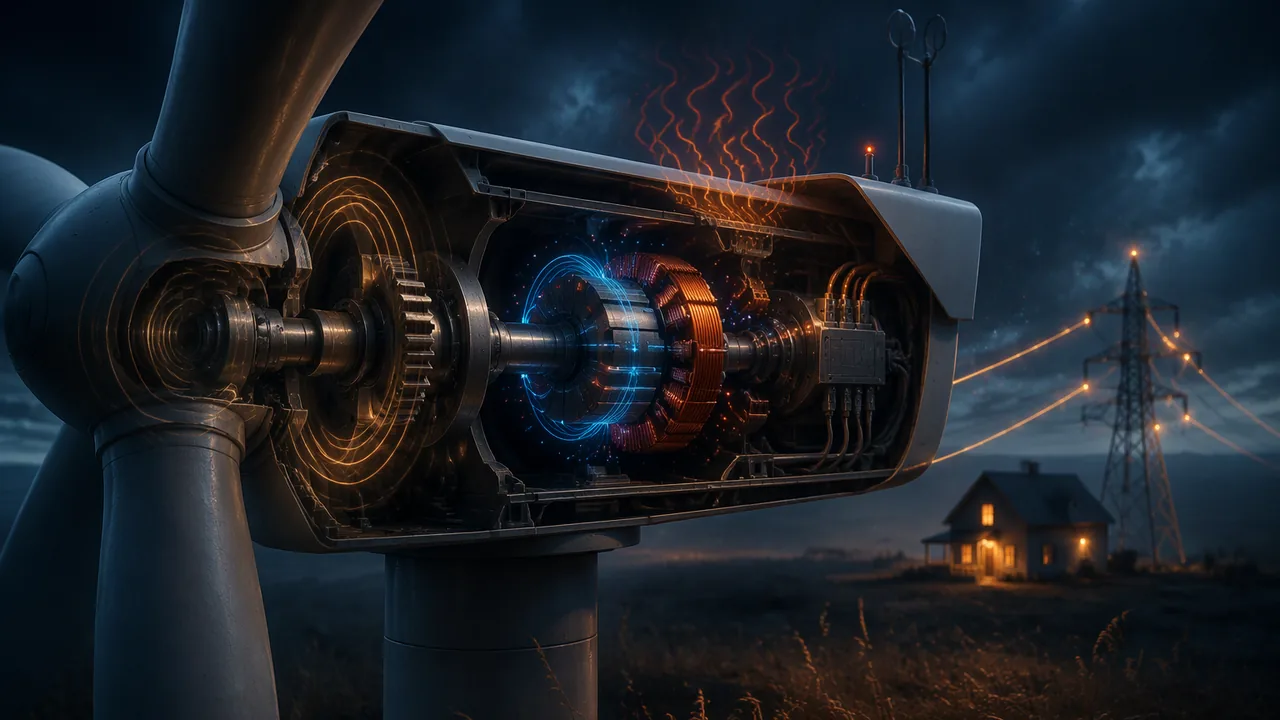
explain with a field model and lab evidence how a wind turbine produces electric current, trace the energy transfers, and compare magnetic, electric and gravitational forces.
Instruction
The context. In 2025, wind turbines produced about 9.1% of all the electricity generated in Missouri: 6.48 million megawatt-hours out of 71.5 million, from 14 wind farms with 2,453.7 megawatts of nameplate capacity (U.S. Energy Information Administration). Many of them stand in the state’s windy northwest corner. Atchison County alone has 342 turbines totaling 800 megawatts (USGS U.S. Wind Turbine Database), and they show how fast the machines have grown: the four turbines of the Loess Hills project, built in 2008, are rated 1.25 megawatts each with 64 m rotors, while 51 of the Outlaw project’s turbines, built in 2021, are rated 4.2 megawatts with 150 m rotors. Most people drive past without knowing how a spinning blade turns into the current in their wall socket. Your job is to explain it clearly and correctly, for an audience of curious adults, using the models you built in this unit.
What the explainer must do.
- Show the evidence for induction (9-12.PS2.B.2). Describe your electromagnet and moving-magnet results: a current produces a magnetic field (compass, clip counts), and a changing magnetic field produces a current (meter readings). Use at least two numbers from your data.
- Model the generator with fields (9-12.PS3.C.1). Draw and label a diagram: blades, shaft, magnet, coils, and field lines. Explain why the field through the coils must keep changing, why the induced current pushes back against the rotation, and therefore why the wind must keep doing work. Trace the energy from moving air to the grid, naming where energy leaves the useful path (thermal energy in coils and gears, sound).
- Compare the forces (9-12.PS2.B.1). Include one inverse-square calculation, for example how the gravitational force on a satellite changes with distance, or how the electric force between two charges changes, and explain in a paragraph why electric and magnetic forces dominate inside the generator while gravity dominates in orbits.
Reading and sources (RST.9-10.2). Summarize accurately how one source explains generators, such as OpenStax Physics or a U.S. Department of Energy wind page, and say whether its explanation matches your model. Do not state figures about a Missouri wind farm (turbine counts, output) unless you cite a source for them; the lesson’s reading gives federal figures you may use.
Quality bar. A strong explainer never says the magnet “makes electricity out of nothing”; it follows the energy. It uses one accurate diagram rather than several vague ones. It defines field, induction and current in plain language before using them.
Stages. Plan, draft, adult-reader review (a parent, guardian or other adult reads it as a non-scientist and marks every sentence they cannot follow), revise, and record a four-minute presentation that ends by answering this question about your model: why must the wind keep pushing on the blades once the generator is already spinning?
📖 Read for this lesson
The reading opens over the lesson; close it to come back to exactly where you were. The checks below draw on it.
Formative check
Work through these before moving on. They are not graded — they tell you whether the standard below has landed yet.
A generator produces current because
All of the wind’s kinetic energy that reaches the blades ends up as electrical energy on the grid.
Draft your plan: sketch the generator diagram in words (what is labeled), list the two lab results you will cite, and write the energy-flow chain from wind to grid.
How confident are you that you can explain with a field model and lab evidence how a generator turns motion into electric current?
Unit 2 checkpoint
Do this before you start the task. It covers the whole unit and tells you what to review first.
The gravitational force between two objects is 100 N. The distance between them is doubled. The force is now
Which is true of both Newton’s law of gravitation and Coulomb’s law?
Astronauts in orbit float because gravity is zero there.
Two charges attract with 2.0 N. When the distance is halved, the force becomes N.
Which observation shows that an electric current produces a magnetic field?
A current is induced in a coil when
Adding more turns to an electromagnet’s coil makes it stronger.
When you pull apart two magnets that are stuck together, the energy you supply is
In a generator, mechanical work becomes electrical energy because
Lifting a 3.0 kg box 2.0 m stores J in the gravitational field (g = 9.8 m/s2).
Electric forces hold atoms together, while gravity dominates the motion of planets because large objects are almost neutral.
A motor converts
Submit: From Wind to Wire explainer (900-1,200 words) + four-minute presentation
Task: Explain how a wind turbine produces electric current for a public audience. Use your lab evidence that currents make magnetic fields and changing fields make currents; draw and explain a labeled field model of the generator with the energy transfers from wind to grid; and include one inverse-square calculation comparing forces. Cite at least two sources.
Submission workflow
- Stage 1 — Plan. Diagram sketch, the lab data you will cite, your energy-flow chain and your inverse-square example.
- Stage 2 — Reviewed draft. An adult reader (a parent, guardian or other adult) reads it as a non-scientist and checks every energy claim for a destination; submit their notes and your revision plan.
- Stage 3 — Final explainer. 900-1,200 words with the labeled diagram, lab evidence, calculation and cited sources.
- Stage 4 — Recorded presentation and defense. Four minutes, recorded, ending with your answer to the question: why must the wind keep pushing on the blades once the generator is already spinning?
How it is scored
| Criterion | What proficient looks like |
|---|---|
| Field model and energy (9-12.PS3.C.1, CCC.4) | Correct field diagram; traces energy from wind to grid, including losses and the push-back of the induced current. |
| Evidence for induction (9-12.PS2.B.2) | Accurately uses lab data for both current-to-field and changing-field-to-current. |
| Forces compared (9-12.PS2.B.1) | Correct inverse-square calculation and a sound comparison of force strengths and scales. |
| Sources (RST.9-10.2) | Summarizes a source accurately and compares it with the model. |
| Communication (SEP.8) | Clear for a public audience; the presentation answers a question with evidence. |
The Source to Summarize: The Department of Energy on How a Turbine Works, and the Federal Figures on Missouri Wind You May Cite
U.S. Department of Energy, How Do Wind Turbines Work? and How a Wind Turbine Works (text version); U.S. Energy Information Administration, Open Data API: electric power operational data (Missouri, annual, all sectors, 2024-2025) and operating generator capacity (Missouri, wind, January and December 2025); U.S. Geological Survey, U.S. Wind Turbine Database API (Atchison County, Missouri); retrieved November 5, 2026 · Public domain (works of the United States government)
Why this reading. The task says: summarize accurately how one source explains generators, “such as … a U.S. Department of Energy wind page, and say whether its explanation matches your model.” It also says: “Do not state figures about a Missouri wind farm (turbine counts, output) unless you cite a source for them.” This reading is the Department of Energy source, reproduced so you can summarize it without leaving the lesson, followed by the federal figures for Missouri wind that are citable, with their sources and dates, and a note on what is not. Read the DOE text twice: once for what it says, and once for what it leaves out that your field model must supply.
1. U.S. Department of Energy: “How Do Wind Turbines Work?”
“Wind turns the propeller-like blades of a turbine around a rotor, which spins a generator, which creates electricity.”
“A wind turbine turns wind energy into electricity using the aerodynamic force from the rotor blades, which work like an airplane wing or helicopter rotor blade. When wind flows across the blade, the air pressure on one side of the blade decreases. The difference in air pressure across the two sides of the blade creates both lift and drag. The force of the lift is stronger than the drag and this causes the rotor to spin. The rotor connects to the generator, either directly (if it’s a direct drive turbine) or through a shaft and a series of gears (a gearbox) that speed up the rotation and allow for a physically smaller generator. This translation of aerodynamic force to rotation of a generator creates electricity.”
2. U.S. Department of Energy: “How a Wind Turbine Works” (component guide, text version)
The component guide names the parts your labeled diagram needs. Its sentences, as published:
- Blades: “… a typical modern land-based wind turbine has blades of over 170 feet (52 meters).”
- Low-speed shaft: “… the low-speed shaft is connected to the rotor and spins between 8–20 rotations per minute.”
- Nacelle: “The nacelle sits atop the tower and contains the gearbox, low- and high-speed shafts, generator, and brake.”
- Generator: “Copper windings turn through a magnetic field in the generator to produce electricity.”
- Anemometer: “The anemometer measures wind speed and transmits wind speed data to the controller.”
- Yaw drive: “The yaw drive rotates the nacelle on upwind turbines to keep them facing the wind when wind direction changes.”
3. Does the source match your model? A worked comparison
A summary for RST.9-10.2 states the source’s central idea and its supporting points in your own words, without adding your opinion: The Department of Energy explains that moving air produces lift on the blades, the way it does on a wing; the lift turns a rotor at 8 to 20 revolutions per minute; a gearbox raises that speed for a compact generator; and in the generator copper windings move through a magnetic field, producing electricity. That is accurate, and it is all the source says about the generator.
Now the comparison. Your model from Lessons 2.2 and 2.4 has three claims the DOE text does not state: (a) a current flows only while the magnetic field through the windings is changing, which is why the windings must turn and why a stopped turbine makes nothing; (b) the induced current makes its own field that pushes back on the rotation, which is why the wind must keep doing work; (c) energy leaves the useful path as thermal energy in the gearbox and windings and as sound. The source is consistent with all three but silent on them. “Copper windings turn through a magnetic field” is true and incomplete: the turning is what matters, not the field. Say that in your explainer. Agreeing with a source and noticing what it omits are both part of summarizing it well.
4. Federal figures for Missouri wind you may cite
| Figure | Value | Source and date |
|---|---|---|
| Rotor speed of a modern land-based turbine | 8–20 rotations per minute | DOE, How a Wind Turbine Works (text version), retrieved Nov. 5, 2026 |
| Missouri electricity generation, all sources, 2025 | 71,526,875 megawatt-hours | EIA, electric power operational data (annual, all sectors), retrieved Nov. 5, 2026 |
| Missouri wind generation, 2025 | 6,483,476 megawatt-hours | same EIA data set |
| Missouri wind generation, 2024 (all sources: 66,875,710 MWh) | 6,789,964 megawatt-hours | same EIA data set |
| Missouri wind nameplate capacity, operating, January and December 2025 | 2,453.7 megawatts at 14 wind farms | EIA, operating generator capacity (Form EIA-860M), retrieved Nov. 5, 2026 |
| Atchison County wind turbines | 342 turbines, 800.0 megawatts in all | USGS, U.S. Wind Turbine Database, retrieved Nov. 5, 2026 |
| Loess Hills Wind Project, Atchison County (2008) | 4 Suzlon S64 turbines, 1.25 MW each; hub height 72 m; rotor diameter 64 m | USGS, U.S. Wind Turbine Database |
| Outlaw project, Atchison County (2021), largest model | 51 Vestas V150 turbines, 4.2 MW each; hub height 105 m; rotor diameter 150 m | USGS, U.S. Wind Turbine Database |
Worked from the table. Wind’s share of Missouri’s electricity was 6,483,476 ÷ 71,526,875 = 9.1% in 2025 and 6,789,964 ÷ 66,875,710 = 10.2% in 2024. A 2021 Outlaw turbine’s rotor sweeps (150 ÷ 64)2 = 5.5 times the area of a 2008 Loess Hills rotor, and its rating is 4.2 ÷ 1.25 = 3.36 times larger.
What a capacity factor is, and why it belongs in an energy explainer. A turbine’s nameplate is the most it can produce in a strong steady wind. Over a year the wind is often light or absent, so the energy actually delivered is a fraction of nameplate times hours. If Missouri’s 2,453.7 MW of wind had run flat out for all 8,760 hours of 2025, it would have produced 2,453.7 × 8,760 = 21,494,412 MWh. It actually produced 6,483,476 MWh, so its capacity factor was 6,483,476 ÷ 21,494,412 = 30.2%. A reader who hears “a 4.2-megawatt turbine” and multiplies by 8,760 hours gets a number more than three times too big. Your explainer should not.
What you may not state. This reading gives no annual output for any single Missouri wind farm, because none was retrieved for this course. If you want a site figure, find it, cite it with a date, and label anything you estimate as an estimate.
5. The inverse-square paragraph, one example ready to adapt
The task requires one inverse-square calculation. Using the Lesson 2.1 reading’s NASA figures: a satellite at 800 km altitude is 7,171 km from Earth’s center, so gravity there is (6,371 ÷ 7,171)2 = 0.789 of its surface value; move it to twice its distance from the center, 14,342 km, and the force falls to one quarter of that. The paragraph that follows the calculation should say why the generator does not care about any of this: the magnetic force between the windings and the field is enormous compared with gravity at the scale of centimeters, while at the scale of orbits every charge is canceled by an opposite one and only mass, which has no opposite, is left to act.
Your turn
- Write your own three-sentence summary of the DOE text and mark each sentence with the quotation it rests on.
- List the three claims of your model the source omits, and for each, name the lab result from Lesson 2.2 or the crank measurement from Lesson 2.4 that supports it.
- Draft your labeled diagram in words, using only parts the DOE component guide names, plus field lines and the arrow for the push-back.
Sources: U.S. Department of Energy, How Do Wind Turbines Work? (energy.gov); U.S. Department of Energy, How a Wind Turbine Works (text version) (energy.gov); EIA Open Data API, electricity/electric-power-operational-data (Missouri, annual generation by fuel) (api.eia.gov); EIA Open Data API, electricity/operating-generator-capacity (Missouri wind, 2025) (api.eia.gov); USGS, U.S. Wind Turbine Database (energy.usgs.gov)