evaluate the evidence that light behaves as a wave and as a particle, use photon energy to explain why different frequencies affect matter differently, and judge the validity and reliability of published claims about electromagnetic radiation.
Instruction
Two models, one light. Light, radio, microwaves, X-rays and ultraviolet are all electromagnetic (EM) waves: oscillating electric and magnetic fields that travel through empty space at c = 3.00 × 10⁸ m/s. They differ only in frequency and wavelength. But “wave” is only half the story, and 9-12.PS4.A.2 asks you to evaluate the evidence for both models.
Evidence for the wave model. Waves interfere: where two sets of waves overlap, crests meet crests and add, and crests meet troughs and cancel. Light does this. The rainbow bands you see on the surface of a DVD, and the bright and dark fringes when light passes through two narrow slits, are interference patterns. Light also diffracts, spreading out as it passes through a narrow opening, and it refracts, bending as it changes speed entering glass or water. A particle model cannot easily explain interference.
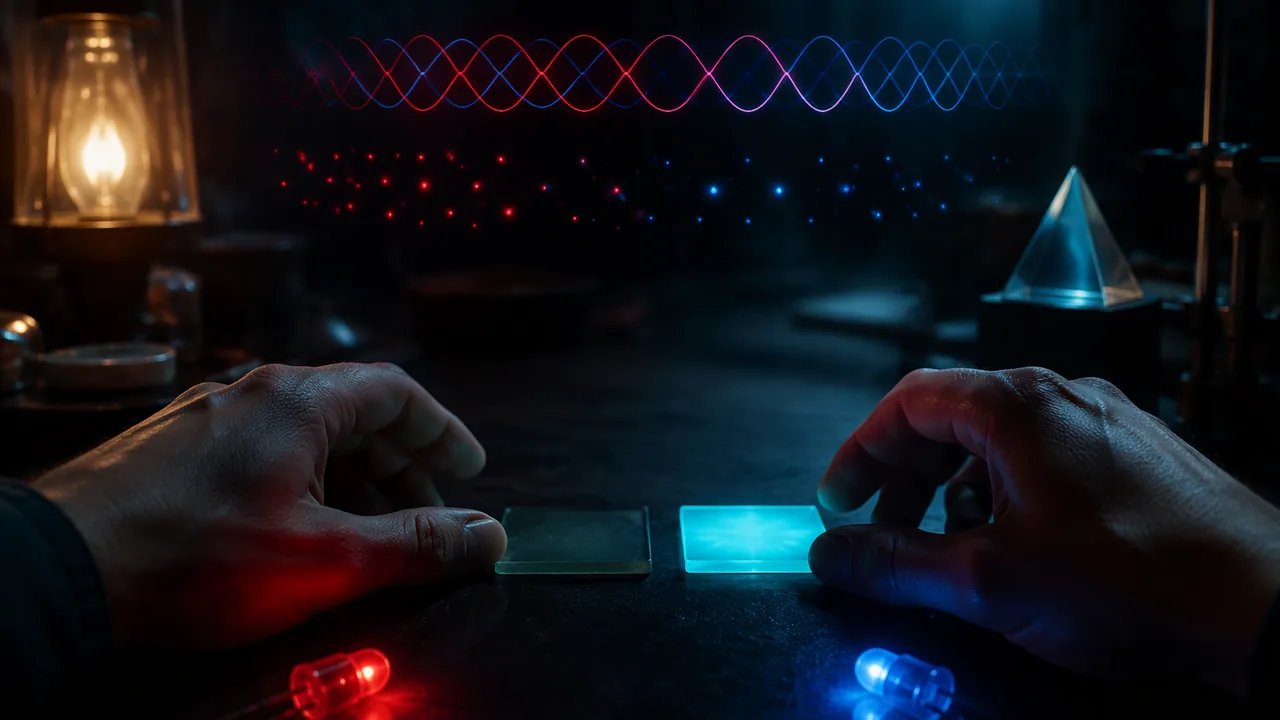
Evidence for the particle model. Glow-in-the-dark material is “charged” by light: electrons in it absorb light energy, jump to higher energy levels, and slowly release it as a glow. Try this at home: shine a bright red LED on a patch of glow material for 30 seconds, then turn off the lights. It barely glows. Shine a dim blue LED on another patch for 30 seconds: it glows brightly. A wave model predicts that brighter light, carrying more energy, should charge it more, whatever the color. It does not. The explanation, first proposed by Einstein for the photoelectric effect in 1905, is that light arrives in packets called photons, each with energy
E = hf, where h = 6.626 × 10⁻³⁴ J·s
An electron absorbs one photon at a time. A red photon (700 nm, about 1.77 eV) does not carry enough energy to lift the electron; making the light brighter only sends more red photons, each still too weak. A blue photon (about 450 nm, 2.76 eV) does. So both models are needed: light travels and interferes like a wave, and it delivers energy to matter in photon-sized amounts.
Photon energies across the spectrum (calculated with E = hf; 1 eV = 1.602 × 10⁻¹⁹ J):
| Radiation | Frequency | Photon energy |
|---|---|---|
| FM radio, 101.7 MHz | 1.017 × 10⁸ Hz | 4.2 × 10⁻⁷ eV |
| Cell phone, 1.9 GHz | 1.9 × 10⁹ Hz | 7.9 × 10⁻⁶ eV |
| Microwave oven, 2.45 GHz | 2.45 × 10⁹ Hz | 1.0 × 10⁻⁵ eV |
| Red light, 700 nm | 4.28 × 10¹⁴ Hz | 1.77 eV |
| Ultraviolet B, 300 nm | 1.00 × 10¹⁵ Hz | 4.13 eV |
A typical carbon-carbon bond takes about 3.6 eV to break. A single UV-B photon can break a bond in DNA, which is why sunburn and skin cancer are linked to UV exposure and why NOAA and the EPA publish a daily UV Index. A radio or cell-phone photon carries hundreds of thousands of times less energy, far too little to break any chemical bond. Radio and microwave radiation can still transfer energy by heating when it is intense (that is how a microwave oven works, and why exposure limits exist), but it does not break bonds.
Evaluating claims (9-12.PS4.B.2, RST.9-10.8). Published claims about radiation range from well supported to baseless. Judge each on validity (does the reasoning match the physics?) and reliability (is the source expert, is the evidence from many studies, is it consistent?). “UV exposure increases skin-cancer risk” is supported by physics (photon energy) and by large bodies of medical evidence from agencies such as the National Cancer Institute. Claims that cell-phone signals break DNA fail the physics test, and major health agencies report no consistent evidence that normal phone use causes cancer, while research continues. Always check: who says so, based on what evidence, and does it fit the photon model?
📖 Read for this lesson
The reading opens over the lesson; close it to come back to exactly where you were. The checks below draw on it.
Lab: Charging Glow Material with Different Colors of Light
Question. Does the color (frequency) or the brightness of light determine whether it can charge glow-in-the-dark material?
Materials
- A glow-in-the-dark sheet or stickers, cut into four equal patches
- LED flashlights or small LED lights in red, green and blue (or a white phone flashlight with red and blue transparent filters, such as colored cellophane)
- A dark room or a shoebox viewer, and a phone timer
- Aluminum foil to cover patches that are not being tested
- Never look directly into an LED or shine lights at anyone’s eyes; do not use laser pointers.
- Move carefully in the darkened room; keep the floor clear and stay seated during glow observations.
Procedure
- Keep all patches covered with foil in the dark for at least 10 minutes so none is glowing at the start.
- Uncover one patch and shine the red light on it from 10 cm away for 30 seconds. Cover it again.
- Repeat with a fresh patch and the green light, and a third patch with the blue light, each from 10 cm for 30 seconds.
- Shine the red light on the fourth patch from 2 cm away (brighter) for 60 seconds.
- Darken the room, uncover all patches and rank their glow brightness at once (0 none to 3 bright). For a second, independent ranking, have a family member rank them without seeing your scores, or cover the patches, wait 10 seconds, and rank them again yourself in a shuffled order.
- Record which colors charged the material and whether extra brightness or time with red light helped.
Data
| Patch | Light color | Distance (cm) | Time (s) | Glow ranking 1 (0-3) | Glow ranking 2 (0-3) |
|---|---|---|---|---|---|
| 1 | Red | 10 | 30 | ||
| 2 | Green | 10 | 30 | ||
| 3 | Blue | 10 | 30 | ||
| 4 | Red, brighter and longer | 2 | 60 |
Analysis
- Claim: what determines whether light charges the material, color or brightness? Evidence: your rankings. Reasoning: explain with photon energy E = hf.
- Explain why the wave model alone predicts the wrong result for patch 4.
- Name one piece of evidence that light also behaves as a wave, and explain why scientists keep both models.
- Use your result to evaluate the claim ‘any light, if bright enough, can damage skin cells the way UV does.’
If you cannot do this lab in person: Use the recorded run of this lab in the lesson’s reading (four patches plus an ultraviolet patch, each ranked twice) and complete the analysis; use the PhET Bending Light simulation to explore the wave behavior (refraction) of different colors.
Formative check
Work through these before moving on. They are not graded — they tell you whether the standard below has landed yet.
Bright red light fails to charge glow material but dim blue light succeeds. This supports
About how many times more energy does a UV-B photon (4.13 eV) carry than a cell-phone photon (7.9 × 10⁻⁶ eV)?
A claim that a radiation source breaks DNA should be checked against the photon energy of that radiation and against reviews by expert health agencies.
Choose two published claims about electromagnetic radiation (one about sunlight or UV and one about phones, Wi-Fi or microwaves). For each, write 3-4 sentences judging its validity with photon energy and its reliability from the source and evidence.
How confident are you that you can evaluate the wave and particle models of light and judge claims about electromagnetic radiation?
Practice
Work these on paper or in your notebook, then open Check your answer. Aim for all of Fluency and Application; try at least one Challenge.
Printable version: this unit’s practice workbook (PDF)
Fluency
Build speed and accuracy with the core skill.
- A wave has frequency 10 Hz and wavelength 1.3 m. What is its speed?
Check your answer
Answer: 13.00 m/sv = fλ. - A sound in air (speed 343 m/s) has wavelength 1.56 m. What is its frequency?
Check your answer
Answer: 219.9 Hzf = v/λ. - Rank these by photon energy from lowest to highest: ultraviolet, radio, green light, microwaves, X-rays.
Check your answer
Answer: Radio < microwaves < green light < ultraviolet < X-raysPhoton energy rises with frequency. - Which light charged the glow material: red or blue? Which model explains this?
Check your answer
Answer: Blue; the photon (particle) model. - Name one observation that supports the wave model of light.
Check your answer
Answer: Interference fringes (two slits, colors on a DVD), diffraction or refraction. - Using E (eV) ≈ 1,240 ÷ wavelength (nm), find the photon energy of green light at 530 nm.
Check your answer
Answer: About 2.34 eV1,240 ÷ 530 = 2.34.
Application
Use the skill in context. Show your reasoning.
- A UV-A photon (365 nm) carries about 3.4 eV and a typical carbon-carbon bond needs about 3.6 eV to break. A UV-B photon (300 nm) carries about 4.1 eV. Which can break such a bond directly, and what does this suggest about why UV-B causes sunburn more than UV-A?
Check your answer
Answer: Only the UV-B photon carries enough energy (4.1 eV > 3.6 eV). UV-B photons can directly damage molecules such as DNA in skin cells, which is consistent with UV-B being the main cause of sunburn; UV-A still contributes to damage by other routes.1,240 ÷ 365 = 3.40 eV; 1,240 ÷ 300 = 4.13 eV. - A website claims: ‘Wi-Fi at 2.4 GHz breaks the DNA in your cells.’ Evaluate its validity with photon energy (h = 6.626 × 10⁻³⁴ J·s; 1 eV = 1.602 × 10⁻¹⁹ J) and name what you would check about its reliability.
Check your answer
Answer: Photon energy is about 1.0 × 10⁻⁵ eV, some 360,000 times too small to break a 3.6 eV bond, so the mechanism is invalid. Reliability: check the author’s expertise, whether it cites peer-reviewed studies, and whether expert health agencies agree.E = 6.626 × 10−34 × 2.4 × 109 = 1.59 × 10⁻²⁴ J = 9.9 × 10⁻⁶ eV. - Why can a microwave oven cook food even though microwave photons cannot break chemical bonds?
Check your answer
Answer: Microwaves are absorbed by water molecules and make them rotate and jostle; at high intensity, many photons deliver a lot of total energy, which becomes thermal energy. Heating does not require breaking bonds.
Challenge
Stretch problems. Expect to think before you write.
- Explain why making the red light brighter and shining it longer (patch 4) still did not charge the glow material, and what the wave model alone would have predicted.
Check your answer
Answer: Brighter red light sends more photons, but each still carries only about 1.8 eV, too little to lift an electron in the material; electrons absorb one photon at a time, so the energies do not add up. A pure wave model predicts that enough total energy of any color would eventually charge it.
Review
Keep earlier skills sharp.
- Find the gravitational potential energy gained when a 0.5 kg object is lifted 10 m (g = 9.8 m/s2).
Check your answer
Answer: 49.0 JPE = mgh. - A generator produces current only while its coil turns. Which effect from Unit 2 explains this?
Check your answer
Answer: Electromagnetic induction: a changing magnetic field through the coil induces a current.
Two Claims and Their Sources: What the FDA, the National Cancer Institute, the FTC and the EPA Say About Phones and Sunlight, With the Photon Energies to Judge Them
FDA, Do Cell Phones Pose a Health Hazard? (content current as of 05/13/2021); National Cancer Institute, Cell Phones and Cancer Risk (reviewed April 4, 2024) and Sunlight (reviewed April 26, 2023); FTC press release, FTC Offers Tips to Help Consumers Avoid Cell Phone Radiation Scams (June 16, 2011); EPA, UV Index Scale; NIST CODATA 2022 for h, c and e; the glow-material rankings are SLS original and illustrative; retrieved September 23, 2026 · Public domain (works of the United States government)
Why this reading. The open question says: “Choose two published claims about electromagnetic radiation … judge its validity with photon energy and its reliability from the source and evidence.” You cannot judge a published claim you have not read. This dossier holds the claims and the agency statements, quoted, with dates. It recomputes the photon-energy table from the constants so the validity test is yours to run, and it records a run of the glow-material lab for anyone who cannot darken a room. Read the claims as a scientist reads them: who says it, based on what, and does it fit the physics?
Table 1. Photon energies, recomputed from the constants
E = hf, with h = 6.626 070 15 × 10−34 J·s and 1 eV = 1.602 176 634 × 10−19 J (both exact in the SI, published by NIST); for light, f = c/λ with c = 299,792,458 m/s. The last column compares each photon with the roughly 3.6 eV it takes to break a typical carbon-carbon bond.
| Radiation | Frequency | Photon energy | Share of a 3.6 eV bond |
|---|---|---|---|
| FM radio, 101.7 MHz | 1.02 × 10⁸ Hz | 4.2 × 10⁻⁷ eV | 1e-05% |
| Cell phone, 1.9 GHz | 1.90 × 10⁹ Hz | 7.9 × 10⁻⁶ eV | 2e-04% |
| Wi-Fi, 2.4 GHz | 2.40 × 10⁹ Hz | 9.9 × 10⁻⁶ eV | 3e-04% |
| Microwave oven, 2.45 GHz | 2.45 × 10⁹ Hz | 1.0 × 10⁻⁵ eV | 3e-04% |
| Red LED, 700 nm | 4.28 × 10¹⁴ Hz | 1.77 eV | 49% |
| Green LED, 530 nm | 5.66 × 10¹⁴ Hz | 2.34 eV | 65% |
| Blue LED, 450 nm | 6.66 × 10¹⁴ Hz | 2.76 eV | 77% |
| Ultraviolet A, 350 nm | 8.57 × 10¹⁴ Hz | 3.54 eV | 98% |
| Ultraviolet B, 300 nm | 9.99 × 10¹⁴ Hz | 4.13 eV | 115% |
The lesson’s five rows reproduce (4.2 × 10⁻⁷, 7.9 × 10⁻⁶, 1.0 × 10⁻⁵, 1.77 and 4.13 eV), and the quiz’s ratio is 4.13 ÷ 7.9 × 10⁻⁶ ≈ 5 × 10⁵: a UV-B photon carries about half a million times the energy of a cell-phone photon. The table is the validity test. A photon below about 1 eV cannot break a chemical bond no matter how many of them arrive, because each is absorbed one at a time; a photon above 3.6 eV can. Everything from radio through visible light is on the harmless side of that line; UV-B is over it.
Claim 1: “Cell-phone radiation causes cancer.”
What the agencies say. The FDA (content current as of May 13, 2021): “The weight of scientific evidence has not linked cell phone radio frequency radiation with any health problems.” And: “The scientific evidence does not show a danger to users of cell phones from radio frequency exposure, including children and teenagers.” The National Cancer Institute (reviewed April 4, 2024) on the physics: cell-phone frequencies “all fall in the nonionizing range of the spectrum, which is low frequency and low energy”; on the one effect that is established: “The only consistently recognized biological effect of radiofrequency radiation absorption in humans that the general public might encounter is heating to the area of the body where a cell phone is held”; and on the evidence: “the evidence to date suggests that cell phone use does not cause brain or other kinds of cancer in humans.”
Validity. A 1.9 GHz photon carries 7.9 × 10⁻⁶ eV, about two millionths of a percent of a bond. The claim that phone signals break DNA fails the photon test; the NCI’s word for this is “nonionizing.” Heating is real and is why exposure limits exist, but heating is not bond-breaking. Reliability. Two federal agencies with medical review, both dated, both describing a body of studies rather than one, and both careful to say “evidence to date” and that monitoring continues. That is what a reliable source sounds like: it states the limits of its own knowledge.
Claim 2: “A shield or sticker protects you from phone radiation.”
What the agency says. The Federal Trade Commission, June 16, 2011, “FTC Offers Tips to Help Consumers Avoid Cell Phone Radiation Scams”: “There is no scientific proof that so-called shields significantly reduce exposure from cell phone” emissions, and “By interfering with the phone’s signal, phony shields may cause it to draw even more power and possibly emit more radiation.” The FTC’s suggestions for anyone who wants to reduce exposure anyway: use an earpiece or speakerphone, text more and keep calls brief, and wait for a strong signal, because a phone with a weak signal transmits harder.
Validity. This claim fails twice. The photon table says there is no bond-breaking to protect against; and a shield that weakens the signal makes the phone transmit at higher power, so it can raise the very exposure it advertises reducing. Reliability. The claim comes from sellers; the rebuttal comes from the consumer-protection agency, dated, with a mechanism. Note the FTC does not say phones are dangerous; it says the product does not do what it claims.
Claim 3: “Ultraviolet exposure increases skin-cancer risk, so check the UV Index.”
What the agencies say. The National Cancer Institute (reviewed April 26, 2023): “Exposure to UV radiation causes early aging of the skin and damage that can lead to skin cancer.” The EPA publishes the UV Index daily and its scale reads, as published: 1–2, Low: “No protection needed. You can safely stay outside using minimal sun protection.” 3–7, Moderate to High: “Protection needed. Seek shade during late morning through mid-afternoon. When outside, generously apply broad-spectrum SPF-15 or higher sunscreen on exposed skin, and wear protective clothing, a wide-brimmed hat, and sunglasses.” 8+, Very High to Extreme: “Extra protection needed. Be careful outside, especially during late morning through mid-afternoon. If your shadow is shorter than you, seek shade…”
Validity. A UV-B photon at 300 nm carries 4.13 eV, more than a carbon-carbon bond; UV-A at 350 nm carries 3.54 eV, close to it. One such photon absorbed by DNA can break or rearrange a bond, and the body must repair the damage. The claim fits the photon model. Reliability. The advice comes from a federal environmental agency and is graded by measured index, not by fear; and the NCI’s sentence rests on decades of medical studies, not on one report. The two agencies agree, and both agree with the photon table. The “shadow shorter than you” rule is the Sun’s height, which is the same air-mass idea that set the 1,000 W/m2 in Unit 3.
The glow-material record (SLS illustrative)
Four patches of a zinc-sulfide glow sheet, plus one extra, charged as the lab directs after 10 minutes covered in the dark; two observers ranked the glow independently, 0 (none) to 3 (bright).
| Patch | Light | Distance (cm) | Time (s) | Observer 1 | Observer 2 |
|---|---|---|---|---|---|
| 1 | Red | 10 | 30 | 0 | 0 |
| 2 | Green | 10 | 30 | 2 | 2 |
| 3 | Blue | 10 | 30 | 3 | 3 |
| 4 | Red, brighter and longer | 2 | 60 | 0 | 0 |
| 5 (extra) | Ultraviolet A blacklight LED | 10 | 5 | 3 | 3 |
Red, at either distance and either time, charged nothing; green charged some; blue charged fully; and five seconds of UV-A did what 30 s of blue did. Brightness and time did not rescue red. The material’s electrons need a minimum energy per photon, somewhere between 1.77 eV (red, fails) and 2.34 eV (green, partly succeeds), and no number of too-small photons adds up to one large one. That is the evidence for the particle model, and it is also why the wave model alone predicts the wrong result for patch 4: more red light is more energy in total, and the material does not care.
Applying the record to a claim
The lab’s fourth analysis question: “any light, if bright enough, can damage skin cells the way UV does.” Patch 4 answers it. Sixty seconds of red light at 2 cm delivered far more total energy than five seconds of UV-A at 10 cm, and charged nothing, because charging, like bond-breaking, is a one-photon-at-a-time event with a threshold. Bright visible light can burn by heating, as a magnifying glass shows; it cannot do what a UV photon does to a bond. The claim confuses total energy with energy per photon, which is the error behind most of the invalid claims in this dossier.
Your turn
- Pick one claim about phones or Wi-Fi and one about sunlight from this dossier, and write the 3–4 sentences the lesson asks for on each: the photon-energy test, then the source’s reliability with its date and the kind of evidence it describes.
- A blacklight advertised for parties emits at 395 nm. Compute its photon energy and say where it falls relative to the 3.6 eV line and to the glow material’s threshold.
- Write one sentence each agency would object to in the claim “phone radiation is harmless in every way,” using the heating statement from NCI and the power statement from FTC.
Sources: FDA, Do Cell Phones Pose a Health Hazard? (fda.gov); National Cancer Institute, Cell Phones and Cancer Risk (cancer.gov); National Cancer Institute, Sunlight (cancer.gov); FTC, FTC Offers Tips to Help Consumers Avoid Cell Phone Radiation Scams (June 16, 2011) (ftc.gov); EPA, UV Index Scale (epa.gov); NIST, CODATA 2022 recommended values (physics.nist.gov)