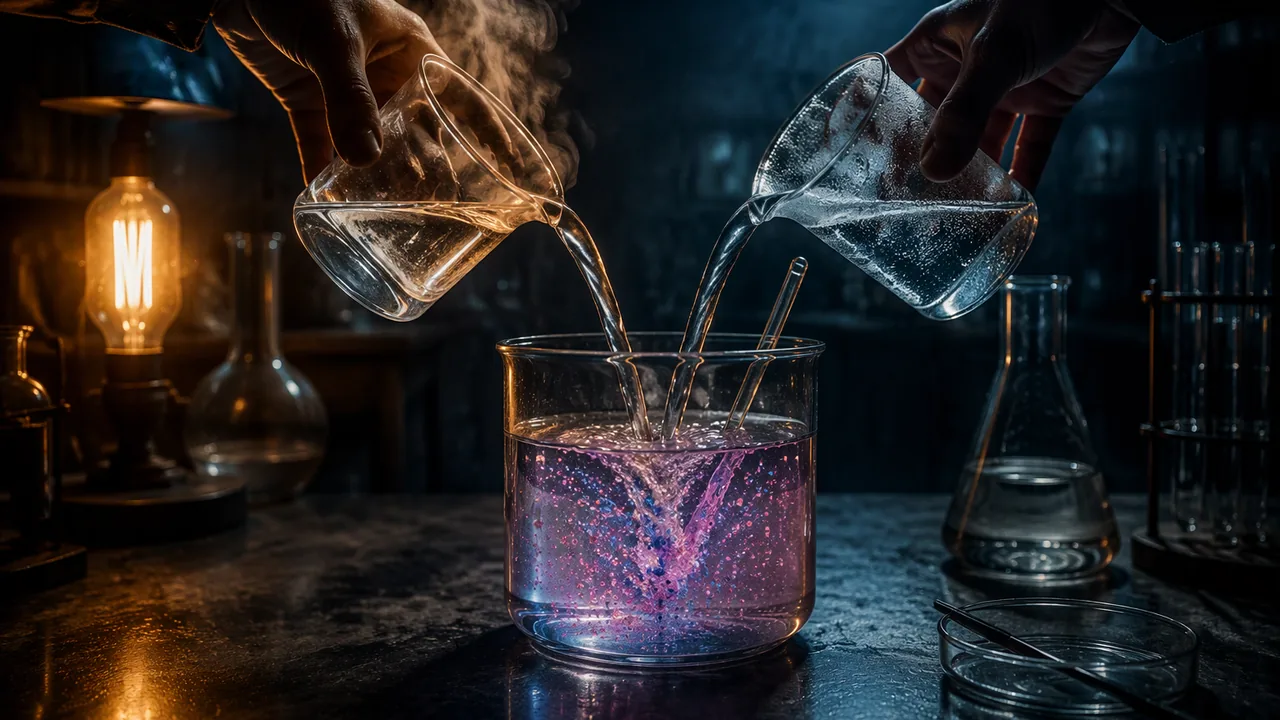
predict and measure the final temperature when hot and cold water are mixed, calculate the thermal energy transferred, and explain why energy flows from hot to cold until temperatures even out.
Instruction
The investigation question. When you combine two things at different temperatures, what happens to the energy? 9-12.PS3.B.1 asks for evidence that thermal energy transfers from the hotter to the colder component until the temperature is more uniform, the second law of thermodynamics in its everyday form.
Temperature and thermal energy are different. Temperature measures the average kinetic energy of the particles. Thermal energy is the total. A bathtub of warm water holds far more thermal energy than a cup of boiling water, even though the cup is hotter. When hot and cold water mix, fast particles collide with slow ones and share energy, until the average is the same everywhere.
Quantifying the transfer. The energy needed to change the temperature of a mass of water is
Q = mcΔT
where m is the mass in grams, ΔT the temperature change in °C, and c the specific heat: for water, 4.18 J/(g·°C). It takes 4.18 J to warm 1 g of water by 1 °C. Water’s specific heat is unusually high (the hydrogen bonds from Physical Science A), which is why oceans and large lakes keep the land beside them mild, while Missouri, far from any ocean, swings from hot summers to cold winters.
Predicting the final temperature. If no energy escapes, the energy lost by the hot water equals the energy gained by the cold water. For two samples of water, c cancels and the final temperature is a mass-weighted average:
Tfinal = (m1T1 + m2T2) ÷ (m1 + m2)
Worked example 1: 100 g at 45 °C with 100 g at 15 °C gives (4,500 + 1,500) ÷ 200 = 30.0 °C, exactly halfway. Worked example 2: 150 g at 45 °C with 50 g at 10 °C gives (6,750 + 500) ÷ 200 = 36.25 °C, closer to the hot water because there is more of it. Energy check for example 1: hot water loses 100 × 4.18 × 15 = 6,270 J; cold water gains 100 × 4.18 × 15 = 6,270 J. Balanced.
Why real results fall short. Your measured final temperature will usually be a little below the prediction, for example 29 °C instead of 30 °C. Some energy goes into warming the cup and thermometer, and some escapes to the room air. That is not a failure of conservation; it means the system you calculated for (just the water) was not the whole system. Nested foam cups with lids reduce the loss. Pour quickly, stir gently, and read the highest steady temperature.
The one-way direction. You will never see mixed 30 °C water spontaneously separate into 45 °C and 15 °C layers, even though that would not break conservation of energy. Energy spreads out; it does not spontaneously concentrate. That one-way direction is why a cold drink warms up on the table, and why engineers must supply energy (a refrigerator’s compressor) to move thermal energy from cold to hot.
Safety. Hot water comes from the hot tap only, no hotter than about 45 °C: check it with your thermometer, and have an adult set or check the tap. No kettles, microwaves or stoves. Wear safety glasses while pouring. Nothing is tasted. Wipe spills at once.
📖 Read for this lesson
The reading opens over the lesson; close it to come back to exactly where you were. The checks below draw on it.
Lab: Thermal Energy Transfer When Hot and Cold Water Mix
Question. When hot and cold water are mixed, is the thermal energy lost by the hot water equal to the energy gained by the cold water, and what final temperature results?
Materials
- Three nested pairs of foam cups (or insulated mugs) with lids or a saucer on top, with a small hole for the thermometer
- One or two kitchen or digital cooking thermometers reading to 0.1-1 °C (with only one, read the cold water first, then the hot)
- Kitchen scale reading to 1 g (or a measuring cup marked in mL, taking 1 mL of water as 1 g)
- Hot tap water (no hotter than about 45 °C) and cold tap or refrigerated water
- A spoon for stirring, paper towels, and safety glasses
- Wear safety glasses while pouring and mixing water.
- Use hot tap water only, no hotter than about 45 °C, checked with your thermometer, with an adult setting or checking the tap; no kettles, microwaves or stoves.
- Wipe up spills immediately to avoid slips; keep water away from outlets and electrical devices. Nothing is tasted.
Procedure
- Measure 100 g of cold water into one cup and 100 g of hot water into another. Record both temperatures.
- Predict the final temperature with the mass-weighted average and record the prediction.
- Pour the hot water into the cold, put on the lid, stir gently and record the highest steady temperature.
- Repeat with 150 g hot and 50 g cold water, then with 50 g hot and 150 g cold water, predicting first each time.
- For each mixture calculate the energy lost by the hot water and gained by the cold water with Q = mcΔT (c = 4.18 J/g·°C).
- Calculate the difference between predicted and measured final temperatures.
Data
| Mixture | Hot mass (g) and temp (°C) | Cold mass (g) and temp (°C) | Predicted final (°C) | Measured final (°C) | Energy lost by hot (J) | Energy gained by cold (J) |
|---|---|---|---|---|---|---|
| 1: 100 + 100 | ||||||
| 2: 150 hot + 50 cold | ||||||
| 3: 50 hot + 150 cold |
Analysis
- Claim: in which direction does thermal energy transfer, and when does it stop? Evidence: your temperature data. Reasoning: explain with particle collisions.
- Compare the energy lost by the hot water with the energy gained by the cold water. Are they equal? If not, where did the difference go?
- Explain why mixture 2 ended closer to the hot temperature than mixture 3 did.
- Name two sources of error and say whether each makes the measured final temperature higher or lower than predicted.
- Explain why a pumped-storage plant such as Taum Sauk, or any real machine, cannot return all the energy put into it, using the idea that energy spreads out as thermal energy.
If you cannot do this lab in person: Use the provided data set in this lesson’s reading (three recorded mixtures with their starting temperatures and predicted and measured final temperatures) and complete the same predictions and energy calculations.
Formative check
Work through these before moving on. They are not graded — they tell you whether the standard below has landed yet.
You mix 200 g of water at 40 °C with 100 g at 10 °C. The final temperature will be
How much energy does 100 g of water lose when it cools from 45 °C to 30 °C?
A measured final temperature 1 °C below the prediction shows that energy was destroyed.
Write your claim-evidence-reasoning paragraph about thermal energy transfer. Use your three mixtures, compare energy lost and gained, and explain the direction of transfer with particle collisions.
How confident are you that you can predict and measure the result of mixing water at different temperatures and explain the energy transfer?
Practice
Work these on paper or in your notebook, then open Check your answer. Aim for all of Fluency and Application; try at least one Challenge.
Printable version: this unit’s practice workbook (PDF)
Fluency
Build speed and accuracy with the core skill.
- How much energy does it take to warm 250 g of water from 18 °C to 33 °C?
Check your answer
Answer: 15,675 J250 × 4.18 × 15. - Predict the final temperature when 80 g of water at 44 °C is mixed with 120 g at 14 °C.
Check your answer
Answer: 26 °C(80 × 44 + 120 × 14) ÷ 200 = (3,520 + 1,680) ÷ 200 = 26. - Predict the final temperature when 300 g at 42 °C is mixed with 200 g at 12 °C.
Check your answer
Answer: 30 °C(12,600 + 2,400) ÷ 500 = 30. - In which direction does thermal energy flow between a cold drink and warm air? When does it stop?
Check your answer
Answer: From the warm air into the drink; when they reach the same temperature. - Which has more thermal energy: a bathtub of water at 40 °C or a cup of water at 90 °C? Which has the higher temperature?
Check your answer
Answer: The bathtub has more thermal energy; the cup has the higher temperature.Thermal energy depends on the amount of matter; temperature is an average.
Application
Use the skill in context. Show your reasoning.
- 100 g of water at 45 °C is mixed with 100 g at 15 °C in a thin plastic cup, and the measured final temperature is 28.5 °C. Calculate the energy lost by the hot water and gained by the cold water, and account for the difference.
Check your answer
Answer: Lost 6,897 J; gained 5,643 J; about 1,254 J went into the cup, thermometer and room air.Hot: 100 × 4.18 × (45 − 28.5) = 6,897 J. Cold: 100 × 4.18 × (28.5 − 15) = 5,643 J. Difference 1,254 J. - A 100 g steel washer stack at 40.0 °C is dropped into 100 g of water at 20.0 °C; the final temperature is 21.9 °C (illustrative data). Assuming no losses, find the specific heat of the steel and compare it with water’s.
Check your answer
Answer: About 0.44 J/(g·°C), roughly one-tenth of water’s 4.18.Water gains 100 × 4.18 × 1.9 = 794 J. Steel: 794 ÷ (100 × 18.1) = 0.44. - Explain why Missouri, in the middle of the continent, has larger swings between summer and winter temperatures than cities on an ocean coast, using specific heat.
Check your answer
Answer: Ocean water has a high specific heat, so it changes temperature slowly and absorbs or releases large amounts of energy with small temperature changes; air over the ocean stays mild and keeps coastal cities mild. Missouri is surrounded by land, which has a lower specific heat and heats and cools faster, so its summers are hotter and its winters colder.
Challenge
Stretch problems. Expect to think before you write.
- Mixed 30 °C water never separates on its own into 45 °C and 15 °C layers, even though that would conserve energy. Explain what principle this illustrates and why a refrigerator needs a power supply.
Check your answer
Answer: Thermal energy spontaneously spreads out from hotter to colder regions, never the reverse (second law of thermodynamics). A refrigerator moves thermal energy from its cold inside to the warmer kitchen, the unnatural direction, so it needs energy input from its compressor.
Review
Keep earlier skills sharp.
- A 10 kg box is pushed with 85 N to the right against 6 N of friction. Find the net force and the acceleration.
Check your answer
Answer: net force 79 N to the right; a = 7.90 m/s2Add forces as vectors: the net force is the applied force minus friction. - Convert 100 m/s to km/h.
Check your answer
Answer: 360.00 km/h
The Kitchen Mixing Record: Three Mixtures, Predicted and Measured, and Where the Missing Joules Went
One recorded run of the Lesson 3.2 procedure in a home kitchen (nested foam cups with lids, 0.1 °C digital cooking thermometers, 1 g kitchen scale), constructed for this course and illustrative; NIST Chemistry WebBook, water, condensed-phase thermochemistry (liquid-phase Shomate equation, Chase 1998), for the specific heat 4.18 J/(g·°C); Ameren Missouri 2011 Integrated Resource Plan for the Taum Sauk pump-back efficiency; retrieved November 5, 2026 · SLS original (constructed teaching data), with a public-domain NIST reference value and a published Ameren Missouri figure
Why this reading. The lab’s alternative route names “the provided data set in this lesson’s reading.” This is it: the three mixtures the procedure specifies, with the actual starting temperatures (hot tap water is never exactly 45 °C), the predicted and measured finals, and the energy accounting. It is constructed teaching data and is labeled illustrative. It also answers a question the lesson leaves open: where does the number 4.18 come from, and how sure are we of it?
Where 4.18 comes from
The National Institute of Standards and Technology publishes the heat capacity of liquid water as a formula (the Shomate equation, from the NIST-JANAF tables) valid from 298 K to 500 K. Evaluated at 298.15 K (25 °C) it gives 75.37 J per mole per kelvin. One mole of water is 18.015 g, so the specific heat is 75.37 ÷ 18.015 = 4.184 J/(g·°C). The lesson’s 4.18 is that value rounded to three figures. Evaluated at 318.15 K (45 °C) the same formula gives 75.26 J/(mol·K), or 4.178 J/(g·°C), a change of less than 0.2%, so a single constant is good enough for this lab, and any difference between energy lost and energy gained larger than 1% is not the constant’s fault.
Procedure that produced the record
A home kitchen. Two nested foam cups with a lid for each sample, a digital cooking thermometer reading to 0.1 °C in each, masses on a kitchen scale reading to 1 g. Hot water from the tap, checked with the thermometer to be below 45 °C; cold water from a pitcher in the refrigerator. Safety glasses on while pouring. Both temperatures read just before pouring; the hot water poured into the cold, lid on, stirred gently, and the highest steady reading recorded within 30 s. Room temperature 21.5 °C. One trial per mixture.
Table 1. The record
| Mixture | Hot | Cold | Predicted final (°C) | Measured final (°C) | Predicted − measured | Energy lost by hot (J) | Energy gained by cold (J) | Difference (J) |
|---|---|---|---|---|---|---|---|---|
| 1: 100 g hot + 100 g cold | 100 g at 45.2 | 100 g at 15.1 | 30.15 | 29.6 | 0.55 | 6,521 | 6,061 | 460 |
| 2: 150 g hot + 50 g cold | 150 g at 44.8 | 50 g at 10.4 | 36.20 | 35.6 | 0.60 | 5,768 | 5,267 | 502 |
| 3: 50 g hot + 150 g cold | 50 g at 45.0 | 150 g at 15.0 | 22.50 | 22.0 | 0.50 | 4,807 | 4,389 | 418 |
Temperatures in °C; energies from Q = mcΔT with c = 4.18 J/(g·°C), using the measured final temperature.
Reading the record
The prediction. Mixture 1: (100 × 45.2 + 100 × 15.1) ÷ 200 = 6,030 ÷ 200 = 30.15 °C, essentially the lesson’s worked example (30.0 °C for 45 and 15 exactly). Mixture 2: (150 × 44.8 + 50 × 10.4) ÷ 200 = 36.20 °C, against the lesson’s 36.25 for 45 and 10. Mixture 3, the lesson’s third case with more cold than hot: 22.50 °C. The prediction question in the lesson is the same arithmetic: (200 × 40 + 100 × 10) ÷ 300 = 30 °C.
Every measured final is below its prediction, by 0.55, 0.60 and 0.50 °C. Always below, never above: this is a systematic error, not scatter. In each mixture the hot water lost more energy than the cold water gained, by 420 to 500 J. That energy went to warm the cup that received the mixture, the two thermometers, the lid, and the air, all of which started at room temperature (21.5 °C) and were not in the calculation. The system you computed for was the water; the system that actually exchanged energy included the container. The true-false statement gets this exactly: a measured final 1 °C below prediction does not show energy was destroyed.
Direction. In every mixture the hot sample cooled and the cold sample warmed, until both reached one temperature, and none of them ever reversed. Fast particles in the hot water collided with slower ones in the cold water and, on average, handed energy over; the handing-over stopped when the averages matched. That is the claim the analysis asks for, and the “when does it stop” answer is: at thermal equilibrium, when there is no longer a difference in average kinetic energy to drive a net transfer.
Why mixture 2 ended near the hot temperature and mixture 3 near the cold. The final temperature is a mass-weighted average. In mixture 2, three-quarters of the water was hot, so the final sits three-quarters of the way from 10.4 up to 44.8; in mixture 3, three-quarters was cold. The same 4.18 J warms each gram by each degree, so the sample with more grams moves fewer degrees.
Two sources of error, and their signs. (1) Energy absorbed by the cup, thermometers and air: makes the measured final lower than predicted, as observed. (2) A delay between reading the hot temperature and pouring: the hot water cools a little first, so the hot temperature used in the prediction is too high, and again the measured final comes out lower. A third possibility works the other way: if the cold water was read while still warming from the refrigerator, its true temperature at pouring was higher than recorded, and the measured final would come out higher than predicted. Since all three finals came out low, the first two dominated here.
The lesson’s quiz, checked
100 g cooling from 45 °C to 30 °C: Q = 100 × 4.18 × 15 = 6,270 J. In mixture 1 the hot water cooled from 45.2 to 29.6 °C, 15.6 degrees, and lost 100 × 4.18 × 15.6 = 6,521 J; the cold water gained 100 × 4.18 × 14.5 = 6,061 J. Both round to the quiz’s order of magnitude, and the gap between them is the cup’s share.
Back to Taum Sauk
The last analysis question asks why a pumped-storage plant cannot return all the energy put into it. Table 1 is the answer in miniature. Every transfer of energy between parts of a real system leaves some of it spread out as thermal energy in parts you did not intend to warm: the cup here, the pump bearings, the tunnel walls and the water itself at Taum Sauk. The figures in the Lesson 3.1 reading, Ameren’s pump-back efficiency of 0.714 for Taum Sauk and the EIA’s 23 billion kWh out for 29 billion in for the whole country, are the same accounting on a grid scale, and the same one-way direction: nobody has ever seen a warm cup of water separate itself into hot and cold layers, or a reservoir refill itself.
Your turn
- Copy Table 1 into the lab’s data table and check every predicted final and every energy value by hand.
- Estimate the energy absorbed by the container in mixture 1 from the difference column, then use it to estimate how much the final temperature would rise if the container absorbed nothing. Compare with the “predicted − measured” column.
- Write the claim-evidence-reasoning paragraph the lesson asks for, using all three mixtures and the sign of every error.
Sources: NIST Chemistry WebBook, Water: condensed-phase thermochemistry data (webbook.nist.gov); Ameren Missouri, 2011 Integrated Resource Plan, Chapter 5: Renewable and Storage Resources (EFIS 55215) (efis.psc.mo.gov)