describe motion with position, velocity and acceleration, calculate acceleration from a change in velocity, and explain why an object’s motion changes only when a net force acts on it.
Instruction
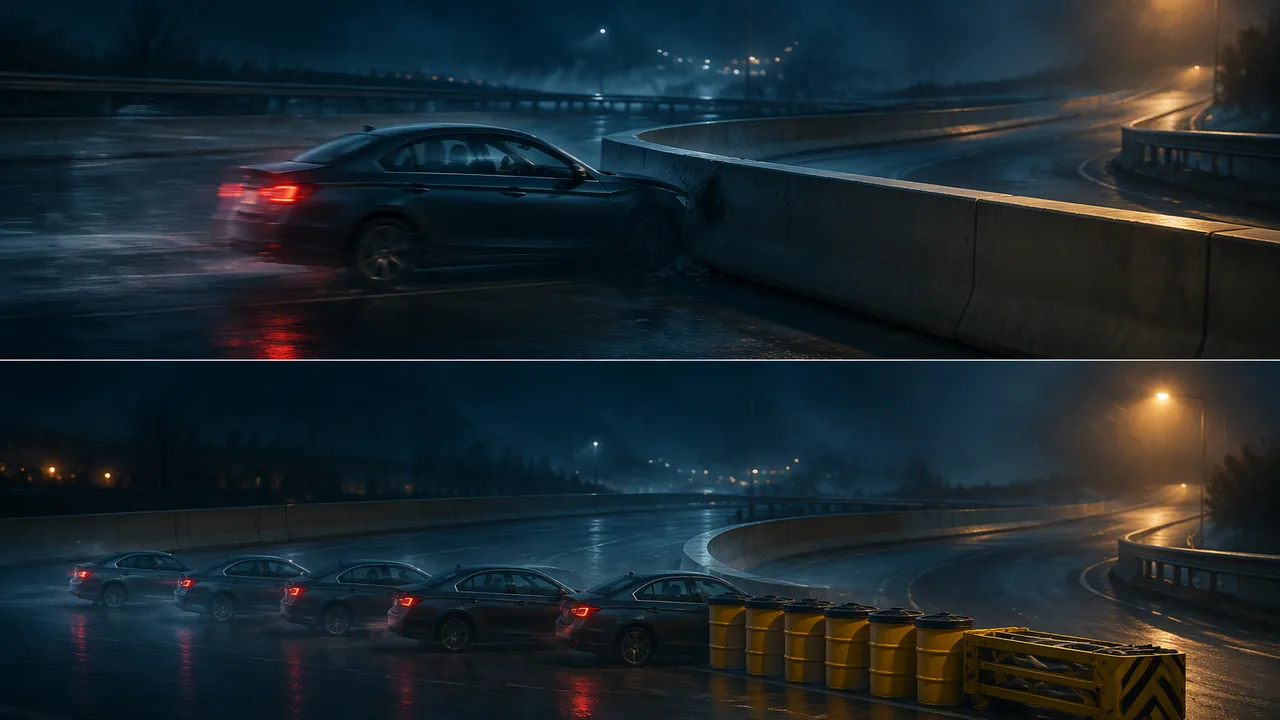
The phenomenon. Drive through a highway work zone on I-70 or I-44 in Missouri and look at the end of the concrete barrier that faces traffic. There is often a row of yellow plastic barrels filled with sand. At many off-ramps, where the exit splits from the main lanes, a long folding metal-and-plastic cushion sits in front of the divider. The Missouri Department of Transportation (MoDOT) calls these impact attenuators, and its engineering guide says they are “designed to absorb energy of an impacting vehicle and reduce the force on a passenger.” They matter: in 2024, MoDOT reports, 23 people were killed in Missouri work-zone crashes. A car that hits the bare concrete stops almost instantly; a car that hits the barrels stops over a longer distance and time. Why does that difference matter so much to the people inside? To answer, we need a language for motion and a rule connecting motion to force.
Describing motion. Position is where an object is, measured from a reference point. Velocity is how fast position changes, with a direction: average velocity = change in position ÷ time. A car that travels 150 m north in 6.0 s has an average velocity of 25 m/s north. (25 m/s is 90 km/h, about 56 mph.) Acceleration is how fast velocity changes: acceleration = change in velocity ÷ time. Its unit is meters per second per second, m/s2.
Worked example. A car speeds up from 0 to 26.8 m/s (60 mph) in 8.0 s. Its acceleration is (26.8 − 0) ÷ 8.0 = 3.35 m/s2: every second it gains 3.35 m/s. Slowing down is acceleration too, in the direction opposite the motion. A car moving at 25 m/s that stops in 0.10 s against concrete has an acceleration of (0 − 25) ÷ 0.10 = −250 m/s2, about 25 times the acceleration of gravity (9.8 m/s2). The same car stopped by a cushion over 0.50 s has an acceleration of −50 m/s2, five times smaller. These numbers are illustrative, but the comparison is the point.
Graphs. On a velocity-time graph, a horizontal line means constant velocity (zero acceleration), a line sloping up means speeding up, and the slope of the line is the acceleration. A steep drop to zero is a sudden stop; a gentle slope to zero is a gradual one. You will read and draw these graphs all unit.
Forces change motion. A force is a push or a pull, measured in newtons (N). Several forces usually act on an object at once: gravity, the push of the road (normal force), friction, air resistance. What matters is the net force, the combined effect with directions taken into account. Newton’s first law says that an object keeps moving at constant velocity, or stays at rest, unless a net force acts on it. This tendency is called inertia. A passenger in a crash keeps moving forward at 25 m/s until something (a seatbelt, an airbag, the dashboard) exerts a force to stop them.
Newton’s second law. The acceleration of an object is proportional to the net force and inversely proportional to its mass: a = Fnet ÷ m, or Fnet = ma. For a 70 kg person to decelerate at 250 m/s2, the net force on them must be 70 × 250 = 17,500 N, roughly 25 times their weight. At 50 m/s2 it is 3,500 N. So a cushion that reduces the acceleration also reduces the force on every person in the car. That is the logic of every safety device in this unit.
Your questions. Build the question board. Which questions could you test at home with toy cars and a ramp? Which need published crash-test data? Which need a model, such as momentum, to answer?
📖 Read for this lesson
The reading opens over the lesson; close it to come back to exactly where you were. The checks below draw on it.
Formative check
Work through these before moving on. They are not graded — they tell you whether the standard below has landed yet.
Two identical cars moving at 25 m/s stop, one against concrete in 0.10 s and one in a crash cushion in 0.50 s. How does the force on each driver compare?
A bike goes from 2 m/s to 8 m/s in 3 s, so its acceleration is m/s2.
A hockey puck slides across smooth ice at constant velocity. What is the net force on it?
Simulation & tools
Net force and acceleration
Open the Acceleration screen and turn on Forces, Values, Mass and Acceleration. Set friction to zero. (1) Apply 100 N to the 50 kg crate and record the acceleration. (2) Double the applied force and record it again. (3) Stack a second object on the crate, record the total mass, apply 200 N and record the acceleration. (4) Write the pattern you see as a sentence and as an equation. No device? Use a = F ÷ m for 100 N and 200 N on 50 kg and 200 N on 100 kg and answer the same question.
Open in a new tab ↗ · PhET Interactive Simulations, University of Colorado Boulder · CC BY 4.0
How confident are you that you can describe motion, calculate acceleration, and explain changes in motion with net force?
Practice
Work these on paper or in your notebook, then open Check your answer. Aim for all of Fluency and Application; try at least one Challenge.
Printable version: this unit’s practice workbook (PDF)
Fluency
Build speed and accuracy with the core skill.
- A car moving at 13 m/s speeds up at 3 m/s2 for 4 s. What is its final speed?
Check your answer
Answer: 25.0 m/sv = v0 + at. - A car moving at 6 m/s speeds up at 2.5 m/s2 for 3 s. What is its final speed?
Check your answer
Answer: 13.5 m/sv = v0 + at. - A car moving at 13 m/s speeds up at 2 m/s2 for 7 s. What is its final speed?
Check your answer
Answer: 27.0 m/sv = v0 + at. - Convert 300 g to kg.
Check your answer
Answer: 0.3000 kg - A runner covers 120 m in 8.0 s. What is her average speed?
Check your answer
Answer: 15 m/s120 ÷ 8.0 = 15. - A skateboarder speeds up from 0 to 8 m/s in 4 s. What is the acceleration?
Check your answer
Answer: 2 m/s2(8 − 0) ÷ 4 = 2. - On a velocity-time graph, what does a horizontal line mean? A line sloping down to zero?
Check your answer
Answer: Constant velocity (zero acceleration); slowing down to a stop.
Application
Use the skill in context. Show your reasoning.
- A car moving at 25 m/s stops against a crash cushion in 0.50 s. Find its acceleration and the net force on a 70 kg passenger during the stop.
Check your answer
Answer: −50 m/s2; 3,500 N (opposite the motion)(0 − 25) ÷ 0.50 = −50 m/s2. F = 70 × 50 = 3,500 N. - Explain with Newton’s first law why an unbelted passenger hits the dashboard when a car stops suddenly.
Check your answer
Answer: The passenger keeps moving forward at the car’s original speed (inertia) because no force acts on them to slow them until they hit the dashboard. The seatbelt supplies that force earlier and over a longer time. - A 60 kg cyclist and her 12 kg bike accelerate at 1.5 m/s2. What net force acts on the cyclist-and-bike system? If friction and air resistance total 20 N, what forward force must the road exert on the tires?
Check your answer
Answer: 108 N net; 128 N forwardFnet = 72 × 1.5 = 108 N. Forward force = 108 + 20 = 128 N.
Challenge
Stretch problems. Expect to think before you write.
- Sketch the velocity-time graphs for the car hitting concrete (stops in 0.10 s) and the car hitting the cushion (stops in 0.50 s), both from 25 m/s. What feature of each graph shows the acceleration, and what does the area under each graph represent?
Check your answer
Answer: Both are straight lines falling from 25 m/s to 0; the slope is the acceleration (−250 and −50 m/s2). The area under each line is the stopping distance: 1.25 m and 6.25 m.Area of a triangle: ½ × 25 × 0.10 = 1.25 m; ½ × 25 × 0.50 = 6.25 m.
Review
Keep earlier skills sharp.
- How many moles are in 100.0 g of Al2O3?
Check your answer
Answer: 0.981 molDivide by the molar mass, 101.96 g/mol. - An isotope has a half-life of 6 days. How long until only 1/64 of the original sample remains?
Check your answer
Answer: 36.0 days (6 half-lives)1/64 = (1/2)6.
What Is Actually in Front of the Barrier: Missouri’s Sand Barrels, the Crash Test They Passed, and Two Stops Compared
MoDOT Engineering Policy Guide, Category 612 Impact Attenuators (sections 612.2 and 612.4); MoDOT roadside hardware listing, End Terminals, Crash Cushions and Barrier Systems; TrafFix Devices, Big Sandy Inertial Crash Cushion System manual, P/N 48100 Rev. A1 (February 27, 2020); MoDOT news release “MoDOT Urges Drivers to ‘Work with Us’ in Busy Construction Season” (April 17, 2025); the two stopping tables are SLS original and illustrative; retrieved November 5, 2026 · SLS original (tables and explanation); quotes brief passages from MoDOT public records and a manufacturer manual for education
Why this reading. The lesson asks you to build a question board and to sort your questions into three piles: testable with toy cars and a ramp, answerable only from published crash-test data, and answerable only with a model. You cannot sort into the second pile without knowing what published data exist. This reading holds the real numbers behind the phenomenon: what the Missouri Department of Transportation (MoDOT) says a sand-barrel array does and when it uses one, what is in the barrels, the crash test every such device must pass, how many people die in Missouri work-zone crashes, and, as an illustrative model, the two stops the mini-lecture compares, worked out step by step so that the −250 m/s2 and −50 m/s2 are numbers you can check rather than accept.
1. What MoDOT says the yellow barrels do
MoDOT’s Engineering Policy Guide (EPG), Article 612, “Impact Attenuators,” opens with the purpose of every device in this unit: “Impact attenuators are designed to absorb energy of an impacting vehicle and reduce the force on a passenger.” Section 612.2 describes the sand barrels you see in Missouri work zones:
“An Impact Attenuator Array (Sand Barrels) is most often used to shield fixed objects that cannot be removed or relocated, when posted speeds are greater than 35 mph. … An Impact Attenuator Array (Sand Barrels) consists of a group of freestanding plastic barrels configured in an array of increasing weights from the impact point toward the object. Such an array transfers the vehicle’s momentum to the increasing masses of sand in the barrels and provides a gradual deceleration.”
That one sentence names three ideas from this unit: momentum (Lesson 1.3), transfer of momentum from one object to another in a collision, and a gradual deceleration, which is a longer stopping time and therefore a smaller force (Lessons 1.1 and 1.4). The same section adds that the array’s “‘footprint’ length and width and the number of barrels will change based upon the permanent posted speed limit of the roadway.” A faster car carries more momentum, so the array has to be longer and heavier to stop it gently.
Two Missouri details are worth noticing. MoDOT recommends sand barrels mainly “for temporary usage such as in work zones,” so the place you are most likely to see them is the blunt end of a concrete barrier in a highway construction zone; permanent off-ramp gores more often get a folding crash cushion that does the same job. And because Missouri winters freeze wet sand into a solid block, the EPG’s inspection guidelines require that “the sand shall have a maximum moisture content and rock salt added,” with inspectors checking during cold spells that the sand “has not frozen.” Frozen sand cannot be flung forward by a car; it would act more like the rigid barrier the array is supposed to soften.
2. What is in the barrels
MoDOT’s roadside-hardware listing includes the Big Sandy sand-barrel system among its approved products. The manufacturer’s installation manual describes it as “a non-redirective, gating crash cushion, designed to shield the end of rigid objects in both temporary and/or permanent roadside installations,” built from free-standing barrels “in consecutive rows which contain gradually increasing weights of sand.” The barrel sizes, with the manual’s own metric values:
| Sand per barrel (as published) | Mass (manual’s metric value) |
|---|---|
| 200 lb | 90 kg |
| 400 lb | 180 kg |
| 700 lb | 320 kg |
| 1,400 lb | 640 kg |
| 2,100 lb | 960 kg |
| Lid diameter, 37 in | 940 mm |
The word inertial in the product name is the physics. Nothing in the array is a spring. A car that hits the first barrel has to set its sand moving; the sand’s inertia is what slows the car, and the increasing masses along the array mean the car meets a little more resistance at each row instead of all of it at once.
3. The test the barrels had to pass
The EPG states that “All impact attenuators manufactured after January 1, 2023 shall meet MASH 2016 Test Level 3 crash test requirements” (MASH is AASHTO’s Manual for Assessing Safety Hardware). The Big Sandy manual states the Test Level 3 conditions it was tested at: “TL-3 (62.1 mph/ 100 km/hr),” with “cars with an approx. weight of 2425 lbs [1100 kg] to trucks with an approx. weight of 5004 lbs [2270 kg].” Converted:
| Published test | Vehicle mass | Speed | Speed in m/s | Momentum (kg·m/s) |
|---|---|---|---|---|
| MASH TL-3, small car | 1,100 kg | 100 km/h | 27.8 | 30,600 |
| MASH TL-3, pickup | 2,270 kg | 100 km/h | 27.8 | 63,100 |
(100 km/h ÷ 3.6 = 27.8 m/s; momentum = mass × speed, rounded to three figures.) The pickup carries about twice the momentum of the small car, and the same array must stop both. The manual is also honest about the limits of a test: “These specified tests are not intended to represent the systems performance when impacted by every vehicle type or every impact condition existing on the roadway.” Keep that sentence for the design challenge in Lesson 1.5, where you will have to state what your cushion is not designed for. The mini-lecture’s 25 m/s (90 km/h, 56 mph) is a little below the test speed: a realistic speed for a car drifting out of a lane on a Missouri highway.
4. Why Missouri cares: work-zone crashes
MoDOT’s April 2025 Work Zone Awareness release reported: “In 2024, 23 people were killed in Missouri work zone crashes. Distracted driving contributed to at least four of those fatalities as well as more than 350 work zone crashes overall.” The state’s highway safety engineer added that “you can expect to see between 800-1,000 active work zones” on any given day of construction season. Every one of those zones with a barrier end facing traffic at more than 35 mph is a place where the physics of this unit decides how hard a crash is.
5. Two stops from 25 m/s, step by step (SLS illustrative model)
The mini-lecture says a car stopping from 25 m/s in 0.10 s has an acceleration of −250 m/s2, and one stopping in 0.50 s has −50 m/s2. Those are averages over the whole stop. The tables below assume the deceleration is steady (real crash pulses are not, but the average is what the impulse argument in Lesson 1.4 needs). Velocity is v = 25 + at; distance is x = 25t + ½at2. These tables are constructed to teach the method and are labeled illustrative; they are not a recording of any real crash.
| Stop A: rigid concrete, 0.10 s. a = (0 − 25) ÷ 0.10 = −250 m/s2 | ||
|---|---|---|
| t (s) | v (m/s) | x (m) |
| 0.00 | 25.0 | 0.00 |
| 0.02 | 20.0 | 0.45 |
| 0.04 | 15.0 | 0.80 |
| 0.06 | 10.0 | 1.05 |
| 0.08 | 5.0 | 1.20 |
| 0.10 | 0.0 | 1.25 |
| Stop B: sand-barrel array, 0.50 s. a = (0 − 25) ÷ 0.50 = −50 m/s2 | ||
|---|---|---|
| t (s) | v (m/s) | x (m) |
| 0.00 | 25.0 | 0.00 |
| 0.10 | 20.0 | 2.25 |
| 0.20 | 15.0 | 4.00 |
| 0.30 | 10.0 | 5.25 |
| 0.40 | 5.0 | 6.00 |
| 0.50 | 0.0 | 6.25 |
Read the tables. In both stops the car loses the same 25 m/s. In Stop A it loses 5 m/s every 0.02 s; in Stop B it loses 5 m/s every 0.10 s, five times more slowly, so the acceleration is one-fifth. The stopping distances are 1.25 m and 6.25 m. A cushion that stretches a stop to half a second needs several meters of room to crush through, which is why a sand-barrel array takes up a long stretch of pavement in front of the barrier, and why MoDOT sizes the array by the posted speed.
The force on a person. Newton’s second law for a 70 kg driver: Stop A, 70 × 250 = 17,500 N; Stop B, 70 × 50 = 3,500 N. A 70 kg person weighs 70 × 9.8 = 686 N, so the two forces are about 25 and 5 times body weight. That five-to-one ratio is the answer to the lesson’s prediction question, and it does not depend on the car’s mass at all: the person’s own mass and the acceleration fix it.
6. Sorting your questions
- Testable at home with toy cars and a ramp: does doubling the stopping time halve the average force? Does a heavier car need a longer cushion? Lesson 1.2 and the design challenge answer these.
- Published data: what speeds and masses are the barrels rated for (section 3)? How much sand is in each barrel (section 2)? How many Missouri work-zone crashes are there (section 4)? These come from agencies and manufacturers, not from a tabletop.
- A model: why does the sand need to be heavier toward the back? What happens to the sand’s momentum when the car hits it? Lesson 1.3 builds that model.
When you write a question on the board, write beside it which pile it belongs to and, for the second pile, which document in this reading would answer it.
Sources: MoDOT Engineering Policy Guide, Category 612 Impact Attenuators (epg.modot.org); MoDOT, End Terminals, Crash Cushions and Barrier Systems (roadside hardware listing) (modot.org); TrafFix Devices, Big Sandy Inertial Crash Cushion System manual, Rev. A1 (2020) (media.trafficsafetystore.com); MoDOT, “MoDOT Urges Drivers to ‘Work with Us’ in Busy Construction Season” (April 17, 2025) (modot.org)