use Newton’s law of gravitation to calculate and compare gravitational forces, explain the inverse-square pattern, and ask questions about forces that act at a distance.
Instruction
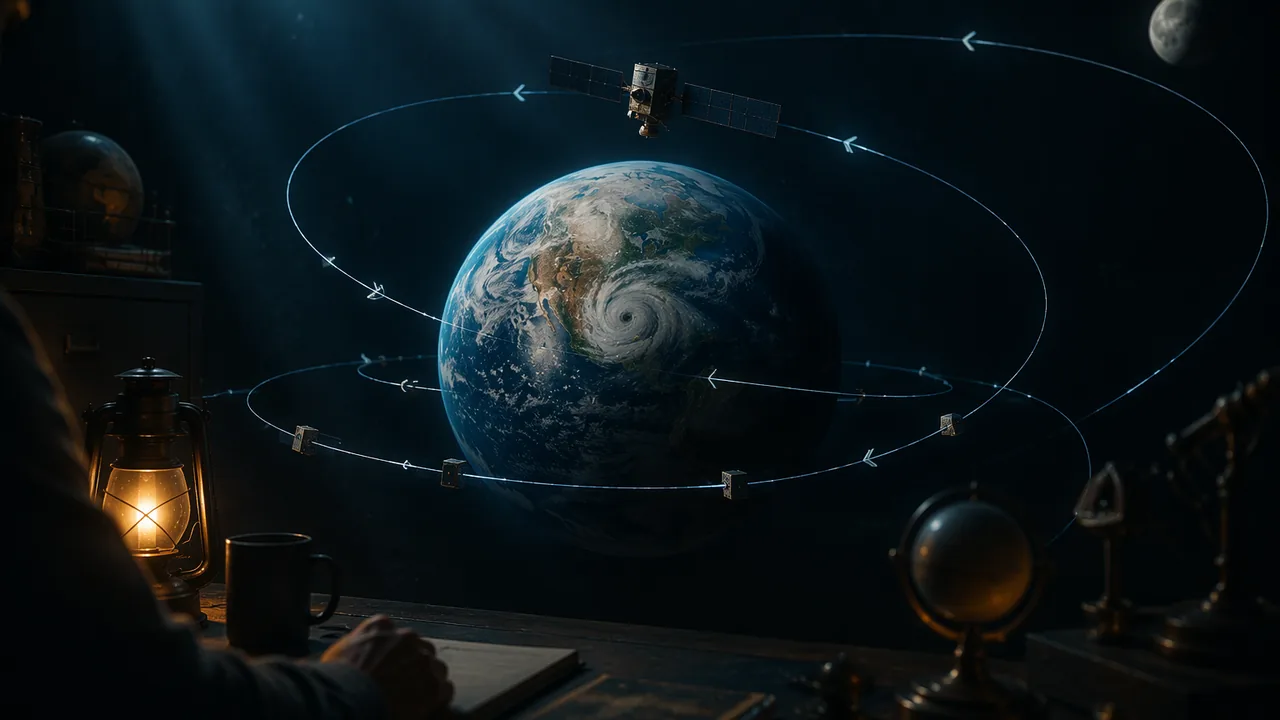
The phenomena. When a line of severe storms builds over Missouri, forecasters watch it from space. GOES East, a NOAA weather satellite, orbits 22,236 miles (about 35,790 km) above the equator “at speeds equal to the Earth’s rotation,” so it stays parked over the same part of the planet and can scan severe storms as often as every 30 seconds. A tractor steering itself down a Missouri soybean row listens to GPS satellites about 20,200 km up, each of which “circles the Earth twice a day.” Once in orbit, a satellite circles Earth for years without an engine running. Meanwhile, in Atchison County, in Missouri’s northwest corner, 342 wind turbines spin in the prairie wind, and inside each one, magnets push electric current through coils of wire without ever touching them. Gravity, electricity and magnetism all act across empty space. This unit models all three.
Newton’s law of gravitation. Every object with mass attracts every other object with mass. The force between two objects is
F = G m1m2 ÷ r2
where m1 and m2 are the masses in kg, r is the distance between their centers in meters, and G = 6.674 × 10⁻¹¹ N·m2/kg2 is a very small constant. Gravity is noticeable only when at least one mass is enormous.
Worked example 1: your weight. Earth’s mass is 5.972 × 1024 kg and its radius 6.371 × 10⁶ m. For a 60 kg student: F = 6.674 × 10−11 × 5.972 × 1024 × 60 ÷ (6.371 × 10⁶)2 ≈ 589 N. Compare 60 × 9.8 = 588 N. The familiar mg is Newton’s law with Earth’s mass and radius already built in.
Worked example 2: two students. Two 70 kg students standing 1.0 m apart attract each other with 6.674 × 10−11 × 70 × 70 ÷ 12 ≈ 3.3 × 10⁻⁷ N, far too small to feel. Worked example 3: Earth and the Moon (7.342 × 10²² kg, 3.844 × 10⁸ m apart) pull on each other with about 2.0 × 10²⁰ N. That force keeps the Moon in orbit and raises the ocean tides along every coast.
The inverse-square pattern. Because r is squared, doubling the distance divides the force by 4; tripling it divides by 9. You can use ratios without the big numbers. The International Space Station orbits about 400 km up, so it is (6,371 + 400) km from Earth’s center. The force there, compared with the surface, is (6,371 ÷ 6,771)2 ≈ 0.89: gravity is still 89% as strong. Astronauts float not because gravity is gone, but because they and the station are falling around Earth together, moving sideways fast enough that they keep missing it. That is what an orbit is. GPS satellites, about 20,200 km up, feel only about 6% of surface gravity, and GOES East, about 35,790 km up, about 2.3%.
Fields. How does the Moon “know” Earth is there? Physicists describe a mass as creating a gravitational field in the space around it; another mass placed in the field feels a force. Electric charges create electric fields and magnets create magnetic fields in the same way. The field model lets us draw forces at a distance and, as you will see in Lesson 2.4, track energy stored in the arrangement of interacting objects.
Your questions. Which questions about satellites and turbines can we test in the lab (magnets and coils, yes; orbits, no)? Which need NASA data? Which need a model first?
📖 Read for this lesson
The reading opens over the lesson; close it to come back to exactly where you were. The checks below draw on it.
Formative check
Work through these before moving on. They are not graded — they tell you whether the standard below has landed yet.
If a satellite moved to twice its distance from Earth’s center, the gravitational force on it would be
Two asteroids attract with 400 N. If the distance between them triples, the force becomes about
Astronauts on the International Space Station float because there is no gravity at that height.
Simulation & tools
Gravity keeps the Moon in orbit
Open the Model screen, choose the Earth and Moon system, and turn on Gravity Force and Path. (1) Start the sim and describe the Moon’s path. (2) Pause and turn gravity off, then play: record what happens and explain it with Newton’s first law. (3) Reset, increase the Moon’s mass with the slider, and record what happens to the gravity force arrows on both bodies. (4) Explain why the arrows on Earth and the Moon are always equal in size. No device? Use F = Gm1m2/r2 to predict what doubling the Moon’s mass does to the force, and answer questions 2 and 4 in words.
Open in a new tab ↗ · PhET Interactive Simulations, University of Colorado Boulder · CC BY 4.0
How confident are you that you can use Newton’s law of gravitation and the inverse-square pattern to calculate and compare forces?
Practice
Work these on paper or in your notebook, then open Check your answer. Aim for all of Fluency and Application; try at least one Challenge.
Printable version: this unit’s practice workbook (PDF)
Fluency
Build speed and accuracy with the core skill.
- If the distance between two masses doubles, by what factor does the gravitational force change? If it triples?
Check your answer
Answer: 1/4; 1/9Inverse square: (1/2)2 and (1/3)2. - If one of two masses doubles and the distance stays the same, how does the gravitational force change?
Check your answer
Answer: It doubles.F is proportional to m1m2. - A student weighs 588 N at Earth’s surface. What would the gravitational force on her be at twice Earth’s radius from the center? At three times?
Check your answer
Answer: 147 N; about 65.3 N588 ÷ 4 = 147; 588 ÷ 9 = 65.3. - Write 6,371 km in meters in scientific notation.
Check your answer
Answer: 6.371 × 10⁶ m - Calculate the weight (mg) of a 60 kg student on Earth (g = 9.8 m/s2) and on Mars (g = 3.71 m/s2).
Check your answer
Answer: 588 N on Earth; about 223 N on Mars60 × 9.8 = 588; 60 × 3.71 = 222.6.
Application
Use the skill in context. Show your reasoning.
- Use F = Gm1m2/r2 to find the gravitational force between two 1,500 kg cars parked with their centers 2.0 m apart (G = 6.674 × 10⁻¹¹). Why don’t parked cars roll toward each other?
Check your answer
Answer: About 3.8 × 10⁻⁵ N. That is far smaller than the friction holding each car in place, so no motion results.6.674 × 10−11 × 1,500 × 1,500 ÷ 2.02 = 3.75 × 10⁻⁵ N. - GPS satellites orbit about 20,200 km above Earth’s 6,371 km radius. By what factor is the gravitational force on a satellite smaller there than it would be at the surface?
Check your answer
Answer: About 0.057 (about 6% of the surface value)(6,371 ÷ 26,571)2 = 0.0575. - A friend says ‘the Moon doesn’t fall to Earth because there’s no gravity in space.’ Correct the claim with the calculation that Earth and the Moon pull on each other with about 2.0 × 10²⁰ N and the idea of an orbit.
Check your answer
Answer: Gravity acts on the Moon with an enormous force. The Moon is falling toward Earth all the time, but it moves sideways fast enough that it keeps missing, so its path curves into an orbit.
Challenge
Stretch problems. Expect to think before you write.
- Earth’s gravity at the surface is 9.8 m/s2. The ISS orbits at about 400 km altitude. Using the inverse-square ratio with Earth’s radius of 6,371 km, estimate the acceleration due to gravity at the ISS, and explain why astronauts still feel weightless.
Check your answer
Answer: About 8.7 m/s2. They feel weightless because they and the station are in free fall together, accelerating at the same rate, so nothing pushes on them.9.8 × (6,371 ÷ 6,771)2 = 9.8 × 0.885 = 8.68 m/s2.
Review
Keep earlier skills sharp.
- A 20 kg box is pushed with 20 N to the right against 18 N of friction. Find the net force and the acceleration.
Check your answer
Answer: net force 2 N to the right; a = 0.10 m/s2Add forces as vectors: the net force is the applied force minus friction. - A 1500 kg object moving at 20 m/s collides and sticks to a 1000 kg object moving at 4.0 m/s (same line; positive is the first object’s direction). Find the total momentum and the velocity just after the collision.
Check your answer
Answer: total momentum 34,000 kg·m/s; final velocity 13.60 m/sMomentum is conserved: m1v1 + m2v2 = (m1 + m2)v.
NASA and NOAA Numbers for Earth, the Moon and the Satellites Over Missouri, With Every Calculation Worked
NASA Earth Fact Sheet and Moon Fact Sheet, NSSDC; NIST, CODATA 2022 Newtonian constant of gravitation; GPS.gov Space Segment; NOAA GOES-R Series Program, Mission Overview; NOAA NESDIS, Joint Polar Satellite System; NASA, What Is the International Space Station? (Grades 5-8); retrieved November 5, 2026 · Public domain (works of the United States government)
Why this reading. The lesson asks which of your questions “need NASA data.” Here are the NASA data, as published, with the retrieval date, and every calculation in the mini-lecture redone from them so you can see where 589 N, 3.3 × 10⁻⁷ N, 2.0 × 10²⁰ N, 89% and 6% come from. The lesson quotes Earth’s mass as 5.972 × 1024 kg; NASA prints 5.9722. Small differences like that are what a source lets you trace. The last table goes one step further than the lesson and computes how fast a satellite has to move to stay up, which is the answer to the question every satellite over Missouri raises: why does it not fall? It also explains why one NOAA weather satellite can hang over the same patch of sky and watch a Missouri storm for hours.
Table 1. The published values
| Quantity | Value as published | Source |
|---|---|---|
| Earth mass | 5.9722 × 1024 kg | NASA Earth Fact Sheet |
| Earth volumetric mean radius | 6,371.000 km | NASA Earth Fact Sheet |
| Earth equatorial radius | 6,378.137 km | NASA Earth Fact Sheet |
| Earth sidereal rotation period (one turn relative to the stars) | 23.9345 hours | NASA Earth Fact Sheet |
| Earth surface gravity (mean) | 9.820 m/s2 | NASA Earth Fact Sheet |
| GM for Earth | 0.39860 × 10⁶ km3/s2 = 3.9860 × 10¹⁴ m3/s2 | NASA Earth Fact Sheet |
| Moon mass | 0.07346 × 1024 kg = 7.346 × 10²² kg | NASA Moon Fact Sheet |
| Moon orbit semimajor axis | 0.3844 × 10⁶ km = 3.844 × 10⁸ m | NASA Moon Fact Sheet |
| Moon revolution period (one orbit of Earth) | 27.3217 days | NASA Moon Fact Sheet |
| G, Newtonian constant of gravitation | 6.674 30 × 10−11 m3 kg−1 s−2 | NIST, CODATA 2022 |
| GPS satellite altitude | “approximately 20,200 km (12,550 miles)”; “Each satellite circles the Earth twice a day” | GPS.gov |
| GOES weather satellites (GOES East watches Missouri) | “GOES satellites orbit 22,236 miles above Earth’s equator, at speeds equal to the Earth’s rotation”; they can scan severe storms “as frequently as every 30 seconds” | NOAA GOES-R Series Program |
| JPSS polar weather satellites | “JPSS satellites orbit Earth from pole to pole 14 times a day” | NOAA NESDIS |
| Space station altitude and speed | “an average altitude of approximately 250 miles”; “17,500 mph”; “orbits Earth every 90 minutes” | NASA |
250 miles is about 400 km, the figure the lesson uses, and 22,236 miles is 35,785 km (1 mile = 1.609344 km), which the lesson rounds to about 35,790 km. Note that Earth has two radii in the table. The planet bulges at the equator; the lesson uses the mean radius, 6,371 km, and so does this reading.
Table 2. The mini-lecture’s three worked examples, recomputed from Table 1
| Pair | m1 (kg) | m2 (kg) | r (m) | F = Gm1m2/r2 | Lesson’s figure |
|---|---|---|---|---|---|
| Earth and a 60 kg student at the surface | 5.9722 × 1024 | 60 | 6.371 × 10⁶ | 589.2 N | ≈ 589 N |
| Two 70 kg students | 70 | 70 | 1.0 | 3.27 × 10⁻⁷ N | ≈ 3.3 × 10⁻⁷ N |
| Earth and the Moon | 5.9722 × 1024 | 7.346 × 10²² | 3.844 × 10⁸ | 1.98 × 10²⁰ N | ≈ 2.0 × 10²⁰ N |
Work the first row by hand in the order that keeps the numbers manageable. Multiply the powers of ten first: 10−11 × 1024 ÷ (106)2 = 10−11+24−12 = 101. Then the leading digits: 6.6743 × 5.9722 × 60 ÷ 6.3712 = 2,391.5 ÷ 40.59 = 58.9. Together, 58.9 × 101 = 589 N. Compare 60 × 9.820 = 589.2 N using NASA’s mean surface gravity. The lesson’s 60 × 9.8 = 588 N differs by one part in six hundred, which is the difference between 9.8 and 9.82, not an error in the law.
Table 3. The inverse-square pattern at real altitudes, and the speed that keeps a satellite up
The force ratio is (6,371 ÷ r)2 with r in km from Earth’s center. The last two columns go beyond the lesson: for a circular orbit the gravitational pull is exactly the force needed to keep turning the satellite’s path, which gives v = √(GM/r) and a period T = 2πr/v. GM is NASA’s 3.9860 × 10¹⁴ m3/s2.
| Where | r from center (km) | Force ratio (6,371/r)2 | Percent of surface gravity | Orbital speed v (km/s) | Period |
|---|---|---|---|---|---|
| Surface (a theoretical satellite skimming the ground) | 6,371 | 1.000 | 100.0% | 7.91 | 84.3 min |
| International Space Station, about 400 km | 6,771 | 0.885 | 88.5% | 7.67 | 92.4 min |
| A JPSS-type polar weather satellite, about 800 km (illustrative altitude) | 7,171 | 0.789 | 78.9% | 7.46 | 100.7 min |
| GPS satellite, about 20,200 km | 26,571 | 0.057 | 5.7% | 3.87 | 718.4 min |
| GOES East, 35,785 km | 42,156 | 0.0228 | 2.3% | 3.07 | 1,435.7 min = 23.93 h |
| The Moon, 384,400 km from Earth’s center | 384,400 | 0.00027 | 0.027% | 1.02 | 27.45 days |
The surface row’s last two columns describe a theoretical satellite skimming the ground with no air in the way: 7.91 km/s is the speed a rocket must reach before it can orbit at all, and every real orbit needs a little less. The Moon’s row shows the inverse square at its most extreme: sixty Earth radii out, gravity is 0.03% of its surface value, and that is still enough to hold 7.3 × 10²² kg in orbit.
Check against the sources. The station row predicts 7.67 km/s, which is 17,163 mph, and a period of 92.4 minutes. NASA says “17,500 mph” and “every 90 minutes,” both rounded figures for a station whose altitude drifts between about 400 and 420 km; the model lands within 2% of each. The polar row predicts 100.7 minutes per lap; NOAA’s “14 times a day” means 1,440 ÷ 14 = 102.9 minutes, about 2% longer, as expected for a satellite flying a little higher than the 800 km used here. The GPS row predicts a period of about 12 hours, and GPS.gov says each satellite “circles the Earth twice a day.” The GOES row predicts 23.93 hours, and NASA gives Earth’s rotation as 23.9345 hours: the model says that at 35,785 km a satellite must take exactly as long to go around as Earth takes to turn, which is what NOAA means by “speeds equal to the Earth’s rotation.” The Moon row predicts 27.45 days; NASA’s fact sheet gives a revolution period of 27.3217 days. A half-percent disagreement is what you expect from treating the orbit as a perfect circle around a fixed Earth. Five published checks, five agreements: that is the evidence that the inverse-square law is the right model for “force at a distance.”
What the table says about the satellites over Missouri. A polar weather satellite at about 800 km still feels 79% of the gravity at the ground. It does not stay up because gravity is weak. It stays up because its rocket gave it about 7.5 km/s of sideways speed, so that in each second it falls toward Earth by exactly the amount the curved surface drops away beneath it. Turn the engine off and nothing changes; there is no air to slow it. GOES East is farther out, where gravity is only 2.3% of its surface value, so it needs only 3.07 km/s, and its huge circle takes one full day to go around. Earth turns underneath it at the same rate, so from Missouri the satellite seems to hang still in the southern sky, which is how forecasters can watch the same storm for hours. That is also the answer to the true-false question about astronauts: 89% of surface gravity acts on them, and they float because they and the station are falling together.
Ratios without big numbers
Every entry in the “force ratio” column came from a ratio of distances, never from G or a mass. Doubling the distance from the center divides the force by 4; that is the prediction question. Two asteroids at 400 N moved to three times the distance: 400 ÷ 9 = 44 N; that is the quiz. The pattern is the same for the Moon’s mass slider in the simulation: the force arrows on Earth and Moon are always equal because the same Gm1m2/r2 acts on both, and doubling the Moon’s mass doubles both arrows.
Your turn
- Recompute the Earth-Moon row of Table 2 by hand, powers of ten first, and show that it rounds to the lesson’s 2.0 × 10²⁰ N.
- A satellite at 1,000 km altitude: compute the force ratio, the orbital speed and the period, and place the row in Table 3.
- Sort your question board: for each question, write whether Table 1, Table 3 or the lab with magnets and coils is the place to look, and one question that none of them can answer without a new model.
Sources: NASA NSSDC, Earth Fact Sheet (nssdc.gsfc.nasa.gov); NASA NSSDC, Moon Fact Sheet (nssdc.gsfc.nasa.gov); NIST, CODATA 2022: Newtonian constant of gravitation (physics.nist.gov); GPS.gov, Space Segment (gps.gov); NASA, What Is the International Space Station? (Grades 5-8) (nasa.gov); NOAA GOES-R Series Program, Mission Overview (goes-r.gov); NOAA NESDIS, Joint Polar Satellite System (nesdis.noaa.gov)