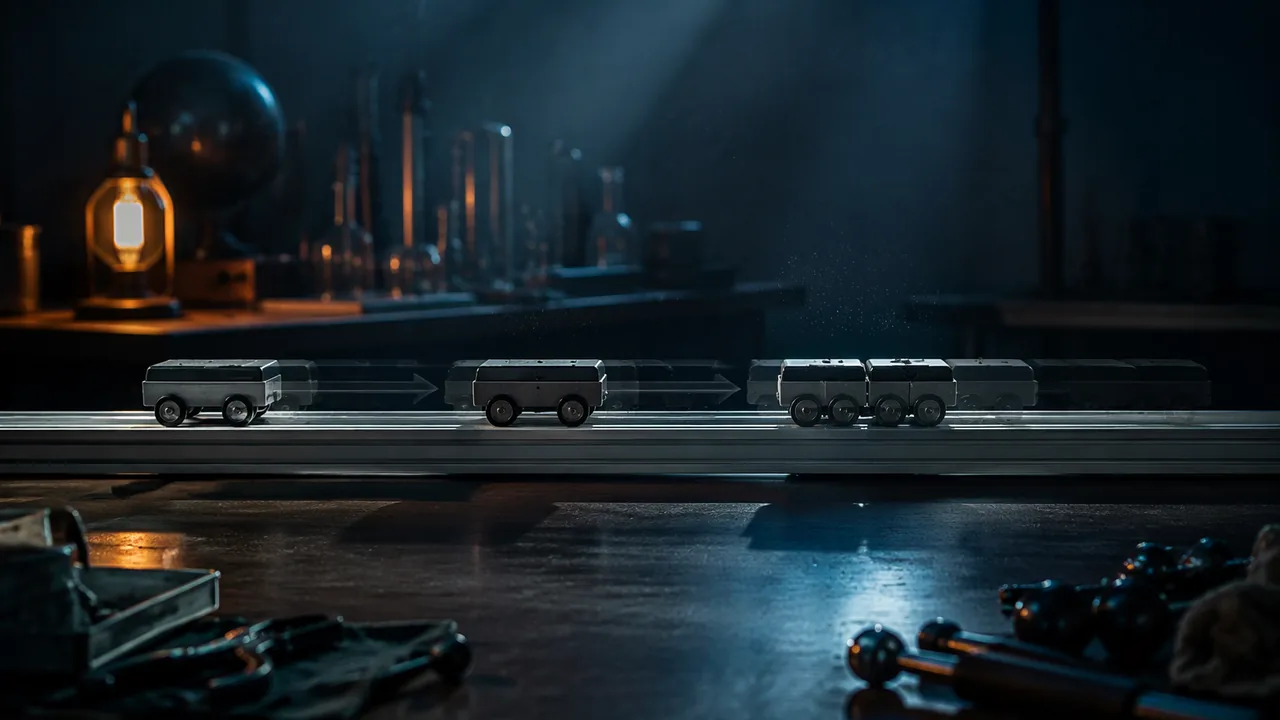
calculate the momentum of objects before and after a collision and argue from the calculations that the total momentum of a system is conserved when no net outside force acts on it.
Instruction
Why a new quantity? In a crash, two objects push on each other for a very short, complicated time. The forces are hard to measure. But something about the pair is the same before and after the crash, and that lets us predict the outcome without knowing the forces. That quantity is momentum.
Momentum. An object’s momentum is its mass times its velocity: p = mv, in kg·m/s. Direction matters: choose one direction as positive, and velocities the other way are negative. A 1,500 kg car at 25 m/s has momentum 1,500 × 25 = 37,500 kg·m/s. A 0.15 kg baseball at 40 m/s has 6 kg·m/s. A slow truck can have more momentum than a fast bicycle.
Conservation. When two carts collide, Newton’s third law says they push on each other with equal and opposite forces for the same time. So whatever momentum one gains, the other loses. If no outside net force acts on the two-cart system (friction is small and the track is level), the total momentum of the system stays the same:
total momentum before = total momentum after
Worked example 1: carts that stick. A 0.50 kg cart moving at 0.80 m/s hits a 0.50 kg cart at rest; Velcro makes them stick. Before: 0.50 × 0.80 + 0.50 × 0 = 0.40 kg·m/s. After, they move together with mass 1.00 kg, so 1.00 × v = 0.40 and v = 0.40 m/s. Half the speed, twice the mass, same momentum.
Worked example 2: head-on. A 1,500 kg car moving east at 15 m/s collides head-on with a 1,000 kg car moving west at 10 m/s, and they lock together. Take east as positive. Before: 1,500(15) + 1,000(−10) = 22,500 − 10,000 = 12,500 kg·m/s. After: 2,500 v = 12,500, so v = 5.0 m/s east. The heavier, faster car “wins,” and the calculation tells you by how much. (Illustrative numbers.)
Bouncing collisions. Momentum is conserved whether objects stick or bounce. When two equal carts with magnets or springs bounce, the moving cart often stops and the struck cart moves off at nearly the first cart’s speed: 0.50(0.80) = 0.50(0) + 0.50(0.80). What is not always conserved is kinetic energy; in a sticking collision some of it becomes thermal energy and sound, and in a car crash it crumples metal. Unit 3 tracks that energy.
Making the argument. 9-12.PS2.A.2 asks for a mathematical representation in support of the claim. Present a table (RST.9-10.7): each object’s mass and velocity before and after, each momentum, and the totals. Compare totals and give the percentage difference. Then reason: equal and opposite forces over the same time transfer momentum from one object to the other without changing the total. Finally, address the conditions: the claim holds for a system with no net outside force. If your track or table slopes or your cart drags, momentum is not conserved for the carts alone, because an outside force acts. A good counter-claim to prepare for: “momentum was lost because the carts slowed down.” Answer it with the full system in the calculation.
📖 Read for this lesson
The reading opens over the lesson; close it to come back to exactly where you were. The checks below draw on it.
Formative check
Work through these before moving on. They are not graded — they tell you whether the standard below has landed yet.
Simulation & tools
Test momentum conservation
Open the Explore 1D screen and show Values and Momentum. (1) Set ball 1 to 1.0 kg at 1.0 m/s and ball 2 to 1.0 kg at rest. Set elasticity to 100%, run, and record both velocities after. (2) Set elasticity to 0% (sticky) and repeat. (3) Change ball 2 to 3.0 kg and repeat both. (4) For every run, compute total momentum before and after in a table and state whether it is conserved. No device? Predict the after-velocities for the sticky cases with the conservation equation and compare them with the worked examples.
Open in a new tab ↗ · PhET Interactive Simulations, University of Colorado Boulder · CC BY 4.0
A 2.0 kg cart at 3.0 m/s sticks to a 1.0 kg cart at rest. Their speed after is
When two carts stick together and move off more slowly, momentum has been lost.
Using a momentum table from the simulation or the recorded cart collisions in this lesson’s reading, write a 5-7 sentence argument that momentum is conserved. State the condition under which the claim holds and rebut the counter-claim ‘the carts slowed down, so momentum was lost.’
How confident are you that you can calculate momentum before and after a collision and argue that total momentum is conserved?
Practice
Work these on paper or in your notebook, then open Check your answer. Aim for all of Fluency and Application; try at least one Challenge.
Printable version: this unit’s practice workbook (PDF)
Fluency
Build speed and accuracy with the core skill.
- A 0.75 kg object moving at 0.4 m/s collides and sticks to a 0.5 kg object at rest (same line; positive is the first object’s direction). Find the total momentum and the velocity just after the collision.
Check your answer
Answer: total momentum 0.30 kg·m/s; final velocity 0.24 m/sMomentum is conserved: m1v1 + m2v2 = (m1 + m2)v. - A 1200 kg object moving at 15 m/s collides and sticks to a 2200 kg object moving at 4.0 m/s (same line; positive is the first object’s direction). Find the total momentum and the velocity just after the collision.
Check your answer
Answer: total momentum 26,800 kg·m/s; final velocity 7.88 m/sMomentum is conserved: m1v1 + m2v2 = (m1 + m2)v. - A 0.75 kg object moving at 0.6 m/s collides and sticks to a 1.0 kg object moving at −0.3 m/s (same line; positive is the first object’s direction). Find the total momentum and the velocity just after the collision.
Check your answer
Answer: total momentum 0.15 kg·m/s; final velocity 0.09 m/sMomentum is conserved: m1v1 + m2v2 = (m1 + m2)v. - A 0.5 kg object moving at 0.4 m/s collides and sticks to a 1.0 kg object moving at −0.3 m/s (same line; positive is the first object’s direction). Find the total momentum and the velocity just after the collision.
Check your answer
Answer: total momentum −0.10 kg·m/s; final velocity −0.07 m/sMomentum is conserved: m1v1 + m2v2 = (m1 + m2)v. - Find the momentum of an 80 kg cyclist and bike moving at 5 m/s.
Check your answer
Answer: 400 kg·m/s80 × 5 = 400. - A 3,000 kg truck moves at 10 m/s. How fast must a 1,200 kg car move to have the same momentum?
Check your answer
Answer: 25 m/s3,000 × 10 = 30,000; 30,000 ÷ 1,200 = 25.
Application
Use the skill in context. Show your reasoning.
- A 2,500 kg SUV moving at 20 m/s rear-ends a 1,250 kg car stopped at a light, and they lock together. Find their velocity just after the collision.
Check your answer
Answer: 13.3 m/s in the SUV’s direction2,500 × 20 = 50,000 kg·m/s = 3,750 v; v = 13.3 m/s. - A 50 kg skateboarder at rest throws a 2.0 kg ball forward at 5.0 m/s. Use momentum conservation to find her recoil velocity.
Check your answer
Answer: 0.20 m/s backwardTotal before = 0. 2.0 × 5.0 + 50 v = 0, so v = −0.20 m/s. - A student’s cart data show total momentum 0.40 kg·m/s before and 0.33 kg·m/s after a sticking collision on a carpeted floor. Evaluate their claim that ‘momentum is not conserved.’
Check your answer
Answer: The claim ignores the outside force: carpet friction acted on the carts during and after the collision, so the two-cart system was not free of outside net force. On a low-friction track the totals should match closely.Conservation applies to a system with no net outside force.
Challenge
Stretch problems. Expect to think before you write.
- Two equal 0.50 kg carts approach each other at 0.60 m/s each and stick. What is their velocity after? Where did their kinetic energy go?
Check your answer
Answer: 0 m/s; the kinetic energy (0.18 J in total) became thermal energy, sound and deformation of the Velcro.Momentum: 0.50(0.60) + 0.50(−0.60) = 0. KE before: 2 × ½ × 0.50 × 0.602 = 0.18 J.
Review
Keep earlier skills sharp.
- For the balanced reaction CH4 + 2O2 → CO2 + 2H2O, what mass of CO2 forms from 25.0 g of CH4, assuming CH4 is the limiting reactant?
Check your answer
Answer: 68.6 g of CO2grams CH4 → moles (1.558 mol) → mole ratio 1:1 → moles CO2 (1.558 mol) → grams. - Which shifts N2 + 3H2 ⇌ 2NH3 toward ammonia: raising or lowering the pressure?
Check your answer
Answer: Raising the pressure
Six Collisions on Video: A Momentum Record to Argue From, and What the Simulation Should Show
Six cart collisions on a 1.2 m track, velocities read from 240 frame-per-second video over 0.20 m before and after impact; constructed for this course and illustrative; the simulation table gives the outcomes the conservation equation predicts for the Lesson 1.3 PhET runs · SLS original (constructed teaching data, with computed predictions)
Why this reading. The lesson’s open question says: “Using a momentum table from the simulation or the carts, write a 5-7 sentence argument.” Nowhere in the lesson is there a momentum table from the carts. This is one. Six collisions were filmed on the same track, the way the argumentation lab is run; the velocities below are what you would read from the frames. Five obey the claim to within a few percent and one, deliberately, does not, because you cannot rebut the counter-claim “momentum was lost” without a case where an outside force really did act. The record is constructed teaching data and is labeled illustrative. The second table gives the results the PhET runs should produce, so that a student without a device can still fill in every row.
How the record was made
Two low-friction carts, 0.50 kg each, with a 0.50 kg bar added to one for the unequal-mass runs. Velcro ends for sticking collisions, repelling magnets for bouncing ones. A phone filmed at 240 frames per second beside a meter tape; each velocity is a 0.20 m stretch divided by the frame count, measured just before and just after the carts touched. Rightward is positive. Six collisions, one trial each shown; all masses to ±0.005 kg, velocities to about ±0.02 m/s.
Table 1. The cart record
| Collision | m1 (kg) | v1 before (m/s) | m2 (kg) | v2 before | v1 after | v2 after | Total p before (kg·m/s) | Total p after | Change |
|---|---|---|---|---|---|---|---|---|---|
| A. Equal carts, Velcro, one at rest | 0.50 | +0.80 | 0.50 | +0.00 | +0.39 | +0.39 | +0.400 | +0.390 | −2.5% |
| B. Equal carts, magnets (bounce), one at rest | 0.50 | +0.80 | 0.50 | +0.00 | +0.02 | +0.77 | +0.400 | +0.395 | −1.3% |
| C. Heavy into light, Velcro | 1.00 | +0.60 | 0.50 | +0.00 | +0.39 | +0.39 | +0.600 | +0.585 | −2.5% |
| D. Light into heavy, magnets (bounce) | 0.50 | +0.90 | 1.00 | +0.00 | −0.29 | +0.58 | +0.450 | +0.435 | −3.3% |
| E. Head-on, Velcro | 1.00 | +0.50 | 0.50 | −0.40 | +0.19 | +0.19 | +0.300 | +0.285 | −5.0% |
| F. As A, but the track sloped 3° downhill | 0.50 | +0.80 | 0.50 | +0.00 | +0.47 | +0.47 | +0.400 | +0.470 | +17.5% |
Reading the record
A, C, E: sticking. Work A by hand. Before: 0.50 × 0.80 + 0 = 0.400 kg·m/s. After: the pair, 1.00 kg, moves at 0.39 m/s, so 0.390 kg·m/s. The mini-lecture’s worked example predicted exactly 0.40 m/s; the record shows 0.39, a 2.5% shortfall. Collision E is the head-on case: the 1.00 kg cart’s +0.500 and the 0.50 kg cart’s −0.200 add to +0.300 before, and the stuck pair carries +0.285 after. The heavier, faster cart “wins,” and the table says by how much.
B, D: bouncing. In B the moving cart nearly stops (0.02 m/s) and the struck cart leaves at nearly the original speed, the pattern the mini-lecture describes. In D the light cart rebounds (negative velocity) while the heavy one moves off more slowly; add the momenta with their signs and the total is still within 3% of the start. Momentum is conserved whether the carts stick or bounce.
F: the exception that explains the rule. Same set-up as A, but the track was tilted 3° so the carts ran slightly downhill. Total momentum rose by 17.5%. Gravity, an outside force on the two-cart system, pushed along the track during the collision and afterward, adding momentum. This is what “when no net outside force acts” means in practice: level the track or you are no longer testing the claim. It is also the answer to the counter-claim. A cart that slows on a level track loses momentum to friction with the track and to the air; include the track and the air in the system and the total is unchanged. F shows the same thing in reverse, with the outside force adding rather than removing.
Why every sticking total is a little low. A, C and E all come in 2 to 5% under. The velocities after were read over 0.20 m of travel during which friction was already slowing the pair, so the “after” velocity is slightly below the velocity at the instant of separation. Name this in your argument as the source of the percent difference; it is systematic, always in the same direction, and it is not evidence against conservation.
Table 2. What the PhET Collision Lab runs should show
For the four runs in the lesson’s simulation task, conservation of momentum, plus conservation of kinetic energy when elasticity is 100%, predicts:
| Run | Set-up | v1 after (m/s) | v2 after (m/s) | Total p before and after (kg·m/s) |
|---|---|---|---|---|
| 1 | 1.0 kg at 1.0 m/s into 1.0 kg at rest, 100% elastic | 0.00 | +1.00 | 1.00 |
| 2 | same, 0% elastic (sticky) | +0.50 | +0.50 | 1.00 |
| 3 | 1.0 kg at 1.0 m/s into 3.0 kg at rest, 100% elastic | −0.50 | +0.50 | 1.00 |
| 4 | same, 0% elastic (sticky) | +0.25 | +0.25 | 1.00 |
Run 4 by hand: 1.0 × 1.0 = 1.0 kg·m/s before; after, 4.0 kg moves together, so 4.0v = 1.0 and v = 0.25 m/s. Run 3 needs the extra condition that kinetic energy is also conserved; the result, a rebound at half speed for the light ball and a forward 0.50 m/s for the heavy one, is the simulation’s version of cart collision D above. Notice the simulation conserves momentum to the last digit and the carts do not. That difference is the whole content of the phrase “no net outside force.”
The quiz, checked
A 2.0 kg cart at 3.0 m/s sticks to a 1.0 kg cart at rest: 6.0 kg·m/s before, 3.0v after, v = 2.0 m/s. Collision C in the record is the same collision at half the masses and one-fifth the speed; its measured 0.39 m/s against a predicted 0.40 m/s is what the quiz’s exact answer looks like on a real track.
Your turn
- Complete the momentum table for collisions B and D yourself, showing each object’s momentum before and after with its sign, then confirm the totals in Table 1.
- Write the 5-7 sentence argument. Use at least two collisions as evidence with their percent differences, state the no-outside-force condition, and use collision F to rebut “the carts slowed down, so momentum was lost.”
- In collision A, compute the kinetic energy (½mv2) before and after. It is not conserved. Say in one sentence why that does not contradict anything above.