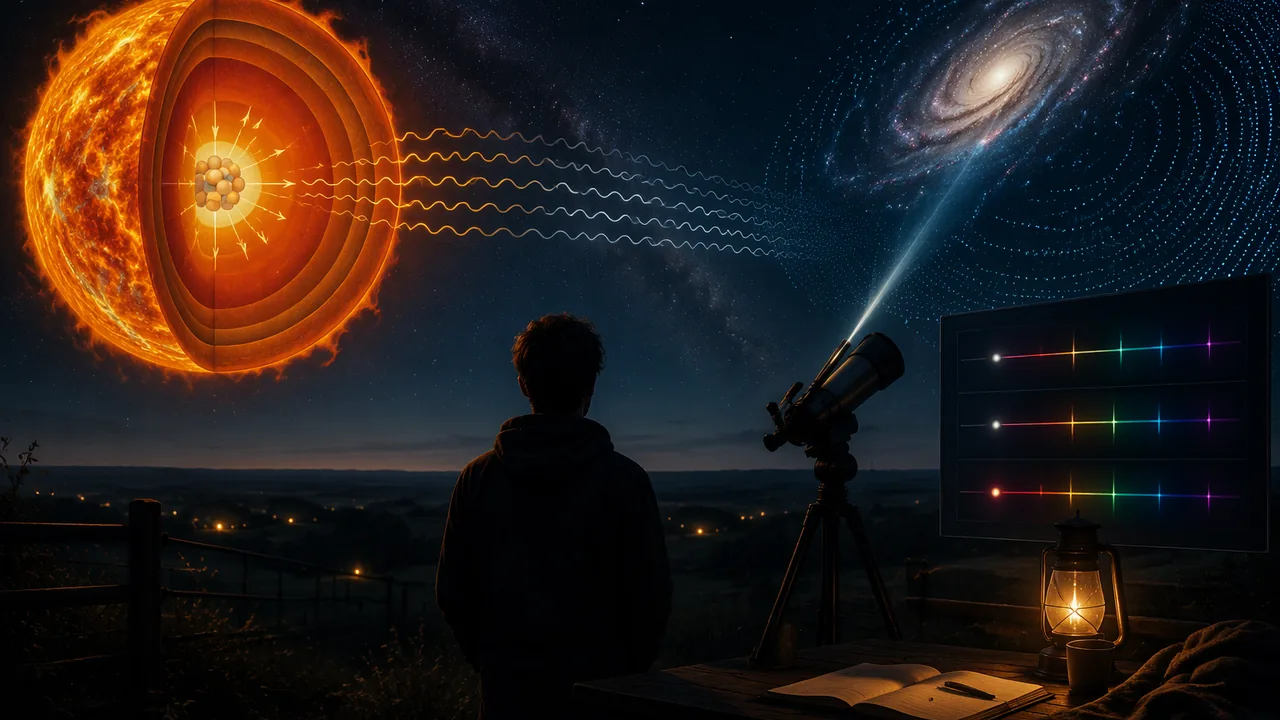
develop a model of how nuclear fusion in the Sun’s core releases energy that reaches Earth as radiation and what sets the Sun’s life span, and construct an explanation of the Big Bang from redshifted galaxy spectra, the cosmic microwave background and the hydrogen-helium composition of ordinary matter.
Instruction
Two questions, one kind of evidence. On a clear night in the Missouri countryside, away from city lights, you can see, in autumn, a faint smudge in the constellation Andromeda that is a whole galaxy 2.5 million light-years away. This lesson asks two big questions about that sky. What keeps our own star shining, and for how long? And where did the universe itself come from? Both answers come from the same kind of evidence: light. Light carries energy from the Sun’s core to Missouri cornfields, and its spectrum carries a fingerprint of what made it and how fast its source is moving.
The Sun’s engine. NASA’s Sun Fact Sheet gives the Sun a mass of 1.9884 × 1030 kg and a luminosity (total power output) of 3.828 × 1026 watts. In the core the model temperature is 1.571 × 10⁷ K, about 15 million °C, hot and dense enough for hydrogen nuclei to fuse. The net result of fusion is that four hydrogen-1 nuclei become one helium-4 nucleus. Use NIST’s atomic masses: four hydrogen atoms total 4 × 1.00783 = 4.03130 u, but one helium atom is only 4.00260 u. The missing 0.0287 u, about 0.71% of the starting mass, leaves as energy, by Einstein’s E = mc2. The fact sheet lists the Sun’s “mass conversion rate” as 4.26 × 10⁹ kg every second. Check it: 4.26 × 109 kg × (3.00 × 108 m/s)2 = 3.83 × 1026 J each second, which is the luminosity. Because only 0.71% of the mass turns into energy, the core must fuse about 6.0 × 10¹¹ kg of hydrogen every second.
From the core to your skin. Energy released in the core does not leap straight out. It travels outward first as radiation through the dense radiative zone, then is carried by rising and sinking currents of hot gas in the convection zone, and finally leaves the visible surface, the photosphere (effective temperature 5,772 K), as electromagnetic radiation: visible light, infrared and ultraviolet. Once in space it crosses the 1.496 × 10¹¹ m to Earth at the speed of light in 499 seconds, about 8.3 minutes. Spread over a sphere that size, 3.828 × 1026 W gives 1,361 watts on every square meter facing the Sun, exactly the solar irradiance NASA lists for Earth. The Sun’s output is not perfectly steady. Solar flares are sudden bursts of radiation; NOAA’s Space Weather Prediction Center rates them from the X-ray flux measured by the GOES satellites you met in Unit 2, with each step (A, B, C, M, X) ten times stronger than the last. Because a flare’s radiation also travels at light speed, its effect on Earth’s upper atmosphere arrives at the same moment it is seen.
The Sun’s life span. NASA puts the Sun’s age at about 4.6 billion years and says it is a little less than halfway through its life, with about 5 billion years or so to go before it swells into a red giant and ends as a white dwarf. The fuel is not running short because the Sun is shrinking away: over 10 billion years, losing 4.26 × 10⁹ kg a second removes only 0.068% of its mass. It ends because the core runs out of hydrogen it can fuse. Other stars are the evidence for this life story: NASA notes that massive stars burn through their fuel in a few million years, while low-mass stars can shine for trillions. Mass sets the pace, and the Sun is in the middle.
Light from galaxies: redshift. Hot hydrogen glows at a set of exact wavelengths; the brightest visible one, hydrogen-alpha, sits at about 656.28 nm (NIST lists its components between 656.27 and 656.29 nm). When a light source moves away from you its waves arrive stretched, so every line shifts toward the red end: a redshift. The fractional shift is z, and for nearby galaxies the speed of recession is v = cz. NASA’s NED database gives NGC 4874, the giant galaxy at the center of the Coma Cluster, z = 0.0239: its hydrogen-alpha line arrives at 671.97 nm and it is moving away at about 7,167 km/s. ESA’s Hubble team puts the Coma Cluster over 300 million light-years away. The closest galaxies are a mixed picture; Andromeda has a blueshift and is approaching us at 297 km/s, pulled by gravity. But the farther away a galaxy is, the more its motion follows Hubble’s law: recession speed grows in proportion to distance, v = H0d. Every distant galaxy moving away from every other is what an expanding universe looks like.
Three pillars of the Big Bang. Run the expansion backward and everything was once hot and dense. ESA’s Planck mission measured H0 = 67.15 km/s per megaparsec and an age of 13.82 billion years; NASA rounds to 13.8 billion. A quick check: 1 ÷ H0 is about 14.6 billion years, the same size. The second pillar is the cosmic microwave background, light released when the universe was 380,000 years old and now stretched by expansion to microwaves at 2.7 degrees above absolute zero. The third is composition. NASA explains that in the first minutes protons and neutrons fused into hydrogen, helium and traces of lithium and beryllium, and the theory predicts ordinary matter about 3/4 hydrogen and 1/4 helium by mass. The Sun’s photosphere is 90.965% hydrogen and 8.889% helium by number of atoms; because a helium atom has about four times the mass of a hydrogen atom, that is about 72% hydrogen and 28% helium by mass, close to the prediction (a little helium was added by earlier generations of stars).
Safety, and an optional look. Never look at the Sun, even briefly or through sunglasses. If you want to see a spectrum, hold an old CD or DVD near a lamp in a dim room and tilt it until the reflected light spreads into a rainbow. A white LED gives a smooth band; a light with glowing gas inside, such as a neon sign seen through a window, shows separate bright lines. Galaxies’ lines are the same idea, measured far more precisely.
📖 Read for this lesson
The reading opens over the lesson; close it to come back to exactly where you were. The checks below draw on it.
Formative check
Work through these before moving on. They are not graded — they tell you whether the standard below has landed yet.
Missouri standard: 9-12.ESS1.A.1
Four hydrogen-1 atoms have a total mass of 4.03130 u; one helium-4 atom has a mass of 4.00260 u. What happens to the difference when the Sun fuses hydrogen into helium?
Missouri standard: 9-12.ESS1.A.1
Light travels 1.496 × 10¹¹ m from the Sun to Earth at 3.00 × 10⁸ m/s, so sunlight reaching Missouri left the Sun’s surface about seconds ago (round to the nearest whole second).
Missouri standard: 9-12.ESS1.A.1
The Sun will stop shining as a main-sequence star in about 5 billion years mainly because it will have converted most of its total mass into energy.
Missouri standard: 9-12.ESS1.A.2
NGC 4874 in the Coma Cluster has a redshift z = 0.0239. Its hydrogen-alpha line, emitted at 656.28 nm, arrives at about 671.97 nm. What does this tell you?
Missouri standard: 9-12.ESS1.A.2, 9-12.ESS1.A.1
Two products. (1) Draw a labeled model of the Sun’s energy path: core (fusion, 15 million °C), radiative zone, convection zone, photosphere, space, Earth. Write three numbers from the reading on it (the luminosity, the 8.3-minute trip and the 1,361 W/m2 that arrives) and one sentence saying what will end the Sun’s main-sequence life. (2) Use the reading’s galaxy table. Plot recession speed against distance for the eight galaxies (on paper or in a spreadsheet). Write a claim-evidence-reasoning paragraph explaining the Big Bang that uses three pieces of evidence: your graph (which galaxies follow the pattern, and why the nearest do not), the cosmic microwave background, and the Sun’s 72% hydrogen, 28% helium composition by mass compared with the predicted 3/4 and 1/4.
Practice
Work these on paper or in your notebook, then open Check your answer. Aim for all of Fluency and Application; try at least one Challenge.
Printable version: this unit’s practice workbook (PDF)
Fluency
Build speed and accuracy with the core skill.
- What is the net nuclear reaction that powers the Sun’s core?
Check your answer
Answer: Four hydrogen-1 nuclei fuse (in steps) into one helium-4 nucleus, releasing energy.About 0.71% of the starting mass becomes energy. - Name, in order, the regions energy passes through from the Sun’s core to space.
Check your answer
Answer: Core, radiative zone, convection zone, photosphere, then space as radiation.Radiation carries it through the radiative zone; moving gas carries it through the convection zone. - A spectral line from a galaxy arrives at a longer wavelength than it was emitted. Is the galaxy approaching or moving away?
Check your answer
Answer: Moving away (a redshift).Stretched waves mean the source is receding.
Application
Use the skill in context. Show your reasoning.
- Using NIST masses, 4 × 1.00783 u = 4.03130 u of hydrogen becomes 4.00260 u of helium. What percentage of the mass becomes energy?
Check your answer
Answer: About 0.71%.(4.03130 − 4.00260) ÷ 4.03130 = 0.0287 ÷ 4.0313 ≈ 0.0071. - The Sun converts 4.26 × 10⁹ kg of mass into energy each second. Use E = mc2 with c = 3.00 × 10⁸ m/s to find the power, and compare with NASA’s luminosity of 3.828 × 1026 W.
Check your answer
Answer: About 3.83 × 1026 W, matching the luminosity.4.26 × 109 × 9.00 × 1016 = 3.83 × 1026 J/s. - M87 in the Virgo Cluster has z = 0.004283. Find its recession speed (c = 299,792 km/s) and the wavelength at which its 656.28 nm hydrogen-alpha line arrives.
Check your answer
Answer: About 1,284 km/s; about 659.09 nm.v = cz = 299,792 × 0.004283 ≈ 1,284 km/s; 656.28 × 1.004283 ≈ 659.09 nm.
Challenge
Stretch problems. Expect to think before you write.
- The Sun will spend about 10 billion years on the main sequence, losing 4.26 × 10⁹ kg each second (1 year = 3.156 × 10⁷ s). What fraction of its 1.9884 × 1030 kg mass is that, and what does the answer say about why its main-sequence life ends?
Check your answer
Answer: About 1.34 × 1027 kg, or 0.068% of its mass. The Sun does not run out of mass; its core runs out of hydrogen it can fuse.4.26 × 109 × 1010 × 3.156 × 107 ≈ 1.34 × 1027 kg; ÷ 1.9884 × 1030 ≈ 0.00068. - Andromeda is approaching us at about 297 km/s, yet NGC 4874 in the Coma Cluster, about 300 million light-years away, recedes at about 7,167 km/s. Explain how both facts fit an expanding universe.
Check your answer
Answer: Nearby galaxies are bound by gravity, so their own motions (Andromeda is falling toward the Milky Way) can outweigh the small expansion speed at short distance. At large distances the expansion speed, proportional to distance, dominates, so distant galaxies all recede.Hubble’s law v = H0d gives only about 50 km/s at Andromeda’s distance but about 6,200 km/s at Coma’s.
Review
Keep earlier skills sharp.
- (Unit 4) Which kind of electromagnetic radiation has the longest wavelength: microwaves, visible light or X-rays?
Check your answer
Answer: Microwaves.The cosmic microwave background is light stretched from short wavelengths into microwaves by expansion. - (Physical Science A) In a nuclear reaction, what quantity is conserved besides charge and the total number of nucleons?
Check your answer
Answer: Mass-energy (mass and energy together, linked by E = mc2).The mass lost in fusion reappears as energy.
The Sun’s Engine and the Expanding Universe: NASA, NIST, NOAA and ESA Numbers, Worked
NASA NSSDC Sun and Earth Fact Sheets; NASA Science pages Sun: Facts, Stars, The Universe and the Hubble Messier Catalog; NASA/IPAC Extragalactic Database redshifts; NIST atomic masses, hydrogen lines and the speed of light; NOAA Space Weather Prediction Center; ESA Planck release; ESA/Hubble heic0813; all retrieved November 5, 2026 · SLS original, citing U.S. government data (public domain) and ESA/ESA-Hubble releases
Why this reading. The lesson’s model of the Sun and its explanation of the Big Bang rest on numbers. Here they are as the agencies publish them (all retrieved November 5, 2026), with every calculation in the lesson redone so you can trace each figure, and the galaxy table you need for the graph.
Table 1. The Sun, as published
| Quantity | Value | Source |
|---|---|---|
| Mass | 1,988,400 × 1024 kg = 1.9884 × 1030 kg | NASA Sun Fact Sheet |
| Luminosity | 382.8 × 1024 J/s = 3.828 × 1026 W | NASA Sun Fact Sheet |
| Mass conversion rate | 4,260 × 106 kg/s = 4.26 × 10⁹ kg/s | NASA Sun Fact Sheet |
| Central temperature (model) | 1.571 × 10⁷ K | NASA Sun Fact Sheet |
| Central density (model) | 1.622 × 10⁵ kg/m3 (NASA’s Sun facts page rounds the core to about 150 g/cm3) | NASA Sun Fact Sheet; NASA Sun: Facts |
| Effective (surface) temperature | 5,772 K | NASA Sun Fact Sheet |
| Photosphere composition, by number of atoms | H 90.965%, He 8.889% | NASA Sun Fact Sheet |
| Mean distance from Earth | 149.6 × 10⁶ km (Earth Fact Sheet semimajor axis: 149.598 × 10⁶ km) | NASA Sun and Earth Fact Sheets |
| Solar irradiance at Earth | 1,361.0 W/m2 | NASA Earth Fact Sheet |
| Age and future | Formed about 4.6 billion years ago; “a little less than halfway through its lifetime”, with about 5 billion years or so left before it becomes a white dwarf | NASA Sun: Facts |
| Other stars | Lower-mass stars burn longer; some shine for trillions of years, some massive stars live only a few million | NASA Stars |
Worked: fusion and the energy that reaches Earth
- Mass lost in fusion. NIST: hydrogen-1 = 1.00782503 u, helium-4 = 4.00260325 u. Four hydrogen atoms: 4.03130013 u. Lost: 4.03130013 − 4.00260325 = 0.02869688 u, which is 0.02869688 ÷ 4.03130013 = 0.712% of the starting mass. (Atomic masses include electrons; the bookkeeping comes out the same.)
- E = mc2 check. c = 299,792,458 m/s (exact, NIST). 4.26 × 10⁹ kg/s × c2 = 3.829 × 1026 W. NASA’s luminosity is 3.828 × 1026 W, a 0.02% difference.
- Hydrogen fused each second. 4.26 × 10⁹ ÷ 0.00712 = 5.98 × 10¹¹ kg/s, about 6.0 × 10¹¹ kg.
- Light travel time. 1.49598 × 10¹¹ m ÷ 299,792,458 m/s = 499 s = 8.3 minutes.
- Arriving power. 3.828 × 1026 W ÷ [4π × (1.49598 × 1011 m)2] = 1,361 W/m2, matching NASA’s solar irradiance.
- Mass lost over the main sequence. Using about 10 billion years (4.6 billion so far plus about 5 billion more, rounded): 4.26 × 10⁹ kg/s × 1010 yr × 3.156 × 107 s/yr = 1.34 × 1027 kg, which is 0.068% of the Sun’s mass.
- Composition by mass. Using 1.008 and 4.0026 for the masses of hydrogen and helium atoms: 0.90965 × 1.008 = 0.9169 and 0.08889 × 4.0026 = 0.3558. Hydrogen’s share of the hydrogen-plus-helium mass is 0.9169 ÷ 1.2727 = 72%; helium’s is 28%. The Big Bang predicts ordinary matter roughly 3/4 hydrogen and 1/4 helium by mass.
Space weather
NOAA’s Space Weather Prediction Center describes solar flares as large eruptions of electromagnetic radiation lasting minutes to hours that travel at the speed of light, so their effect on the sunlit side of Earth’s upper atmosphere arrives when the flare is seen. Flares are rated by the peak soft X-ray flux measured by the X-ray sensor on the NOAA GOES satellites: A (from 10−8 W/m2), B (10−7), C (10−6), M (10−5) and X (10−4), each ten times the one before. An X flare at its peak adds about 10−4 W/m2 of X-rays, tiny next to 1,361 W/m2 of sunlight but enough to disturb long-distance radio.
Table 2. Galaxies: distance and redshift
Distances are NASA’s Hubble Messier Catalog figures (ESA/Hubble for the Coma Cluster, which it gives as “over 300 million light-years”, so 300 is a lower bound). Redshifts z are from the NASA/IPAC Extragalactic Database. 1 megaparsec (Mpc) = 3.2616 million light-years (from the definitions of the parsec, the astronomical unit and the light-year). Speed v = cz, with c = 299,792 km/s; hydrogen-alpha (656.28 nm, the middle of NIST’s listed components at 656.271 to 656.285 nm) arrives at 656.28 × (1 + z). A negative speed means the galaxy is approaching.
| Galaxy | Distance (million ly) | Distance (Mpc) | Redshift z | Speed v (km/s) | H-alpha arrives at (nm) | v ÷ d (km/s per Mpc) |
|---|---|---|---|---|---|---|
| Andromeda Galaxy (M31) | 2.5 | 0.77 | -0.000991 | −297 | 655.63 | −388 |
| Bode’s Galaxy (M81) | 11.6 | 3.56 | -0.000130 | −39 | 656.19 | −11 |
| Pinwheel Galaxy (M101) | 25 | 7.67 | 0.000804 | 241 | 656.81 | 31 |
| Sombrero Galaxy (M104) | 28 | 8.58 | 0.003633 | 1,089 | 658.66 | 127 |
| Whirlpool Galaxy (M51) | 31 | 9.50 | 0.002000 | 600 | 657.59 | 63 |
| M87, Virgo Cluster | 54 | 16.56 | 0.004283 | 1,284 | 659.09 | 78 |
| M49, Virgo Cluster | 60 | 18.40 | 0.003272 | 981 | 658.43 | 53 |
| NGC 4874, Coma Cluster | 300 | 91.98 | 0.023907 | 7,167 | 671.97 | 78 |
What the table shows. The two nearest galaxies are approaching: they belong to our own gravitationally bound neighborhood, and their own motions swamp the expansion. Between 25 and 60 million light-years the speeds are all away from us but scattered, because galaxies in the Virgo Cluster swarm around inside it at hundreds of km/s. At the Coma Cluster the expansion dominates: 7,167 km/s at 92 Mpc gives v ÷ d ≈ 78 km/s per Mpc, an upper limit since the distance is “over” 300 million light-years. ESA’s Planck mission found H0 = 67.15 km/s per Mpc, which would put Coma’s 7,167 km/s at about 107 Mpc (348 million light-years). The farther you look, the cleaner the pattern: that is Hubble’s law.
The Big Bang’s three pillars, as the agencies state them
- Expansion and age. ESA (Planck): H0 = 67.15 km/s per Mpc; age of the universe 13.82 billion years. NASA: about 13.8 billion years. Check: 1 ÷ H0 = 3.0857 × 10¹⁹ km per Mpc ÷ 67.15 km/s = 4.60 × 10¹⁷ s = 14.6 billion years, the same size as the measured age.
- Cosmic microwave background. ESA: light imprinted when the universe was 380,000 years old, from a hot plasma at about 2,700 °C, now stretched by expansion to microwaves equivalent to 2.7 degrees above absolute zero.
- Composition. NASA: in the first minutes, protons and neutrons produced hydrogen, helium and traces of lithium and beryllium; after five minutes most of today’s helium had formed. Stars and gas today are still mostly hydrogen and helium (Table 1 and the composition calculation above). ESA adds that normal matter makes up only 4.9% of the universe’s mass-energy; dark matter and dark energy make up the rest.
Your turn
- Plot v against d (in Mpc) for the eight galaxies. Circle the points that follow a straight line through the origin and explain the ones that do not.
- Andromeda’s hydrogen-alpha arrives at 655.63 nm. Show that this is a blueshift of about 297 km/s.
- Explain in two sentences why 72% hydrogen and 28% helium in the Sun’s surface is evidence for the Big Bang, and why it is slightly more helium than 1/4.
Sources: NASA NSSDC, Sun Fact Sheet (nssdc.gsfc.nasa.gov); NASA NSSDC, Earth Fact Sheet (nssdc.gsfc.nasa.gov); NASA Science, Sun: Facts (science.nasa.gov); NASA Science, Stars (science.nasa.gov); NASA Science, Overview: The Universe (history of the universe) (science.nasa.gov); NIST, Atomic Weights and Isotopic Compositions: hydrogen (physics.nist.gov); NIST, Atomic Weights and Isotopic Compositions: helium (physics.nist.gov); NIST Handbook of Basic Atomic Spectroscopic Data, strong lines of hydrogen (physics.nist.gov); NIST CODATA, speed of light in vacuum (physics.nist.gov); NOAA Space Weather Prediction Center, Solar Flares (Radio Blackouts) (swpc.noaa.gov); NASA/IPAC Extragalactic Database (NED), object lookups for M31, M81, M101, M104, M51, M87, M49 and NGC 4874 (ned.ipac.caltech.edu); NASA Hubble Messier Catalog (M31, M81, M101, M104, M51, M87, M49 pages) (science.nasa.gov); ESA/Hubble, heic0813: Coma Cluster (esahubble.org); ESA, Planck reveals an almost perfect Universe (esa.int)