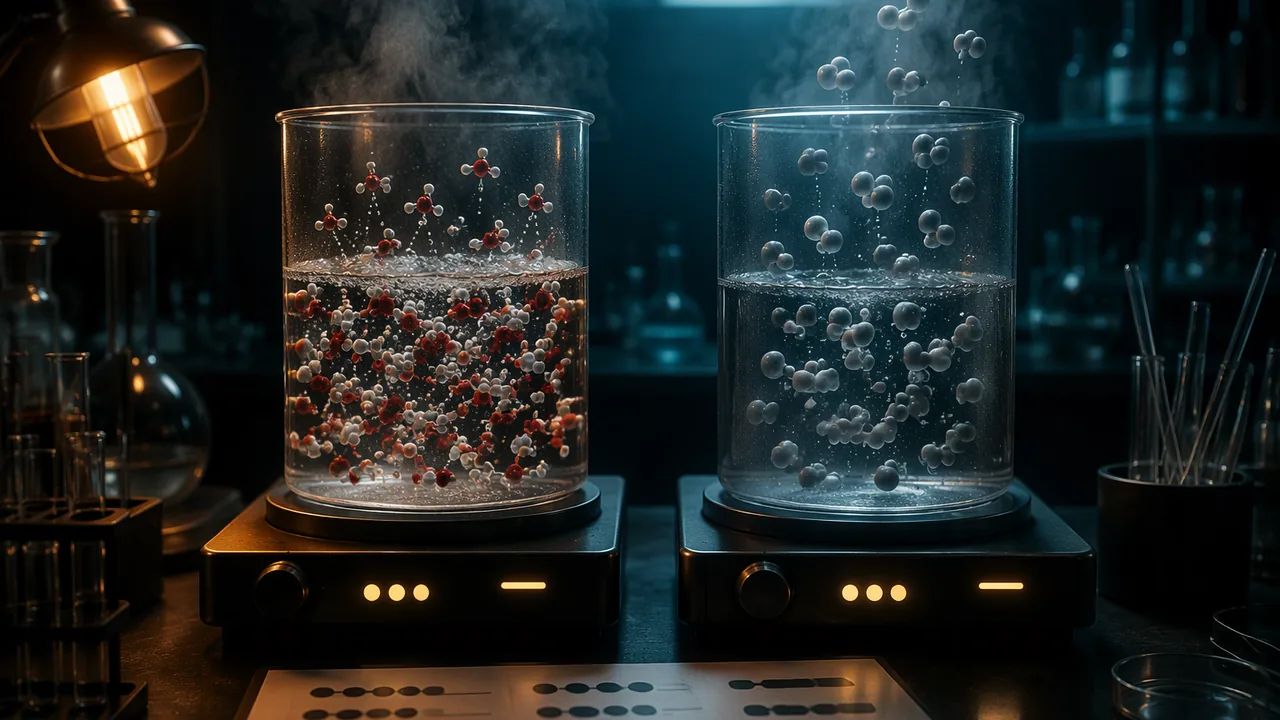
use published boiling-point data to argue how molecule size and polarity affect the strength of intermolecular forces, and explain water’s unusually high boiling point.
Instruction
A strange liquid. A water molecule has a mass of only 18 u, lighter than the oxygen (32 u) and nitrogen (28 u) molecules in the air, yet water is a liquid at room temperature and they are gases. Water runs off Missouri’s salted winter roads, fills the Lake of the Ozarks and makes up most of your body. Something holds water molecules together more strongly than their size would suggest. Today you argue what that is from data.
Boiling point as a measure of attraction. To boil, molecules must separate from their neighbors in the liquid. The stronger the intermolecular forces, the more energy is needed and the higher the boiling point. So boiling points are evidence about forces.
Data set 1: noble gases (boiling points at 1 atm, as tabulated in OpenStax Chemistry 2e and standard references): helium −268.9 °C, neon −246.0 °C, argon −185.8 °C, krypton −153.4 °C, xenon −108.1 °C. These atoms are not charged and not polar, yet they attract each other weakly, and the attraction grows with size. The reason is dispersion forces: an atom’s electron cloud can shift for an instant, making a temporary positive and negative side that attracts the neighboring atom. Bigger atoms have larger, looser electron clouds that shift more easily, so the attraction is stronger. Every molecule has dispersion forces.
Data set 2: hydrides (compounds with hydrogen). Group 14: CH4 −161.5 °C. Group 15: NH3 −33.3 °C. Group 17: HF 19.5 °C. Group 16: H2O 100.0 °C, H2S −60.3 °C, H2Se −41.3 °C, H2Te −2.2 °C. From H2S to H2Te the boiling point rises with size, as dispersion forces predict. Extend that trend backward and water “should” boil somewhere below −60 °C. It boils at 100 °C instead: an anomaly of more than 150 degrees.
The explanation: hydrogen bonds. In water, oxygen is much more electronegative than hydrogen (3.44 against 2.20), so each O–H bond is strongly polar and the hydrogen is left with a significant partial positive charge. That small, exposed hydrogen is strongly attracted to a lone pair of electrons on the oxygen of a neighboring molecule. This attraction, called a hydrogen bond, occurs when H is bonded to N, O or F. It is far weaker than a covalent bond but much stronger than dispersion forces between small molecules. HF and NH3 also sit above their group trends for the same reason. Water, with two hydrogens and two lone pairs per molecule, forms an extended network of hydrogen bonds, which is why its anomaly is the largest.
Making the argument. Graph the data first (RST.9-10.7): period on the x-axis, boiling point on the y-axis, one line per group. The pattern jumps out visually in a way it does not in a list. A strong claim names the cause (hydrogen bonding between water molecules), cites specific values (H2O 100.0 °C against H2S −60.3 °C), and reasons with the mechanism (a strongly polar O–H bond and lone pairs). A strong rebuttal answers a counter-claim with data. If someone says “water boils high because it is heavier,” point out that H2S (34 u) is almost twice as heavy and boils 160 degrees lower.
Why it matters. Hydrogen bonding explains why ice floats, why lakes freeze from the top down, and why water absorbs so much heat, which is why cities beside an ocean have milder winters and summers than inland cities such as Kansas City and St. Louis.
📖 Read for this lesson
The reading opens over the lesson; close it to come back to exactly where you were. The checks below draw on it.
Formative check
Work through these before moving on. They are not graded — they tell you whether the standard below has landed yet.
Why does xenon (−108.1 °C) boil at a higher temperature than argon (−185.8 °C)?
Water boils about °C higher than H2S (−60.3 °C), which is evidence of bonding between water molecules.
Water’s high boiling point is explained by its large molecular mass.
A student in an online discussion claims that NH3 boils higher than CH4 only because it has more electrons. Write a rebuttal of 4-6 sentences that uses the boiling-point data and the hydrogen-bond mechanism, and says what part of the student’s claim is partly true.
How confident are you that you can argue from boiling-point data how size and polarity affect the strength of intermolecular forces?
Practice
Work these on paper or in your notebook, then open Check your answer. Aim for all of Fluency and Application; try at least one Challenge.
Printable version: this unit’s practice workbook (PDF)
Fluency
Build speed and accuracy with the core skill.
- Which boils at a higher temperature, krypton or neon? Name the force responsible.
Check your answer
Answer: Krypton; dispersion forces are stronger for its larger electron cloud.Kr −153.4 °C, Ne −246.0 °C. - Which molecules can form hydrogen bonds with each other: CH4, NH3, H2O, H2S, HF?
Check your answer
Answer: NH3, H2O and HFHydrogen bonding needs H bonded to N, O or F. - How many degrees higher does water (100.0 °C) boil than H2S (−60.3 °C)?
Check your answer
Answer: 160.3 °C100.0 − (−60.3) = 160.3. - Rank all intermolecular attractions from generally weakest to strongest: hydrogen bonds, dispersion forces between small molecules, forces between polar molecules without N–H, O–H or F–H bonds.
Check your answer
Answer: Dispersion (small molecules) < polar-molecule attractions < hydrogen bonds - True or false: boiling water breaks the O–H bonds inside water molecules.
Check your answer
Answer: False; boiling separates whole molecules by overcoming hydrogen bonds between them. Steam is still H2O.
Application
Use the skill in context. Show your reasoning.
- HF boils at 19.5 °C and HCl at −85.1 °C, even though HCl is the larger molecule. Find the difference and write a claim with evidence and reasoning.
Check your answer
Answer: HF boils 104.6 °C higher. Claim: forces between HF molecules are stronger. Evidence: 19.5 °C against −85.1 °C. Reasoning: H bonded to F forms hydrogen bonds; HCl cannot, and its larger size does not make up for that.19.5 − (−85.1) = 104.6. - Group 16 hydrides boil at H2S −60.3 °C, H2Se −41.3 °C and H2Te −2.2 °C. Describe the trend and say what it predicts for water if only dispersion forces mattered.
Check your answer
Answer: Boiling point rises with molecule size (H2S to H2Se +19.0 °C, H2Se to H2Te +39.1 °C). Extending it to the smaller water molecule predicts a boiling point below −60 °C, far from the real 100 °C.Differences: −41.3 − (−60.3) = 19.0; −2.2 − (−41.3) = 39.1. - Sketch a graph with period (2 to 5) on the x-axis and boiling point on the y-axis for the group 16 hydrides, and circle the anomaly. Write one sentence describing what the graph shows that the list does not.
Check your answer
Answer: The graph shows a steady rise from H2S to H2Te with water far above the line at period 2, making the size of water’s anomaly obvious at a glance.Plot H2O (100.0), H2S (−60.3), H2Se (−41.3), H2Te (−2.2).
Challenge
Stretch problems. Expect to think before you write.
- Ice floats on water. Use hydrogen bonding to explain why solid water is less dense than liquid water, and why this matters for fish in a Missouri farm pond in winter.
Check your answer
Answer: In ice, hydrogen bonds lock each molecule into an open hexagonal network that holds molecules farther apart than in the liquid, so ice is less dense and floats. The floating ice layer insulates the water below, so lakes freeze from the top and fish survive in liquid water beneath.Density = mass / volume: the same mass in a larger volume gives lower density.
Review
Keep earlier skills sharp.
- What volume does 13.5 g of aluminum (density 2.7 g/cm3) occupy?
Check your answer
Answer: 5.0 cm3Volume = mass / density. - An ion has 8 protons and 10 electrons. Write its symbol.
Check your answer
Answer: O2−Z = 8 is oxygen; 8 − 10 = −2.
Boiling Points of the Noble Gases and the Hydrides of Groups 14 to 17
NIST Chemistry WebBook phase-change data for Ar, Kr, Xe, CH4, H2O, HF, H2S (public domain), retrieved Sept. 23, 2026; other boiling points are reference values from standard compilations, marked in the table · Public domain (NIST data) with reference values and SLS commentary
Why this reading. The argument today is built on boiling points, and the graph you draw needs more points than the lecture quotes. Here is the complete set for the noble gases and for the hydrides of groups 14 to 17, with electron counts and molar masses so that you can test the “bigger” and “heavier” claims directly. Values come from the NIST Chemistry WebBook where it tabulates a normal boiling point, and otherwise from standard reference compilations, marked in the source column.
Data set 1: the noble gases
| Gas | Electrons per atom | Atomic weight (u, NIST) | Boiling point (K) | Boiling point (°C) | Source |
|---|---|---|---|---|---|
| Helium | 2 | 4.0026 | 4.22 | −268.9 | reference (CRC) |
| Neon | 10 | 20.180 | 27.10 | −246.0 | reference (CRC) |
| Argon | 18 | 39.948 | 87.28 | −185.9 | NIST WebBook |
| Krypton | 36 | 83.798 | 119.78 | −153.4 | NIST WebBook |
| Xenon | 54 | 131.293 | 165.02 | −108.1 | NIST WebBook |
Kelvin to Celsius: subtract 273.15. Plot boiling point against electrons per atom and the points rise smoothly. Nothing here is polar and nothing bonds; the whole rise is dispersion forces growing with the size of the electron cloud.
Data set 2: hydrides of groups 14 to 17, by period
| Period | Group 14 | °C | Group 15 | °C | Group 16 | °C | Group 17 | °C |
|---|---|---|---|---|---|---|---|---|
| 2 | CH4 (10 e−, 16.0 u) | −162 (NIST: 111 ± 2 K) | NH3 (10 e−, 17.0 u) | −33.3 (reference) | H2O (10 e−, 18.0 u) | 100.0 (NIST: 373.17 K) | HF (10 e−, 20.0 u) | 19.5 (NIST: 292.7 K) |
| 3 | SiH4 (18 e−, 32.1 u) | −111.9 (reference) | PH3 (18 e−, 34.0 u) | −87.5 (reference) | H2S (18 e−, 34.1 u) | −60.3 (NIST: 212.87 K) | HCl (18 e−, 36.5 u) | −85.0 (reference) |
| 4 | GeH4 (36 e−, 76.6 u) | −88 (reference) | AsH3 (36 e−, 77.9 u) | −62.4 (reference) | H2Se (36 e−, 81.0 u) | −41.3 (reference) | HBr (36 e−, 80.9 u) | −66.8 (reference) |
| 5 | SnH4 (54 e−, 122.7 u) | −52 (reference) | SbH3 (54 e−, 124.8 u) | −18.4 (reference) | H2Te (54 e−, 129.6 u) | −2.2 (reference; some compilations give −4) | HI (54 e−, 127.9 u) | −35.4 (reference) |
A note on precision: NIST’s methane value is an average of 13 measurements, 111 ± 2 K, so −162 °C is as far as the data go; the lecture’s −161.5 is within that range. Boiling points in reference tables are typically good to a few tenths of a degree, which is far finer than any argument here needs.
Reading the table
Group 14 behaves like the noble gases. CH4, SiH4, GeH4, SnH4 rise steadily: −162, −112, −88, −52 °C. These molecules are symmetrical, so their bond polarities cancel; dispersion is all they have, and it grows with electron count exactly as in argon, krypton and xenon.
Groups 15, 16 and 17 rise from period 3 to period 5 just as group 14 does. Follow group 16: H2S −60.3, H2Se −41.3, H2Te −2.2 °C, about 20 to 40 degrees per period. Extend that line backward one period and water “should” boil somewhere near −80 to −100 °C. It boils at 100 °C. The gap is roughly 180 degrees.
The three period-2 anomalies are NH3, H2O and HF. Each sits far above where its group’s trend points; CH4 does not. The three molecules that break the trend are the three with hydrogen bonded to N, O or F, which is what hydrogen bonding predicts. The anomaly is largest for water, whose molecule has two hydrogens and two lone pairs, so each molecule can hold four hydrogen bonds to neighbors; HF and NH3 can each form fewer.
Numbers for the two rebuttals
- “Water boils high because it is heavy.” H2O is 18.0 u; H2S is 34.1 u, nearly twice as heavy, and boils 160 degrees lower (100.0 against −60.3). Heavier does not mean higher.
- “NH3 boils higher than CH4 only because it has more electrons.” Both molecules have exactly 10 electrons, and their masses differ by one unit (17.0 against 16.0 u). Yet NH3 boils at −33.3 °C and CH4 at −162 °C, a gap of about 129 degrees. Something other than electron count is at work. The part of the claim that is true: in period 3, where neither molecule hydrogen-bonds, PH3 (−87.5) does boil higher than SiH4 (−111.9) with the same 18 electrons, because PH3 is polar and SiH4 is not. Polarity adds a modest amount; hydrogen bonding adds a great deal.
Making the graph
Period on the horizontal axis (2, 3, 4, 5), boiling point in °C on the vertical axis from −200 to +100, one line per group with its own symbol. Three lines will hook sharply upward at period 2 and one will not. Label the three hooked points with their formulas; that labeled graph is the evidence for your claim, and a reader can check it against the table above.
Sources: NIST Chemistry WebBook, SRD 69 (phase change and thermochemistry data by species) (webbook.nist.gov); Melting points, boiling points and solubilities: reference values as tabulated in standard compilations (CRC Handbook values as reproduced on public data pages) (en.wikipedia.org); Hydrogen chalcogenide and pnictogen hydride property tables (reference boiling points) (en.wikipedia.org)