describe ionic, covalent and metallic bonding as electrical attractions, predict the bond type between two elements, and ask questions about how particle forces explain the properties of road salt and water.
Instruction
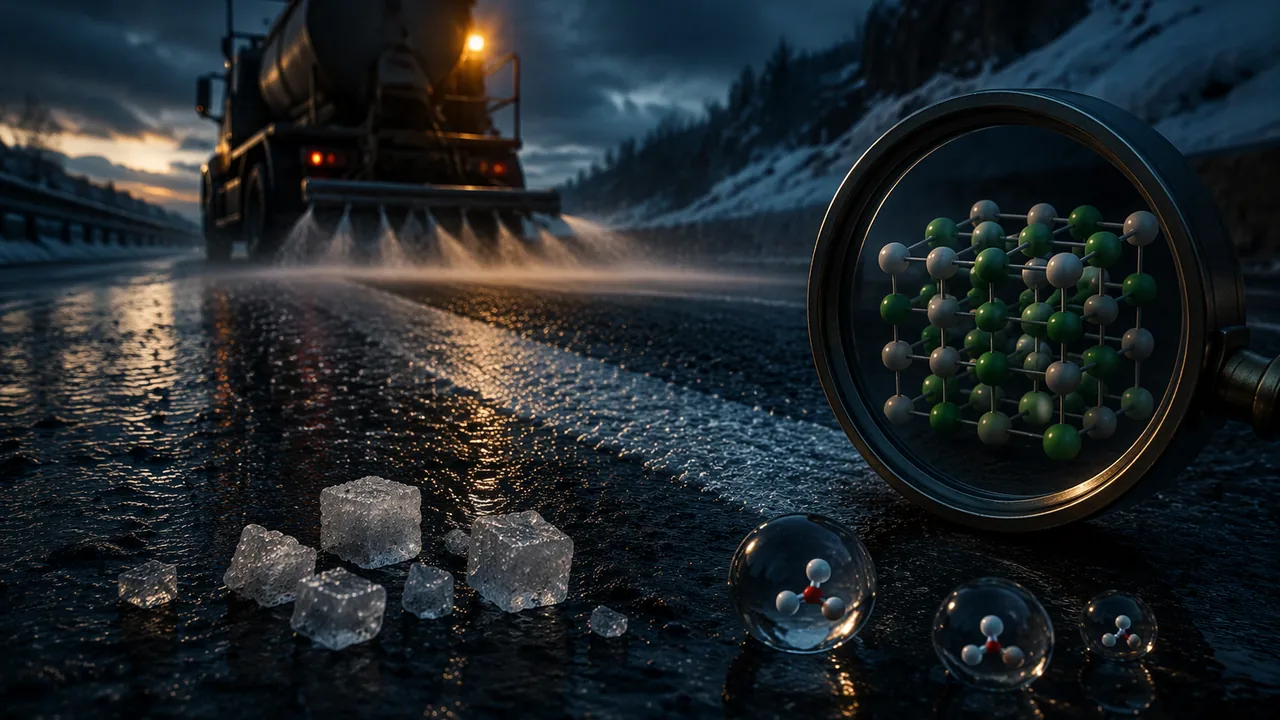
The phenomenon. Drive a Missouri interstate the day before a winter storm and you may see long white stripes on the pavement. They are dried salt brine. MoDOT crews spray brine, which is rock salt dissolved in water, on roads and bridges ahead of a storm so that ice cannot bond to the pavement, and the department uses about 123,000 tons of salt in an average winter. When the sprayed pavement dries, the water evaporates and white crystals of sodium chloride stay behind. Look closely at a grain of rock salt and you will often see that it is a cube or a stack of cubes. Two questions organize this unit. Why does salt stay behind as a hard crystal when the water leaves? And why is water, a tiny molecule, a liquid at all at room temperature?
All bonding is electrical. Every bond and every attraction between particles comes from the same force: opposite charges attract, like charges repel. The force is stronger when the charges are larger and when they are closer together. What differs between substances is which charged particles attract which.
Ionic bonding. In Unit 1 you saw that sodium loses its one valence electron easily and chlorine gains one readily. When they meet, an electron transfers and the resulting Na+ and Cl− ions attract each other in every direction. Each Na+ ends up surrounded by six Cl− ions, and each Cl− by six Na+, in a repeating cubic lattice. That is why salt crystals are cubes. Pulling the lattice apart means overcoming many strong attractions at once, so salt melts only at 801 °C.
Covalent bonding. Two nonmetals both hold their electrons tightly, so neither gives one up. Instead they share a pair of electrons, and both nuclei are attracted to the shared pair between them. A water molecule has two O–H covalent bonds. The bonds inside a molecule are strong, but the attractions between separate molecules (intermolecular forces) are much weaker. Melting or boiling a molecular substance breaks only those weaker attractions, which is why sugar melts near 186 °C and wax near 60 °C, far below salt.
Metallic bonding. In a metal, the atoms give their valence electrons to a shared “sea” that moves through a lattice of positive ions. The mobile electrons explain why metals conduct electricity, the result you measured in Lesson 1.2.
Predicting the bond type. Electronegativity measures how strongly an atom pulls on shared electrons (Pauling scale: fluorine 3.98 is highest; sodium 0.93 is low). The difference between two atoms predicts the bond. As a guideline used in OpenStax Chemistry 2e: a difference below about 0.4 gives a nonpolar covalent bond; from 0.4 to about 1.8, a polar covalent bond, with the shared electrons pulled toward one atom; above about 1.8, an ionic bond. Worked examples: Na and Cl, 3.16 − 0.93 = 2.23, ionic. O and H, 3.44 − 2.20 = 1.24, polar covalent. C and H, 2.55 − 2.20 = 0.35, nonpolar covalent. These cut-offs are a continuum, not sharp walls.
Structure explains properties. The big idea for the unit is a crosscutting one: structure determines function. If we know how strongly the particles of a substance attract each other, we can predict its melting point, whether it dissolves, and whether it conducts. In the next lesson you run that logic backward: you measure the properties and infer the forces.
📖 Read for this lesson
The reading opens over the lesson; close it to come back to exactly where you were. The checks below draw on it.
Formative check
Work through these before moving on. They are not graded — they tell you whether the standard below has landed yet.
When the water in a brine stripe on a Missouri highway evaporates, what do you predict remains, and why doesn’t it evaporate too?
Using electronegativities Mg 1.31 and O 3.44, what kind of bond forms in magnesium oxide?
Melting a molecular substance such as sugar breaks the forces between molecules, not the covalent bonds each molecule.
Write three questions about salt on Missouri roads: one you could test in your kitchen lab, one you could answer with published data, and one about why road salt stops working on very cold nights. Say which question needs a model of particle forces to answer.
How confident are you that you can describe ionic, covalent and metallic bonding as electrical attractions and predict the bond type from electronegativity?
Practice
Work these on paper or in your notebook, then open Check your answer. Aim for all of Fluency and Application; try at least one Challenge.
Printable version: this unit’s practice workbook (PDF)
Fluency
Build speed and accuracy with the core skill.
- Electronegativities: Na 0.93, Cl 3.16. Find the difference and classify the Na–Cl bond.
Check your answer
Answer: 2.23; ionic3.16 − 0.93 = 2.23, above about 1.8. - Electronegativities: H 2.20, Cl 3.16. Find the difference and classify the H–Cl bond.
Check your answer
Answer: 0.96; polar covalent3.16 − 2.20 = 0.96, between 0.4 and 1.8. - Electronegativities: C 2.55, H 2.20. Classify the C–H bond.
Check your answer
Answer: Nonpolar covalent (difference 0.35)2.55 − 2.20 = 0.35, below about 0.4. - Electronegativities: K 0.82, F 3.98. Classify the bond in KF.
Check your answer
Answer: Ionic (difference 3.16)3.98 − 0.82 = 3.16. - Classify the bond in Cl2.
Check your answer
Answer: Nonpolar covalent (difference 0)Identical atoms pull equally on the shared pair. - Electronegativities: N 3.04, H 2.20. Classify the N–H bond and say which atom carries the partial negative charge.
Check your answer
Answer: Polar covalent (difference 0.84); nitrogen is partially negative3.04 − 2.20 = 0.84; the more electronegative atom pulls the shared pair toward itself. - Name the type of bonding (ionic, covalent or metallic) in: copper wire, table salt, water, sugar, aluminum foil.
Check your answer
Answer: Metallic; ionic; covalent; covalent; metallicMetal only: metallic. Metal with nonmetal: ionic. Nonmetals only: covalent.
Application
Use the skill in context. Show your reasoning.
- Magnesium oxide (Mg2+, O2−) melts at about 2,852 °C and sodium chloride (Na+, Cl−) at 801 °C. Use the idea that electrical force grows with the size of the charges to explain the difference.
Check your answer
Answer: The ions in MgO carry charges of 2+ and 2−, twice those in NaCl, so each attraction is much stronger and more energy is needed to break the lattice apart.Product of charges: 2 × 2 = 4 for MgO against 1 × 1 = 1 for NaCl. Stronger forces between particles mean a higher melting point. - MoDOT-style anti-icing brine is close to 23.3% sodium chloride by mass, the strength the federal anti-icing manual recommends. A student lets 250 g of this brine evaporate in a shallow dish. About how much salt should remain?
Check your answer
Answer: About 58 g250 g × 0.233 = 58.25 g ≈ 58 g. The other 191.75 g was water, which evaporated because its molecules are held only by intermolecular forces. - A student says the white salt stays behind on a dried highway because salt is heavier than water, so it cannot float up into the air. Explain what is wrong and give the particle-level reason.
Check your answer
Answer: Evaporation depends on the forces holding particles in the sample, not on weight. Water molecules are held by weak intermolecular forces and escape; the Na+ and Cl− ions are held by strong ionic attractions in every direction and stay.Compare forces between particles, not masses.
Challenge
Stretch problems. Expect to think before you write.
- Silicon (1.90) bonds to oxygen (3.44) in quartz sand. Classify the Si–O bond, then explain why sand does not melt in boiling water even though its bonds are covalent, not ionic.
Check your answer
Answer: Polar covalent (difference 1.54). Sand is a covalent network: every atom is bonded to its neighbors throughout the grain, so melting means breaking strong covalent bonds, not weak intermolecular forces.3.44 − 1.90 = 1.54. Covalent bonds are strong; molecular substances melt easily only because the forces between molecules are weak, and a network has no separate molecules.
Review
Keep earlier skills sharp.
- Convert 100 g to kg.
Check your answer
Answer: 0.1000 kg - Predict the ions formed by magnesium and by oxygen, and write the formula of their compound.
Check your answer
Answer: Mg2+, O2−; MgOMg loses its two valence electrons; O gains two. Charges +2 and −2 balance 1 : 1. - Which is more reactive, calcium or magnesium? Give the periodic-table reason.
Check your answer
Answer: Calcium; it is below magnesium in group 2, so its outer electrons are farther from the nucleus and more easily lost.
Brine to Salt Crystal: Missouri Road Salt, Brine Freezing Points and Electronegativities
MoDOT Winter Operations fact sheet (salt use, storage, fleet, miles); FHWA-RD-95-202 Manual of Practice for an Effective Anti-Icing Program, Appendix B (brine concentration, Table 7 crystallization temperatures, eutectic); USGS Mineral Commodity Summaries 2026 (Salt); MoDOT Quick Facts on salt brine as reprinted by MaineDOT; Pauling electronegativities and melting points are reference values; retrieved Nov. 5, 2026 · Public domain (U.S. and state government works), with reference values and SLS commentary
Why this reading. The lesson asks for a bond-type prediction table for eight pairs of elements and for questions you could answer with published data about salt on Missouri roads. Here are both: how much salt the Missouri Department of Transportation (MoDOT) uses and how it uses it, what is in a road-salt brine particle by particle, the federal anti-icing manual’s measurements of when salt brine freezes and when it crystallizes, and the electronegativity values the predictions need.
Salt on Missouri roads
MoDOT’s winter-operations fact sheet reports that the department spends an average of $45 million a year fighting ice and snow on more than 34,000 miles of roadway, with a fleet of over 1,500 trucks and more than 3,000 employees working from over 170 buildings. It can store over 250,000 tons of salt and uses 123,000 tons in an average winter. Spread evenly, that is about 3.6 tons of salt per mile of roadway each winter (123,000 ÷ 34,000 = 3.62; an SLS calculation from MoDOT’s two figures). MoDOT also uses calcium chloride, magnesium chloride, beet juice and abrasives, because plain salt works less well as the temperature falls.
Much of the salt goes down as brine, which a MoDOT fact sheet (reprinted by Maine DOT) describes simply as rock salt dissolved in water. Crews spray it on pavement before a storm (pre-treating) and onto rock salt as it is spread (pre-wetting) so the salt sticks instead of bouncing off. When pre-treated pavement dries, the water evaporates and the salt stays behind: those are the white stripes you see on Missouri highways before a storm.
Where road salt comes from
The U.S. Geological Survey reports that U.S. salt production was about 40 million metric tons in 2025, from 60 plants in 15 states; Kansas, Louisiana, Michigan, New York, Ohio, Texas and Utah produced about 95% of it. Highway deicing accounted for about 37% of all salt consumed, and rock salt averaged about $54 per metric ton. The Federal Highway Administration’s anti-icing manual explains that most U.S. highway salt is rock salt: the mineral halite, mined underground, usually with 1% to 4% impurities such as gypsum, shale, dolomite and quartz. Halite’s crystals are cubes for the same reason the lesson gives: a repeating cubic lattice of Na+ and Cl− ions.
What is in the brine, particle by particle
The FHWA manual says anti-icing brine should be as close to 23.3% sodium chloride by mass as possible, and never above 25%. A kilogram of 23.3% brine therefore holds 233 g of NaCl in 767 g of water. Dissolved, that salt is not NaCl molecules; it is separate ions. The grams of each ion below are computed from the formula masses (Na 22.99, Cl 35.45, NaCl 58.44).
| Particle in 1 kg of 23.3% brine | Grams (computed) | Type of particle |
|---|---|---|
| Water, H2O | 767 | polar molecules |
| Chloride, Cl− | 233 × 35.45 ÷ 58.44 = 141.3 | negative ion |
| Sodium, Na+ | 233 × 22.99 ÷ 58.44 = 91.7 | positive ion |
Every dissolved particle of salt is an ion, which is why brine conducts electricity and pure water barely does. The cubic crystals only reassemble when the water leaves.
When brine freezes and when salt comes back out
Table 7 of the FHWA manual lists, for each brine strength, the temperature at which something first crystallizes out of it:
| NaCl in brine (% by mass) | Crystallization temperature | What crystallizes |
|---|---|---|
| 10 | −6.7 °C (20 °F) | ice |
| 15 | −11.1 °C (12 °F) | ice |
| 20 | −17.8 °C (0 °F) | ice |
| 23 (about the eutectic) | −21.1 °C (−6 °F) | ice and salt together |
| 25 | −8.9 °C (16 °F) | salt |
Up to about 23%, more dissolved ions mean the water must get colder before its molecules can lock into ice. The manual’s summary table gives sodium chloride’s lowest possible point (the eutectic) as −21 °C (−5.8 °F) at 23.3%. Past that, adding salt makes things worse: in 25% brine the extra salt crystallizes out as the brine cools, because the solution cannot hold that many ions. That is the same event as the white stripe on a drying road, seen from the other side. Water molecules leave or lock up; ions that no longer have enough water around them snap back into their lattice.
How much water must evaporate before the first salt crystal appears? The reference solubility of NaCl is about 360 g per liter of water at 25 °C. The 233 g of salt in a kilogram of brine needs 233 ÷ 0.360 = 647 g of water to stay dissolved; the brine has 767 g, so once about 120 g of water (16% of it) has evaporated, salt starts to crystallize (SLS calculation from the two published figures). Brine sprayed on a dry road is already most of the way to becoming a white crust.
Electronegativity: reference values for the prediction table
Pauling-scale electronegativities are reference values, established by chemists from bond energies and tabulated in standard compilations; they are not a NIST measurement. The set below is the one the lesson’s guideline uses (difference below about 0.4: nonpolar covalent; 0.4 to about 1.8: polar covalent; above about 1.8: ionic).
| H 2.20 | |||||||
|---|---|---|---|---|---|---|---|
| Li 0.98 | Be 1.57 | B 2.04 | C 2.55 | N 3.04 | O 3.44 | F 3.98 | |
| Na 0.93 | Mg 1.31 | Al 1.61 | Si 1.90 | P 2.19 | S 2.58 | Cl 3.16 | |
| K 0.82 | Ca 1.00 | Fe 1.83 | Cu 1.90 | Zn 1.65 | Ag 1.93 | Br 2.96 | I 2.66 |
| Au 2.54 |
Eight pairs: three worked, five for you
| Pair | Difference | Prediction | Where you meet it |
|---|---|---|---|
| Na and Cl | 3.16 − 0.93 = 2.23 | ionic | road salt |
| Mg and O | 3.44 − 1.31 = 2.13 | ionic (Mg2+, O2−) | the quiz block |
| O and H | 3.44 − 2.20 = 1.24 | polar covalent | water itself |
| C and H | 2.55 − 2.20 = 0.35 | ? | wax, Lesson 2.2 |
| Si and O | 3.44 − 1.90 = 1.54 | ? | sand, Lesson 2.2 |
| Ca and Cl | 3.16 − 1.00 = ? | ? | calcium chloride, a second de-icer MoDOT uses |
| N and H | 3.04 − 2.20 = ? | ? | ammonia, Unit 4 |
| Fe and O | 3.44 − 1.83 = ? | ? | rust, Unit 3 |
Silicon and oxygen sit in the polar-covalent range, yet sand is a hard, high-melting solid. The difference alone does not tell you that: it tells you what kind of bond forms between two atoms, not how the bonds are arranged. Sand’s strength comes from every silicon being bonded to four oxygens in a network that runs through the whole grain, which Lesson 2.2 tests and Lesson 2.4 draws. The iron–oxygen difference of 1.61 is on the border; rust behaves as an ionic compound in Unit 3, and the electronegativity rule is a guideline with a fuzzy edge, exactly as the lecture says.
Melting points, for the question board
Reference values as tabulated in standard compilations: sodium chloride melts at 800.7 °C and boils at 1,413 °C; sucrose melts near 186–189 °C and begins to decompose before it melts cleanly; paraffin wax melts between about 46 and 68 °C depending on its blend; quartz melts near 1,670–1,713 °C. A question like “Why does road salt need 800 °C to melt when wax needs 50?” is answerable with published data plus a model of particle forces, which is what the next three lessons build.
Sources: Missouri Department of Transportation, MoDOT Winter Operations: Maintaining a Safe and Reliable Transportation System (fact sheet) (modot.org); FHWA-RD-95-202, Manual of Practice for an Effective Anti-Icing Program (Appendix B, Table 7 and eutectic table) (fhwa.dot.gov); USGS, Mineral Commodity Summaries 2026: Salt (February 2026) (pubs.usgs.gov); MaineDOT, Getting the Facts About Salt Brine (reprinted in part from a MoDOT Quick Facts sheet) (maine.gov); Electronegativities of the elements (data page), Pauling scale, reference values (en.wikipedia.org); Melting points, boiling points and solubilities: reference values as tabulated in standard compilations (CRC Handbook values as reproduced on public data pages) (en.wikipedia.org)