use collision theory to explain how temperature, concentration and surface area change the rate of a reaction, and ask questions about the chemistry of food spoilage.
Instruction
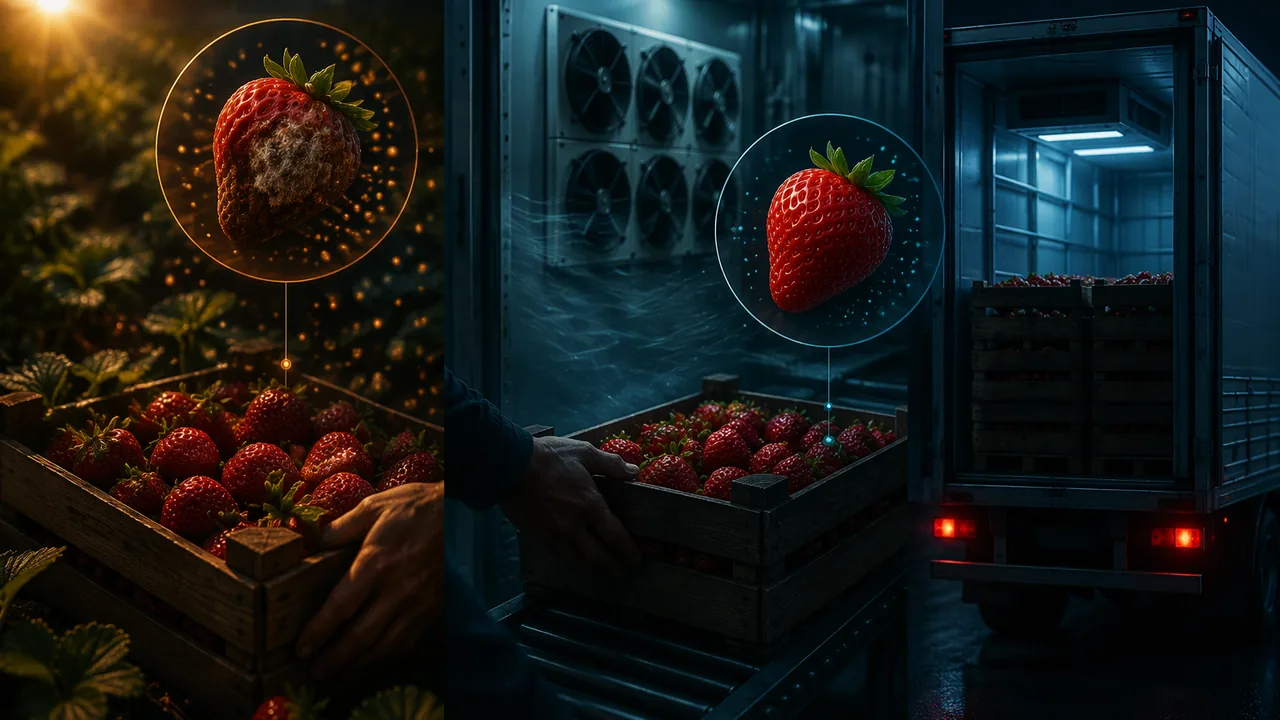
The phenomenon. Strawberries grow well in Missouri: University of Missouri Extension describes them as well adapted to the state’s climate, and Missouri farms sell them each spring at farm stands, farmers’ markets and pick-your-own patches. The berries in a Missouri supermarket the rest of the year are trucked in from other states. Either way, a picked strawberry is still alive: it keeps respiring, softening and ripening, and molds start to grow on any damaged spot. The U.S. Department of Agriculture’s storage handbook calls strawberries “extremely perishable” and advises that cooling begin within 1 hour of harvest, then storage at 0 °C (32 °F), where they keep for up to about 7 days. Growers move flats from the field to a cooler quickly, where fans pull cold air through the boxes, and the fruit then travels in refrigerated trucks. This chain of cold storage is called the cold chain. Why does cold buy days of shelf life? Because the chemical reactions of ripening and decay slow down when it is cold. To see why, we need a model of how reactions happen.
Collision theory. For two particles to react, three things must happen: (1) they must collide; (2) they must collide with enough energy to begin breaking bonds, at least the activation energy; and (3) they must be oriented the right way. Most collisions do not produce a reaction. The rate of a reaction depends on how many effective collisions happen each second.
Temperature. Temperature measures the average kinetic energy of particles. At higher temperature, particles move faster, so they collide more often, and, more important, a larger fraction of collisions have at least the activation energy. The second effect is much larger. A common rule of thumb is that many reactions near room temperature go roughly twice as fast for every 10 °C rise; it is an approximation, not a law, and real reactions vary. Apply it anyway to see the scale: cooling fruit picked on a warm 30 °C (86 °F) afternoon to 0 °C is three 10-degree steps, so the spoilage reactions slow by roughly 2 × 2 × 2 = 8 times. That is the logic of the cold chain. Real fruit can be even more sensitive: USDA’s measured respiration rate for strawberries is about 9 times faster at 20 °C than at 0 °C (this lesson’s reading), where the rule of thumb predicts 4.
Concentration. More particles in the same volume means more collisions per second. Ripening fruit gives off ethylene gas, which triggers more ripening. In a sealed room ethylene builds up and speeds ripening; ventilation or ethylene absorbers keep its concentration, and so the rate, low. For gases, raising the pressure raises the concentration in the same way.
Surface area. Only particles at the surface of a solid can collide with the other reactant. Cutting a solid into pieces exposes more surface, so it reacts faster. A cube 2 cm on a side has a surface area of 6 × 4 = 24 cm2; cut into eight 1 cm cubes, the same material has 8 × 6 = 48 cm2, twice as much. That is why cut fruit spoils faster than whole fruit, and why the fine iron powder in a hand warmer rusts in minutes while a nail takes weeks.
Catalysts. A catalyst speeds a reaction by providing a pathway with a lower activation energy, and it is not used up. The enzymes in fruit that drive ripening are biological catalysts, and cold slows them too.
Your questions. Build the question board: which factors could we test with a simple lab tomorrow? Which need published data (for example, storage temperatures from agricultural agencies)? Which would need a model of particles to answer?
📖 Read for this lesson
The reading opens over the lesson; close it to come back to exactly where you were. The checks below draw on it.
Formative check
Work through these before moving on. They are not graded — they tell you whether the standard below has landed yet.
Two identical boxes of strawberries: one is cooled to 1 °C within an hour of picking, the other waits in the field at 30 °C for six hours first. Which lasts longer in the store, and why?
Why does raising the temperature speed up a reaction most?
Cutting a 2 cm cube into eight 1 cm cubes raises its surface area from 24 cm2 to cm2.
Simulation & tools
Temperature and particle speed
Open the Energy screen. Pump in about 100 heavy particles and open the Speed histogram. (1) Record the average speed at the starting temperature. (2) Use the heater to raise the temperature by about 100 K and record the new average speed and the shape of the histogram. (3) Draw a vertical line on your sketch of each histogram at a high speed (the ‘activation’ speed) and compare how many particles are to the right of it. (4) Explain in two sentences why a small rise in temperature can speed a reaction a lot. No device? Sketch two speed curves on the same axes: a cold one with a tall, narrow peak at low speed, and a warm one that is lower, wider and shifted to higher speeds. Mark the same ‘activation’ speed on both and answer questions (3) and (4).
Open in a new tab ↗ · PhET Interactive Simulations, University of Colorado Boulder · CC BY 4.0
How confident are you that you can use collision theory to explain the effects of temperature, concentration and surface area on reaction rate?
Practice
Work these on paper or in your notebook, then open Check your answer. Aim for all of Fluency and Application; try at least one Challenge.
Printable version: this unit’s practice workbook (PDF)
Fluency
Build speed and accuracy with the core skill.
- Name the three conditions a collision must meet for particles to react.
Check your answer
Answer: The particles must collide, with at least the activation energy, and with the right orientation. - State the effect on reaction rate (faster or slower) of: raising temperature, lowering concentration, grinding a solid into powder, adding a catalyst.
Check your answer
Answer: Faster; slower; faster; faster - A 1 cm cube has what surface area? What is the total surface area of eight such cubes?
Check your answer
Answer: 6 cm2; 48 cm26 faces × 1 cm2; 8 × 6 = 48. - Does a catalyst get used up in a reaction? What does it change?
Check your answer
Answer: No; it lowers the activation energy, providing a faster pathway. - Using the rule of thumb that rate roughly doubles for every 10 °C rise, by about what factor does the rate change from 25 °C to 5 °C?
Check your answer
Answer: It falls to about 1/4 (4 times slower).Two 10-degree steps down: ÷ 2 ÷ 2.
Application
Use the skill in context. Show your reasoning.
- A 3 cm cube of potato is cut into 1 cm cubes. How many cubes result, and how does the total surface area change? Explain what this means for how fast the pieces cook or brown.
Check your answer
Answer: 27 cubes; surface area rises from 54 cm2 to 162 cm2, three times as much. More particles are exposed to heat and oxygen, so the pieces cook and brown faster.One cube: 6 × 32 = 54. Small cubes: 27 × 6 = 162. 162 / 54 = 3. - By the rule of thumb (an approximation), lettuce that keeps 2 days at 20 °C would keep about how long at 0 °C? Say why the real answer might differ.
Check your answer
Answer: About 8 days. Real produce may differ because the rule is only approximate, spoilage involves many reactions and living tissue, and very cold temperatures can damage some produce.20 °C to 0 °C is two 10-degree steps: rate ÷ 4, so time × 4: 2 × 4 = 8 days. - Explain why a sealed storage room full of ripening pears can ripen faster than a ventilated one, using concentration.
Check your answer
Answer: Ripening fruit gives off ethylene, which triggers more ripening. In a sealed room ethylene concentration builds up, so more ethylene molecules reach the fruit each second and ripening speeds up. Ventilation keeps the concentration low.
Challenge
Stretch problems. Expect to think before you write.
- Explain why raising the temperature from 20 °C to 30 °C can double a reaction’s rate even though the average particle speed rises only a few percent.
Check your answer
Answer: The rate depends on the fraction of collisions with at least the activation energy, which lie in the high-energy tail of the distribution. A small shift of the whole distribution adds many particles to that tail, so the number of effective collisions can double even though the average speed barely changes.In kelvin, 293 K to 303 K is about a 3% rise in temperature.
Review
Keep earlier skills sharp.
- For the balanced reaction 2Mg + O2 → 2MgO, what mass of MgO forms from 50.0 g of Mg, assuming Mg is the limiting reactant?
Check your answer
Answer: 82.9 g of MgOgrams Mg → moles (2.057 mol) → mole ratio 2:2 → moles MgO (2.057 mol) → grams. - Find the molar mass of H2O.
Check your answer
Answer: 18.02 g/molAdd the atomic masses of every atom in the formula (H 1.008, O 15.999).
Why Cold Buys Time: Strawberry Respiration Rates from a Missouri Field to the Store
USDA Agriculture Handbook 66 (rev. 2016), strawberry chapter and Table 1 respiration rates, retrieved 2026-11-05 from ars.usda.gov; University of Missouri Extension G6135, retrieved 2026-11-05; SLS commentary and Q10 calculation · Public domain (USDA) and cited university extension guidance, with SLS commentary
Why this reading. The lesson applies the rule of thumb that reactions roughly double in rate for every 10 °C rise. This reading gives the measured respiration rates for strawberries, so you can test the rule against real numbers and so the performance task’s comparison with a published source has something specific to compare against.
Strawberries in Missouri
University of Missouri Extension describes strawberries as well adapted to Missouri’s climate and advises home growers to pick berries daily, pick all ripe berries, and throw out moldy ones so rot does not spread. Commercial berries sold in Missouri stores outside the local season arrive by refrigerated truck from other states. Whether the trip is ten minutes or several days, the same chemistry sets the clock.
What respiration rate measures
A picked strawberry keeps respiring: it breaks down its own sugars and gives off carbon dioxide and heat. Faster respiration means the fruit uses up its stored sugars faster and softens sooner, which is much of what “spoiling” is before mold takes hold. Postharvest scientists measure respiration as milligrams of CO2 given off per kilogram of fruit per hour.
Strawberry respiration at three temperatures (USDA Agriculture Handbook 66)
| Storage temperature | Range, strawberry chapter (mg CO2/kg/h) | Single value, Table 1 (mg CO2/kg/h) | Relative to 0 °C (Table 1) |
|---|---|---|---|
| 0 °C (32 °F) | 12 to 20 | 16 | 1 (baseline) |
| 10 °C (50 °F) | 50 to 100 | 75 | 75 ÷ 16 ≈ 4.7 |
| 20 °C (68 °F) | 100 to 200 | 150 | 150 ÷ 16 ≈ 9.4 |
A Q10 value is how many times faster a process runs for a 10 °C rise. From Table 1, the Q10 is 75 ÷ 16 ≈ 4.7 between 0 and 10 °C, and 150 ÷ 75 = 2.0 between 10 and 20 °C. Across the whole 20 °C span the rate rose about 9.4 times, an average Q10 of √9.4 ≈ 3.1. The rule of thumb (Q10 = 2) predicts only 2 × 2 = 4 times. So the rule gets the direction and the rough size right, but strawberries are more temperature-sensitive than the rule near freezing.
Why delay matters as much as the final temperature
The handbook calls strawberries “extremely perishable” and says cooling should begin within 1 hour of harvest to avoid loss of quality and of marketable fruit. It recommends storage at 0 °C (32 °F) and 90 to 95% relative humidity, where strawberries keep for up to about 7 days, and notes that temperature management is the single most important factor in slowing deterioration. Gray mold keeps growing at 0 °C, but slowly, and another common rot fungus cannot grow below 5 °C.
Put numbers on the delay with Table 1: each hour a flat waits at 20 °C uses as much sugar as 150 ÷ 16 ≈ 9.4 hours in a 0 °C cooler. On a warm Missouri afternoon the field is often hotter than 20 °C, and the table stops at 20 °C, so the real cost of waiting is likely higher still.
Using this data
Compare your antacid-lab warm-to-cold rate ratio (Lesson 4.2) with the strawberry ratios above. Both show the collision-theory pattern: faster particles, and many more collisions reaching the activation energy. Note where the two agree in direction but differ in size, and explain the difference: an antacid tablet runs one simple acid-carbonate reaction (and part of the time you measure is dissolving), while a strawberry’s respiration is many enzyme-driven reactions at once, each with its own activation energy.
Sources: USDA Agricultural Research Service, Agriculture Handbook 66 (revised February 2016), The Commercial Storage of Fruits, Vegetables, and Florist and Nursery Stocks: Strawberry chapter (pp. 559-560) and Table 1, Rates of respiration (retrieved 2026-11-05) (ars.usda.gov); University of Missouri Extension, Home Fruit Production: Strawberry Cultivars and Their Culture (G6135, reviewed March 2026) (retrieved 2026-11-05) (extension.missouri.edu)