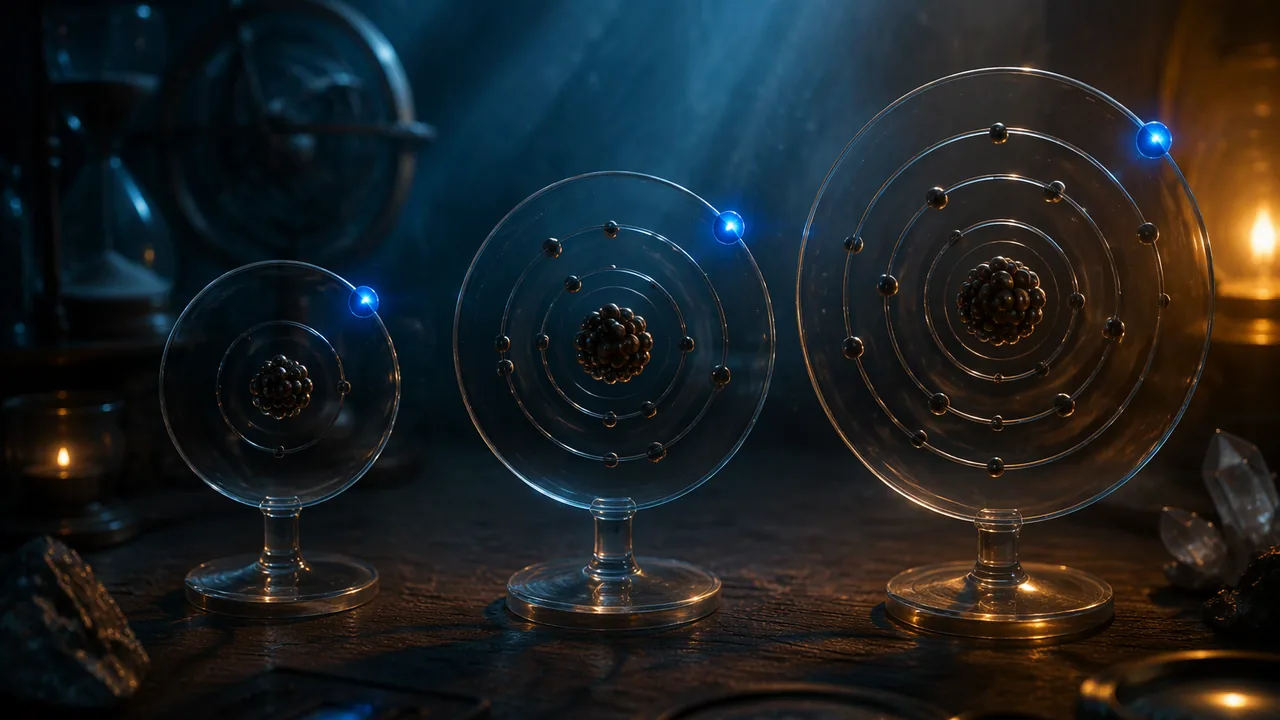
use ionization-energy data from NIST and the pattern of outer electrons to argue which element in a pair is more reactive.
Instruction
A number that measures grip. The first ionization energy is the energy needed to remove the outermost electron from a neutral atom in the gas phase. It measures how tightly an atom holds its outer electron. NIST publishes these values, in electron-volts (eV), for every element. A small value means the electron is easy to remove, so a metal with a small ionization energy reacts readily.
Data down group 1 (alkali metals), NIST: lithium 5.39 eV, sodium 5.14 eV, potassium 4.34 eV, rubidium 4.18 eV, cesium 3.89 eV. The values fall steadily down the group. The observations match: lithium fizzes steadily in water, sodium skates and hisses, and potassium reacts violently enough to ignite the hydrogen it produces. (Those reactions are shown only on video; never try them at home.)
Why the trend? Each alkali metal has one outer electron. Going down the group, each atom has one more filled shell between the nucleus and that electron. The outer electron is farther away and is shielded by the inner electrons, so the attraction it feels from the nucleus is weaker. The electrical force between charges gets weaker with distance, so a farther electron is easier to remove. This is the core reasoning of the whole unit: patterns of outer electrons, and their distance from the nucleus, explain patterns of properties.
Across a period. From sodium (5.14 eV) across period 3 to argon (15.76 eV), ionization energy generally rises. Each step adds a proton to the nucleus while the new electron goes into the same outer shell, so the outer electrons are pulled in more strongly. There are small dips (aluminum 5.99 eV is below magnesium 7.65 eV; sulfur 10.36 eV is below phosphorus 10.49 eV). A good argument does not hide exceptions; it notes them and says whether they change the overall claim. They do not.
Nonmetals run the other way. Halogens (group 17) react by gaining an electron. Fluorine, the smallest, pulls hardest on an incoming electron and is the most reactive nonmetal; reactivity falls down the group to iodine. Their ionization energies also fall (F 17.42, Cl 12.97, Br 11.81, I 10.45 eV), but for halogens a high value means the atom holds on to electrons, which fits their tendency to gain rather than lose them.
Building the argument. A scientific argument has a claim (potassium is more reactive than sodium), evidence (NIST: K 4.34 eV, Na 5.14 eV, a difference of 0.80 eV; observed reactions with water), and reasoning that connects them with a scientific principle (the outer electron of potassium is one shell farther from the nucleus, more shielded, so less tightly held). In today’s argumentation lab you will write an argument, read a counter-claim from the practice list in this lesson’s reading, and write a rebuttal. A strong rebuttal uses evidence, not volume.
📖 Read for this lesson
The reading opens over the lesson; close it to come back to exactly where you were. The checks below draw on it.
Formative check
Work through these before moving on. They are not graded — they tell you whether the standard below has landed yet.
Which atom holds its outer electron least tightly?
Going down a group, first ionization energy generally because the outer electron is from the nucleus.
Aluminum’s ionization energy (5.99 eV) being lower than magnesium’s (7.65 eV) disproves the trend across period 3.
A student claims: ‘Chlorine is more reactive than fluorine because chlorine is bigger and has more electrons to react with.’ Write a rebuttal of 4-6 sentences using the pattern of outer electrons and at least one NIST value.
How confident are you that you can argue from ionization-energy data and outer-electron patterns which element is more reactive?
Practice
Work these on paper or in your notebook, then open Check your answer. Aim for all of Fluency and Application; try at least one Challenge.
Printable version: this unit’s practice workbook (PDF)
Fluency
Build speed and accuracy with the core skill.
- Order Li, Na, K and Rb from highest to lowest first ionization energy.
Check your answer
Answer: Li > Na > K > RbNIST: 5.39, 5.14, 4.34, 4.18 eV. - Which has the higher first ionization energy, sodium or chlorine? Why?
Check your answer
Answer: ChlorineSame period; chlorine has 17 protons pulling on the same outer shell, so its electrons are held more tightly. - How many valence electrons do the atoms of group 1, group 2, group 17 and group 18 have?
Check your answer
Answer: 1, 2, 7, 8 (helium: 2) - Which halogen is most reactive, and which least: F, Cl, Br, I?
Check your answer
Answer: Most F, least ISmaller halogens pull an incoming electron more strongly. - What is the difference between the first ionization energies of sodium (5.14 eV) and potassium (4.34 eV)?
Check your answer
Answer: 0.80 eV
Application
Use the skill in context. Show your reasoning.
- NIST first ionization energies across period 2 are Li 5.39, Be 9.32, B 8.30, C 11.26, N 14.53, O 13.62, F 17.42, Ne 21.56 eV. Describe the overall trend, identify the two exceptions, and say whether they overturn the trend.
Check your answer
Answer: Overall increase from Li to Ne. Exceptions: B is below Be, and O is below N. They are small dips in a strong overall rise and do not overturn it.Look for each value that is lower than the one before it. - Write a claim, evidence and reasoning for: ‘Cesium is more reactive than lithium.’
Check your answer
Answer: Claim: Cs is more reactive. Evidence: NIST first ionization energy Cs 3.89 eV vs Li 5.39 eV. Reasoning: Cs’s single outer electron is four shells farther out and heavily shielded, so it is removed more easily; metals that lose electrons easily react faster. - Make a bar chart (sketch) of the group 1 ionization energies Li to Cs, then state what the graph shows in one sentence.
Check your answer
Answer: The bars decrease steadily from Li (5.39) to Cs (3.89): the further down the group, the less energy is needed to remove the outer electron.RST.9-10.7: translate the numbers into a visual form and back into words.
Challenge
Stretch problems. Expect to think before you write.
- Helium (24.59 eV) has the highest first ionization energy of any element even though it has only 2 protons. Explain using distance and shielding.
Check your answer
Answer: Its two electrons are in the first shell, very close to the nucleus, with no inner electrons shielding them, so the attraction is very strong.Distance and shielding matter as much as nuclear charge.
Review
Keep earlier skills sharp.
- Convert 1250 km to m.
Check your answer
Answer: 1,250,000.00 m - An ion has 20 protons and 18 electrons. Write its symbol.
Check your answer
Answer: Ca2+ - Name a metal that bubbled vigorously in vinegar and one that did not bubble at all.
Check your answer
Answer: Magnesium bubbled vigorously; copper did not bubble.
First Ionization Energies from NIST: The Data Behind the Trends, and Their Limits
NIST Handbook of Basic Atomic Spectroscopic Data, first ionization energies of the neutral atoms (public domain), retrieved Sept. 23, 2026; electrode potentials are reference values from standard compilations · Public domain (U.S. government data), with SLS commentary
Why this reading. The argument you write today stands on NIST ionization energies, and the rebuttal you write asks for “at least one NIST value.” The lecture quotes a handful. Here is the full set for the groups and periods the lesson uses, taken from NIST’s Handbook of Basic Atomic Spectroscopic Data, plus the one place where ionization energy alone does not carry the argument. A good arguer knows the limits of the evidence.
Down the groups
First ionization energy of the neutral atom, in electron-volts, from NIST. The kJ/mol column is the same number multiplied by 96.485, the conversion NIST uses. Values are rounded to two decimals; NIST gives up to seven.
| Group 1 | eV | kJ/mol | Group 2 | eV | kJ/mol | Group 17 | eV | kJ/mol | Group 18 | eV | kJ/mol |
|---|---|---|---|---|---|---|---|---|---|---|---|
| Li | 5.39 | 520 | Be | 9.32 | 900 | F | 17.42 | 1,681 | He | 24.59 | 2,372 |
| Na | 5.14 | 496 | Mg | 7.65 | 738 | Cl | 12.97 | 1,251 | Ne | 21.56 | 2,081 |
| K | 4.34 | 419 | Ca | 6.11 | 590 | Br | 11.81 | 1,140 | Ar | 15.76 | 1,521 |
| Rb | 4.18 | 403 | Sr | 5.69 | 549 | I | 10.45 | 1,008 | Kr | 14.00 | 1,351 |
| Cs | 3.89 | 376 | Ba | 5.21 | 503 | Xe | 12.13 | 1,170 |
Every column falls going down. That is the pattern the lecture explains with distance and shielding, and it holds for metals that lose electrons (groups 1 and 2), nonmetals that gain them (group 17) and gases that do neither (group 18). The explanation is about the atom’s structure, not about what it goes on to do.
Across two periods
| Period 2 | Li | Be | B | C | N | O | F | Ne |
|---|---|---|---|---|---|---|---|---|
| eV | 5.39 | 9.32 | 8.30 | 11.26 | 14.53 | 13.62 | 17.42 | 21.56 |
| Period 3 | Na | Mg | Al | Si | P | S | Cl | Ar |
| eV | 5.14 | 7.65 | 5.99 | 8.15 | 10.49 | 10.36 | 12.97 | 15.76 |
The rise across each period is unmistakable: sodium to argon triples the value. The dips are real and repeat in both periods at the same positions: after group 2 (Be → B, Mg → Al) and after group 15 (N → O, P → S). A trend that has the same exceptions in two different rows is not being disproved by them; the exceptions are themselves a pattern, and they come from the way electrons fill sub-levels within a shell, a refinement of the simple shell model this course does not need. State the trend, name the dips, and say they do not change the claim.
The transition metals of Unit 1 and Unit 3
| Element | Fe | Cu | Zn | Ag | Pt | Au |
|---|---|---|---|---|---|---|
| First ionization energy (eV, NIST) | 7.90 | 7.73 | 9.39 | 7.58 | 8.96 | 9.23 |
Gold’s 9.23 eV against sodium’s 5.14 eV is the Unit 1 comparison, and it is fair: both are single atoms in the gas phase, which is exactly what an ionization energy measures. Now look at iron, copper and zinc. Your Lesson 1.2 data ranked them Zn > Fe > Cu in vinegar. Their ionization energies run the other way: copper (7.73) is the easiest of the three to ionize and zinc (9.39) the hardest. Ionization energy alone predicts the wrong order for these three metals.
Why, and what an honest argument does about it
An ionization energy is the cost of removing one electron from one isolated atom. A metal reacting in vinegar is doing something more: atoms leave a metal lattice (which costs energy, and costs more for a metal with strong metallic bonding), lose two electrons rather than one, and the ions are then surrounded by water molecules (which releases energy, and releases more for a small, highly charged ion). The measured quantity that adds all of this up is the standard electrode potential, a reference value from standard compilations rather than a NIST atomic constant: Zn2+/Zn −0.76 V, Fe2+/Fe −0.44 V, Cu2+/Cu +0.34 V, which matches your lab order. So the rule for today’s arguments is this: ionization energy is decisive when the comparison is between atoms of the same kind of element in the same group or period, where the other costs are similar, as with Na and K, or F and Cl. When you compare a metal in the middle of the table with a metal at the left edge, say so, and bring the lab evidence with the NIST value.
Counter-claims to practice on
- “Chlorine is more reactive than fluorine because chlorine is bigger and has more electrons to react with.” Data to use: F 17.42 eV, Cl 12.97 eV; both have seven outer electrons; fluorine’s are one shell closer to the nucleus. Ask what a halogen does in a reaction (gains one electron) and what “more electrons” would have to do with that.
- “Argon’s ionization energy is higher than potassium’s, so argon must be more reactive.” Data: Ar 15.76 eV, K 4.34 eV. A high value means the atom holds its electrons tightly; whether that makes it reactive depends on whether it reacts by losing or by gaining. Argon does neither.
- “Magnesium’s value (7.65) is higher than aluminum’s (5.99), so aluminum is more reactive than magnesium.” Here the dip is real, and aluminum does react readily; but aluminum instantly coats itself in a tough oxide layer that stops further reaction, which is why foil survives in a kitchen. This is a case where the atomic number is only the beginning of the story, and a good rebuttal says which part of the story it explains.
Sources: NIST, Handbook of Basic Atomic Spectroscopic Data (ground states and first ionization energies) (physics.nist.gov); Standard electrode potential (data page), values as tabulated from standard reference compilations (en.wikipedia.org)